There's no single "going rate" for a pallet. Value depends on grade, wood species, size, and which region you're buying or selling in. A Grade A pallet in Philadelphia won't price the same as one in Ohio.
This guide breaks down 2026 pallet pricing by grade, the forces pushing costs up or down, what buying versus selling actually costs, and how to avoid overpaying (or underselling) in the current market.
Key Takeaways
- New 48x40 GMA pallets cost $10–$17 delivered, depending on region, per Fastmarkets data
- Recycled Grade A/B pallets run 30-60% less than new, based on condition and repair history
- Lumber availability, mill capacity, and freight costs now drive price more than grade alone
- Pallet waste can earn cash back, trade-in credit, or free pickup instead of disposal fees
Wood Pallet Recycling Prices in 2026 (Complete Pricing Overview)
"Pallet recycling price" actually covers two different questions: what you'll pay to buy recycled pallets, and what you can get paid for offloading your used ones. The answer to both depends heavily on grade.
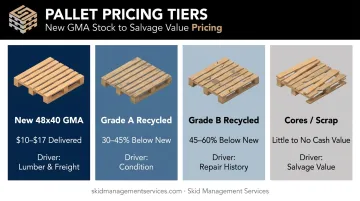
Here's how 2026 pricing typically breaks down:
| Category | 2026 Price Range | What Drives It |
|---|---|---|
| New 48x40 GMA | $10-$17 delivered | Lumber, fasteners, freight, regional demand |
| Grade A recycled | 30-45% below new | Near-new condition, minimal repairs |
| Grade B recycled | 45-60% below new | Functional, visible repair work |
| Cores/scrap | Little to no cash value | Salvage for lumber chips or mulch |
Regional variation is real. Fastmarkets' April 2025 assessments showed new pallets delivered to Dallas-Fort Worth priced at $10-$14 per pallet, while Seattle-delivered softwood GMA pallets ran $11-$16.50 that same month. Location changes the number every time.
Grade A (Near-New) Recycled Pallets
Grade A stock is the closest thing to new without paying new-pallet prices. At Skid Management Services, Grade A classification requires all seven deck boards present, no broken stringers, and minimal repair history.
- Suits food, pharma, and export shipments where presentation and reliability matter
- Performs close to new for load-bearing and stacking applications
- Commands the smallest discount versus new stock among recycled grades
Grade B (Standard/Repaired) Pallets
Grade B pallets carry more repair history but still hold full structural integrity. SMS defines Grade B as allowing 1-2 minor board repairs while maintaining load capacity.
- Suits internal warehouse use, one-way shipments, and non-regulated goods
- Shows mixed boards and visible repair work as normal, not a defect
- Delivers the biggest cost savings for buyers who don't need cosmetic perfection
Pallet Cores & Scrap Value
Broken or unusable pallets still have value, just not much of it in cash. These go toward lumber salvage, chip production, or mulch rather than reuse.
- Offers the best option for businesses looking to offload damaged stock without landfill fees
- Gains pricing power as of late 2025, per Pallet Enterprise's reports of tighter core supplies and rising costs
- Rarely earns cash payment, but often qualifies for free pickup
Coastal and metro markets often price differently than rural areas due to freight and mill proximity, though the spread isn't uniform. Nature's Packaging found roughly an 8% regional spread for new pallets and nearly 25% for recycled pallets across U.S. regions, driven by local timber access and transportation costs rather than a simple coastal-versus-inland rule.
Key Factors That Affect Wood Pallet Recycling Prices
Pricing isn't set by one variable. Condition, material, market forces, and order volume all move the number together.
Pallet Grade, Wood Type, and Size
The A/B/utility grading system is the single biggest lever on resale value. Buyers pay a premium for structural soundness and low repair counts; sellers get less for units needing multiple board replacements or showing broken stringers.
Wood type adds another layer: hardwood pallets generally cost more than softwood due to density and durability, though current national premium percentages aren't publicly standardized. Size matters too:
- Standard 48x40 GMA pallets price most predictably due to high-volume production
- Oversized or custom dimensions (48x48, 42x42, 44x44) carry higher per-unit costs
- Specialty builds for drums, IBC totes, or telecom equipment often run outside standard pricing tiers entirely
Regional Supply and Lumber Costs
Lumber availability is the strongest 2026 price driver. Fastmarkets reported low-grade lumber prices up 27%, and hem-fir #4 2x4 up 65%, between early January and late March 2026. Mill closures compounded the squeeze: roughly 775 million board feet of North American capacity shut down in 2025, following 3,665 million board feet in 2024.
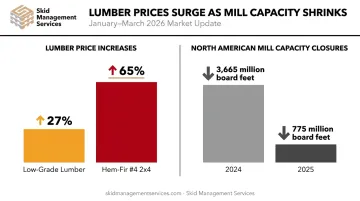
Fewer mills mean tighter low-grade lumber supply, which feeds directly into new pallet costs and, by extension, the gap between new and recycled pricing.
Volume, Seasonality, and Market Trends
Buying or selling by the truckload changes per-unit economics substantially. Bulk orders reduce per-pallet freight cost, and bulk pallet returns improve buyback economics for recyclers.
SMS notes that closed-loop pallet programs become most cost-effective once an operation moves roughly 500+ pallets per month in two-way flow, since scheduled pickup and delivery can share the same trip.
Seasonal timing compounds these volume effects. Pallet Enterprise reported in late 2025 that many industry participants believed prices had bottomed out, with meaningful recovery possible in 2026 barring a recession.
That prediction largely held. Fastmarkets recorded the largest new, Grade A, and Grade B pallet price increases since its assessment series began, driven by low-grade lumber inflation and seasonal demand.
Gains moderated later in April as broader economic uncertainty crept in, but the direction through early 2026 has been upward.
Cost Breakdown: Buying, Selling, and Recycling Pallets
What a pallet "really costs" depends entirely on which side of the transaction you're on.
If you're buying recycled pallets, three factors drive your cost:
- Grade selected (Grade A costs more than Grade B, which costs more than utility stock)
- Delivery and freight distance from the supplier
- Any minor repair work bundled into the price
If you're selling or recycling used pallets, outcomes vary by condition:
- Reusable Grade A or Grade B pallets can earn direct cash-back or trade-in credit against future purchases
- Broken or mixed loads typically qualify for free pickup rather than payment
- Trade-in credit programs commonly offset 15-40% of new-pallet spend, depending on grade mix and volume
Many businesses overlook hidden costs that recycling actually eliminates:
- Onsite storage space consumed by accumulating used pallets
- Dumpster and landfill disposal fees avoided by routing pallets to a recycler instead
- Labor hours spent sorting and stacking pallets before they can be picked up
This is where sourcing strategy matters. Relying on a single local yard for pallet supply creates a single point of failure. If that yard runs short on Grade A stock or a specific size, you're stuck.
Skid Management Services combines its own inventory with an expansive supplier network spanning Pennsylvania, New Jersey, Delaware, and Maryland, plus nationwide reach. That structure lets clients like Campbell Snacks and Knouse Foods keep production running without waiting on one supplier's stock levels.
New vs. Recycled Pallets — Which Offers Better Value?
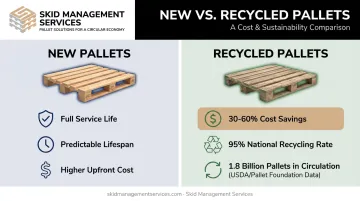
The price gap between new and recycled pallets is significant, and it's widening as lumber costs climb. Recycled Grade A and Grade B stock typically runs 30-60% below new-pallet pricing, based on internal industry data from recyclers processing high volumes of returned pallets.
That gap changes the cost-per-use math. A new pallet costs more upfront but starts with a full service life. A well-graded recycled pallet costs far less and, if it's genuinely Grade A, performs nearly identically for most applications.
Durability trade-offs are real but manageable:
- Grade A recycled pallets handle multiple more trips with minimal issue
- Grade B pallets are better suited to internal handling than repeated long-haul shipping
- New pallets offer the most predictable lifespan for demanding, high-cycle programs
Beyond durability, the sustainability angle matters more than it used to. A 2020 USDA Forest Products Laboratory study found the U.S. pallet system supports roughly 1.8 billion pallets in service, with recovery and repair extending material use well past first manufacture.
The Pallet Foundation separately reported a 95% recycling rate for recovered wood pallets. For customers tracking ESG metrics, choosing recycled stock reduces virgin lumber demand and supports circular-economy goals that more supply chain partners are asking about directly.
How to Get the Best Value When Buying or Selling Pallets in 2026
Getting a fair deal in either direction takes more than accepting the first quote.
- Inspect grade and condition before buying. Mislabeled "Grade A" stock is a common overpay risk. Check for missing deck boards, broken stringers, and repair count before paying a premium price.
- Time bulk purchases or sales around regional demand cycles. Buying during a seasonal lumber spike, like the one Fastmarkets tracked in early 2026, means paying peak rates. Selling into a tight-core market, on the other hand, can work in your favor.
- Work with a supplier that has network depth, not just local stock. A single local yard can run short on the exact grade or size you need. Skid Management Services pairs its own inventory with a broad supplier network for steadier pricing and supply, even when regional lumber markets tighten.
Businesses running recurring pallet volume can turn a recurring cost into ongoing savings by asking suppliers about:
- Trade-in credit for returned or surplus pallets
- Buyback programs that offset disposal costs
- Closed-loop options that combine supply, pickup, and recycling in one program
Frequently Asked Questions
What is the going rate for wooden pallets?
New 48x40 GMA pallets typically run $10-$17 delivered, depending on region. Recycled Grade A pallets run roughly 30-45% below that, and Grade B pallets run 45-60% below new pricing. Rates shift by grade, region, and current lumber costs.
What is the best way to dispose of wooden pallets?
Recycling or reselling usable pallets beats landfill disposal every time. Many suppliers, including Skid Management Services, offer free pickup for reusable pallets and sometimes cash-back or trade-in credit.
What's the difference between Grade A and Grade B pallets?
Grade A pallets have all deck boards intact, no broken stringers, and minimal repair history, making them near-equivalent to new. Grade B pallets allow 1-2 minor board repairs while keeping full structural integrity, at a lower price point.
How much can I get for selling used pallets?
Payouts depend entirely on grade and condition. Reusable Grade A or B pallets can earn direct cash or trade-in credit, while broken or mixed loads typically earn no payment but still qualify for free pickup.
Are wood pallets more valuable than plastic pallets?
Wood pallets cost less upfront and can be repaired repeatedly, while plastic pallets can't be repaired but may last longer per unit under specific use cases. A 2019 peer-reviewed study found no universal cost or environmental winner between the two.
Will wood pallet prices go up or down in 2026?
Direction has been upward through early 2026. Fastmarkets recorded its largest price increases since tracking began in April 2026, driven by low-grade lumber inflation and tightening core supply, though gains moderated slightly later that month.