 — Is Yours One?](https://file-host.link/website/skidmanagementservices-4yg7r9/assets/refined-images/1781007426935000_0a518850341540219dde001240b22ce9/360.webp)
The reality is that wood pallets aren't limited to one type of operation. They move raw ingredients through food processing plants, carry engine blocks across automotive assembly floors, and stage recyclables inside waste management facilities. Each of those applications looks completely different from the others, yet all of them depend on the same fundamental unit-load platform.
This article walks through 12 specific industries that rely on wood pallets, what each one demands from its pallets, and what procurement teams should look for when choosing a supplier.
Key Takeaways
- Nearly 2 billion wood pallets are in active circulation across U.S. supply chains
- 12 major industries depend on them — including food & beverage, retail, e-commerce, automotive, pharmaceuticals, and construction
- Each industry has distinct requirements: load ratings, ISPM-15 heat treatment, hygiene grades, and custom sizing all vary by sector
- The wrong pallet for your industry means product damage, compliance failures, and supply gaps you can't afford
- A national supplier with its own inventory and a broad partner network keeps your supply uninterrupted
Food & Beverage, Retail, and E-Commerce: High-Volume Industries That Can't Function Without Wood Pallets
These three industries are among the highest-volume pallet users in the country. Each involves continuous, high-frequency movement of goods across long supply chains where pallet availability is a hard operational requirement, not a variable.
Food & Beverage
Food and beverage companies use wood pallets at every stage: moving raw ingredients into processing facilities, transporting packaged goods to distribution centers, and delivering finished products to retail.
Pallets in this sector carry specific compliance requirements:
- ISPM-15 heat treatment for any shipments crossing international borders
- Food-safety grade construction to prevent contamination risk
- Consistent quality grades to meet retailer receiving standards
- Documentation support for chain-of-custody tracking
Major food manufacturers require pallet supply at scale and without interruption. Skid Management Services supplies national accounts in this sector — including Campbell Snacks, Knouse Foods, Nissin, and Hain Celestial — where consistent availability and correct specifications are non-negotiable.
Retail
Big-box stores and grocery chains use wood pallets for merchandise display, back-of-store storage, and replenishment logistics. The 48" x 40" GMA pallet dominates retail because it integrates with most racking systems and handling equipment without modification.
Retail supply chains have two non-negotiable requirements:
- Availability — gaps in pallet supply stall replenishment cycles and create downstream delays
- Consistent quality — damaged or undersized pallets cause product damage claims and warehouse inefficiencies that ripple back through the chain
E-Commerce & Fulfillment
Fulfillment centers receive inbound bulk inventory on pallets and use them to stage outbound shipments. The difference from traditional retail is pace. According to Pallet Enterprise's e-commerce roundtable, products move off pallets and into totes or crates faster in e-commerce environments, which means pallet turnover is significantly higher than in conventional facilities.
Same-day and two-day fulfillment models intensify that pressure. When cycle times compress, pallet demand spikes without warning — and suppliers that lack inventory depth or a broad sourcing network can't cover peak-period shortfalls. For high-volume fulfillment operations, that gap is a direct operational failure.
Manufacturing, Automotive, Construction, and Agriculture: Industries Where Pallets Bear Heavy Loads
These four industries place greater physical demands on wood pallets. Heavier loads, rougher environments, and non-standard product dimensions push pallets beyond what standard specs were designed for.
Manufacturing
Factories rely on pallets to move raw materials to production lines and finished goods to staging areas. What sets manufacturing apart from retail or e-commerce is the footprint problem: production equipment, conveyors, and racking systems often use non-standard configurations that standard 48" x 40" pallets can't accommodate.
Custom-sized pallets solve this. The 2016 Pallet Foundation market survey found that custom pallets represented 39% of the U.S. wood pallet market — a larger share than the 48" x 40" GMA category itself. That number reflects just how many manufacturing environments require purpose-built pallet designs. Skid Management Services works directly with manufacturing teams to spec and source custom pallets that fit their production layouts.
Automotive
Auto parts manufacturers and assembly plants use pallets to transport heavy, irregularly shaped components — engine blocks, body panels, brake assemblies, and suspension parts. These loads demand pallets built for structural integrity under real stress.
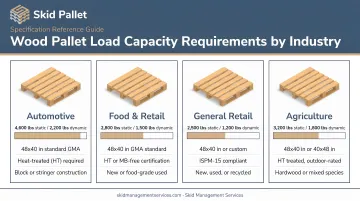
Standard GMA pallets require a minimum load-bearing capacity of 2,500 lbs, but automotive applications often exceed that threshold depending on the component. The automotive industry also uses formal pallet specifications; the AIAG RC-12:2010 standard sets intercontinental pallet requirements and mandates ISPM-15 compliance for international supply chains.
Construction
Construction sites use pallets to receive and organize bulk materials: bricks, cement blocks, roofing tiles, and bundled lumber. These are outdoor, exposed environments where pallets face moisture, uneven ground, and forklift handling by operators who aren't always gentle.
Construction pallets need to hold up under sustained weight and weather exposure. A failure mid-site wastes product and creates a real safety hazard for workers on the ground.
Key factors for construction pallet selection:
- Hardwood or mixed-hardwood construction for load capacity
- Solid deck boards to support uneven or irregular material footprints
- Treated lumber options for sites with extended outdoor exposure
Agriculture
Agricultural operations handle bulk produce, seed bags, fertilizer sacks, and packaged farm products. Standard pallets work fine for domestic distribution — but export shipments require ISPM-15 heat-treated wood without exception.
ISPM-15 requires the wood core to reach 56°C for at least 30 continuous minutes. USDA APHIS enforces this requirement for all wood packaging material entering the U.S., and most major agricultural export destinations apply equivalent rules. Non-compliant shipments get detained or rejected at the border.
Pharmaceuticals, Chemicals, Textiles, Shipping & Logistics, and Recycling: Compliance-Driven and Specialized Pallet Users
These industries don't just need pallets that hold weight — they need pallets that meet regulatory requirements. In these sectors, the wrong pallet creates a compliance failure, not just a warehouse headache.
Pharmaceuticals
Pharmaceutical manufacturers and distributors operate under FDA Current Good Manufacturing Practice (CGMP) rules. Under 21 CFR 211.142, written warehousing procedures must ensure appropriate storage conditions. Pallets that introduce contamination risk — through splinters, mold, chemical residue, or pest harboring — can trigger product recalls or FDA audit findings.
High-grade, heat-treated pallets are the standard choice in pharmaceutical warehousing and cold-chain distribution. Chain-of-custody records and treatment certifications must travel with the product — documentation is part of the compliance package, not an afterthought.
Chemicals & Hazardous Materials
Under DOT regulations (49 CFR 171.8), a palletized load is classified as an overpack — meaning the pallet itself becomes part of the regulated load's packaging system. 49 CFR 173.25 sets compatibility and labeling requirements for hazmat loads on pallets.
Pallet selection here goes well beyond load capacity. Structurally compromised pallets under chemical loads create:
- Spill risk during transit or storage
- Handling hazards for warehouse personnel
- Potential OSHA violations under 29 CFR 1910.176(b), which requires stacked materials to be secured against collapse
Textiles
Textile manufacturers and distributors require clean, splinter-free pallets. Fabric snagging during transit is a product quality issue — and contamination from a dirty or degraded pallet can damage an entire load of finished goods.
Load weights in textiles are lower than in heavy industry, but cleanliness grade matters more. This sector prioritizes consistent quality over maximum structural strength.
Shipping & Logistics
Third-party logistics (3PL) providers and freight carriers move shipments across every other industry on this list. Standardized sizing and consistent quality grades are critical for automated handling systems that can't accommodate dimensional inconsistencies.
3PLs are often among the largest single-category pallet users because they process volume on behalf of multiple clients simultaneously. Supply disruptions that affect a 3PL cascade across all their downstream customers at once.
Recycling & Waste Management
Recycling facilities and waste management operations use pallets to organize, stage, and transport recyclable materials within processing centers. Cleanliness requirements here are less stringent than in food or pharma — which makes this sector a natural fit for lower-grade or reconditioned pallets.
That's efficient sourcing: matching pallet grade to the actual application requirements. The wood pallet industry's 95% recycling rate (per the NWPCA) means reconditioned pallets are widely available and cost-effective for operations where hygiene isn't the primary specification driver.
What Every Procurement Team Should Know About Wood Pallet Specifications
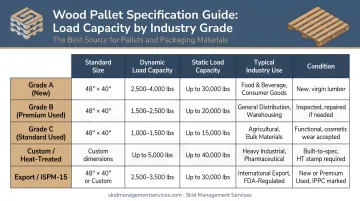
Buying pallets without matching specs to your industry is one of the more preventable supply chain mistakes. Here's what actually varies by sector:
| Specification | What It Means | Who It Matters Most To |
|---|---|---|
| Load capacity | Static, dynamic, and racking loads differ significantly | Automotive, manufacturing, construction |
| ISPM-15 treatment | Required for international shipments; also used in food/pharma | Agriculture, pharma, any exporter |
| Grade | New, #1 recycled, or lower — affects hygiene and structural integrity | Food, pharma, textiles vs. recycling |
| Sizing | 48" x 40" GMA is standard; custom dimensions for non-standard footprints | Manufacturing, automotive |
The Risk of Under-Specifying
Damaged pallets create real operational hazards — load instability, product damage, forklift handling difficulty, and racking impact. Buying the cheapest available pallet without verifying it matches your weight, environment, and compliance requirements isn't a cost savings strategy — it pushes liability down the line.
Ask suppliers for load ratings and treatment certifications before committing to a sourcing arrangement. For regulated industries, request documentation that can travel with shipments or support internal audits.
The Supply Continuity Problem
Spec compliance matters less if pallets aren't available when you need them. Industries with high pallet turnover — food, retail, e-commerce — and sectors with seasonal demand spikes — agriculture, construction — are most vulnerable to supply gaps. A regional shortage, a manufacturing disruption, or an unexpected demand surge can leave operations short within days.
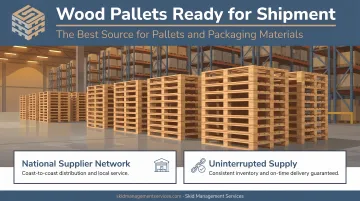
Working with a national supplier that maintains its own inventory and a network of partner suppliers is the practical hedge against this. Skid Management Services carries direct inventory and partners with suppliers across the country — so competitive pricing and uninterrupted supply hold even when demand spikes or regional availability tightens.
Frequently Asked Questions
What companies use a lot of pallets?
The heaviest users include food and beverage manufacturers, big-box retailers, automotive assembly plants, e-commerce fulfillment centers, and third-party logistics providers. These sectors collectively account for the majority of the nearly 2 billion pallets currently in circulation in the U.S.
Do companies buy wood pallets?
Yes — most companies purchase pallets directly from suppliers or through distributors. Options include new pallets, recycled/reconditioned pallets, and pallet pooling programs. For high-volume operations, direct purchasing from a national supplier typically offers better pricing and more consistent availability than pooling arrangements.
What is the most common wood pallet size used across industries?
The 48" x 40" GMA pallet is the dominant U.S. standard, representing 35% of the wood pallet market in 2016 according to the Pallet Foundation. It's accepted by most major retailers, warehouses, and logistics systems. Custom sizes are standard in automotive, manufacturing, and export applications.
Do wood pallets need to be heat-treated?
ISPM-15 heat treatment is required for international shipments to most major trading partners. Domestically, food-grade and pharmaceutical operations often specify it as well — even when not legally required — to address hygiene and contamination risks.
How do wood pallets compare to plastic pallets for industrial use?
Wood pallets cost less upfront, are easier to repair, and handle heavier loads across more applications. Plastic options offer moisture resistance but come with higher costs and limited repair options. Wood accounts for 92% of global unit pallet demand, per 2019 Freedonia data.
Wood pallets aren't a generic commodity. Each of the 12 industries covered here has distinct requirements — load ratings, treatment specifications, grade standards, and sizing constraints that directly affect whether a pallet performs or fails in its specific environment. Getting the specifications wrong creates real operational problems — and the right supplier makes that difference.
If your industry is on this list, review whether your current supplier matches your actual specifications, volume needs, and delivery requirements. Skid Management Services supplies national accounts across food manufacturing, retail, e-commerce, and industrial sectors — with the inventory depth and national network to handle high-volume and time-sensitive requirements. Contact SMS at 717-202-0304 or Info@SkidManagementServices.com to discuss your requirements and request a quote.