
Introduction
According to the National Wooden Pallet & Container Association, more than 1.8 billion pallets are in service across the United States every single day — and 93% of them are wood. Most supply chains treat that infrastructure as background noise — until something goes wrong.
Most facilities manage pallets reactively. A plant runs short, someone calls a supplier, pallets arrive — often at spot prices, inconsistent quality, and with no documentation.
Repeat that across multiple facilities and the costs compound fast: supply disruptions, inflated procurement spend, and warehouse floors cluttered with unusable skids.
This guide covers everything procurement and operations teams need to run a proactive pallet program: what pallet management actually involves, the core functions that keep it running, proven strategies for cost control, warehouse best practices, and how to evaluate suppliers beyond unit price.
Key Takeaways
- Over 1.8 billion pallets are in daily use in the U.S. — managing them as operational assets, not commodities, directly affects your cost structure
- Effective pallet management spans procurement, lifecycle tracking, storage, compliance, and recovery — not just buying
- Standardizing on the 48×40 GMA pallet and centralizing procurement data across locations are two of the highest-ROI moves available
- Close to 95% of wooden pallets are recycled — a formal reverse logistics program turns disposal into cost recovery
- Single-source supplier dependence is a supply chain risk — building redundancy into procurement protects against disruption
What Is Pallet Management?
Pallet management is the coordinated oversight of sourcing, storing, tracking, maintaining, and disposing of pallets across the supply chain.
The distinction from simply buying pallets matters: reactive purchasing treats pallets as a commodity restocked when supplies run low. Proactive pallet management treats them as operational assets with a defined lifecycle, measurable cost structure, and direct impact on production continuity.
Why Pallet Management Matters for Your Bottom Line
Poor pallet management creates three specific problems that compound over time:
- Production bottlenecks — pallet shortages at one facility halt outbound shipments even when product is ready
- Product damage — degraded pallets with broken stringers or protruding nails cause load failures and customer claims
- Wasted floor space — unmanaged accumulation of empty or damaged pallets consumes valuable warehouse square footage
These operational problems don't exist in isolation — they also affect compliance, sustainability, and cost. A structured pallet program supports:
- OSHA storage standard compliance and safer warehouse conditions
- Sustainability outcomes (wood pallet recycling rates are high, but only when a formal program is in place)
- Total supply chain cost reduction that shows up directly in procurement budgets
Key Functions of an Effective Pallet Management Program
Pallet management spans the full lifecycle of a pallet. Understanding each function helps identify where gaps exist in your current approach.
Procurement and Sourcing
Procurement means more than placing orders. It involves:
- Identifying suppliers who can meet volume and quality requirements across all your locations — not just the closest facility
- Negotiating terms that balance unit price with delivery reliability and consistent grading
- Qualifying backup suppliers before a shortage forces your hand
Businesses that consolidate pallet purchasing through a national supplier relationship — rather than letting individual plant managers source locally — gain volume leverage and eliminate quality inconsistencies between sites.
Inventory Tracking and Lifecycle Management
The real cost of your pallet program isn't the purchase price per unit. Total Cost of Ownership (TCO) includes:
- Initial purchase cost
- Inbound freight
- Repair and maintenance frequency
- End-of-life disposal or resale value
A pallet that costs less per unit but requires frequent replacement or causes automated line jams will cost more in the long run than a higher-grade option. TCO analysis requires tracking data — which means you need systems for recording usage, damage rates, and repair history.
Receiving, Inspection, and Storage
Check incoming pallets against agreed specifications before they enter your inventory:
- Inspect against GMA Grade A or B standards (or your own documented spec)
- Store in clean, dry conditions — moisture is the primary accelerant of wood pallet deterioration
- Use FIFO rotation so older stock moves first and doesn't sit until it degrades
Damage Assessment and End-of-Life Disposal
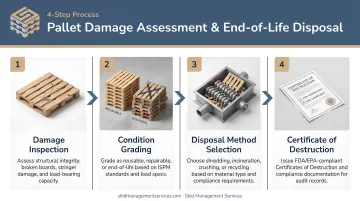
Not every damaged pallet warrants an immediate replacement order, but each one needs a clear disposition. A straightforward assessment process:
- Inspect for cracked deck boards, split stringers, and protruding nails
- Evaluate whether damage affects load-bearing capacity or creates a safety hazard
- Retire compromised pallets into a recycling stream — mulch, animal bedding, or biomass — rather than landfill disposal
- Reorder replacements through your supplier before stock dips below operational minimums
Keeping a reliable supplier relationship means you can replace condemned pallets quickly without scrambling during peak seasons.
Compliance and Specification Governance
Compliance functions are non-negotiable in certain contexts:
- ISPM-15 — international export shipments require wood packaging heat-treated to a minimum core temperature of 56°C for at least 30 minutes, with the official IPPC mark. USDA APHIS requires exporters to verify destination-country requirements before shipment
- Food and pharmaceutical applications — under FDA's sanitary transportation framework, pallets used as transportation equipment must be suitable and adequately cleanable for their intended use
- Dimensional compatibility — pallet specifications must be compatible with your forklifts, racking systems, and any automated handling equipment
Skid Management Services supplies ISPM-15 heat-treated pallets with proper treatment stamps and documentation — a practical option for food and pharma companies that need compliant pallets without managing the certification process internally.
Proven Pallet Management Strategies
Centralize Procurement Data Across Locations
When individual facility managers buy pallets independently, the company loses two things: volume leverage and visibility. Aggregating purchase data across all sites reveals your true annual spend and creates the negotiating position to secure enterprise-wide pricing and consistent quality terms. A single national account relationship can replace a fragmented web of local vendor relationships, removing the administrative burden of managing each one separately.
Standardize Pallet Specifications
According to Modern Materials Handling's 2023 Pallet Report, 70% of respondents commonly use 48×40 inch pallets — the North American standard for a reason. Standardizing on the GMA 48×40 wherever possible:
- Simplifies inventory transfers between facilities
- Reduces procurement complexity and SKU proliferation
- Prevents dimensional mismatches in automated handling systems
- Makes recycled and replacement pallets interchangeable across sites
Custom pallet dimensions are sometimes necessary — for unusual product weights or configurations — but every non-standard SKU adds procurement friction.
Implement Vendor-Managed Inventory (VMI)
VMI shifts the stock-monitoring burden to the supplier. Instead of placing emergency orders when stock runs low, the supplier monitors usage against agreed thresholds and replenishes automatically. Benefits:
- Eliminates stockouts caused by reactive ordering
- Prevents over-accumulation of pallets tying up floor space
- Reduces internal administrative overhead for procurement teams
Diversify Your Supplier Network
A single local supplier is a single point of failure. Lumber prices, weather events, and regional capacity constraints can disrupt even reliable partners. The practical solution is qualifying at least one regional or national backup before a disruption occurs, not after one starts.
Skid Management Services operates through an expansive network of pallet and packaging suppliers across the U.S., giving multi-location accounts built-in supply redundancy without the overhead of managing multiple vendor relationships directly.
Optimize Reverse Logistics and Pallet Recovery
A formal recovery program doesn't just reduce waste — it reduces purchase volume. The industry numbers support this investment: close to 95% of wooden pallets are recycled, with landfill volumes dropping from roughly 178.5 million pallets in 1998 to 25.39 million in 2016.
A typical recovery workflow:
- Sort returned pallets into reusable, repairable, and scrap categories at receiving
- Route repairable pallets to repair through your in-house maintenance process
- Send scrap pallets to recycling partners for conversion to mulch, animal bedding, or biomass
- Negotiate pallet buy-back or credit programs with your supplier for bulk returns
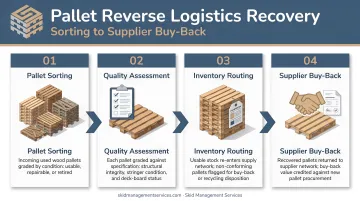
Skid Management Services offers pallet pickup and reverse logistics services, along with recycling coordination, making them a practical closed-loop option for recovering value from used pallet inventory.
Pallet Management Best Practices for Warehousing and Storage
Choose the Right Pallet for the Job
| Pallet Type | Best For |
|---|---|
| Standard wood (48×40 GMA) | General domestic distribution, most warehouse applications |
| Heat-treated (ISPM-15) | International export shipments to regulated destination countries |
| Food-grade / hygienic | Food manufacturing, pharmaceutical, hygiene-sensitive transport |
| Custom-sized | Non-standard product dimensions, unusual weight requirements |
Using the wrong pallet type risks compliance failures, product damage, or unnecessary cost.
Stack and Store Pallets Safely
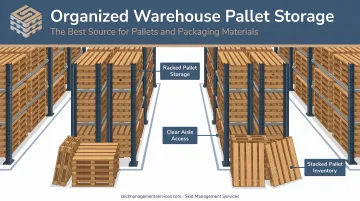
Stored materials must be stacked, blocked, and height-limited to prevent sliding or collapse — a requirement under OSHA's materials handling standards (29 CFR 1910.176). For pallets specifically:
- Stack on flat, stable surfaces — never on uneven ground
- Keep pallets off the ground in humid environments to prevent moisture absorption
- Use racks or strapping where appropriate for tall or unstable stacks
- Maintain clear forklift aisles around pallet storage areas
Organize Pallets Systematically
Floor organization directly affects how quickly damaged pallets enter service undetected:
- Designate separate zones for good pallets, damaged pallets, and scrap — clearly labeled
- Keep empty pallets away from active picking and staging areas
- Apply FIFO rotation so older stock is used before it deteriorates
- Limit pallet zones to designated areas to prevent accumulation throughout the facility
Good zoning makes the next step easier: spotting damaged units before they reach a load.
Conduct Regular Inspections and Remove Damaged Units Promptly
Before any pallet enters service, check for:
- Cracked or broken deck boards
- Split or missing stringers
- Protruding nails or fasteners
- Excessive moisture, mold, or staining
Pull non-conforming pallets immediately. One compromised pallet under a full load can trigger product damage, a safety incident, and a claims process that costs far more than the pallet was worth.
Train Employees on Safe Pallet Handling
Equipment quality and pallet condition mean nothing if handling technique is wrong. Key training points for any pallet operation include:
- Correct fork insertion angles to avoid splintering deck boards
- Proper pallet jack approach and tilt on inclines
- Manual lifting protocols for handlers moving empty pallets
- Recognizing when a pallet is unsafe to load, regardless of appearance
Even well-maintained pallets fail under misuse. Training closes the gap.
Common Pallet Management Challenges and How to Overcome Them
Supply and Price Volatility
Lumber prices don't move on a predictable schedule. Construction demand, weather events, and raw material availability all create procurement budget uncertainty. The wood pallet Producer Price Index (FRED series WPU0841) reached 346.876 in April 2026, reflecting ongoing market movement.
Mitigation strategies:
- Negotiate index-linked pricing contracts that adjust with documented market benchmarks rather than supplier discretion
- Maintain a small buffer inventory — even two to three days of coverage reduces emergency buy exposure
- Work with suppliers who have diversified sourcing networks and can absorb regional disruptions
Inconsistent Pallet Quality Across Suppliers
"Grade A" means different things to different suppliers. When pallets arrive that don't match your operational requirements — wrong deck board thickness, unacceptable stringer repairs, excessive wear — the downstream costs show up as automated line jams, rejected loads, and product damage.
Documentation closes the gap — not goodwill:
- Create visual specification sheets with photos of acceptable vs. unacceptable defects
- Attach specifications to every purchase order
- Track supplier defect rates and use the data in contract renewals
Limited Warehouse Space for Empty Pallet Storage
Empty pallets pile up faster than most operations plan for. These three approaches free up floor space without disrupting supply:
- Drop trailer programs — negotiate with your supplier to leave a trailer on-site that functions as mobile pallet storage
- Just-in-time delivery scheduling — reduce on-hand pallet inventory by tightening replenishment frequency
- Surplus sell-back — establish a retrieval or buy-back program for pallets that exceed your immediate needs
How to Choose the Right Pallet Supplier
Evaluate Network Reach, Quality Standards, and Reliability
Three criteria matter most:
- Geographic reach — can they serve all your locations without sourcing gaps or inconsistent lead times?
- Quality grading — do they have documented, enforceable specifications and accountability when pallets fall short?
- Delivery reliability — do they have a track record of on-time performance during demand peaks, not just normal conditions?
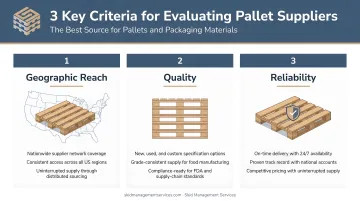
Suppliers that check all three boxes are rare at the regional level. National providers like Skid Management Services — which supplies major food manufacturers including Campbell Snacks, Knouse Foods, Nissin, and Hain Celestial — can serve multi-location accounts with consistent supply and pricing, eliminating the need to manage multiple regional vendors independently.
Assess Flexibility, Transparency, and Total Cost of Ownership
Before committing to a supplier relationship, ask:
- Can they scale volume during seasonal peaks without price spikes?
- Do they offer pricing documentation and transparency on how rates are determined?
- Are they willing to provide performance data on delivery and quality rates?
- What does total cost look like — including inbound freight, damage and replacement rates, and administrative burden?
The supplier with the lowest per-unit price rarely is the lowest total cost. Evaluating the full picture — including the operational overhead of managing a poor supplier — gives a far more accurate comparison.
Frequently Asked Questions
What are pallet management services?
Pallet management services are programs — operated in-house or through a third-party provider — that handle the full lifecycle of pallets, including sourcing, inspection, storage, repair, and recycling. The goal is ensuring the right pallets are available at the right time while controlling costs and reducing waste across the supply chain.
Does anyone collect pallets for free?
Many pallet recyclers, local woodworkers, and pallet suppliers will collect used or scrap pallets at no charge. In some cases, suppliers will pay for bulk quantities of standard-size pallets in reusable condition — contact a local supplier or recycler to determine whether your volume qualifies for a buy-back rate.
What is the best way to organize pallets in a warehouse?
Designate separate storage zones for good, damaged, and scrap pallets with clear labeling, apply FIFO rotation, and stack within safe height limits. Keeping forklift aisles clear around pallet storage areas is as important as the storage method itself.
What are the most common types of wood pallets used in warehousing?
The 48×40 GMA stringer pallet is the North American standard, used across most domestic supply chains. Block pallets offer four-way fork entry and greater load capacity for heavier applications. Heat-treated pallets — marked with the IPPC stamp — are required for international export under ISPM-15 regulations.
How often should pallets be inspected and replaced?
Pallets should be visually inspected before each use for broken boards, protruding nails, and structural damage. Formal audits across your pallet inventory should occur at regular intervals — monthly at minimum for high-throughput operations. Any pallet showing structural compromise should be pulled immediately rather than returned to service.
What is the difference between new and recycled pallets?
New pallets are built to exact specifications and are the better choice for heavy loads, automation-sensitive lines, or hygiene-sensitive applications. Recycled pallets are refurbished units that offer a cost-effective alternative for standard use — with roughly 95% of wooden pallets recycled in the U.S., quality used stock is widely available.