This scenario plays out regularly for businesses that ship without ISPM 15-compliant, heat-treated pallets. The regulation is not obscure — it's enforced by customs authorities across the overwhelming majority of global trade destinations.
This guide is written for logistics managers, export coordinators, and supply chain professionals who need a working understanding of what heat-treated pallets are, why they're mandatory for international shipping, how the treatment process actually works, and when the requirement doesn't apply.
Key Takeaways
- Heat-treated (HT) pallets must reach 56°C (132.8°F) at the wood core for 30 continuous minutes to achieve ISPM 15 compliance
- 185 IPPC member countries enforce this standard — covering virtually every major trade destination
- A single non-compliant pallet can trigger shipment refusal, quarantine, or full cargo destruction
- Heat treatment is permanent unless the pallet is later repaired with untreated wood
- Domestic shipments within the same country don't require ISPM 15 compliance
What Are Heat-Treated Pallets?
Heat-treated pallets are wood pallets processed inside a certified kiln to eliminate insects, larvae, fungi, and other pathogens embedded in the wood. The purpose: prevent wood packaging materials from carrying invasive pests across international borders.
The Treatment Standard
Per the IPPC/FAO ISPM 15 standard, heat treatment requires the internal core temperature of the wood to reach 56°C (132.8°F) and remain there for a minimum of 30 continuous minutes throughout the entire wood profile — not just the surface.
ISPM 15 recognizes four approved treatment codes:
- HT — Heat treatment (most widely used)
- MB — Methyl bromide fumigation
- DH — Dielectric heating (60°C for 1 continuous minute)
- SF — Sulphuryl fluoride
Methyl bromide remains technically recognized but is banned or severely restricted in most major markets. The EU prohibited MB use in March 2010, and the U.S. phased out domestic production and import on January 1, 2005 under the Montreal Protocol.
The IPPC Stamp — What It Contains and Why It Matters
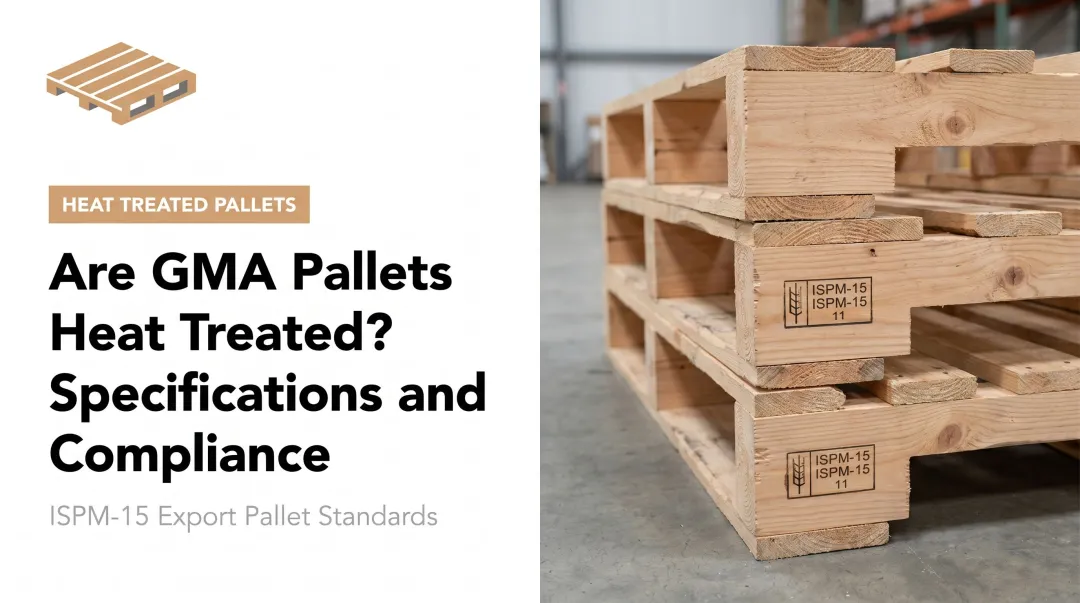
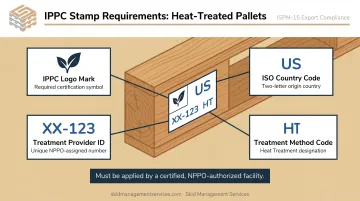
Every compliant pallet must carry an IPPC stamp applied by a certified facility. The stamp contains four required elements:
- The IPPC two-leaf logo
- A two-letter ISO country code (e.g., "US")
- A unique treatment provider ID issued by the national plant protection authority
- The treatment-method code (e.g., "HT")
The stamp is typically branded directly onto a stringer or block. It cannot be self-applied — treatment and mark application must be performed under the authority of the National Plant Protection Organization (NPPO). Any stamp missing required elements, or applied by an unauthorized party, is grounds for rejection at the destination port.
Why International Shipping Requires Heat-Treated Pallets
ISPM 15 — International Standards for Phytosanitary Measures No. 15 — was developed by the International Plant Protection Convention (IPPC), a treaty body operating under the UN Food and Agriculture Organization (FAO) and recognized by the World Trade Organization (WTO). Its purpose: prevent invasive wood-boring insects and pathogens from spreading globally through wood packaging materials. The reach of this standard is what makes it operationally unavoidable for exporters.
Global Enforcement Scope
As of the most recent IPPC country list (retrieved June 23, 2026), 185 contracting parties enforce this standard. Every major trading nation is included:
| Region | Countries Enforcing ISPM 15 |
|---|---|
| North America | United States, Canada |
| Europe | All EU member states |
| Asia-Pacific | China, Japan, Australia, New Zealand, India |
| Americas | Brazil, Mexico |
The U.S.–Canada Cross-Border Question
This one trips up many exporters. Canada is an ISPM 15 signatory, and the Canadian Food Inspection Agency (CFIA) administers entry requirements through Directive D-98-08. There's a current bilateral exemption worth knowing: wood packaging material imported from the continental United States is presently exempt from CFIA policy D-98-08.
That exemption won't last. CFIA and USDA-APHIS are actively working toward full ISPM 15 implementation between the two countries. Exporters shipping to Canada should monitor CFIA updates and build HT compliance into their supply chain now — before the phase-out makes it mandatory.
U.S. Enforcement
Two federal agencies jointly control what enters U.S. ports:
- USDA APHIS sets the regulatory rules and prohibits non-compliant wood packaging material from entry or transit
- U.S. Customs and Border Protection (CBP) enforces those rules through targeting, detection, and interception at ports of entry
- Non-compliant WPM is turned back or held — there's no informal grace period at the border
The Cost of Non-Compliance
Non-compliant shipments face several costly outcomes:
- Refusal of entry — shipment turned back at the importer's expense
- Quarantine hold — cargo detained while compliance is assessed
- Mandatory treatment — fumigation performed at the destination at the importer's cost
- Destruction — the entire consignment destroyed if treatment isn't feasible
The disproportionate risk: a single non-compliant pallet can trigger action against the entire consignment. The cost of compliant pallets is trivial compared to a refused shipment on a booked vessel.
Skid Management Services sources HT pallets exclusively through USDA APHIS-recognized treatment providers and verifies stamp compliance before pallets enter any export shipment — so non-compliance issues get caught before the cargo reaches the port, not after.
How the Heat Treatment Process Works
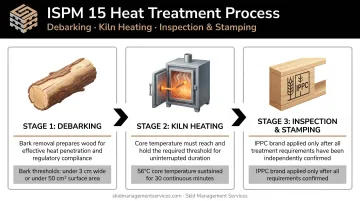
Heat treatment follows a three-step process — debarking, kiln heating, and post-treatment inspection — with the IPPC stamp applied only after all requirements are confirmed.
Step 1: Debarking
Bark is the primary habitat for insect eggs and larvae, so debarking comes first. ISPM 15 doesn't require bark-free wood — it sets specific thresholds:
- Residual bark pieces less than 3 cm wide (any length) are permitted
- Pieces wider than 3 cm must have a total surface area under 50 square cm
Debarking typically happens before pallet construction. Post-build inspection determines whether additional removal is needed.
Step 2: Kiln Heating
Pallets are loaded into large kilns, arranged to allow even airflow, and heated until internal temperature probes confirm the 56°C (132.8°F) core threshold is sustained for at least 30 continuous minutes. Surface readings don't count — every piece of wood must hit the required internal temperature.
Treatment method variants include:
- Conventional dry heat — most common in commercial settings; longer process time
- Steam/moist heat — faster results, but more corrosive to equipment and energy-intensive
- Dielectric heating (DH) — uses electromagnetic energy; requires 60°C for 1 continuous minute under a separate ISPM 15 code
Buyers sourcing from different suppliers may encounter any of these methods. What matters for compliance is whether the core threshold and duration were met, not which method achieved it.
Step 3: Inspection, Stamping, and Repair Rules
After treatment, pallets are reviewed to confirm all ISPM 15 requirements are met before the IPPC brand is applied. Treatment is permanent for the life of the pallet — with one important exception involving repairs.
ISPM 15 distinguishes between two repair categories:
- Repaired WPM (up to approximately one-third of components replaced): each added component must be individually treated and marked
- Remanufactured WPM (more than approximately one-third replaced): previous marks must be permanently obliterated, the entire unit re-treated, and a new mark applied
You cannot simply replace a broken board and re-stamp the whole pallet. The extent of the repair determines the compliance path — and re-treatment must always be coordinated through a certified, APHIS-licensed provider.
Common Misconceptions About Heat-Treated Pallets
Misconception 1: Kiln Drying and Heat Treatment Are the Same
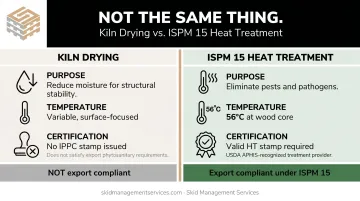
They're not. Kiln drying is a lumber processing step designed to reduce moisture content for structural stability. It involves heat, but it only qualifies as ISPM 15 heat treatment if it achieves the specific 56°C/30-minute core temperature requirement under a certified program.
The key distinction comes down to three factors:
- Temperature: Must reach 56°C at the wood's core (not just the surface)
- Duration: Must hold that temperature for a minimum of 30 minutes
- Certification: Must occur under an IPPC-recognized program with a valid HT stamp
A kiln-dried pallet without that stamp is not ISPM 15-compliant, regardless of how dry the wood is.
Misconception 2: Heat-Treated Pallets Are Always Required
ISPM 15 applies specifically to wood packaging material in international trade. Domestic shipments that don't cross international borders are outside its scope. A truck moving palletized goods entirely within the United States has no ISPM 15 obligation.
The compliance trigger is international transit. For businesses running mixed domestic and export supply chains, clear pallet segregation is essential: it controls costs and prevents non-HT pallets from entering export streams.
Misconception 3: Certification Provides Ongoing Protection
The IPPC stamp certifies that treatment occurred — it doesn't guarantee the pallet remains pest-free indefinitely. Even certified pallets can become re-contaminated if stored improperly after treatment: outdoors, in pest-prone areas, or in contact with non-compliant materials.
ISPM 15 guidance explicitly requires that treated and untreated materials be kept segregated. That means operational vigilance in warehouse and port environments is built into compliance — the stamp confirms the treatment happened, but storage and handling practices determine whether that protection holds.
Conclusion
Heat treatment is not an optional upgrade. For any shipment moving across international borders on wood pallets, ISPM 15 compliance is a legal requirement enforced by customs authorities across 185 countries. The cost of non-compliance — refused shipments, quarantine fees, mandatory fumigation, or load destruction — far exceeds the price difference of using certified pallets from the start.
Understanding the process, the stamp requirements, the repair rules, and where exemptions apply protects both your shipments and your operations from disruptions that proper supplier selection can prevent.
Supplier selection is part of the compliance infrastructure. Skid Management Services sources ISPM 15-compliant heat-treated pallets through USDA APHIS-recognized treatment providers, with stamp verification services, 24/7 availability, and a nationwide supplier network built for high-volume export programs.
Businesses that need uninterrupted, certified HT pallet supply can reach the team at 717-202-0304 or Info@SkidManagementServices.com.
Frequently Asked Questions
Are heat-treated pallets required for international shipping?
Yes. ISPM 15 requires all wood packaging materials — including pallets — used in international trade to be heat-treated or otherwise treated per IPPC standards. Non-compliant shipments may be refused entry, quarantined, or destroyed at the destination port.
Which countries require ISPM 15?
The IPPC lists 185 contracting parties as of June 2026, spanning nearly every significant trade destination. Major enforcers include the United States, Canada, all EU member states, China, Australia, India, Japan, and New Zealand.
Does Canada require heat-treated pallets from the USA?
Canada is an ISPM 15 signatory, and the CFIA enforces wood packaging requirements under Directive D-98-08. However, wood packaging material from the continental United States is currently exempt from that directive — a bilateral provision that CFIA and USDA-APHIS are actively working to phase out. Exporters should monitor CFIA updates closely.
How long does heat treatment last on a pallet?
Heat treatment is a permanent, one-time certification that doesn't expire. The exception is repair or remanufacturing with new untreated wood, which voids certification and requires re-treatment by a licensed facility before the pallet can carry a valid ISPM 15 stamp again.
What happens if you ship internationally with non-compliant pallets?
Consequences include refused entry, quarantine, mandatory fumigation at the importer's expense, or destruction of the shipment. One non-compliant pallet can put the entire consignment at risk, meaning the financial exposure quickly exceeds the cost of sourcing compliant pallets in the first place.