This guide covers everything you need to make better strapping decisions: material types, manual versus automated application, how to calculate strap requirements, correct placement and tensioning, and how to spot inadequate strapping before a load leaves the dock.
Key Takeaways
- Pallet strapping secures loads during transport — wrong material or poor application causes load failure
- Three strap materials to know: PP for light loads, PET for medium-to-heavy, and steel for extreme weights or sharp edges
- Calculate minimum tensile strength with: (Pallet Weight × 1.5) ÷ Number of Straps
- Placement, tension, and seal type all determine whether the load holds in transit
- Before shipment, check for slack straps, damaged seals, or any product shift — each signals a likely failure
Why Proper Pallet Strapping Matters
A strapping failure mid-transit doesn't just mean a damaged product. It triggers a chain of problems that's expensive to unwind.
The Real Cost of Getting It Wrong
Poor strapping leads to:
- Product damage and replacement costs from load collapse or shifting
- Retailer chargebacks — Weber Logistics notes these can reach 15–20% of an invoice value
- Worker injuries from falling loads — BLS reported 357 fatal struck-by incidents in 2024 alone
- Re-palletizing labor and delayed shipments when loads are rejected at the dock
An OSHA accident report (ID 201353620) illustrates the stakes directly: a stack of 2,205-lb bags secured by only two 0.5-inch plastic strapping bands, stacked three pallets high, collapsed and killed an employee. Undersized strapping on a heavy load is a life-safety issue, not just a compliance checkbox.
Start With the Pallet Itself
Strapping can only do so much. If the pallet underneath is cracked, has missing deck boards, or can't handle the load weight, even correctly applied strapping won't prevent failure. Structurally sound pallets are the foundation of a secure load.
For food manufacturers and consumer goods operations, sourcing pallets and strapping through the same national supplier simplifies procurement and keeps supply consistent. Skid Management Services supplies new, used, and custom wood pallets — including GMA 48×40 and block formats — alongside strapping and other packaging materials, with pricing supported by an extensive supplier network.
Types of Pallet Strapping Materials
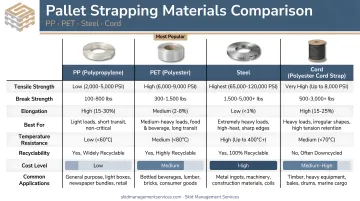
Material selection comes down to four factors: load weight, whether the load is rigid or compressible, transit distance, and environmental exposure. These are not interchangeable options — each material has a defined performance window.
Polypropylene (PP) Strapping
PP is the lightest and most economical strapping material, suited for light to medium-duty bundling, carton unitizing, and package reinforcement.
- Break strength range: 120–600 lbs (Signode Empax data)
- Elongation: 14–20% standard duty; up to 40% high-elongation grades
- Key limitation: PP loses over 50% of its original tension within the first 24 hours
That tension loss is the critical issue. For short-haul shipments with lighter loads, PP works fine. For anything heavier, long-haul, or requiring consistent clamping force over time, PP will fail you quietly before the load reaches its destination.
Polyester (PET) Strapping
PET has largely replaced steel for heavy palletized loads. It offers higher break strength and better tension retention than PP.
- Break strength range: 360–4,000 lbs (Signode Tenax data)
- Recovers well after stretching — adapts to load expansion and contraction during transit
- Can reduce material costs by up to 50% compared to steel in suitable applications (FROMM data)
PET's elongation-and-recovery property is what makes it particularly valuable: the strap tightens back up after a bump or temperature shift rather than staying slack. For most medium-to-heavy pallets, PET is the right answer.
Steel Strapping
Steel is used where load weight, sharp edges, or rigidity rule out plastic options entirely.
- Break strength: 787–5,860 lbf (3,500–26,080 N); elongation only 0.5–2% (Signode)
- Suitable for loads in the 4,000+ lb range, metal coils, machinery, and materials with edges that would cut plastic strap
- Shock absorption: Minimal elongation means steel won't adapt if the load settles or compresses in transit
- Safety requirement: Requires PPE and proper cutting technique — steel recoils sharply when cut under tension
Cord / Composite Strapping
Woven polyester cord strapping delivers steel-level break strength with the shock absorption plastic can't match — making it the practical choice where neither works cleanly.
- Signode woven cord: 400–2,500 daN break strength; hotmelt cord up to 2,000 daN
- Cordstrap composite: up to 2,600 daN / 5,850 lbf
- Common in agriculture, construction, outdoor storage, and irregular or awkward loads where steel is impractical
| Material | Typical Use | Break Strength | Key Advantage |
|---|---|---|---|
| PP | Light-to-medium loads | 120–600 lbs | Low cost |
| PET | Medium-to-heavy pallets | 360–4,000 lbs | Retained tension |
| Steel | Extreme weights, sharp edges | ~787–5,860 lbf (3,500–26,080 N) | Maximum strength |
| Cord/Composite | Irregular, outdoor, heavy | Up to 5,850 lbf | Shock absorption |
Pallet Strapping Methods: Manual vs. Automated Application
Manual Application
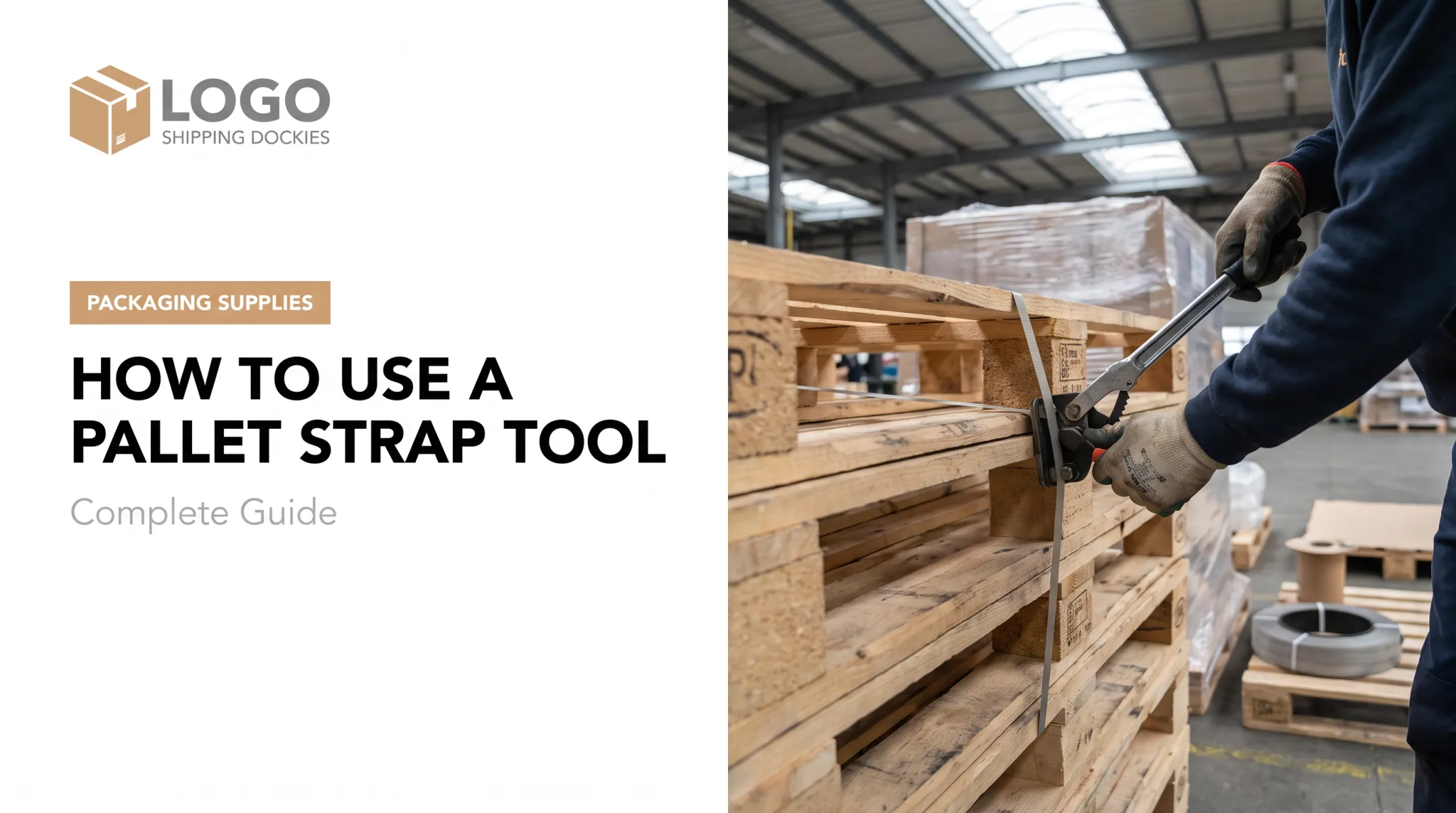
Manual strapping uses a three-piece tool set: tensioner, sealer, and cutter, typically fed from a cart or floor dispenser.
- Works well for low-to-moderate volume operations
- Starting cost: hand tools from around $300; electric handheld tools average around $2,500
- Tension quality is entirely operator-dependent — training matters
The biggest vulnerability with manual application is inconsistency. Two operators using the same tool can produce significantly different tension levels, and neither may know how far off they are without a tension gauge.
Semi-Automatic and Automatic Machines
Machine strapping removes the operator variability problem.
- Semi-automatic machines: up to 11 straps/minute; starting around $2,500
- Fully automatic machines: up to 50 straps/minute; starting around $6,500 for basic models, $16,000+ for fully integrated systems
- Automatic tensioning and load sensors ensure each strap receives consistent force
Machines require machine-grade strapping with tight tolerances and minimal camber — standard hand-grade coils can jam chutes and arches. If you're running a semi-automatic or automatic strapper, confirm your strapping supplier carries machine-grade material.
How to Strap a Pallet: Best Practices and Guidelines
Correct material selection fails without correct application. Strap placement, tension level, and seal type all determine whether the load survives the trip — here's how to get each one right.
Calculating How Many Straps You Need
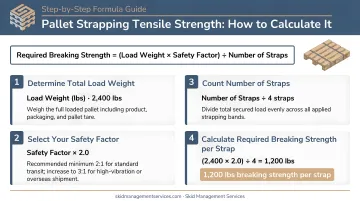
Use this industry-standard formula:
(Pallet Weight × 1.5) ÷ Number of Straps = Required Tensile Strength per Strap
Example: A 1,200-lb pallet with 3 straps: 1,200 × 1.5 = 1,800 ÷ 3 = 600 lbs tensile strength required per strap
The 1.5× multiplier accounts for dynamic forces in transit — acceleration, braking, and road vibration. For taller loads, longer routes, or uneven weight distribution, increase strap count or move to higher-tensile material beyond what the formula minimum suggests.
Strap Placement Patterns
Standard horizontal strap placement:
- One strap near each end of the pallet load
- Additional straps spaced across the middle for loads taller than 48 inches
- Straps should run over the top and around the full pallet perimeter — not just across the top surface
Use edge protectors (corner boards) whenever strapping contacts box corners or fragile packaging. UPS packaging guidelines specify that angle boards must extend from the deck board to the top of the load. Edge protectors protect packaging from strap pressure and distribute tension evenly across the load edge, preventing stress concentration at a single point. Skid Management Services stocks corner boards alongside strapping materials, so both can be sourced in one order.
Tensioning and Sealing Correctly
Tension target: the strap should not lift more than half an inch from the load surface. Too loose allows shifting; too tight risks crushing product or snapping the strap prematurely.
Seal type directly affects how much of the strap's rated strength you actually get at the closure:
| Seal Type | Approximate Strength Retention |
|---|---|
| Friction weld | 75%+ of PET break strength |
| Heat weld | Comparable to friction weld |
| Metal seals/buckles | Under 50% of PET break strength |
If you're specifying PET strapping and using metal seals, your effective holding strength may be less than half what the strap's break strength suggests. Friction or heat weld closures are the better option for load-critical applications.
Signs Your Pallet Strapping Is Not Adequate
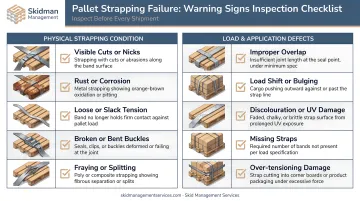
Before a pallet leaves the dock, run a quick inspection. Catching a strapping failure at this stage costs a few minutes. Catching it after a claim costs much more.
Visible Slack or Strap Lifting
Any strap that lifts more than half an inch from the load surface has insufficient tension. Don't adjust it. Re-apply.
Slack straps allow micro-shifts that compound: the load shifts slightly, the strap loosens further, and by the time the pallet reaches the receiver, the load may have shifted enough to cause structural failure.
Damaged Seals, Buckles, or Strap Integrity
- Cracked seals or slipped buckles compromise the closure entirely
- Fraying, nicks, or kinks in the strap material create stress concentration points
- A visually compromised strap is not a reliable strap — replace it even if it appears to still be holding
Load Shifting or Unitization Failure
Warning signs that a strapped load has already shifted:
- Products overhanging the pallet edge
- Visible gaps between layers
- The pallet leaning or tilting
These indicate the strap count, placement pattern, or tension was insufficient for the load. Re-strap before shipping.
Edge Damage or Strap Cutting Into Product
If strapping has cut into box corners or packaging material, either the tension was excessive or edge protectors were absent. Either way, the contact point becomes a stress concentration that weakens the strap and damages the product. Use edge protectors on any load with exposed corners or compressible packaging.
Frequently Asked Questions
What is the difference between strapping and banding?
Strapping and banding refer to the same process — applying a strap or band around a load to secure it. "Banding" is common in some manufacturing and agricultural industries, while "strapping" is the standard term in logistics and packaging. The materials and tools are identical.
How many straps does a pallet need?
Most standard pallets require a minimum of 2–3 straps, but the correct number depends on weight, load height, and the formula: (Pallet Weight × 1.5) ÷ Number of Straps. Heavier or taller loads need more straps or higher-tensile material to meet the required strength per strap.
What is the best strapping material for heavy pallets?
PET polyester handles loads up to roughly 4,000 lbs with strong retained tension, good elongation recovery, and costs up to 50% less than steel in comparable applications. Above that threshold — or where sharp edges would cut plastic strap — steel strapping is the right call.
Can pallet strapping be applied without tools?
Basic hand-grade strapping can be buckled manually, but professional tensioners and sealers are strongly recommended. Inconsistent manual tension is one of the most common causes of load failure, and the half-inch lift test is nearly impossible to achieve reliably without proper tooling.
How tight should pallet strapping be?
The strap should not lift more than half an inch from the load surface — but should never be tight enough to crush the product or risk snapping. Handheld or machine tensioners are the most reliable way to hit that consistent force across every strap.
Is polypropylene or polyester strapping better for pallets?
Polyester is the better choice for palletized loads — it delivers higher retained tension, better elongation recovery, and greater break strength. Polypropylene suits lighter, less demanding applications where lower cost is the priority.