For food, beverage, pharmaceutical, and manufacturing operations, the stakes are higher than most buyers expect. Pallet quality directly affects load stability, worker safety, equipment compatibility, and regulatory compliance. FDA's sanitary transportation guidance specifically flags poor pallet quality as a contamination risk — meaning it's not just an operational issue, it's a compliance one.
This guide covers everything you need to evaluate used pallets confidently: structural condition, contamination risk, wood type, treatment stamps, grades, and how to find a supplier you can actually rely on.
Key Takeaways
- Used pallets save money and reduce waste, but condition varies widely — inspect every shipment before accepting
- Check for structural damage, mold, stains, and contamination before accepting any shipment
- Avoid pallets stamped MB (methyl bromide); they carry real chemical contamination risks
- Grade A and Grade B are common labels, but definitions vary by supplier; always get specs in writing
- Work with a supplier who has consistent inventory, vetted sourcing, and experience in your industry
What Are Used Wood Pallets?
Used wood pallets are recovered pallets that have been sorted and resold — either as-is after inspection or repaired to restore structural integrity. They're recovered assets, not rejects. Wood dominates the U.S. pallet market, with more than 1.8 billion pallets in service and 93% made from wood. Millions of those cycle through recovery and resale each year.
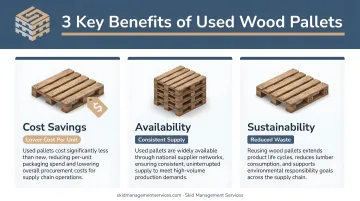
Businesses choose used pallets for three main reasons:
- Lower cost per unit compared to new pallets, with savings that compound quickly at volume
- Wide availability in the standard 48×40" GMA footprint used across most U.S. industries
- Sustainability — a 2016 NWPCA/Virginia Tech study reported a 95% wood pallet recycling rate, with landfilled pallets dropping from 178.5 million in 1998 to just 25.39 million
Two Types You'll Encounter
| Type | What It Is | Best For |
|---|---|---|
| Recycled/Sorted | Recovered pallets inspected and graded as-is | Standard warehouse and shipping use |
| Remanufactured/Repaired | Boards or stringers replaced to bring performance closer to new | Higher-load applications, longer service cycles |
Knowing which type you're buying matters. A remanufactured pallet typically carries a higher price but performs closer to new. A sorted/graded pallet may look sound on inspection but still carry hidden fatigue that only surfaces once it's under load.
What to Look For When Buying Used Wood Pallets
Used pallets vary in condition, treatment history, and structural integrity. These are the factors that separate a smart purchase from a liability.
Structural Integrity
Start here. A structurally compromised pallet is a workplace hazard — OSHA 29 CFR 1910.176 requires materials to be stored in ways that prevent sliding or collapse, and damaged pallets are a recognized cause of incidents. NWPCA has documented cases where collapsing pallets led to hospitalizations and fines exceeding $100,000.
Look for:
- Broken or cracked deckboards
- Missing boards or uneven board spacing
- Split or broken stringers
- Protruding nails or staples
- Visible warping, rot, or board displacement
Any of these issues weaken load-bearing capacity. Under repeated load cycles, minor damage compounds fast.
Cleanliness and Contamination Risk
For food, beverage, or pharmaceutical buyers, this is the section that matters most. FDA's CGMP rules under 21 CFR 117.93 require storage and transport conditions that protect against biological, chemical, physical, and radiological contamination.
Reject pallets with:
- Dark stains — may indicate chemical spills or pesticide residue
- Unusual odors — a strong sign of contamination
- Visible mold — mold spores can spread to stored goods; NWPCA confirms this as a documented risk
- Discoloration that doesn't match normal wood aging
Mold is especially common on softwood pallets that have been stored in wet or uncovered conditions. Keeping wood moisture below 20% inhibits mold growth — so ask where pallets were stored before you buy.
Wood Type: Hardwood vs. Softwood
The wood species affects durability, weight, and moisture behavior.
Hardwood (oak, mixed hardwood, hard maple):
- Denser, stronger under repeated use
- A USDA Forest Service study found mixed hardwood pallet parts were 41% stronger and 40% stiffer than softwood equivalents
- Better suited for heavy warehouse loads and multi-trip applications
Softwood (Southern Pine, Douglas-Fir, Spruce-Pine-Fir):
- Lighter and lower cost
- More prone to moisture absorption and mold
- Appropriate for lighter, shorter-cycle shipping — particularly if kiln-dried
Match wood type to your application. Heavy manufacturing and warehouse storage benefit from hardwood. Lighter outbound logistics can use softwood, provided it's been properly dried.
Pallet Size and Equipment Compatibility
The 48×40" GMA pallet is the U.S. default, defined in ANSI MH1-2016 as the standard footprint. But "standard" doesn't mean universal — grocery, automotive, beverage, and export industries each have preferred dimensions that may differ.
Before buying in bulk, confirm the pallets match:
- Forklift entry dimensions and tine length
- Pallet jack clearance
- Rack beam depth and bay width
- Conveyor width and spacing
- Customer or retail compliance specs
Verify dimensions against your equipment specs before placing a bulk order — a mismatch that surfaces after delivery typically means rehandling costs or rejected loads.
Treatment Stamps and Chemical Safety
Every wood pallet used in commerce should carry an IPPC stamp block — typically found on the stringer or block. That stamp tells you how the wood was treated, and it matters more than most buyers realize.
| Stamp | Meaning | Safe to Use? |
|---|---|---|
| HT | Heat-treated — meets ISPM 15 export requirements | ✅ Yes |
| KD | Kiln-dried — reduces moisture, but not automatically ISPM 15 compliant | ✅ Yes (domestic) |
| DB | Debarked | ✅ Yes (verify full mark) |
| MB | Methyl bromide fumigated | ❌ Avoid |
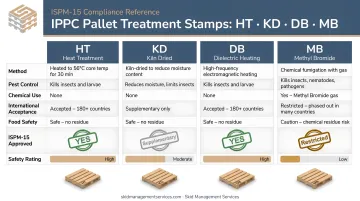
MB-treated pallets are not acceptable for any application. Methyl bromide is a toxic, ozone-depleting pesticide that has been phased out under the Montreal Protocol and is banned from general use in the EU.
MB-treated pallets can react with warehouse chemicals and are prohibited for food-adjacent applications. Always inspect the IPPC stamp visually and confirm with your supplier that no MB-treated inventory will be included in your order.
Load Capacity and Durability
Used pallets may have degraded load tolerance due to prior repairs, board replacements, or structural fatigue that isn't visible on the surface. A pallet that looks fine can fail under a load it should handle — especially in rack storage.
Ask your supplier for:
- Static load rating — weight the pallet can hold when stationary
- Dynamic load rating — weight it can carry while being moved
- Racking load rating — weight it can hold when supported only at the edges in rack storage
Also clarify whether the pallets are intended for single-trip or multi-use applications. Single-trip pallets are typically Grade B or C; multi-use warehouse applications require Grade A construction with no repaired stringers or replaced boards.
Understanding Pallet Grades and Specifications
Used pallets are commonly sorted into Grade A (or #1) and Grade B (or #2) — but these are supplier-defined labels, not formal national standards. Definitions vary, and two suppliers calling something "Grade A" may be describing very different products.
Grade A Pallets
Grade A pallets (including Premium A and Standard A categories) typically feature:
- Minimal repairs and consistent deckboard spacing
- No broken boards; stringers intact
- Higher structural integrity suitable for forklift handling and rack storage
- Better appearance for customer-facing or automated system use
This is the right choice for regulated environments, heavy-load applications, and any operation where pallet consistency affects throughput.
Grade B Pallets
Grade B pallets may include:
- More significant wear and cosmetic damage
- Companion stringers reinforcing damaged original stringers (up to two per pallet is common)
- Greater board variability
These work for internal transfers, one-way shipping, or cost-sensitive operations where load requirements are modest. Without written specs, you have no recourse when pallets don't match the stated grade. That's the real risk with Grade B sourcing.
Always Get Specs in Writing
Before committing to a supplier, request documentation that covers:
- Number of deckboards and allowable board gaps
- Maximum repair percentage and stringer repair allowances
- Acceptable damage tolerances
- Moisture expectations and storage conditions
- ISPM 15 status if export use is possible
Reputable suppliers provide this documentation as a standard part of quoting. If a supplier can't define their grade criteria in writing, treat that as a reason to keep looking.
How Skid Management Services Simplifies Used Pallet Procurement
Sourcing used pallets at scale creates supply chain exposure most buyers don't account for until something breaks. Inconsistent grades, surprise shortages, and untraceable treatment histories add up fast — especially across multi-location operations.
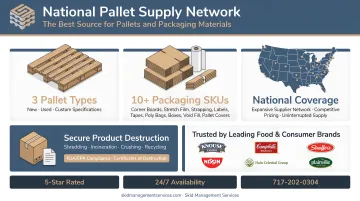
Skid Management Services is a national B2B supplier of wood pallets and packaging products, serving major food and consumer goods brands including Campbell Snacks, Knouse Foods, Nissin, Hain Celestial, Stauffer's, and Plainville. Their model combines owned inventory with a national supplier network, which means buyers aren't dependent on a single source when demand spikes or regional supply tightens.
Key advantages for buyers sourcing used pallets through Skid Management Services:
- Consistent availability across regions through a vetted national supplier network — not a single-source dependency
- Pricing driven by network depth: access to pallet cores, sorting capacity, and supplier relationships that move costs more than lumber spot prices
- Hands-on experience with regulated food and consumer goods accounts where pallet compliance and cleanliness aren't optional
- Spec alignment across dimensions, grade requirements, and material handling configurations for your specific operation
- Dual-source supply structure (owned inventory plus supplier network) built to hold through demand spikes and regional tightness
For buyers who want to discuss specific grade requirements, sizes, or volume needs, Skid Management Services can be reached at 717-202-0304 or Info@SkidManagementServices.com.
Conclusion
Getting used pallet procurement right comes down to the same factors every time: structural condition, treatment stamps, wood type, size compatibility, and grade documentation. Each one determines whether a pallet delivers real cost savings or quietly creates problems downstream.
Getting those factors right the first time also makes the next procurement decision easier. As load types shift, compliance requirements tighten, or your warehouse or distribution setup changes, the specs that worked before may no longer fit. Revisiting pallet requirements periodically — and working with a supplier who tracks your operational needs over time — keeps supply consistent and costs predictable.
Frequently Asked Questions
How do you tell if wood pallets are chemically treated?
Look for the IPPC stamp block on the pallet's stringer or block face — it will include a treatment code. HT indicates heat treatment, KD indicates kiln-drying, and MB indicates methyl bromide fumigation. Any pallet stamped MB should be excluded from your inventory due to chemical hazard and regulatory risks.
How much do secondhand pallets cost?
Used pallet prices vary by grade, size, regional supply, and local demand. Grade A 48×40" pallets typically cost 20–40% more than Grade B, driven by pallet core acquisition costs, sorting and repair labor, and freight rather than lumber commodity prices.
What pallet grade is best for heavy warehouse use?
Grade A (or #1) pallets are the right choice for heavy warehouse use, forklift handling, and rack storage. They have minimal repairs, intact stringers, and the structural consistency needed to maintain load integrity under racking conditions.
Are used wood pallets safe for food and beverage products?
Yes, when properly sourced. Used pallets can meet food-adjacent standards if they're free of chemical stains, mold, MB treatment stamps, and physical damage. For regulated food operations, source from suppliers who can provide documentation on treatment history and pallet condition.
What is the difference between heat-treated and kiln-dried pallets?
Heat treatment (HT) raises the wood's core temperature to eliminate pests and satisfies ISPM 15 requirements for international shipping. Kiln-drying (KD) reduces moisture to inhibit mold but does not qualify as ISPM 15 treatment on its own. Both stamps can appear together: KD HT on the same pallet satisfies export requirements under U.S. marking programs.
Can used wood pallets be used for international shipping?
Only if they carry a valid ISPM 15-compliant HT stamp issued under an ALSC-accredited program. If the pallet has been repaired after original certification, ALSC regulations require the original mark to be obliterated and the pallet re-marked under certified conditions. Uncertified repairs on export pallets can trigger customs delays or fines.