Use the wrong pallet type for your transport mode, storage system, or trade destination and you're looking at shipment rejections at customs, re-palletizing fees, and supply chain delays that eat into margins. Getting this decision right upfront is far cheaper than fixing it downstream.
This guide breaks down the structural and regulatory differences between block pallets and Euro pallets, explains when each is appropriate, and helps you make the right call for your operation.
Key Takeaways
- Euro pallets are a certified EPAL standard — a specific type of block pallet, but not all block pallets are Euro pallets
- Euro pallets have fixed dimensions of 1,200 × 800 mm (47.2" × 31.5") with strict EPAL construction requirements
- US block pallets lack a single mandatory standard; the most common size is 48" × 40" (GMA/Consumer Brands Association convention)
- Euro pallets are required for European trade and join an open exchange pool; US block pallets are the default for domestic supply chains
- Your choice depends on destination market, load requirements, automation compatibility, and export compliance obligations
Block Pallet vs Euro Pallet: Quick Comparison
| Factor | US Block Pallet | Euro Pallet (EPAL) |
|---|---|---|
| Dimensions | Typically 48" × 40" (no fixed standard) | Fixed 1,200 × 800 mm (47.2" × 31.5") |
| Construction standard | No mandatory national equivalent | EN 13698-1; 78 nails in specified pattern |
| Safe working load | ~2,500–2,800 lb (manufacturer-specific) | 1,500 kg (~3,307 lb) dynamic |
| Heat treatment | Required only for international shipment | ISPM-15 compliant (required for EU entry) |
| Exchange system | No national open pool equivalent | EPAL open exchange pool across Europe |
| Certification | Not required for domestic US use | EPAL logo required on corner blocks |
Dimensions and Container Loading
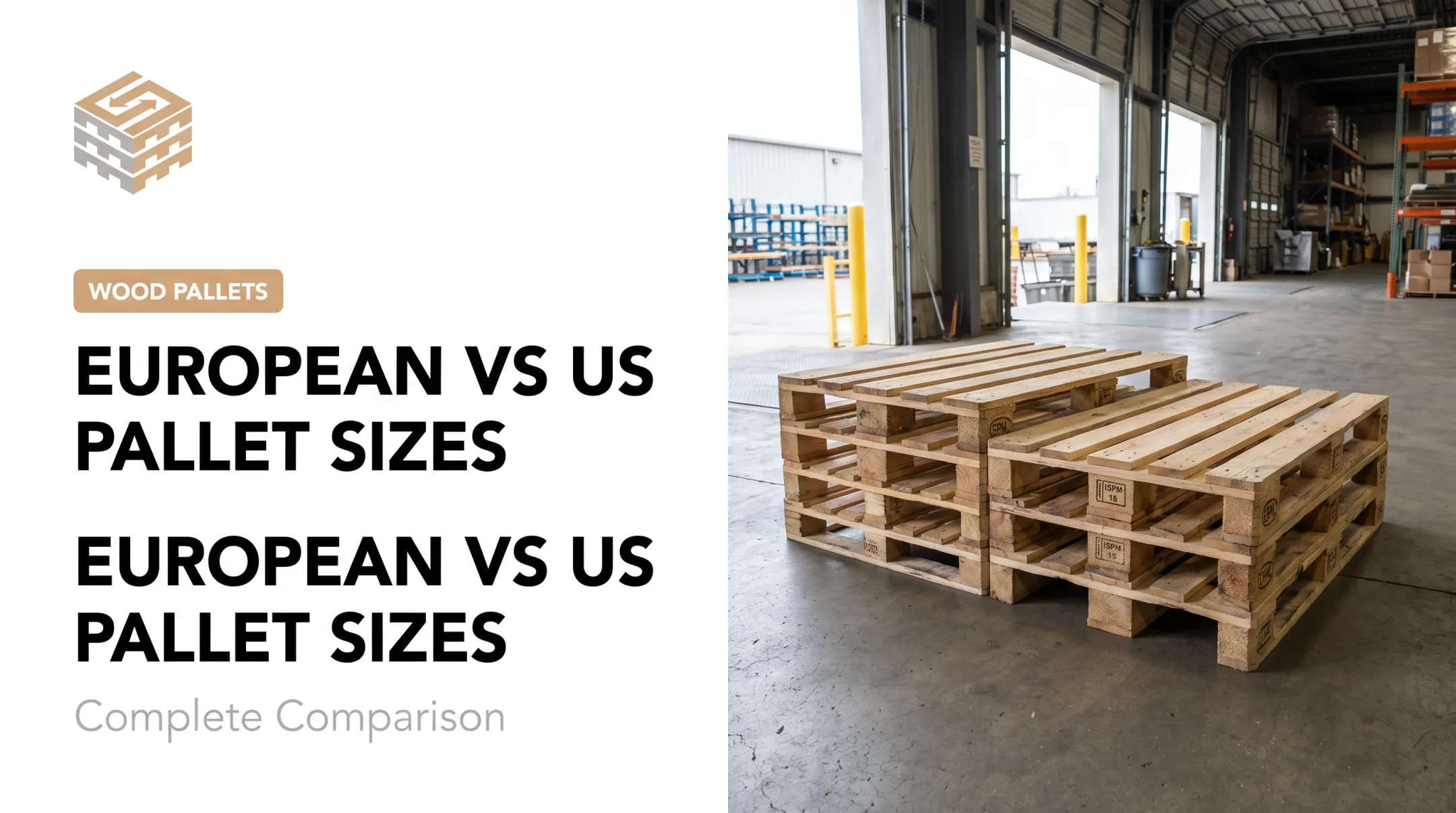
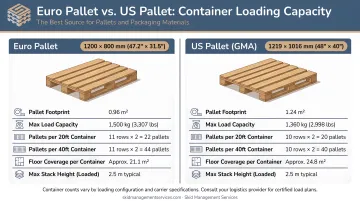
According to Modern Materials Handling's 2025 pallet report, 48" × 40" is the dominant US pallet footprint, and PalletOne identifies it as tied to former Grocery Manufacturers Association guidance. Euro pallets are fixed at 1,200 × 800 mm with no variation permitted under EPAL certification.
That size gap has direct consequences for container loading. A standard 20-ft container fits roughly 10 standard American pallets or 11 Euro pallets. In a 40-ft pallet-wide container, the number climbs to 30 Euro pallets versus 21 standard 1.2 × 1.0 m pallets. For high-volume international shippers, one extra pallet per container means tens of thousands of dollars in recaptured freight capacity annually.
Construction and Load Capacity
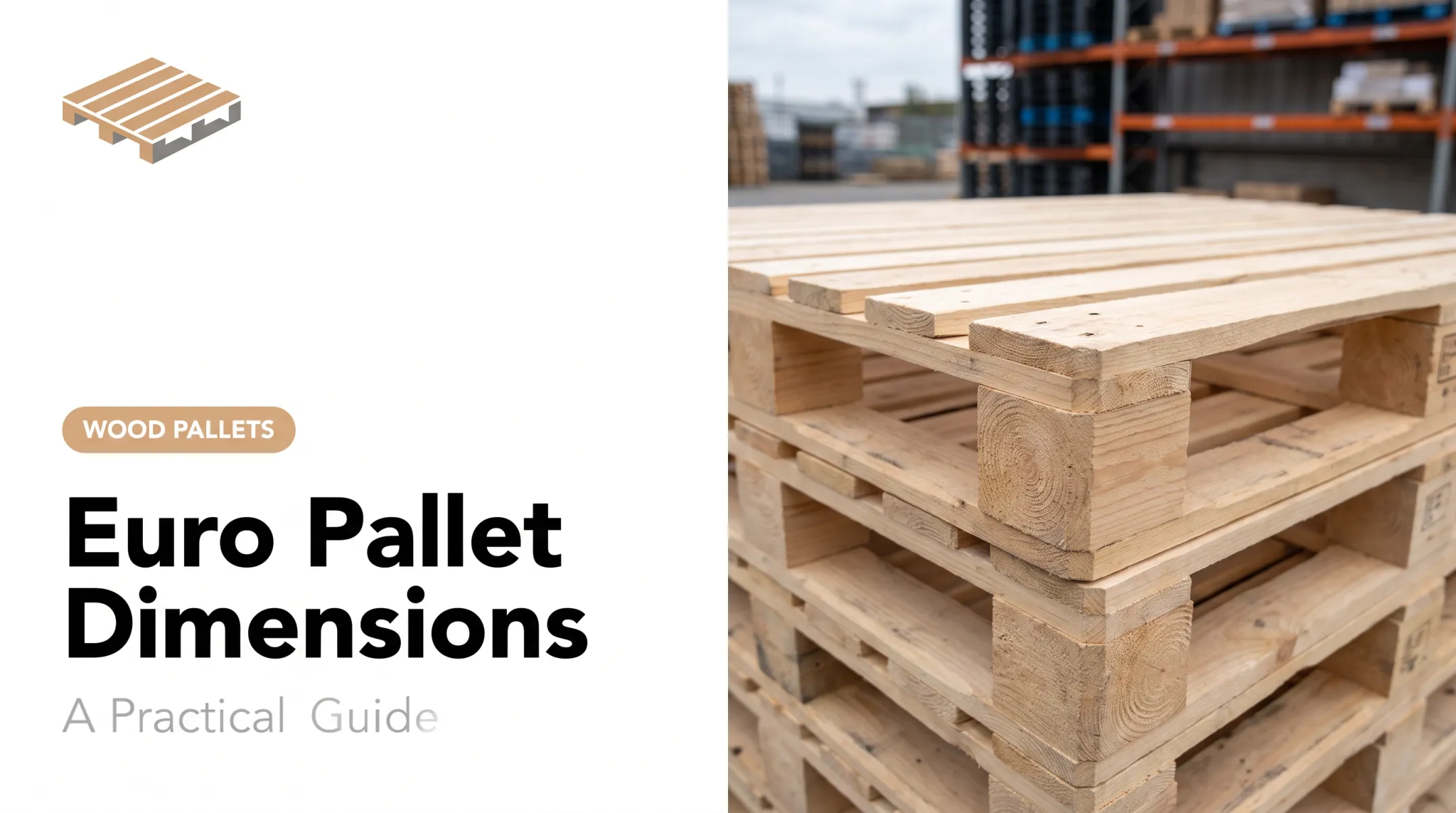
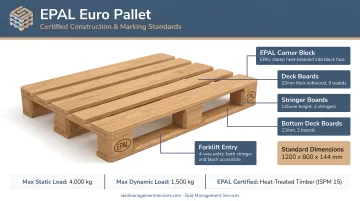
Euro pallets require 11 boards, 9 blocks, and exactly 78 ring or rivet nails in a prescribed pattern. The EPAL product specification sets a safe working load of 1,500 kg and permits stacking of laden pallets up to 5,500 kg on a solid, even surface.
US block pallets have no equivalent mandatory construction standard. Load ratings vary by manufacturer:
- PalletOne's 48" × 40" GMA pallet carries a minimum 2,500 lb capacity
- CHEP's pooled 48" × 40" wood block pallet is designed for 2,800 lb under normal operating conditions
- CHEP pallets are stackable up to five high, provided total weight stays under 10,000 lb
Heat Treatment
Any wood pallet crossing an international border (into the EU, Canada, Australia, or most other major trading partners) must comply with ISPM-15, requiring the wood core to reach 56°C (133°F) for at least 30 continuous minutes. The European Commission explicitly requires ISPM-15 compliance for all wood packaging material from non-EU countries.
Block pallets used purely within US domestic supply chains have no mandatory heat treatment requirement. That changes the moment goods leave US borders.
What Is a Block Pallet?
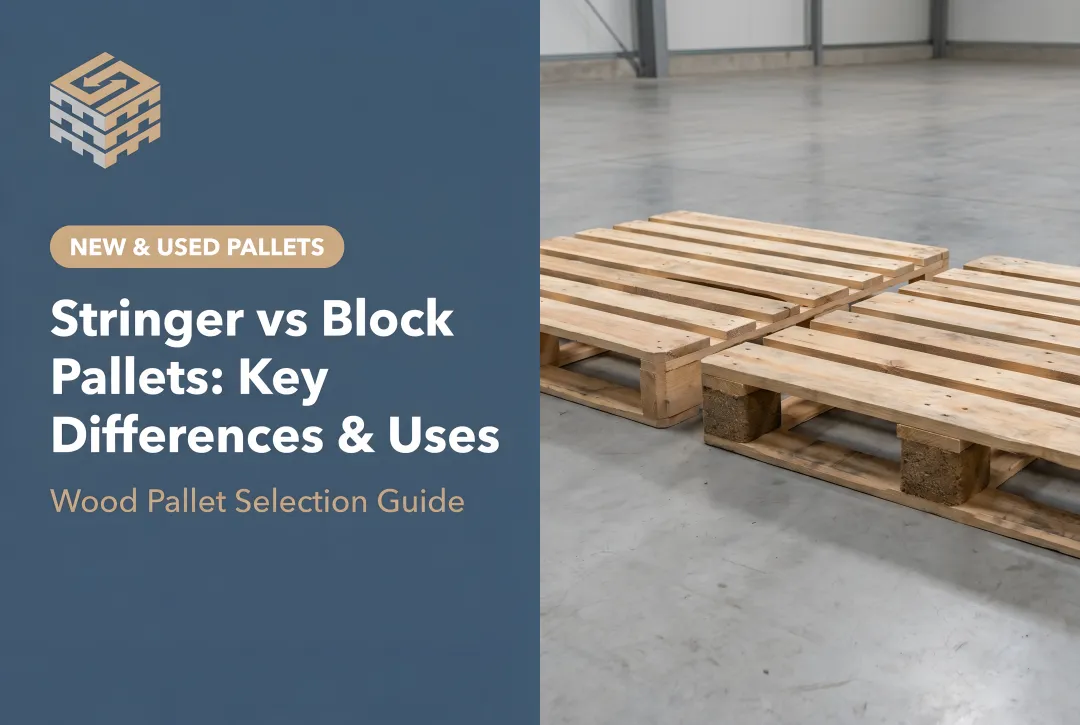
A block pallet gets its name from its support structure: nine wooden blocks — positioned at the corners, center edges, and middle — replace the 2×4 stringers found in stringer-style pallets. That block layout is what enables true four-way entry, meaning forklifts and pallet jacks can approach from any side.
Why Four-Way Entry Matters
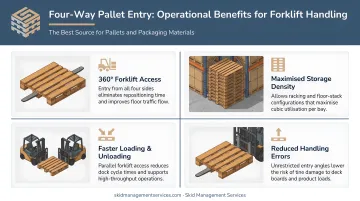
Two-way pallets restrict forklift approach to two sides only, which slows loading cycles in tight aisles and limits flexibility in rack-dense environments. Four-way entry removes that constraint:
- Faster loading and unloading in high-throughput facilities
- Better compatibility with automated handling equipment and conveyor systems
- More orientation flexibility in selective racking
- Reduced handling time per pallet in cross-dock operations
For food and beverage operations running high volumes — the kind Campbell Snacks, Knouse Foods, and similar manufacturers manage — these time savings compound quickly across millions of pallet moves per year.
Common US Block Pallet Sizes
No federal standard dictates US pallet dimensions, but most operations work from a few common sizes:
- 48" × 40" — the dominant size, accounting for approximately 35% of all US pallets in circulation
- 48" × 48" — common in chemicals
- 48" × 45" — used in automotive
- Custom dimensions available for specialized applications
For operations with non-standard requirements, sourcing custom dimensions through a supplier with a broad national network is typically the most reliable path to consistent supply.
Subtypes and Deck Configurations
Block pallets vary beyond just footprint. Deck configuration affects racking and handling compatibility:
- Single-face — deck boards on top only; lighter, lower cost, not reversible
- Double-face — boards on top and bottom; more durable, better for racking
- Solid deck — fully covered top surface; better for small or irregularly shaped loads
- Notched stringerboard — allows partial forklift entry on all four sides
When specifying block pallets for racking or automated systems, communicate your required deck configuration to your supplier before ordering. Mismatched deck specs across a fleet — for example, mixing single-face and double-face pallets in the same racking system — can cause load instability and equipment jams that require operational downtime to resolve.
What Is a Euro Pallet?
A Euro pallet (also called EUR-pallet or EPAL pallet) is a standardized wooden pallet measuring 1,200 × 800 mm, governed by the European Pallet Association (EPAL) and referenced under ISO 6780 for intercontinental materials handling. Its origins trace to 1961, when UIC leaflet 435 series specifications established the standard for European railway logistics. EPAL was founded in 1991 to administer the open exchange pool and quality licensing system.
EPAL Certification Requirements
Every genuine Euro pallet must carry the EPAL logo mark on the corner blocks, along with the producer license number, country code, and production date on the middle block. Customs authorities and receiving logistics teams use these markings to verify compliance.
Goods arriving in Europe on uncertified pallets face real consequences under ISPM-15 enforcement. Per the IPPC's explanatory document, non-compliant wood packaging material may be subject to treatment, disposal, redirection, or outright refusal of entry. For US exporters, that translates to re-palletizing costs at the port of entry — or a rejected shipment.
EPAL Construction Specs
The construction requirements are precise and required for certification:
- 11 boards and 9 blocks per pallet
- 78 ring or rivet nails in a specified pattern (40, 55, 70, or 90 mm lengths with marked heads)
- Board thickness of 22–24 mm, stringerboards up to 25 mm
- Quality timber only (poplar prohibited for stringerboards)
- Safe working load: 1,500 kg; stacking on solid surface: up to 5,500 kg
This consistency is a direct advantage over ungraded block pallets, especially in automated environments where dimensional variation causes misalignments.
The EPAL Open Exchange Pool
With approximately 670 million EPAL Euro pallets in circulation, the open exchange pool means an empty pallet is available at nearly every goods recipient in Europe. Shippers deliver loaded Euro pallets and receive equivalent empties in return, avoiding the one-way abandonment costs that US block pallet users often absorb in export scenarios. For companies running repeated European trade lanes, that difference adds up quickly.
Euro Pallet Size Variants
Beyond the standard EPAL 1 (800 × 1,200 mm), EPAL offers additional formats:
| Variant | Dimensions | Safe Working Load | Notes |
|---|---|---|---|
| EPAL 1 (EUR-1) | 800 × 1,200 × 144 mm | 1,500 kg | Standard Euro pallet |
| EPAL 2 | 1,200 × 1,000 × 162 mm | 1,250 kg | Heavy industrial; chain/roller conveyor compatible |
| EPAL 3 | 1,000 × 1,200 × 144 mm | 1,500 kg | Positioned as Asian standard in EPAL's range |
| EPAL 6 Half | 800 × 600 × 144 mm | 750 kg | Retail/display applications |
The EPAL 2 and EPAL 3 dimensions (1,200 × 1,000 mm range) are closer to the standard US 48" × 40" footprint — useful context for companies bridging US and European operations or evaluating equipment compatibility.
Block Pallet vs Euro Pallet: Which Is Right for Your Operation?
Neither pallet is universally better. The right choice depends on where your goods are going, what your handling systems require, and what compliance obligations you're subject to.
Choose a Standard US Block Pallet When:
- Distribution is primarily domestic US
- You need flexibility on pallet dimensions for different product lines
- EPAL certification is not required by your customer or destination
- Cost-per-pallet is a primary factor in sourcing decisions
- You're working with a supplier that can guarantee dimensional consistency for your automation setup
The absence of a mandatory US construction standard means upfront costs can be lower — but it also means quality varies by manufacturer. Consistent sourcing from a reliable supplier is what closes that gap.
Choose a Euro Pallet When:
- Exporting to Europe or working with European-origin goods
- Your automated storage or racking system is calibrated to 1,200 × 800 mm
- A retailer, distributor, or buyer explicitly requires EPAL certification
- Your goods will be transferred through European distribution networks using the exchange pool
Non-compliance with EPAL requirements goes beyond paperwork. Re-palletizing at destination adds direct cost, and shipment refusal creates supply chain disruption at the worst possible time.
The Heat Treatment Factor
If your block pallets will cross any international border — not just into Europe — ISPM-15 heat treatment is non-negotiable.
Skid Management Services sources ISPM-15 heat-treated export pallets with required certification stamps for pharmaceutical, food, and other exporters shipping through East Coast ports including Philadelphia and Baltimore. For domestic or export-compliant block pallet supply, contact the team at 717-202-0304 or Info@SkidManagementServices.com to request a quote.
Conclusion
Block pallets and Euro pallets serve the same fundamental purpose, but they operate within different regulatory frameworks. Euro pallets are a certified subset of block-construction pallets; a standard US block pallet is not a Euro pallet unless it carries EPAL certification and meets EN specifications.
The right pallet choice comes down to three questions:
- Where are your goods going? Domestic US distribution and European export follow different size and certification standards.
- What does your handling system require? Conveyor compatibility, forklift entry points, and racking specs vary between block and Euro designs.
- What compliance obligations apply? EPAL certification and ISPM-15 heat treatment requirements are non-negotiable for certain markets.
Answer those correctly and the selection is straightforward. Answer them wrong and the costs — re-palletizing fees, shipment rejections, transit delays — hit your supply chain before your product ever reaches its destination.
Frequently Asked Questions
What is the difference between a Euro pallet and a block pallet?
A Euro pallet is a specific EPAL-certified standard with fixed 1,200 × 800 mm dimensions and strict construction requirements (78 nails, prescribed board thickness, certified markings). A block pallet is a broader structural category defined by nine-block construction enabling four-way forklift entry. Euro pallets use block construction, but most block pallets are not Euro pallets.
Are Euro pallets the same as block pallets?
Structurally, Euro pallets qualify as block pallets — both use nine-block support construction. But "block pallet" covers a wide range of non-certified variants, while "Euro pallet" refers exclusively to EPAL-certified pallets meeting European regulatory standards.
Can Euro pallets be used in the US?
Yes, Euro pallets can be physically used in the US and are occasionally sourced domestically for compatibility with European-spec equipment or specific retailer requirements. They are not required for US domestic shipping, however, and typically carry a higher cost than standard US block pallets.
Do block pallets need to be heat treated?
ISPM-15 heat treatment is mandatory for any wood pallet — including block pallets — crossing international borders. Block pallets used entirely within the US have no mandatory heat treatment requirement.
What load capacity does a Euro pallet have compared to a standard US block pallet?
An EPAL-certified Euro pallet is rated for 1,500 kg (~3,307 lb). Standard US block pallets vary by manufacturer — typically ranging from 2,500 to 2,800 lb — with no single mandatory industry-wide rating.
Which pallet type works better in automated warehouse systems?
Euro pallets offer predictable performance in automated storage and retrieval systems due to their fixed dimensions and consistent EPAL construction standards. US block pallets can work in automation too, but dimensional consistency depends on sourcing discipline — variation in quality can cause misalignments and operational issues.