Introduction
Wood pallets move an estimated 80% of all commerce in the United States — they're the foundation beneath virtually every freight shipment, from food manufacturing to retail distribution. Yet a surprising number of shipments arrive damaged, get rejected by carriers, or incur unexpected freight charges because of avoidable pallet mistakes made before the truck even leaves the dock.
This guide walks through how to choose the right wood pallet for your load, what materials to have ready, how to stack and secure correctly, and which mistakes consistently cause damage claims and carrier rejections.
Key Takeaways
- The GMA 48"x40" pallet accounts for roughly one-third of all U.S. pallets and is compatible with most carriers and warehouse systems
- Choose pallet type, size, and grade based on load weight, product type, and destination — international shipments require ISPM 15-certified heat-treated wood
- Stacking method and securing technique — wrap passes, film gauge, banding, corner boards — directly determine whether your load arrives intact
- Most product damage and carrier rejections trace back to three preventable mistakes: damaged pallets, load overhang, and under-wrapping
- Working with a national supplier like Skid Management Services gives you consistent grade quality, competitive pricing, and a broad supplier network to keep stock flowing without interruption
Choosing the Right Wood Pallet for Your Shipment
Not all wood pallets are interchangeable. Construction type, wood species, size, and condition each affect carrier acceptance, load stability, and whether your goods arrive undamaged.
Stringer vs. Block Pallets
The two main pallet designs handle fork entry and weight distribution differently:
- Stringer pallets use 2x4 boards running lengthwise, available in 2-way entry (unnotched) or partial 4-way entry (notched) — the most common and cost-effective option for standard domestic loads
- Block pallets use cylindrical corner and center blocks, always providing full 4-way entry — better weight distribution makes them the stronger choice for heavy loads and automated warehouse environments
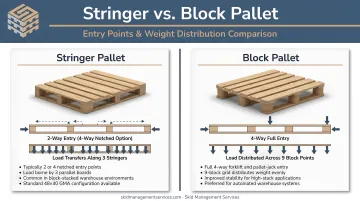
4-way entry matters operationally: forklifts and pallet jacks can approach from any direction, which reduces handling time and dock congestion. For LTL shipments where your pallet shares trailer space and may be repositioned multiple times, 4-way access is a practical advantage.
Wood Type: Hardwood vs. Softwood
| Type | Species | Best For |
|---|---|---|
| Hardwood | Oak, maple | Heavy loads, repeated reuse, demanding environments |
| Softwood | Pine, spruce | Lighter freight, single-use or cost-sensitive applications |
A newly manufactured 48"x40" softwood GMA pallet weighs approximately 40–44 lbs. Hardwood pallets run heavier but handle repeated cycles without degrading as quickly.
Standard Pallet Sizes and When to Use Them
The GMA 48"x40" is the North American standard. According to NWPCA data, it represents about 35% of all U.S. pallets — compatible with the vast majority of warehouse racking systems and freight carriers.
Other common sizes and their applications:
- 42"x42" — telecom equipment, paint industry
- 48"x48" — drums and barrels
- 40"x40" — dairy products
Matching pallet size to your product's footprint eliminates overhang and prevents load instability. Choosing the wrong size doesn't just waste space — it creates real damage risk in transit.
New vs. Used Pallets and ISPM 15 Requirements
New or well-graded pallets are strongly recommended. Carriers and receivers may reject shipments on damaged or structurally compromised pallets, and a broken board under a heavy load creates both a safety hazard and a carrier liability.
ISPM 15 requirements depend on where your shipment is going:
| Shipment Type | ISPM 15 Required? | Key Requirement |
|---|---|---|
| International | Yes | Heat-treated (HT) to 56°C for 30+ continuous minutes; IPPC stamp required showing country code, producer code, and treatment type |
| Domestic U.S. | No | Pallet condition and structural integrity still critical |
Pallets without the IPPC stamp will be stopped at customs — no exceptions.
For shippers who need ISPM 15-compliant pallets, Skid Management Services carries heat-treated inventory with full IPPC certification. This is especially relevant for food manufacturers and export shippers moving product through ports like Philadelphia and Baltimore.
How to Ship Using Wood Pallets: Step-by-Step
Step 1: Inspect and Select Your Pallet
Before loading anything, inspect the pallet physically:
- Check for broken or missing boards, protruding nails, soft spots, or signs of moisture damage
- Look for pest infestation evidence (exit holes, frass, discoloration)
- Confirm the pallet footprint matches your product dimensions
- Verify the pallet's rated load capacity meets or exceeds your total shipment weight including all packaging
Reject any pallet with structural weakness. A compromised pallet under a 2,000-lb load can collapse mid-transit, triggering freight damage claims and product loss.
Step 2: Prepare Your Goods for Loading
Organize and prep before anything goes on the pallet:
- Sort by weight — heaviest items go on the bottom tier, lightest on top
- Wrap or cushion fragile items individually to protect against compression and vibration
- Inspect all cartons and boxes — damaged inner packaging compounds risk during freight handling
- Confirm all boxes are properly sealed before loading
Step 3: Stack Your Load
Two stacking methods are used in freight shipping, each with different strengths:
Column stacking — boxes stacked in straight vertical columns, aligned edge-to-edge. This preserves top-to-bottom compression strength of each carton. Corrugated load protector pads between tiers add stability and distribute weight evenly.
Interlocking stacking — boxes offset like brickwork, improving lateral stability for loads with rigid contents.
Critical rules regardless of method:
- Never use pyramid stacking or allow overhang past the pallet edge
- Research from Cal Poly packaging studies shows pallet overhang can reduce top-to-bottom compression strength by up to 32%
- Keep the load within the pallet footprint on all four sides
- Confirm total height stays within your carrier's limits (FedEx Express Freight, for example, requires prior approval for skids exceeding 70 inches in height)
Step 4: Secure the Load
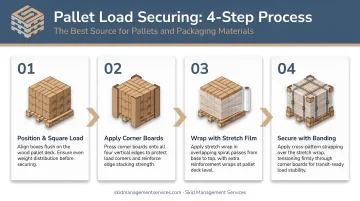
Stretch wrap first, then band if needed:
- Start at the pallet base and work upward — anchor the wrap to the pallet deck so the load and pallet become one unit
- Make a minimum of five full passes using 70-gauge self-adhering stretch wrap, per FedEx freight packaging guidance
- For heavy or tall loads, apply banding straps horizontally — loop through pallet fork openings, not side access notches
- Install corner/angle boards running the full height of the load before banding to protect box edges and maintain vertical compression strength
For single items over 1,500 lbs, FedEx guidelines specify hardwood pallets with wood blocking and bracing material, using at least two fasteners per brace to prevent lateral shift and pivoting.
A note on containment force: This is the inward pressure stretch wrap exerts on your load. Getting it wrong in either direction causes problems:
- Too little wrap tension and boxes shift during braking and cornering
- Too much tension without corner boards crushes box edges and destroys the compression strength you built into your stack
Corner boards and proper wrap tension solve different parts of the same problem — skip either one and you're exposed.
Step 5: Label and Schedule Pickup
- Place shipping labels on at least two visible sides of the pallet
- Include sender and receiver names, addresses, zip codes, and any handling instructions ("Fragile," "This Side Up," "Do Not Stack")
- Generate a Bill of Lading (BOL) with accurate weight, pallet count, dimensions, and freight class — inaccurate BOL information is a consistent source of billing adjustments and delivery delays
- Choose the right carrier service:
- LTL (Less-than-Truckload): For smaller shipments where you're sharing trailer space
- FTL (Full Truckload): For larger loads filling a trailer — a standard 53-foot dry van holds 26–30 standard 48"x40" pallets
Key Factors That Affect Pallet Shipping Results
Load Weight and Pallet Capacity
A standard GMA 48"x40" wood pallet has a maximum safe load of approximately 4,600 lbs, with GMA guidance setting a minimum load-bearing capacity of 2,500 lbs. Exceeding capacity risks structural failure mid-transit. Overloaded pallets are also more likely to be flagged or rejected by carriers before they ever leave the dock.
Pallet Size Relative to Load Footprint
Load overhang — product extending past the pallet edge — does more damage than most shippers expect. Beyond the 32% compression strength reduction documented in packaging research, overhanging product is vulnerable to forklift blade damage during loading and unloading. Match pallet size to product footprint before the first box goes down.
Securing Method and Containment Force
Under-wrapped loads allow boxes to shift during hard braking and cornering. Banding applied without corner boards crushes box edges and reduces the compression strength of your carton stack. Follow this sequence for consistent containment:
- Use minimum 70-gauge stretch wrap
- Apply corner boards before banding
- Anchor wrap to the pallet base — a load that's only wrapped above the deck can slide off the pallet entirely
Common Mistakes When Shipping on Wood Pallets
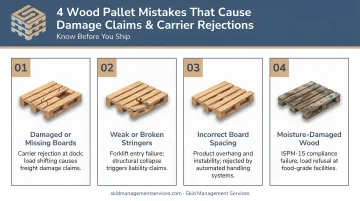
Most pallet failures trace back to the same small set of errors:
Using damaged or substandard pallets — Cracked, repaired, or pest-compromised pallets can be refused at pickup and create liability if they fail under load. Sourcing new or properly graded pallets from a consistent supplier reduces carrier refusals and liability exposure.
Allowing load overhang or inboard gaps — Products extending past pallet edges are vulnerable to forklift damage and lose compression integrity. Products loaded too far inboard create lateral instability. The load should sit flush with all four pallet edges.
Insufficient or improper wrapping — Fewer than five wrap passes, failure to anchor to the pallet base, or using lightweight wrap all result in load shift. Wrap gauge matters: 70-gauge is the minimum for freight.
Incomplete or incorrect labeling — Labels on only one side, missing BOL details, or illegible handling instructions cause misrouted freight, delivery delays, and billing disputes. Labels on two sides is the minimum standard for most carriers.
Frequently Asked Questions
What is the average cost to ship a pallet?
LTL pallet shipping costs vary based on weight, dimensions, freight class, and origin/destination lane. Published rate estimates range widely — get current quotes directly from carriers or a freight broker for accurate pricing on your specific lane and load profile.
Can I ship a pallet via FedEx?
FedEx Freight handles LTL pallet shipments for standard ground freight. FedEx Express Freight covers air freight skids for time-sensitive loads, with individual skids of 151 lbs or more eligible, subject to size and weight limits.
How much does a 24"x24" custom pallet weigh?
The 24"x24" size is a custom, non-standard pallet dimension — it is not one of the US standard pallet sizes (48x40 GMA, 48x48, 42x42, or 48x42). A 24"x24" custom wood pallet is significantly smaller than the standard GMA pallet and typically weighs between 15–25 lbs depending on wood species and construction. Because this is a non-standard size, it must be custom-built to order rather than sourced from standard pallet inventory.
What is the standard size for a wood shipping pallet?
The GMA 48"x40" is the U.S. standard, representing roughly one-third of all pallets in circulation. It's compatible with the majority of warehouse racking systems and freight carriers, with a maximum safe load of approximately 4,600 lbs.
What is ISPM 15 and does it apply to domestic pallet shipments?
ISPM 15 is an international phytosanitary standard requiring wood pallets in cross-border trade to be heat-treated and stamped with the IPPC mark. It is not required for domestic U.S.-only shipments. Skid Management Services stocks ISPM 15-certified pallets for export shippers.
How many pallets fit in a standard freight truck?
A standard 53-foot dry van trailer holds 26–30 standard 48"x40" pallets single-stacked, according to industry trucking sources.