The short answer is yes — but outdoor storage isn't a passive decision you make once and forget. Heat treatment certifies pallets at a specific point in time. It does not weatherproof the wood, and according to IPPC/FAO ISPM-15, it is not intended to provide ongoing protection from contaminating pests after treatment.
This guide covers the direct answer, the four specific risks outdoor storage creates for HT pallets, best practices for mitigating those risks, and an inspection schedule to maintain compliance over time.
Key Takeaways
- Outdoor storage is acceptable if you maintain elevation, breathable covers, drainage, pest control, and mark monitoring
- The biggest risk isn't physical weathering; it's losing ISPM-15 mark legibility or allowing pest re-infestation
- A faded or unreadable ISPM-15 stamp has the same customs consequence as no stamp at all
- Inspect marks before every shipment, check for moisture and pests weekly, and rotate stock monthly using FIFO
- Sourcing properly certified, clearly stamped pallets from a reliable supplier reduces downstream compliance risk
Can Heat-Treated Pallets Be Stored Outside?
Yes — outdoor storage is widely practiced and entirely permitted. The important clarification is what heat treatment actually does, and what it doesn't.
What ISPM-15 Heat Treatment Actually Certifies
Under ISPM-15 standards, heat treatment requires wood to reach a minimum core temperature of 56°C (132.8°F) for at least 30 continuous minutes throughout the entire wood profile. This eliminates quarantine pests present in the wood at the time of treatment.
That's a point-in-time certification. Once pallets leave the treatment facility, the ISPM-15 mark confirms what happened during treatment — it says nothing about conditions since.
Two Distinct Storage Concerns
Outdoor storage creates two separate categories of risk, and they don't move at the same speed:
| Risk Category | How Quickly It Develops | Primary Concern |
|---|---|---|
| Physical/structural weathering | Slowly — months of exposure | Load-bearing capacity, board integrity |
| Compliance status | Faster — weeks in harsh conditions | Mark legibility, pest re-infestation |
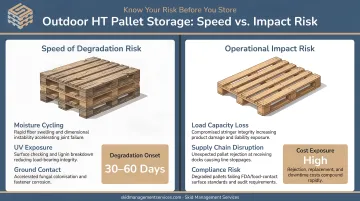
Structural degradation from normal weathering is gradual. Compliance loss can happen faster — a few weeks of direct rain on poorly stored stacks can fade a stamp enough to trigger customs rejection.
When Outdoor Storage Is Most and Least Risky
Lower risk situations:
- Short-term staging (days to a few weeks)
- Low-humidity climates with infrequent rain
- Facilities with concrete hardstanding and good drainage
Higher risk situations:
- Long storage cycles lasting several months
- High humidity or frequent rain exposure
- Bare-earth storage areas
- Pallets stored near vegetation or untreated wood
Starting with properly certified stock matters. Skid Management Services stamps and documents ISPM-15 compliance at the point of supply, so your pallets are fully certified before outdoor conditions have a chance to affect them.
What Outdoor Storage Does to Heat-Treated Pallets
Outdoor exposure introduces four primary risk categories. Knowing what each one means in practice helps you avoid customs complications and product losses.
Moisture, Mold, and Wood Degradation
Heat treatment reduces moisture content but does not seal the wood. Wood is hygroscopic — it absorbs and releases moisture based on surrounding humidity and temperature. Rain and high ambient humidity can raise moisture content in outdoor-stored pallets after treatment.
The threshold matters here. USDA Forest Products Laboratory research indicates mold can develop when surface equilibrium relative humidity exceeds roughly 80%, corresponding to approximately 16% moisture content at room temperature. Wood decay typically occurs above 30% moisture content.
In stacked pallets with restricted airflow, moisture trapped between boards accelerates both mold growth and surface discoloration. Neither is immediately structural — but visible mold is a red flag for buyers and signals degraded storage conditions.
Pest Re-Infestation Risk
Heat treatment eliminates pests present in the wood at the time of treatment. It creates no chemical barrier against future infestation. Outdoor storage reintroduces exposure to insects common in most environments, including:
- Wood-boring beetles and powderpost beetles
- Subterranean termites (active in soil-contact situations, per University of Maryland Extension)
- Other boring insects common to outdoor wood storage
If a customs inspector finds live insects or fresh bore holes in an HT-stamped pallet, the shipment can be held or rejected regardless of the original certification. Elevated storage reduces soil-contact risk but does not eliminate it entirely.
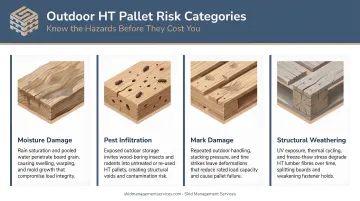
ISPM-15 Mark Damage
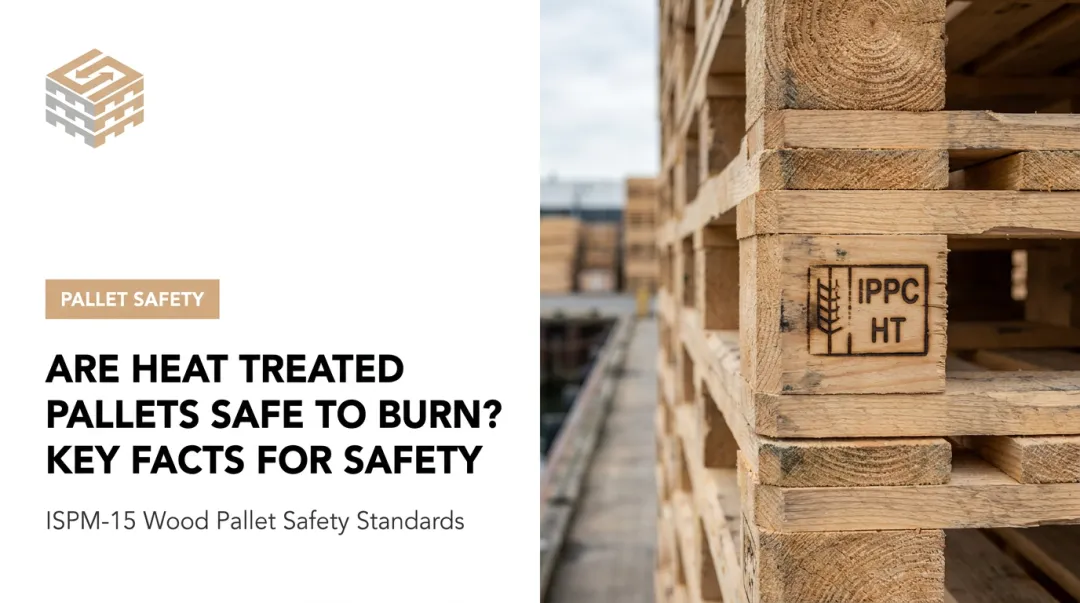
The ISPM-15 mark must remain visible, legible, durable, and non-transferable — this is an explicit requirement under ISPM-15 Annex 2, and it's echoed by USDA APHIS, the EU Food Safety authority, and CFIA for Canada-U.S. shipments.
Several outdoor weathering processes affect the surface where the stamp sits:
- UV radiation chemically degrades wood surfaces
- Rain leaches degraded material away from the mark
- Repeated wetting and drying causes checking and splitting
A partially faded or physically chipped mark carries the same customs risk as no mark at all.
Structural Weathering
Physical weathering, surface darkening, minor checking, light warping, does not typically affect load-bearing capacity over short outdoor storage periods. The concern to monitor is more specific: cracked stringers, loose or protruding fasteners, or board separation that affects how pallets interact with forklifts and racking systems.
Best Practices for Storing Heat-Treated Pallets Outside
These five practices cover the key risks of outdoor HT pallet storage — moisture, pests, mark integrity, and compliance separation.
Elevate Pallets Off the Ground
Keep HT pallets off bare earth using slave pallets, timber bearers, or concrete hardstanding. Ground contact does two things: it accelerates moisture absorption from soil, and it provides direct access for subterranean insects.
Penn State Extension guidance on wood storage recommends keeping stacked wood elevated and loosely stacked to promote airflow. The same principle applies to pallet storage. Even a few inches of clearance makes a measurable difference.
Use Breathable Covers — Not Plastic Sheeting
This is one of the most common outdoor storage mistakes. Plastic tarps shed rain effectively, but they trap moisture underneath, creating a warm, humid micro-environment directly against the wood surface. Mold thrives in exactly those conditions.
Breathable woven covers (woven polypropylene or purpose-made pallet covers) shed precipitation from the top while allowing condensation to escape from the sides. Skid Management Services carries pallet covers as part of our packaging product line. Call 717-202-0304 to confirm the right specifications for your outdoor storage setup.
Maintain Stack Spacing and Orientation
Proper stacking protects both wood condition and mark accessibility:
- Keep stacks on firm, level ground to prevent lean or collapse
- Maintain at least one meter of clearance around each stack for airflow and inspection access
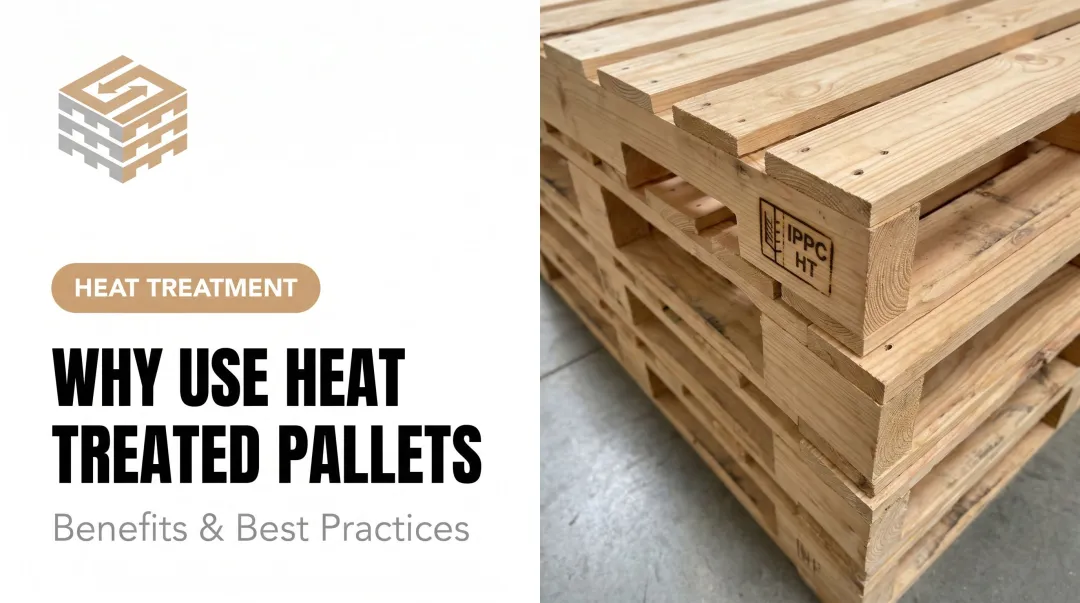
- Ensure ISPM-15 marks always face outward and remain unobstructed; a buried mark can't be verified without dismantling the stack
- Follow applicable fire code guidelines for stack height in your jurisdiction (NFPA 13 addresses idle pallet storage in fire-protection design contexts)
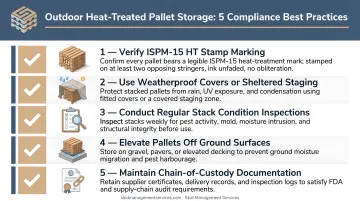
Apply Pest Control Around the Storage Perimeter
Remove vegetation from the buffer zone around outdoor storage areas. Plant material retains moisture and provides shelter for wood-boring insects. Maintain bait stations or perimeter treatments appropriate for your facility type. Keep the area free of debris, waste wood, or other material that attracts rodents or insects.
Separate HT Pallets from Untreated Stock
HT-certified pallets must be stored in clearly designated zones, physically separated from non-treated stock. Commingling creates dispatch errors: the wrong pallet in an export shipment triggers a compliance failure that has nothing to do with the original treatment quality. Use signage, color-coded markers, or physical barriers to make the separation unambiguous.
How to Inspect and Monitor Outdoor-Stored HT Pallets
Regular inspection is what keeps outdoor storage compliant over time. The frequency should scale with weather intensity, storage volume, and how close pallets are to their dispatch date.
What to Check on Every Inspection
- ISPM-15 mark — confirm it's clearly readable, not faded, chipped, or obscured by dirt or cover contact
- Moisture and mold — check deck boards and stringers for discoloration, soft spots, or visible fungal growth
- Pest signs — look for fresh bore holes, frass (fine sawdust), or visible insects under deck boards
- Structural condition — check for cracked stringers, loose boards, or protruding fasteners
- Stack stability — confirm no lean or displacement after wind or rain events
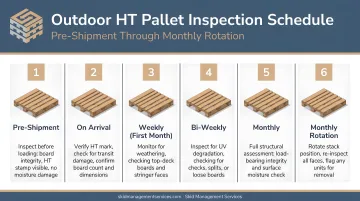
Recommended Inspection Schedule
| Frequency | What to Do |
|---|---|
| Before each shipment | Verify ISPM-15 mark is legible on all pallets being dispatched; check for obvious damage or pest signs |
| After rain or weather events | Check drainage, cover integrity, stack stability, and moisture signs on exposed boards |
| Weekly | Full moisture and mold check, pest-control station review, document findings |
| Monthly | Rotate older stock to front (FIFO), assess cover wear, review traceability records for long-held batches |
Record Keeping for Compliance Audits
That schedule only works if findings are recorded. Logs of inspection dates, results, and corrective actions give you a traceable paper trail if pallets are questioned at customs. For food, pharma, or high-value export operations, photographing ISPM-15 marks upon receipt is best practice — this documents the mark's condition at the start of your storage period, before weathering or handling can affect it.
USDA APHIS guidance specifically advises importers to include ISPM-15 compliance in contracts and require exporters to inspect WPM for pest signs before use. Your own records support exactly that chain of accountability.
Skid Management Services provides stamped and documented ISPM-15 certification with every heat-treated pallet order. That supplier documentation is your starting record: keep it with your inspection logs as the baseline for any customs inquiry.
Conclusion
Heat-treated pallets can be stored outside without losing compliance — but only if you treat outdoor storage as an ongoing management task. Elevation, breathable covers, drainage, pest perimeter control, mark-facing orientation, and regular inspection are not optional extras. Skip any one of them consistently and you risk losing certification status on stock that was compliant when it arrived.
The operational investment is modest. A single customs hold or rejected shipment will cost far more than the practices that prevent it.
Frequently Asked Questions
Can heat-treated pallets be stored outside?
Yes, outdoor storage is acceptable when pallets are elevated off the ground, covered with breathable materials, kept in a pest-controlled area, and inspected regularly. The key requirement is that the ISPM-15 mark remains legible throughout the storage period — compliance depends on it.
How long can heat-treated pallets be stored outside?
There is no fixed time limit, but extended outdoor storage raises cumulative risk to mark integrity, moisture content, and pest exposure. Rotate stock using FIFO practices and review any batch stored outside for more than a month before use.
Does rain or moisture affect ISPM-15 compliance on heat-treated pallets?
Rain doesn't invalidate the original heat treatment, but moisture can cause mold growth and fade the ISPM-15 stamp. A pallet with an unreadable stamp is treated as non-compliant at customs regardless of its treatment history.
Can insects re-infest heat-treated pallets stored outside?
Yes. Heat treatment eliminates pests present at the time of treatment but provides no ongoing chemical barrier against new infestation. A vegetation-free perimeter and regular pest checks are essential for any pallets stored outdoors.
Do heat-treated pallets need to be stored separately from untreated pallets?
Yes — always store HT pallets in clearly marked, dedicated zones. Mixing them with untreated stock creates dispatch errors, compliance risk, and traceability problems during customs audits.
What type of cover should be used for outdoor heat-treated pallet storage?
Use breathable woven covers, not plastic sheeting. Plastic traps moisture underneath stacks, creating the moisture buildup that promotes mold and degrades the stamp. Breathable covers shed rain while allowing condensation to escape from the sides.