This guide covers wholesale wood pallets used for shipping, warehousing, and distribution (not liquidation merchandise pallets). It answers one practical question: is committing to wholesale purchasing the right move for your business in 2026?
You'll find a breakdown of pallet types, honest 2026 pricing context, a straightforward pros/cons analysis, and what to look for before signing any supplier agreement.
Key Takeaways
- Wholesale pallets deliver real savings for businesses with consistent, moderate-to-high pallet volume.
- New pallets cost more upfront; reconditioned pallets offer a lower entry price with some trade-offs in uniformity.
- First-time wholesale buyers most often underestimate freight costs and minimum order quantities.
- Supply continuity matters as much as unit price — gaps during peak demand can erase per-pallet savings fast.
What Are Wholesale Pallets?
Wholesale pallets are wood pallets purchased in bulk directly from a supplier or distribution network at volume-based pricing — lower per-unit cost as order quantity increases. The concept is straightforward; the decisions around type, grade, and specification are where buyers lose money.
Pallet Types You'll Encounter
Three categories make up the majority of wholesale pallet transactions:
| Type | Best For | Key Consideration |
|---|---|---|
| New/Virgin | Food production, pharma, automated warehouses | Consistent dimensions, highest load ratings |
| Reconditioned/Repaired | General distribution, non-regulated freight | Lower cost, inspect grade definitions carefully |
| Heat-Treated (ISPM-15) | International export, regulated industries | Required for customs compliance in most countries |
The 48x40 GMA pallet is the dominant format in U.S. supply chains. According to Modern Materials Handling's 2025 Pallet Report, 92% of operations use wood pallets and 72% use 48x40 as their primary size. Most wholesale pricing conversations start and end with this format.
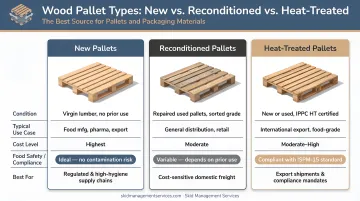
Custom dimensions are available but priced separately — expect longer lead times and minimum order requirements that differ from standard stock.
A note on terminology: "Reconditioned" is a market term, not a formal industry classification. The NWPCA Uniform Standard defines repaired and remanufactured pallets with specific criteria. When evaluating reconditioned pallets, ask suppliers for the grade and repair standard they're applying — not just a label.
What Wholesale Pallets Actually Cost in 2026
Wholesale pallet pricing shifts based on region, volume, grade, and supplier relationship — no single published rate covers the market. Trade publications like Pallet Profile Weekly track pricing across North America for current benchmarks.
The BLS Producer Price Index for Wood Pallets and Pallet Containers reached 346.876 in April 2026, up from 186.306 in December 2025. That kind of movement makes a locked supplier agreement more than just convenient — it's a buffer against unpredictable cost swings.
Volume and Freight: The Two Real Cost Variables
Volume drives unit cost. Freight determines whether those savings are real or just theoretical.
Volume tiers — general market pattern:
- Small bundles: highest per-unit cost
- Half truckload: moderate savings over spot
- Full truckload: best per-unit economics — a 53-foot dry van holds 26–30 standard 48x40 pallets depending on loading orientation
Freight economics to understand:
- LTL (less-than-truckload) is generally suited to shipments of 1–10 pallets — efficient for small orders, but the per-pallet freight cost is high relative to the product
- Orders exceeding 12–15 pallets start to justify partial or full truckload, where freight cost spreads more favorably across the load
- The practical threshold: if you're ordering enough to approach a full truckload, you're in territory where wholesale economics work in your favor
Hidden Costs Buyers Miss
Before committing to wholesale volume, factor in:
- Safety stock carrying costs — bulk buying requires storage space with real square footage costs
- Lead time buffer — you need inventory on hand before you run out, not when you run out
- Damaged pallet disposal — broken pallets need a plan, whether that's recycling, repair, or disposal fees
- Cash flow timing — larger upfront orders require capital that smaller spot purchases do not
These costs don't eliminate the case for wholesale buying — but they do affect where your break-even point actually sits. Factor them in before committing to volume.
Are Wholesale Pallets Worth It? The Honest Pros and Cons
The Case For Wholesale
- Price predictability — you know your cost per unit going into budget season, not after a supplier sends a new quote
- Supply reliability — you're not competing with other buyers during peak demand
- Negotiating leverage — committed volume gives you standing to negotiate pricing, lead times, and service terms
- Operational continuity — no scrambling for pallets in October when every food and beverage producer is running at capacity
The supply continuity argument is backed by recent history. Supply Chain Dive reported in 2021 that pallet costs surged 400% amid a shortage driven by lumber prices, demand spikes, and trucking constraints. Businesses without committed supplier relationships absorbed that shock directly. Those with established wholesale arrangements had far more insulation.
The Case Against (Or: When It's the Wrong Fit)
Wholesale requires trade-offs that don't suit every operation:
- Minimum order quantities — most wholesale pricing kicks in at truckload or half-truckload volumes; smaller operations may not hit that threshold economically
- Storage commitment — you need floor space dedicated to pallet inventory
- Cash flow planning — bulk purchasing ties up capital that smaller businesses may not have available
- Limited flexibility — if your pallet size requirements shift frequently, committing to a single spec can create problems
A Simple Cost Comparison
Consider a distribution operation using 500 pallets per month. The cost difference between spot and wholesale breaks into two categories:
| Cost Factor | Spot Market | Wholesale |
|---|---|---|
| Unit price | Higher; fluctuates with demand | Lower; locked at negotiated volume tier |
| Price predictability | Variable — hard to budget | Fixed — known going into each quarter |
| Supply availability | Competitive during peak seasons | Committed; not subject to open-market demand |
| Operational risk | High — shortages trigger production delays | Low — established supply absorbs demand spikes |
| Emergency sourcing costs | Frequent; often expensive | Rare; supplier relationship reduces exposure |
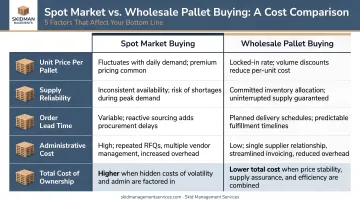
The visible price difference per unit matters. But for most operations running consistent volume, the hidden costs — production delays, missed shipments, rush sourcing fees — typically outweigh it. Wholesale is as much a risk management decision as a pricing one.
When Buying Wholesale Makes Sense (And When It Doesn't)
Business Profiles That Benefit Most
Wholesale pallet buying works best for operations with predictable, recurring demand:
- Food and beverage manufacturers (consistent production schedules, regulatory requirements for pallet quality)
- Consumer goods distributors with steady outbound shipments
- E-commerce fulfillment centers with defined weekly pallet throughput
- Manufacturing operations that load and ship on a regular cadence
The volume threshold where wholesale becomes clearly advantageous aligns roughly with full truckload economics — if you're moving enough product to justify truckload freight, you're likely moving enough pallets to benefit from wholesale pricing.
When Wholesale May Not Be the Right Fit
- Seasonal-only operations where storage costs during off-peak months offset per-unit savings
- Highly variable size requirements where committing to a standard spec creates downstream problems
- Early-stage businesses without the cash flow to commit to minimum quantities upfront
Understanding where wholesale falls short helps clarify which procurement model fits your operation. Here's how the three main options stack up.
Buy vs. Rent vs. Lease: A Quick Comparison
| Model | Key Advantage | Key Limitation |
|---|---|---|
| Buy wholesale | Full cost control; best for one-way shipping | Requires storage and upfront capital |
| Rent (pooling: CHEP, PECO) | No ownership burden; suits closed-loop supply chains | Ongoing rental fees; billing tied to usage/program rules |
| Lease | Defined period, flexible exit | Less common; terms vary widely by provider |
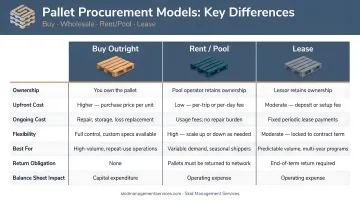
The rental model works well when pallets circulate back through a closed supply chain. If your pallets ship out and don't return, buying is the better economic choice — you're paying ongoing fees for an asset you'll never see again.
How to Choose a Wholesale Pallet Supplier in 2026
Price matters, but supply reliability determines whether a supplier relationship actually holds up under pressure.
Supply Network Depth
A supplier who can fulfill 500 pallets in a normal month but can't deliver during a lumber shortage or peak shipping season creates disruptions worth far more than any per-unit savings. Look for suppliers with regional or national sourcing networks — not single-facility operations that carry concentrated supply risk.
Skid Management Services operates from both its own inventory and a national network of pallet and packaging suppliers, which keeps supply moving when regional markets tighten. Their customer base includes Campbell Snacks, Knouse Foods, Nissin, and Stauffer's — brands that depend on consistent, high-volume pallet supply to keep production lines running.
Quality and Grading Standards
Pallet variability causes real problems in automated warehouses and on shipping docks. Inconsistent dimensions or load ratings create rework, damage, and liability.
When evaluating a supplier's quality standards, ask:
- What grade designation applies to these pallets, and what specific repair limits does that grade allow?
- Are grading standards anchored to NWPCA Uniform Standards, or are they informal labels?
- For ISPM-15 compliance: can you provide documentation confirming treatment to 56°C for 30 continuous minutes?
Pricing Transparency
Three questions worth asking any supplier when reviewing a pricing proposal:
- What drives price changes between now and my next order — is pricing fixed for a period, or does it float with the lumber index?
- What fees exist beyond the per-unit price — delivery surcharges, fuel adjustments, damaged pallet handling?
- What volume threshold unlocks your best per-unit rate — and what happens to pricing if my volume drops below that level?
Product Range and Single-Source Advantages
Businesses with specific needs — heat-treated pallets for export, custom dimensions, or particular grade requirements — should verify a supplier's actual capacity to deliver consistently, not just occasionally.
Consolidating pallet and packaging supply through a single national vendor reduces administrative overhead, simplifies accounts payable, and often produces better rates across both categories. Skid Management Services supplies pallets alongside stretch film, strapping, corner boards, and poly bags — a practical option for operations looking to cut the number of vendor relationships they manage.
Frequently Asked Questions
How much is a 48x40 pallet worth?
Pricing varies by grade, volume, and region. New 48x40 GMA pallets cost more than reconditioned equivalents, and full truckload orders carry meaningfully lower per-unit costs than small bundles. For current 2026 pricing, contact suppliers directly — published benchmarks lag market conditions.
What is the difference between new and reconditioned wholesale pallets?
New pallets offer consistent dimensions and verified load ratings from the outset. Reconditioned pallets are used pallets that have been repaired or remanufactured — sold at a lower price point, but with more variability in condition depending on grade. New pallets suit automated facilities and regulated industries; reconditioned options work for general distribution when grade is clearly specified upfront.
How many pallets do I need to order to get wholesale pricing?
Minimum quantities vary by supplier, but wholesale pricing typically applies at half-truckload or full truckload volumes. Ask suppliers directly about their volume tiers — the threshold where best pricing unlocks is not standardized across the industry.
Is it better to buy or rent pallets for my business?
Buying wholesale makes more sense for one-way shipping operations where pallets don't return. Closed-loop supply chains — where pallets consistently circulate back to origin — are the primary scenario where pooling arrangements compete with ownership on cost.
Do I need heat-treated pallets for my shipments?
ISPM-15 heat-treated pallets are required for international export under regulations administered by USDA APHIS. Some regulated industries — food, pharmaceutical — also require HT pallets for domestic compliance. Confirm your specific requirements before ordering.
How do I avoid supply disruptions when buying wholesale pallets?
Work with suppliers who have broad regional or national sourcing networks rather than single-facility operations. Maintain a safety stock buffer. Establish the relationship before you need it urgently — suppliers prioritize customers with existing agreements during shortage periods.