Introduction
Improperly secured pallets cause a staggering amount of freight damage. TT Club reports that two-thirds of cargo damage claims are caused or exacerbated by poor packing practices, with inadequate cargo securing and poor weight distribution listed among the primary culprits.
For warehouse managers, shipping coordinators, and procurement teams handling palletized freight, the fallout is concrete: damaged product, rejected shipments, freight claims, and compliance liability under DOT and FMCSA cargo securement regulations (49 CFR Part 393).
The terms "blocking" and "bracing" get used interchangeably — and incorrectly. They're related but functionally different, and applying one without the other leaves a load exposed to a specific class of transit forces.
This guide covers:
- What blocking and bracing mean, and how they differ
- Why proper securement matters across all shipping modes
- How to execute the process step by step
- Which materials to use and when
- Where most teams get it wrong
Key Takeaways
- Blocking prevents lateral and longitudinal movement; bracing resists vertical shift and structural force — neither substitutes for the other
- Start with a load plan: assess pallet arrangement, identify gap types, and match materials to each gap before anything is placed
- Key materials: dimensional lumber, dunnage air bags, void fill panels, straps, stretch wrap, and friction mats
- FMCSA regulations under 49 CFR Part 393, Subpart I require all highway cargo to remain secured within the transporting vehicle
- The most common failures: unanchored lumber blocking, stretch wrap used as the sole securement method, and mismatched dunnage air bag sizing
What Is Blocking and Bracing for Pallets?
How Blocking Controls Lateral Load Movement
Blocking is the placement of physical materials — dimensional lumber, corrugated panels, void fillers — against or around a palletized load to prevent lateral (side-to-side) and longitudinal (front-to-back) movement. The blocking element acts as a barrier, transferring force to the container floor or walls instead of allowing the pallet to travel.
How Bracing Prevents Tipping and Collapse
Bracing introduces structural resistance above or within the load to prevent vertical movement, tipping, or collapse. Braces are fixed elements — diagonal lumber, tensioned straps, dunnage panels — that absorb and redirect energy when the load encounters vertical or rotational forces during transit.
How They Differ from Strapping and Stretch Wrap
Strapping and stretch wrap are unitization tools: they bind the pallet stack together and supplement securement. They are not structural barriers. A stretch-wrapped pallet on a smooth trailer floor will still slide under braking force — the wrap keeps the cartons on the pallet, but nothing keeps the pallet in place.
Blocking and bracing are the foundational load control elements. Strapping, stretch wrap, and edge protection all contribute — but none of them substitute for a properly blocked and braced load.
Why Blocking and Bracing Pallets Matters in Freight
The Physical Forces at Work
Palletized freight faces a combination of forces across every shipping mode:
- Forward surge during hard braking — the most common and highest-magnitude force in highway transport
- Lateral roll on road curves and rail switching
- Vertical heave on uneven road or rail surfaces
- Rotational forces during intermodal transfers and loading operations
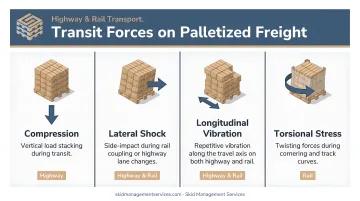
A heavy pallet on a smooth trailer floor will shift once momentum builds. Weight alone does not prevent movement; friction and structural barriers do.
Under 49 CFR 393.102, FMCSA requires highway cargo securement systems to withstand 0.8 g forward deceleration, 0.5 g rearward acceleration, and 0.5 g lateral acceleration, applied separately. Stretch wrap alone cannot satisfy those thresholds.
Regulatory Requirements
49 CFR Part 393, Subpart I — "Protection Against Shifting and Falling Cargo" — applies to all commercial motor vehicles on public highways. Specific obligations include:
- 49 CFR 393.100: Cargo must be immobilized or secured to prevent shifting that adversely affects vehicle stability or maneuverability
- 49 CFR 393.106(b): Cargo must be firmly immobilized using structures of adequate strength, dunnage or dunnage bags, shoring bars, tiedowns, or a combination
Additional rules apply by cargo type:
- Hazardous materials: 49 CFR 177.834(a) requires packages to be secured against shifting under all transport conditions
- Food-grade cargo: 21 CFR 1.906 and 1.908 require vehicles to be maintained so food does not become unsafe during transportation
- Heavy equipment ≥ 10,000 lb: 49 CFR 393.130 requires a minimum of four tiedowns
These regulations place responsibility on shippers before departure. That liability doesn't transfer to the carrier if the shipper configured the load improperly at origin.
Operational Consequences
Beyond regulatory exposure, inadequate blocking and bracing creates direct operational costs:
- Product damage and inventory loss
- Load collapse risk to warehouse and transport workers
- Delays from in-transit re-securing
- Rejected shipments at destination
- Freight claim costs and insurance rate impacts
How to Block and Brace Pallets: A Step-by-Step Process
Effective blocking and bracing starts before any material is placed. A load plan should cover:
- Pallet arrangement and orientation
- All gap locations and their dimensions
- Materials specified for each gap type
- Confirmed weight distribution across the floor plan
Improvising at the dock without a plan is the root cause of most failures.
Step 1: Position and Stage the Pallet Load
- Place heaviest pallets low and centered across the floor plan
- Align pallet faces flush wherever possible to minimize gap formation
- For multi-layer loads, use cross-tier stacking — rotate pallet orientation 90° between layers to interlock the stack
- Inspect every pallet for structural soundness before loading; a cracked stringer or broken deck board cannot support the anchoring process reliably
Step 2: Apply Blocking Materials to Fill Identified Gaps
Gap location determines material selection:
| Gap Type | Location | Recommended Material |
|---|---|---|
| Longitudinal end wall gap | Front/rear of load | Dunnage air bags, lumber blocking |
| Lateral gap between pallets | Side-to-side | Void fill panels, corrugated honeycomb |
| Lateral gap to side wall | Pallet to trailer wall | Lumber blocking, void fill |
| Vertical gap in partial load | Top surface | Drop-down void fillers, bracing lumber |
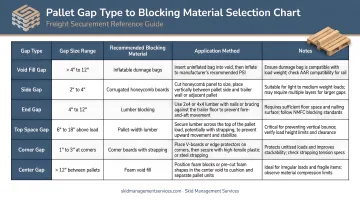
All lumber blocking must be fastened to the floor using 16d nails or larger. Drive nails perpendicular to the floor, penetrating at least 1 inch, staggered every 4–6 inches to prevent splitting. Unanchored lumber travels with the load and provides no resistance.
Address end wall gaps first — they face the highest longitudinal force during braking and acceleration.
Step 3: Secure, Verify, and Document
With blocking in position, shift focus to verification and documentation:
- Apply supplemental securement — ratchet straps, tie-downs, and stretch wrap compress and unitize but don't substitute for structural blocking
- Test stability physically — apply lateral and longitudinal hand pressure to each pallet before closing the container
- Photograph the load — capture the secured state before doors close
- Retain the load plan — document pallet placement, gap measurements, and securement methods; this record is essential if a freight claim is filed
Materials and Methods for Blocking and Bracing Pallets
Dimensional Lumber
The standard structural material for floor blocking and bracing. Key requirements:
- Use 2×4s, 4×4s, or plywood sheets sized to the gap width and cargo weight
- Fasten with 16d nails or larger — loose lumber is not blocking
- Lumber condition matters: cracked or green (unseasoned) lumber reduces holding strength significantly
Dunnage Air Bags
Inflatable bags designed for longitudinal end wall gaps and between-pallet gaps. Matching bag size to gap width is critical:
- A bag too small for the gap will over-inflate beyond its rated PSI, creating burst risk
- A bag too large won't generate sufficient contact pressure
For rail and intermodal applications, AAR GIB No. 9 sets the performance standard. Key specifications:
- Level 1: Rated for lateral voids in intermodal shipments; BNSF requires minimum 48 × 96 inches at 2 PSI max inflation
- Levels 2–5: Rated for lengthwise boxcar voids — from 75,000 lb (Level 2) up to 216,000 lb (Level 4)
- Void limit: Do not use bags in voids over 12 inches without supplemental void fillers
Void Fill Solutions
Corrugated panels, honeycomb filler, and drop-down void fillers work well for lateral gaps and surface-to-surface stabilization:
- Lightweight and often disposable — no added shipping weight
- Handle compressive loads without structural anchoring
- Practical when multiple small gaps exist across a load where individual air bags would fit poorly
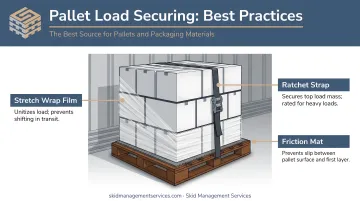
Stretch Wrap, Straps, and Friction Mats
These materials serve distinct roles:
- Stretch wrap unitizes the pallet stack and creates a skid-level anchor; it does not prevent a pallet from sliding on a smooth floor. The CTU Code notes that repetitive loading during rough transport can fatigue stretch film over time
- Ratchet and cam buckle straps provide compression and can anchor to e-track or cargo rails — a reliable securement layer when combined with blocking
- Friction mats placed beneath pallet bases reduce sliding risk and are frequently overlooked; the CTU Code recognizes rubber mats and structured plastics as friction-increasing materials that measurably improve load stability on smooth surfaces
Pallet Quality as the Foundation
A damaged, undersized, or incorrect-grade pallet limits how blocking materials can be positioned, nailed, or anchored against the load. The blocking plan is only as solid as what it's built against.
That makes pallet specification the logical first step — before the load plan, not after. Skid Management Services supplies new, used, and custom wood pallets, including:
- The industry-standard 48×40 GMA pallet used across most North American warehousing and shipping operations
- Custom dimensions for non-standard container configurations or specific load requirements
- ISPM-15 heat-treated options for food and beverage manufacturers with compliance requirements, including customers like Campbell Snacks and Knouse Foods
Common Mistakes and Key Factors Affecting Blocking and Bracing
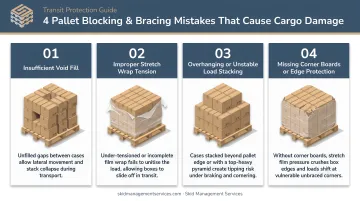
The Four Most Consequential Mistakes
1. Placing lumber without fastening it Blocking lumber set against a load without nails transfers zero force during transit. It moves with the pallet rather than stopping it. This is the single most common structural failure in palletized load securement.
2. Using stretch wrap as the sole securement method Stretch wrap unitizes the stack — it does not anchor the pallet to the floor. Under 0.8 g of forward deceleration, a fully wrapped pallet on a smooth trailer floor will slide.
3. Mismatched dunnage air bags Over-inflating a small bag to compensate for a large gap creates burst risk and uneven pressure. Under-pressuring a large bag leaves the gap insufficiently filled. Bag size must match gap width.
4. One-size-fits-all approach across modes Road, rail, and ocean transport have different force profiles. A configuration adequate for a regional highway run may be insufficient for intermodal transfer through a rail yard.
When Blocking and Bracing Is Unnecessary
These mistakes matter because teams apply blocking and bracing by default — but some movements don't need it. You can scale back or skip for:
- Very short, controlled internal warehouse movements at low speed
- Loads on fixed conveyor systems without transit gaps
- Fully crated loads with internal structural support already in place
The real problem is when teams use the same configuration regardless of load weight, gap size, trip distance, or mode. Identical setups across dissimilar shipments indicate load securement is being treated as a formality, not a decision — and that's when cargo shifts.
Key Factors That Should Drive Material Selection
Once you've confirmed blocking and bracing is warranted, the configuration should be designed around six variables, not assumed:
- Pallet grade, condition, and dimensions — can the pallet accept fasteners and bear anchoring forces?
- Cargo weight and density distribution — heavier, denser loads require higher-capacity materials
- Container or trailer type and interior dimensions — floor material affects nail holding; interior width affects gap calculations
- Shipping mode and expected force profile — highway, rail, and ocean each have distinct acceleration profiles
- Trip duration and number of load transfers — more transfers increase cumulative force exposure
- Load uniformity — mixed loads with varying heights and densities create irregular gap patterns that require individual material assessment
Conclusion
Blocking prevents load movement by filling gaps and creating a physical barrier against lateral and longitudinal force. Bracing provides structural resistance that absorbs and redirects energy during vertical and rotational loading. Both functions require anchoring to the floor or container structure and must be matched to the specific gap type and shipping mode to work as intended.
The repeatable process for every shipment:
- Build a load plan before selecting materials
- Choose blocking and bracing based on gap type and load characteristics
- Fasten every element to the floor or container structure — never rely on friction alone
- Document the configuration before departure for compliance and repeatability
Pallet specification is where this process starts. Correct grade, dimensions, and condition determine how reliably everything built on top of that foundation will perform in transit.
Frequently Asked Questions
Frequently Asked Questions
What is the difference between blocking and bracing for pallets?
Blocking uses materials placed against the load to fill gaps and prevent lateral or longitudinal movement, transferring force to the container structure. Bracing adds structural elements that resist vertical movement and tipping during transit. Both methods work together to address the full range of forces cargo faces in transport.
What is the 2% bracing rule for pallets?
No verified regulatory source (FMCSA, AAR, or CTU Code) formally establishes a "2% rule" as a requirement. FMCSA instead uses specific g-force performance criteria under 49 CFR 393.102: 0.8 g forward, 0.5 g rearward, and 0.5 g lateral. The percentage-of-weight framing is informal shorthand, not a codified standard.
What materials are most commonly used for blocking and bracing pallets?
The primary materials are dimensional lumber, dunnage air bags, corrugated void fill panels, ratchet straps and tie-downs, stretch wrap, and friction mats. The right choice depends on gap size, cargo weight, and shipping mode.
Is blocking and bracing required by law for highway freight?
Yes. Under 49 CFR Part 393, Subpart I, FMCSA requires all highway cargo to remain secured within the vehicle, with shippers responsible for compliance before departure. Section 393.106(b) identifies dunnage, dunnage bags, shoring bars, tiedowns, and structures of adequate strength as acceptable securement methods.
Can stretch wrap alone substitute for proper pallet blocking and bracing?
No. Stretch wrap unitizes the pallet stack (securing cartons to the pallet) but does not prevent the pallet itself from sliding on a smooth trailer floor under braking or cornering forces. Adequate load securement requires structural blocking anchored to the floor, supplemented by straps or tie-downs. Stretch wrap is a useful layer within that system, not a replacement for it.