
Introduction
Picture a forklift operator in a busy distribution center, repeatedly backing out and repositioning because the pallet in front of them only accepts entry from one direction. In a high-throughput warehouse, that wasted motion adds up fast — and it's entirely avoidable.
The 4-way entry flush stringer pallet solves this problem. It's one of the most widely used pallet designs in North American warehousing because it delivers access flexibility, racking compatibility, and predictable cost — without overcomplicating the design.
This guide breaks down how flush stringer pallets are constructed, how they compare to wing designs, their load capacities, which industries rely on them most, and what to evaluate before sourcing.
Key Takeaways
- 4-way entry flush stringer pallets use notched stringers to allow forklift access from all four sides, flush-cut deck boards align with the outer stringer faces
- The flush edge profile makes them compatible with standard pallet racking — no deck overhang to interfere with beam spacing
- They sit between 2-way stringer pallets and block pallets on cost — more versatile than one, cheaper than the other
- The dominant size is 48"×40" (the GMA/CBA standard), accounting for 69% of the recycled pallet market in the U.S.
- Heat-treated (HT-stamped) versions meet ISPM-15 requirements for international export
What Is a 4-Way Entry Flush Stringer Pallet?
Anatomy of a Stringer Pallet
A standard wood stringer pallet has four main components:
- Top deck boards — the load-bearing surface, running perpendicular to the stringers
- Three parallel stringers — solid wood beams running the full length of the pallet, providing structural support
- Bottom deck boards — provide stability and create ground clearance
- Fasteners — nails or staples securing deck boards to stringers
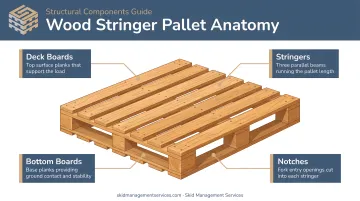
The stringers carry the load and define the pallet's entry type. In a basic 2-way stringer pallet, forklift tines can only enter from the two open ends. Notching the stringers creates side-entry openings, converting a 2-way pallet into a 4-way design.
The Notch: What "Partial 4-Way" Actually Means
According to a GMA stringer pallet specification published by NWPCA, the standard partial 4-way notch measures 9 inches long, 1.38 inches deep, with a 1.5-inch radius, located 6 inches from the stringer end. The notch allows forklift tines to enter from the side — but the opening is sized for forks, not pallet jack wheels.
This is why the design is called partial 4-way: forklifts can enter from all four sides, but standard hand pallet jacks may still be restricted on the notched sides. True full 4-way access — where a hand pallet jack can also enter from all sides — is the domain of block pallets, which use discrete corner and center blocks instead of continuous stringers.
What "Flush" Means
Entry type defines how a pallet is handled; the flush edge defines how it fits. On a flush pallet, the outer edges of the top and bottom deck boards align exactly with the face of the outer stringers — no overhang, clean perimeter on all sides.
That flush profile is why these pallets sit consistently on rack beams and move predictably through automated handling systems.
Materials and Treatment
Flush stringer pallets are built from hardwood or softwood lumber, with softwood (typically Southern Yellow Pine or similar species) most common in North American production. For export shipments, pallets can be heat-treated to meet ISPM-15 phytosanitary requirements: per IPPC ISPM 15, wood must reach 56°C for at least 30 continuous minutes throughout the entire profile. Compliant pallets are stamped with the IPPC logo, country code, facility number, and treatment type (HT).
Flush Stringer vs. Wing Stringer Pallets
The Three Overhang Configurations
Stringer pallets come in three deck-overhang configurations:
| Design | Top Deck | Bottom Deck | Notes |
|---|---|---|---|
| Flush | Aligned with stringer face | Aligned with stringer face | Cleanest profile; best racking fit |
| Single-wing | Extends past stringers | Flush (if present) | Wider load surface; overhang varies |
| Double-wing | Extends past stringers | Extends past stringers | Maximum surface area; largest footprint |
For comparison, block pallets use discrete blocks instead of continuous stringers, providing true full 4-way access and generally higher load capacity — at higher cost.
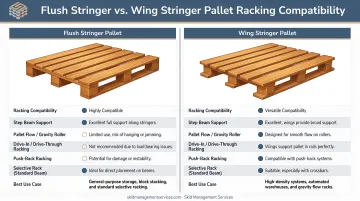
Racking Compatibility: The Main Reason Flush Wins
The primary practical advantage of the flush design comes down to how pallets sit on rack beams. Standard pallet rack guidance calls for 2 to 4 inches of pallet overhang over the front and back beams. Wing pallets add deck overhang on the sides, which changes the pallet's effective footprint and can conflict with beam spacing in tighter rack configurations.
With a flush stringer pallet, the footprint is exactly what it appears to be. Rack designers and warehouse operators can account for it precisely — which is why flush designs dominate cold storage facilities, high-density distribution centers, and any environment with standardized rack layouts.
Automated Systems and Predictable Footprints
Automated conveyor and sorting systems are designed around controlled pallet envelopes. Wing overhangs shift where the pallet edge sits relative to conveyor rails, sensors, and transfer points. Flush designs remove that uncertainty entirely — the pallet behaves exactly as the system expects at every transfer point.
Cost and Availability
Flush stringer pallets are the most widely produced and standardized design in North America. That standardization means better pricing and faster sourcing. Wing configurations — especially double-wing — are less common in the used and reconditioned pallet market, making them harder to source and consistently more expensive than flush designs.
Benefits and Operational Advantages
Handling Efficiency
The most immediate benefit is reduced repositioning. With 2-way access, a forklift operator approaching from the wrong direction must back up, reorient, and re-approach. In a busy loading dock or distribution center, this happens dozens of times per shift. Four-way access eliminates that step. Operators approach from whatever angle is available without breaking flow.
Space Optimization and Trailer Loading
One underused advantage is pinwheeling — alternating pallet orientation in trailers to improve load density. According to Packaging Revolution, pinwheeling 48"×40" pallets in a 53-foot trailer can fit 28 pallets versus 26 in a straight pattern. That's two additional pallet positions per load, which adds up quickly for high-volume shippers.
Cost vs. Block Pallets
Block pallets offer true 4-way access and higher load ratings, but they're more complex to manufacture and typically cost more per unit. Flush stringer pallets provide most of the handling flexibility at a lower price point — fewer components, simpler construction, and wider availability in the used/reconditioned market.
Repairability
When a stringer pallet is damaged, repairs are straightforward: replace an individual deck board or a single stringer. Block pallets require more involved disassembly and component replacement. For high-volume operations cycling through large pallet quantities, that repairability difference has a real impact on total cost of ownership.
Versatility
The flush 4-way stringer pallet covers most shipping scenarios without requiring separate pallet inventories:
- Domestic truckload and LTL shipments
- International export (when HT-stamped per ISPM-15)
- Food and consumer goods supply chains requiring consistent, inspectable pallets
Standard Sizes, Weight Capacities, and Specifications
The 48"×40" Standard
The 48"×40" GMA/CBA pallet is the dominant size in North American warehousing. The USDA Forest Service reports it accounts for 69% of the recycled pallet market. This prevalence matters because your racking, trailers, and handling equipment are almost certainly already sized for this footprint. Custom sizes are available, with common alternatives including 40"×40", 42"×42", 48"×36", and 48"×48", but the 48"×40" offers the best availability and pricing in both new and reconditioned markets.
Understanding Load Capacity
Pallet capacity varies based on how the pallet is supported. The GMA stringer pallet specification published by NWPCA lists the following design-specific values for a standard 48"×40" stringer pallet:
| Support Condition | Rated Capacity |
|---|---|
| Warehouse storage (floor, single stack) | 6,842 lb |
| Forklift entry from pallet end | 3,500 lb |
| Racked across length (two beams, 44" span) | 1,757 lb |
| Racked across length (three beams, 21" span) | 4,571 lb |
| Stacked two high | 4,276 lb per pallet |
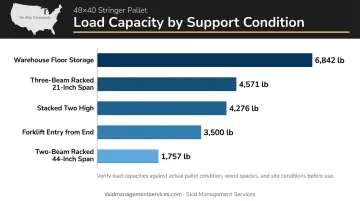
Verify capacity against your actual support conditions before specifying.
The Notching Trade-Off
Notching reduces the stringer's cross-sectional area at the notch point. Virginia Tech research found that non-notched pallets were 51% stiffer than notched pallets in racked-across-length conditions. Whether that trade-off works for your operation depends on the load:
- Standard distribution loads within rated limits: notched stringers perform reliably
- Heavy industrial loads requiring maximum racking strength: a solid 2-way stringer or block pallet is the better choice
Best Industries and Applications
Who Relies on Flush Stringer Pallets
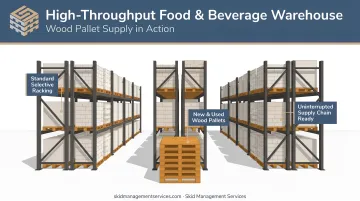
Food and beverage manufacturing is the largest user segment. High-throughput facilities — like those run by Campbell Snacks, Knouse Foods, Nissin, and Hain Celestial — can't afford pallet-related slowdowns. The flush design integrates directly into cold storage racking and moves efficiently through automated picking lines.
Other strong-fit industries include:
- Retail and grocery distribution — the standardized 48"×40" footprint aligns with DC racking and store delivery systems
- Consumer packaged goods (CPG) — high pallet volumes favor the cost and availability advantages of flush stringer designs
- Pharmaceutical logistics — ISPM-15 heat-treated versions support domestic GMP requirements and export compliance
- General manufacturing — versatility across shipping modes reduces the need for multiple pallet types per facility
That said, flush stringer pallets aren't a universal fit. A few scenarios call for a different approach.
When to Choose Something Else
- Very heavy industrial loads — block pallets carry higher rated capacities and provide true 4-way structural support
- Full 4-way hand pallet jack access — if jacks must enter from all four sides, block pallets are the only wood option that reliably handles this
- Export to block-pallet markets — some international buyers use equipment and racking built around block pallet dimensions, making stringer designs a poor fit
How to Choose and Source 4-Way Flush Stringer Pallets
Key Buying Criteria
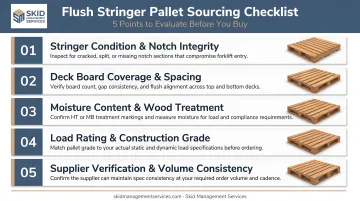
Before contacting a supplier, work through these questions:
- What are your load weights? Match static, dynamic, and racking capacities to your actual loads and support conditions
- What does your racking system require? Confirm beam spacing against the pallet's stringer span and verify the flush profile clears your rack configuration
- Do you need ISPM-15 heat treatment? Required for any wood packaging entering most international markets
- New or reconditioned? New pallets offer consistent specs; reconditioned Grade A/B pallets offer cost savings for applications where minor wear is acceptable
- What are your volume and frequency requirements? High-volume, recurring orders need a supplier with genuine inventory depth, not just spot-market access
Supply Consistency Matters More Than Price Per Unit
The lumber market can be volatile — the 2021 lumber shortage disrupted pallet manufacturers across North America, pushing lead times out and prices up for buyers who didn't have strong supplier relationships in place. For operations running on tight schedules, a pallet shortage is a production stoppage.
Suppliers with both direct inventory and a broad network of backup sources are better positioned to absorb those disruptions. Skid Management Services operates that way — combining their own stock with an expansive network of pallet suppliers across the U.S. so they're not dependent on a single source when supply tightens. For high-volume buyers in food manufacturing, CPG, and distribution, that means consistent availability and competitive pricing even when the broader market is constrained.
Questions to Ask Any Supplier
When vetting pallet suppliers, ask directly:
- Can you supply heat-treated, ISPM-15 stamped pallets on standard orders?
- What are your lead times for large volume orders?
- Do you offer custom sizing outside of 48"×40"?
- What grade standards do you apply to reconditioned pallets?
- How do you handle supply disruptions — do you have backup sources?
Frequently Asked Questions
What is a 4-way entry pallet?
A 4-way entry pallet allows forklifts and/or pallet jacks to access the pallet from all four sides. This is achieved either through notched stringers (partial 4-way, fork access only from the sides) or through block construction (true full 4-way, including hand pallet jack access).
What size is a 4-way entry pallet?
The most common size is 48"×40" — the GMA/CBA standard that dominates North American warehousing. Four-way entry pallets are also manufactured in custom sizes including 40"×40", 42"×42", 48"×36", and 48"×48" to suit specific facility or industry requirements.
How do you identify a 4-way entry flush stringer pallet?
Check the stringers for notches cut into the lower portion (4-way access), then confirm deck boards align flush with — not past — the outer stringer faces. Finally, verify the support structure uses three continuous beams rather than discrete corner and center blocks, which would indicate a block pallet.
What is the difference between a flush stringer pallet and a wing pallet?
A flush stringer pallet has deck boards that align exactly with the outer stringer faces — no overhang. A wing pallet has deck boards that extend past the stringers, creating a wider surface area. Flush pallets are generally preferred for racking systems because the even edge profile prevents interference with rack beam spacing and provides a more predictable load footprint.
Are 4-way flush stringer pallets compatible with standard pallet racking systems?
Yes — the flush edge profile means no deck overhang to conflict with beam spacing, making them well-suited to most standard selective rack systems. Always verify your specific rack beam span against the pallet's stringer dimensions and confirm load ratings match your actual racking conditions.
Can 4-way flush stringer pallets be heat-treated for export?
Yes. Flush stringer pallets can be heat-treated and ISPM-15 stamped for international shipments. The stamp includes the IPPC logo, country code, facility number, and HT designation, as required by USDA APHIS for wood packaging entering the US — and by most trading partners reciprocally.