The decision between new and used pallets carries more operational weight than most businesses account for. Used pallets have a legitimate role in closed-loop internal moves and low-risk applications. But when structural reliability, hygiene compliance, or dimensional precision are on the line, new wood pallets offer a level of performance certainty that used pallets simply cannot match.
This article breaks down what that performance difference actually looks like — in measurable outcomes, not just general quality claims.
Key Takeaways
- New wood pallets carry a known, verifiable load capacity with no hidden stress history to account for
- Built to tight dimensional tolerances, new pallets work predictably with forklifts, racking, and automated handling systems
- For food, pharma, and export shipping, new pallets eliminate contamination risk and simplify ISPM 15 compliance
- Custom new pallets can be spec'd to exact load, size, and treatment requirements before the first shipment
- Consistent national inventory availability protects operations from costly supply disruptions
What Are New Wood Pallets?
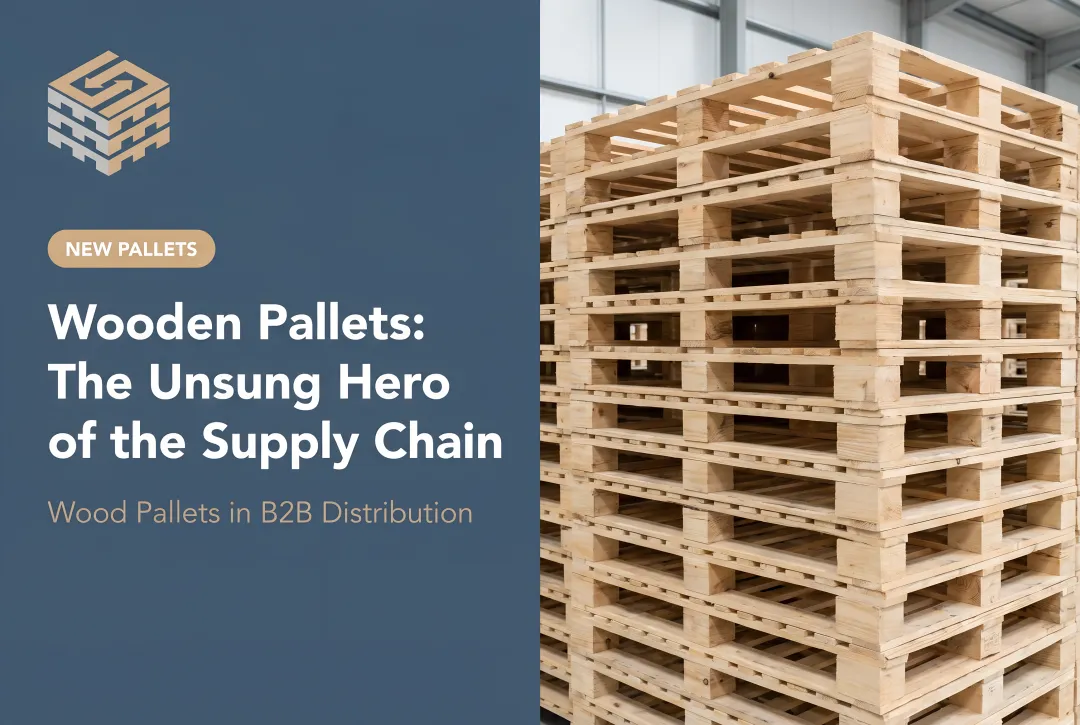
New wood pallets are manufactured from virgin, first-use lumber — built to a specified size, grade, and load capacity, and never previously used in shipping or storage. They're available in standard sizes like the industry-dominant 48x40 GMA or in custom dimensions for specific operational requirements.
New pallets serve warehousing, food manufacturing, pharmaceutical distribution, retail fulfillment, and export shipping. More than a packaging input, they're a structural component of the supply chain — the physical base every load depends on from the warehouse floor to final delivery.
When that base is compromised, the consequences are measurable: damage claims, compliance failures, and operational slowdowns. Understanding what separates new pallets from used ones starts here.
Key Advantages of Buying New Pallets for Shipping
The advantages below aren't theoretical. They map directly to KPIs that operations teams track: damage rates, compliance incidents, equipment downtime, and freight claims. Each one represents a real operational difference between knowing exactly what you're working with and hoping for the best.
Advantage 1: Guaranteed Structural Integrity and Load Reliability
A new pallet has no prior stress history. No prior overloading. No moisture cycling that weakens boards over time. No hidden impact damage from a previous forklift operator. Its rated load capacity is fully reliable at the point of use.
For a standard new 48x40 GMA wood pallet, supplier specifications from PalletOne cite a minimum load-bearing capacity of 2,500 lb, while Uline's new GMA model lists 2,500 lb fork capacity and 7,528 lb floor capacity for evenly distributed loads. These figures assume proper load distribution. For stacked or uneven loads, verify exact capacity for your application with the supplier's spec sheet or Pallet Design System output.
Used pallets carry none of this certainty. A pallet that looks structurally sound may have boards weakened by prior overloading or moisture exposure that isn't visible during a visual inspection. When that pallet fails mid-transit, the consequences compound quickly:
- Product damage and potential write-offs
- Freight claims filed with the carrier
- Customer chargebacks and redelivery costs
- Injury liability if a failed pallet creates a handling hazard
- Quality incident reports in regulated industries
The cost of a single mid-transit pallet failure — in product loss, rework, and reshipment — routinely exceeds the per-unit price difference between new and used pallets. Running that comparison before the next procurement cycle is the more accurate cost calculation.
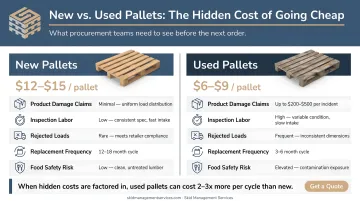
When this matters most: High-value goods, heavy loads, long-haul shipments, and any operation where product loss triggers downstream chargebacks or compliance reporting.
Advantage 2: Hygiene, Food Safety, and Compliance Assurance
New pallets have no contamination history. No prior exposure to chemicals, pest activity, mold, food waste, or unidentified cargo. For businesses shipping food, beverages, pharmaceuticals, or personal care products, that clean history is a compliance requirement, not an optional upgrade.
FDA sanitary transportation guidance identifies poor pallet quality as a potential contamination problem area. FSMA's sanitary transportation rule requires shippers, loaders, carriers, and receivers to use sanitary practices for human and animal food.
A used pallet with unknown prior cargo doesn't reliably meet that standard.
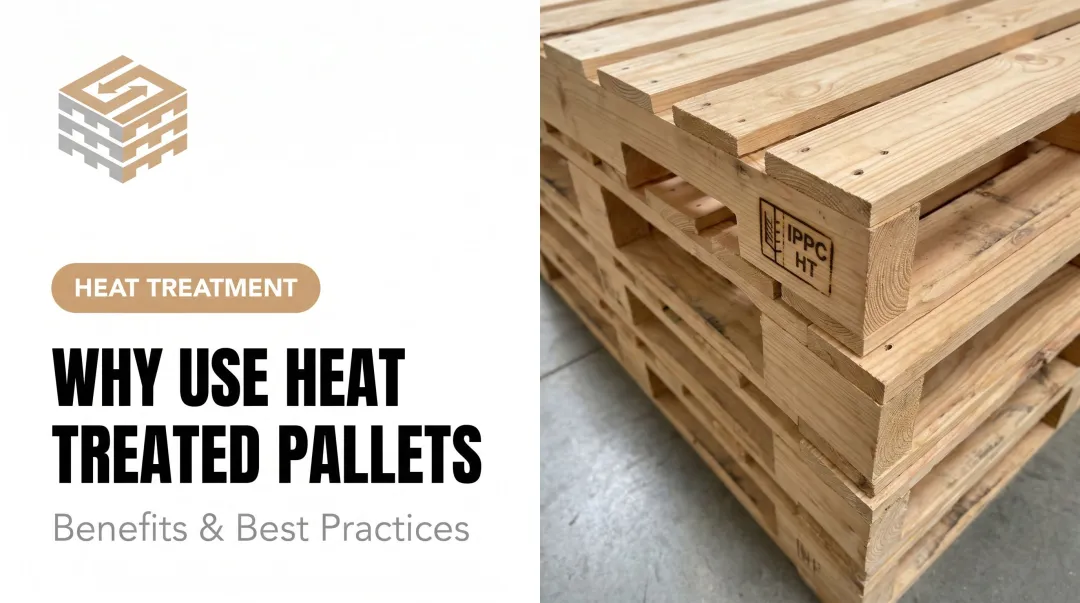
The hygiene advantage compounds for export shipments. APHIS requires all regulated wood packaging material entering the U.S. to be treated and certified under ISPM 15, and the same applies for exports to the EU and most other trading partners. New pallets can be ordered pre-treated to ISPM 15 heat-treatment standards and stamped at manufacturing, making export compliance straightforward.
Skid Management Services offers a dedicated ISPM 15 heat-treated export pallet service with documentation that supports clean customs clearance.
Customer requirements add another layer. Many large retail and food manufacturing customers — including grocery chains and CPG companies — specify pallet condition in their supplier manuals. A typical standard requires 48 in. ±0.25 x 40 in. ±0.25, Grade A, four-way, flush condition with no broken deck boards. Only a new or verified-grade pallet reliably meets that spec.
KPIs impacted: Compliance incident rate, customs clearance success, food safety audit scores, supplier scorecard ratings.
When this matters most: Food and beverage manufacturers, pharmaceutical distributors, export shippers, and businesses supplying large retail customers with defined pallet requirements.
Advantage 3: Dimensional Consistency and Custom Fit
New pallets are built to precise, controlled specifications. The NWPCA Uniform Standard allows total pallet size within +1/4 in. to -1/2 in. of target dimensions, with stringer and block height and width tolerance of ±1/16 in.. Every pallet in a shipment behaves identically when engaged by a forklift, pallet jack, conveyor, or automated system.
Used pallets don't deliver this consistency. Warped boards, missing stringers, inconsistent fork entry heights — even small geometric variance causes problems:
- Equipment jams and conveyor misfeeds
- Misstacked loads and unstable unit loads
- Improper rack engagement in high-density storage
- Manual interventions that slow throughput
For operations running AS/RS systems, the tolerance requirements are tight. High-performance stacker cranes operate with positioning accuracy of ±3 mm, and non-conforming pallets are stopped or diverted. Overhang above two inches is a common rejection threshold. In automated environments, pallet variability creates system failures and measurable downtime, not just handling friction.
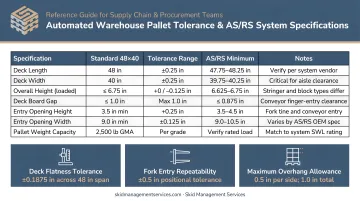
Custom new pallets extend this advantage further. When pallets are built to exact dimensions, entry configuration (2-way or 4-way), deck board spacing, and load ratings, every unit fits the operation it was designed for. Skid Management Services builds custom pallets to customer specifications, covering non-standard dimensions, specialized automation requirements, and unique container configurations.
KPIs impacted: Handling cycle time, equipment downtime, load rejection rate, space utilization in trailers and containers.
When this matters most: Automated or semi-automated warehouses, high-volume distribution, standardized container shipping, and operations with specific product-to-pallet size requirements.
What Happens When You Rely on Substandard or Used Pallets
The cost of a bad pallet decision rarely shows up in the purchase price. It appears later, in harder-to-track places:
- Mid-transit failures that result in product damage, freight claims, and expedited reshipments
- Failed compliance audits when pallets don't meet ISPM 15 marking requirements, customer grade specs, or food safety standards
- Automation disruptions when inconsistent pallet geometry causes equipment jams, conveyor misfeeds, or rack engagement failures
- Reactive procurement costs — emergency pallet replacements purchased at spot pricing tend to cost significantly more than contracted new pallet supply
- Customer chargebacks triggered by damaged or non-compliant deliveries
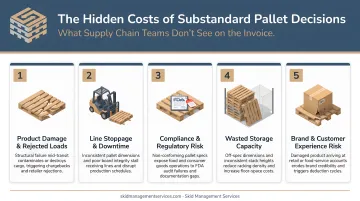
CBP's 2017 wood packaging material guidance removed the previous five-violation threshold before penalties apply — responsible parties are now liable for costs associated with non-compliant material from the first incident. That shift means using pallets with unknown treatment histories in export lanes now carries real financial liability from day one.
The per-unit savings on used pallets are easy to see on an invoice. The downstream costs — claims, chargebacks, emergency procurement — are what actually define the total picture.
How to Get the Most Value from New Pallets
Buying new pallets delivers full value when the spec is matched to actual operational needs — not when a standard size is assumed to fit every application.
Before ordering, define:
- Load capacity requirements (fork and floor, under actual load distribution)
- Entry configuration (2-way vs. 4-way, based on handling equipment)
- Surface requirements (deck board spacing, flush vs. non-flush)
- Heat treatment need (ISPM 15 for any export lanes)
- Dimensional tolerances for automated handling or racking systems
Once specs are confirmed, the supplier relationship matters just as much. For ongoing supply, prioritize:
- A supplier with national distribution reach and consistent inventory — supply disruptions in pallets can halt production lines
- Ability to source custom specs through a network, not just a single facility
- Documentation support for compliance-sensitive shipments
Skid Management Services serves food and beverage manufacturers including Campbell Snacks, Knouse Foods, Nissin, Hain Celestial, Stauffer's, and Plainville — customers that operate under defined pallet specs and compliance requirements. Reviewing pallet performance data regularly — damage rates, compliance incidents, handling times — helps confirm the spec is working and catches emerging issues before they generate downstream costs.
Conclusion
New pallets deliver structural reliability, hygiene assurance, dimensional consistency, and supply predictability — and each translates directly into fewer damage claims, cleaner compliance records, reduced equipment downtime, and uninterrupted production.
The cost difference between new and used pallets is real. So is the cost of the problems new pallets prevent. Operations that specify the right grade, treatment, and dimensions upfront avoid the reactive costs that erode the savings from cheaper alternatives. Sourcing from a supplier with consistent national inventory — like Skid Management Services — removes the supply uncertainty that forces last-minute compromises on pallet quality.
Frequently Asked Questions
What are the benefits of buying pallets for shipping?
Pallets standardize how goods are loaded, stored, and transported — reducing product damage, improving handling efficiency, and enabling compliance with carrier and retailer requirements. New pallets specifically add guaranteed structural integrity and a clean contamination history that used pallets cannot reliably provide.
Are new pallets better than used pallets for shipping?
New pallets are the better choice when structural reliability, hygiene compliance, or dimensional precision matter — particularly for food, pharma, or export shipping. Used pallets may be appropriate for low-risk, closed-loop internal moves where condition can be visually verified and load requirements are predictable.
Do new wood pallets need to be heat-treated for international shipping?
ISPM 15 regulations require heat treatment (or methyl bromide fumigation) for wood pallets entering most countries, including all EU member states. New pallets can be ordered pre-treated and officially marked at manufacturing, making export compliance straightforward and avoiding customs holds.
How much weight can a standard new wood pallet hold?
A standard 48x40 GMA wood pallet is rated at 2,500 lb fork capacity and up to 7,528 lb floor capacity for evenly distributed loads. Actual capacity varies by construction type and wood grade — confirm specs with your supplier before ordering.
Can new pallets be customized to specific sizes or load requirements?
Yes. New wood pallets can be manufactured to custom dimensions, deck board spacing, stringer configuration, and weight ratings — making them suitable for non-standard products, automation lines, or container configurations that standard sizes don't accommodate.
How do I choose the right new wood pallet supplier?
Prioritize inventory consistency, national supply coverage, customization capability, compliance documentation, and on-time delivery. Pallet supply disruptions create downstream production problems, so reliability matters as much as per-unit price.