Introduction
Picture this: a warehouse manager orders a new batch of pallets based on price alone. They arrive, get loaded into racking, and within a week the forklift operators are spending an extra 15 minutes per shift repositioning loads because the pallets can only be approached from two directions. Multiply that by three shifts and 250 working days — and what looked like a cost-saving decision turns into an expensive one.
That scenario plays out across thousands of facilities. 2.6 billion pallets are in circulation across the US, with wood pallets making up 95% of that market — yet the 2-way versus 4-way decision is still routinely made on habit or unit price rather than operational fit.
This guide breaks down exactly how each pallet type is built, where each one belongs, and how to make the right call for your facility.
Key Takeaways
- A 2-way pallet allows forklift or pallet jack entry from two sides only; a 4-way pallet allows entry from all four sides
- The difference comes from construction: solid stringers block side entry on 2-way pallets; notched stringers or block designs create clearance on 4-way pallets
- 2-way pallets cost less and suit static storage or single-direction workflows
- 4-way pallets offer greater maneuverability, making them the standard choice for distribution centers, automated warehouses, and export shipping
- Choosing between them comes down to workflow, facility layout, and automation requirements, not just unit cost
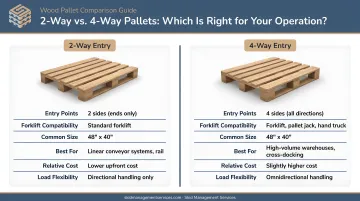
2-Way vs. 4-Way Pallets: Quick Comparison
| Attribute | 2-Way Pallet | 4-Way Pallet |
|---|---|---|
| Forklift/Pallet Jack Entry | 2 sides (stringer ends only) | All 4 sides |
| Construction Type | Solid stringer | Notched stringer or block |
| Unit Cost | Lower | Higher |
| Maneuverability | Limited — requires orientation | High — approach from any direction |
| Space Utilization | Requires consistent orientation | Flexible load positioning |
| Automation Compatibility | Limited or incompatible | Compatible with most AS/RS and conveyor systems |
| Best Use Case | Static storage, single-direction workflows | Distribution, automation, export shipping |
Both types are available in standard US sizes: 48"×40" (GMA), 42"×42", and 48"×48". Entry configuration is independent of size, so you can find 2-way and 4-way options at the same dimensions. New and recycled versions of each are widely available across the US market. The sections below break down how construction, handling, and use case differ between the two.
What Is a 2-Way Pallet?
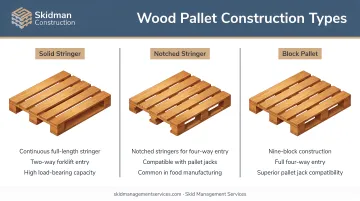
A 2-way pallet is a stringer pallet built with solid, unnotched boards running lengthwise beneath the deck. These stringers — typically three parallel beams, one on each side and one down the center — create entry openings only at the two short ends. The long sides are physically closed off by the solid stringer faces.
Construction and Strength
Because the stringers are continuous and unnotched, they maintain their full cross-sectional integrity. Research from the USDA Forest Products Laboratory found that notches cut into pallet stringers produce 37% to 44% reductions in modulus of rupture — solid stringers sidestep that vulnerability entirely.
Key operational advantages:
- Lower manufacturing cost due to simpler construction
- Solid stringers are structurally uncompromised at the sides
- Well-suited for static, long-term storage where pallets don't need reorientation
- Reliable in closed-loop internal operations where pallets travel the same direction every time
Limitations to Know
- Forklifts need more room to maneuver and align with the two accessible ends
- Product must be consistently oriented in trailers and racking — no flexibility to rotate
- Reduces trailer cube efficiency when loads can't be turned
- Many automated systems reject or can't accommodate 2-way pallets
Where 2-Way Pallets Fit Best
2-way pallets make the most sense in operations where movement is predictable and controlled.
- Fixed-rack storage facilities where every pallet enters from the same direction
- In-house manufacturing loops where pallets stay within the plant and don't ship externally
- Paper, printing, and similar industries with consistent single-direction production flows
- Long-term storage applications where pallets sit stationary for extended periods
Food processing plants with dedicated internal pallet programs are a practical fit here. When pallets cycle between production, staging, and storage within one facility, 2-way entry covers everything the operation needs.
What Is a 4-Way Pallet?
A 4-way pallet allows forklift tines or pallet jack forks to enter from all four sides. Two distinct construction methods achieve this:
- Notched stringer pallets — same three-stringer layout as a 2-way, but with rectangular cutouts in the middle of each stringer that create clearance for side entry
- Block pallets — nine solid wood blocks replace stringers entirely, positioned at corners, edges, and center; the gaps between blocks naturally allow four-way access
The NWPCA Uniform Standard for Wood Pallets distinguishes between partial 4-way entry (associated with notched stringers) and full 4-way entry (associated with block construction). Block pallets are generally more durable under heavy loads — block construction eliminates the stringer notch, the structural weak point identified in USDA research.
Operational Advantages
For daily warehouse operations, 4-way entry matters because:
- Forklifts can approach from any direction — no repositioning required
- Trailers can be loaded without worrying about pallet orientation, improving cube utilization
- Pallets work in tight spaces where turning a forklift to hit a specific end isn't practical
- Compatible with most automated warehouse systems, including AS/RS, conveyor lines, and robotic palletizers
The 48"×40" GMA pallet — the most widely used pallet size in North America — is a 4-way format with two notches on each long side.
Trade-Offs
- Higher per-unit cost due to additional manufacturing steps
- Notched stringer pallets can chip or crack at the notch if tines are misaligned during side entry
- Slightly more complex to repair when damaged
Where 4-Way Pallets Fit Best
4-way pallets are the standard choice in high-movement, high-turnover environments:
- Distribution centers and cross-docking operations where loading speed directly affects throughput
- Export shipping requiring ISPM-15 heat treatment — block pallets handle the process well and meet international trade requirements
- Retail and wholesale distribution networks where pallets cycle through multiple handlers and orientations
- Grocery and food & beverage distribution, where the GMA 4-way format is the industry standard
- Pharmaceutical and e-commerce fulfillment where pallet orientation shifts frequently across the supply chain
Skid Management Services supplies ISPM-15 heat-treated pallets for export applications, including shippers moving product through the Philadelphia and Baltimore ports.
Which Pallet Is Right for Your Operation?
The unit price is rarely the right metric to optimize on. The true cost of a pallet choice includes:
- Labor time for forklift maneuvering and load repositioning
- Trailer space utilization (can you rotate orientation to maximize cube?)
- Pallet damage rates — notch-point failures add replacement and repair costs
- Automation compatibility: will your system accept the pallet or reject it?
Labor alone can account for up to 65% of total warehouse fulfillment costs, excluding trucking. When a pallet choice forces extra handling steps across every shift, the per-unit savings disappear quickly.
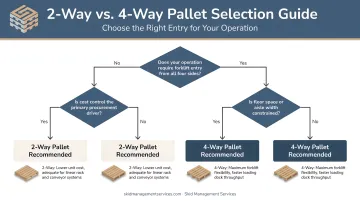
Decision Framework
Choose a 2-way pallet when:
- Your facility runs single-direction workflows with fixed rack orientation
- Pallets remain in a controlled internal loop and aren't shipped externally
- You're prioritizing lower per-unit cost and the operational constraints don't apply
- Speed of forklift maneuvering is not a bottleneck in your operation
Choose a 4-way pallet when:
- Your operation involves frequent handling, tight aisles, or multi-directional movement
- You're loading trailers where orientation flexibility improves cube utilization
- Your warehouse uses or is moving toward automated equipment
- Pallets leave your facility and need to be handled by third parties or at distribution points
- You're shipping internationally and need ISPM-15 compliance
The Automation Consideration
Most modern AS/RS systems, 4-way shuttle systems, and robotic palletizers are designed around 4-way entry pallets, specifically the 48"×40" GMA standard. If your facility is scaling toward automation, locking into 2-way pallets now could create equipment incompatibilities that are costly to resolve later.
When evaluating both options, supply availability matters as much as specs. Skid Management Services stocks new, used, and custom 2-way and 4-way pallets — including block pallets and GMA 48"×40" formats — through a national supplier network. That means you can compare options side-by-side without inventory constraints pushing the decision. Reach them at 717-202-0304 or Info@SkidManagementServices.com to discuss your requirements.
Conclusion
2-way pallets work well for operations with predictable, single-direction workflows and fixed internal loops. If your supply chain involves high-turnover distribution, automated handling, or pallets that regularly change hands, 4-way entry is the stronger choice.
Neither type is universally superior. The right answer comes down to how your facility actually operates: rack orientation, handling frequency, automation plans, and whether pallets stay in-house or move through a broader supply chain.
Before your next pallet order, run through the criteria in this guide: entry needs, automation compatibility, trailer utilization, and total cost. If you're still not certain which configuration fits your operation, Skid Management Services can help you source the right pallet type with consistent national supply and competitive pricing.
Frequently Asked Questions
What is a two-way entry pallet?
A two-way entry pallet is a wood pallet built with solid stringer boards running lengthwise beneath the deck. Forklift tines and pallet jack forks can only slide in from the two short ends (the stringer ends), while the solid stringer faces on the long sides physically block entry.
What is the difference between a 2-way entry pallet and a 4-way entry pallet?
The core difference is the number of sides a forklift or pallet jack can access: two on a 2-way pallet, four on a 4-way. Solid stringers block side entry on 2-way pallets, while notched stringers or block construction create the clearance needed for 4-way access.
What is the difference between a 2-way and 4-way pallet jack?
A standard pallet jack enters from two sides, matching 2-way pallet access. A 4-way pallet jack (also called an omni-directional pallet truck) uses rotating wheels or a specialized fork mechanism to pick up pallets from any side, making it useful in tight warehouse aisles where turning isn't possible.
Are 4-way pallets more expensive than 2-way pallets?
Yes, 4-way pallets typically cost more per unit due to additional manufacturing steps, whether notching stringers or assembling block construction. When you factor in labor efficiency, trailer utilization, and reduced damage rates, the overall cost advantage often shifts toward 4-way pallets.
Can 2-way pallets be used in automated warehouse systems?
Most automated systems (AS/RS, conveyor lines, robotic palletizers) are designed around 4-way entry pallets, particularly the 48"×40" GMA format. 2-way pallets are often incompatible or require special accommodation, making 4-way pallets the preferred choice for automated operations.
What is the standard size for 2-way and 4-way pallets?
Both 2-way and 4-way pallets are available in standard US sizes including 48"×40", 42"×42", and 48"×48". The 48"×40" GMA pallet, a 4-way format, is the most widely used pallet size in North America and the established standard for grocery, food & beverage, and general distribution.