This guide covers everything you need to make an informed purchasing decision: what block pallets are, how the grading system works, what Grade B actually means in practice, weight capacity considerations, the best applications for this grade, and how to compare Grade A versus Grade B when budget and performance both matter.
Key Takeaways
- Block pallets use 9 wooden blocks for support, enabling true 4-way forklift entry from all sides
- Grade B is an industry-recognized condition tier — functional, repaired, and structurally sound
- Always confirm load capacity specs per unit with your supplier — especially before racking or high-stack applications
- Grade B fits warehousing, manufacturing, and outbound distribution — but not food-grade or automated conveyor applications
- Suppliers stocking both Grade A and Grade B let you right-size pallet spend without compromising structural requirements
What Are Block Pallets?
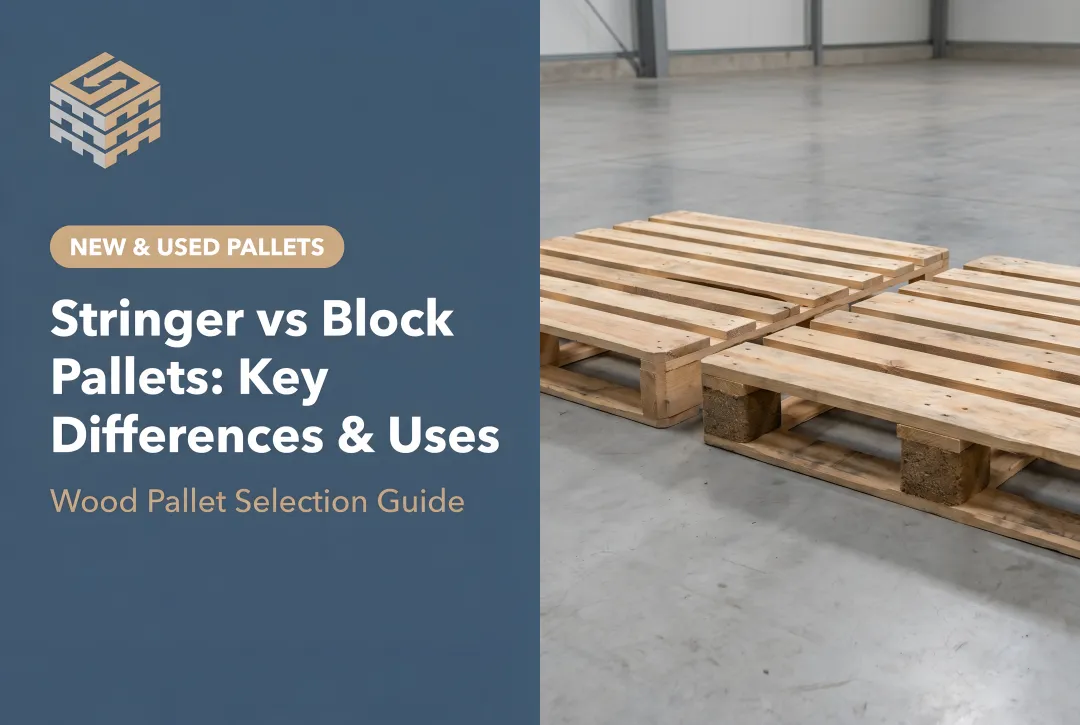
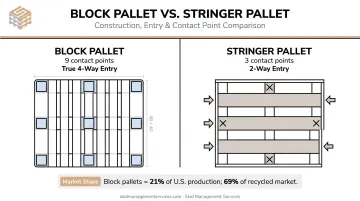
Block pallets are built using wooden blocks — typically arranged in a 9-block configuration at corners, edges, and the center — as the primary structural spacers between the top and bottom decks. This construction differs from stringer pallets, which use three continuous parallel boards running lengthwise beneath the top deck.
That structural difference creates several practical advantages over stringer pallets:
- True 4-way entry — forklifts and pallet jacks can insert from any side, versus 2-way entry on unnotched stringer pallets
- More contact points — 9 blocks distribute load more evenly than a stringer pallet's 3 boards
- Fewer handling constraints — variable forklift approach angles work without repositioning in high-volume warehouse environments
The NWPCA Uniform Standard for Wood Pallets (2025) formally defines blocks as "rectangular, square, multisided, or cylindrical deck spacers" positioned at corners, ends, edges, inner positions, and center.
The most common block pallet footprint is 48x40 inches, the GMA standard. According to USDA Forest Service and Virginia Tech research, the 48x40 size accounts for 69% of the recycled and remanufactured pallet market in the U.S. — making it the dominant format for used pallet sourcing. Despite that dominance, block pallets represent approximately 21% of U.S. wood pallet production versus 76% for stringer pallets, so they're less common overall but well-established in the recycled market.
Understanding the Pallet Grading System
Pallet grading classifies used or refurbished wood pallets by condition, repair history, and structural integrity. There is no single universal regulatory standard — the NWPCA's Uniform Standard governs construction and repair methods, but the A/B/C grade designations are a commercial industry convention followed consistently by most suppliers.
The three-tier framework works like this:
| Grade | Condition | Typical Use |
|---|---|---|
| Grade A (#1) | Near-new; minimal or no repairs; consistent dimensions | Retail-facing, food-grade, automated systems |
| Grade B (#2) | Functional; repaired components; slight dimensional variation | Warehousing, distribution, manufacturing |
| Grade C (Utility) | Heavy wear; multiple significant repairs; reduced structural reliability | One-way non-critical shipments, scrap recovery |
Grade C pallets are unsuitable for standard warehousing or racking. They're better suited to single-use outbound shipments where the pallet won't return, or for wood recycling programs.
That distinction makes Grade B the workhorse of the used pallet market. It delivers structural soundness at a fraction of new pallet cost, which is why it's the most actively purchased tier for general warehouse and distribution operations.
Skid Management Services supplies across this full spectrum: Grade A for premium recycled applications, Grade B for standard warehouse and distribution work, and a #2/utility designation for the lowest-cost internal-flow needs. Customers get precise options matched to their actual application requirements.
What Is a Grade B Block Pallet?
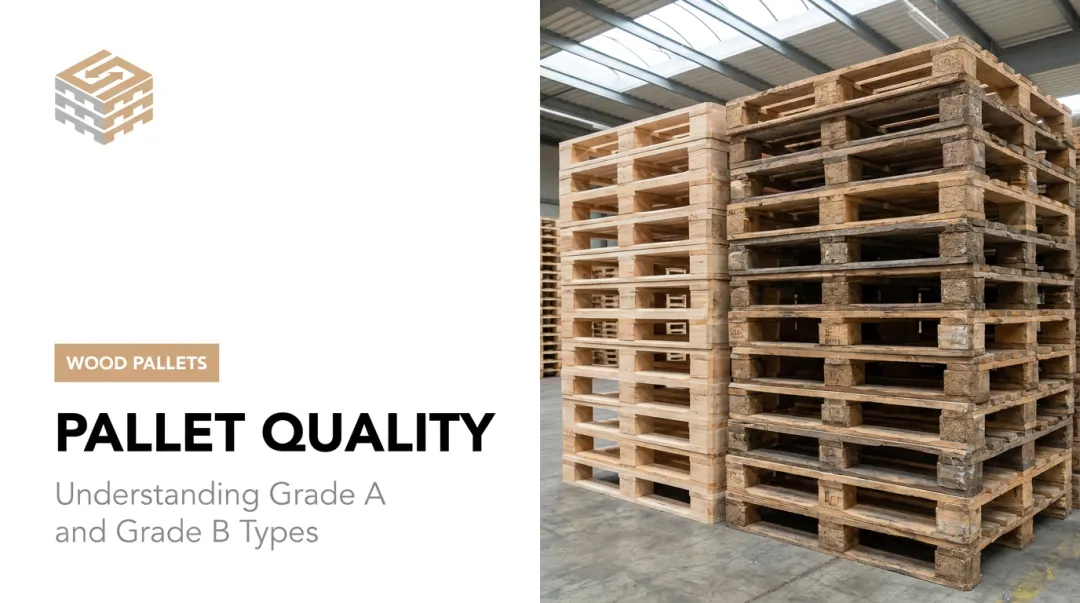
A Grade B block pallet is a previously used block-style pallet that has undergone repairs — but remains structurally sound and safe to load. The grade reflects wear and repair history, not structural failure.
Physical Specifications
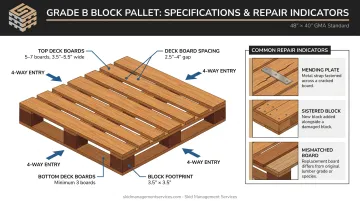
Typical physical characteristics of a Grade B block pallet include:
- Top deck boards: 5–7 boards (depending on board width, typically 3.5"–5.5" each)
- Bottom deck boards: Minimum 3 boards
- Top deck spacing: Average 2.5"–4" between boards (NWPCA specifies no more than 4" for pallets of unknown specification)
- Block dimensions: Typically 3.5" x 3.5" footprint; standard stringer/block thickness of 1.5" x 3.5"
- Entry: 4-way maintained
- Board consistency: May vary slightly across units due to replacement history
Visible Signs and Repair Indicators
Specific visible markers identify Grade B classification. These are functional repairs, not cosmetic failures:
- Discoloration or weathering from prior use cycles
- Mismatched deck boards where replacement boards differ in color or grain
- Mending plates — steel plates (minimum 20-gauge per NWPCA standards) bridging cracked board sections
- Staples securing minor cracks in deck boards or blocks
- Sistered blocks — a companion block fastened alongside a damaged original to restore load capacity
- Surface checking on block faces (shallow cracks that don't compromise load capacity)
On block pallets specifically, repair indicators tend to appear on the blocks themselves rather than on stringers. A cracked or replaced block is the block-pallet equivalent of a plated stringer on a stringer pallet.
Block construction offers more repair flexibility than stringer construction — replacing or sistering a block doesn't compromise 4-way entry the way a plated stringer can limit fork access.
Grade B does not mean structurally compromised. Skid Management Services defines Grade B as pallets with 1–2 minor board repairs and full structural integrity — the distinction from Grade A is condition and repair history, not safety.
Weight Capacity and Load Performance
Load capacity for any wood pallet — Grade A or B — is design-specific. There is no single universal figure that applies to all 48x40 Grade B block pallets, because capacity depends on wood species, board dimensions, repair extent, and how the load is applied.
Three Load Types to Understand
- Static load: Pallet sitting stationary on the floor with no movement. The highest capacity figure — often cited at 2,500–3,000 lbs for a standard 48x40 block pallet, though this varies by construction.
- Dynamic load: Pallet in motion via forklift or pallet jack. Lower than static — commonly around 2,000–2,800 lbs for a standard 48x40 configuration.
- Racking load: Pallet supported at two points on a rack beam, with center span unsupported. This is usually the most demanding scenario and produces the lowest capacity rating — often 1,500–2,200 lbs depending on span and construction.
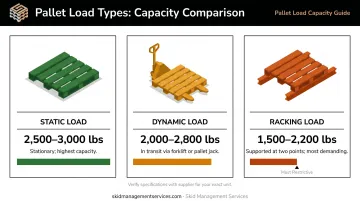
These figures represent general industry ranges, not guaranteed specifications. The NWPCA Uniform Standard treats safe working load as design-specific and dependent on support conditions — the authoritative tool for structural analysis is the Pallet Design System (PDS), which generates load estimates based on actual pallet specifications.
How Grade B Affects Capacity
Replaced or sistered blocks can slightly reduce racking performance compared to an intact original block, particularly on longer unsupported spans. Dynamic capacity is well-maintained when the core structure is intact.
USDA Forest Service research on repaired GMA-style pallets found that properly applied repair methods restored bending strength in tested pallets. In other words, competently repaired Grade B pallets often perform closer to Grade A than the grade label suggests.
Nine contact points matter for load distribution: block pallets spread weight across 9 positions versus a stringer pallet's 3, so Grade B block pallets often outperform Grade B stringer pallets under equivalent load conditions despite similar wear classifications.
Always confirm load ratings with your supplier before using Grade B pallets in racking systems or for heavy loads. Grade B capacity varies by unit, and no single published figure covers all configurations.
Best Use Cases and Industries for Grade B Block Pallets
Grade B block pallets are well-suited to a wide range of operational environments — but not all of them.
Where They Work Well
Warehousing and internal storage is the strongest fit. Grade B block pallets handle repeated forklift cycles and work with most standard racking systems. The 4-way entry speeds up handling in tight storage configurations, and for high-volume operations where pallets cycle continuously, the cost savings versus Grade A or new pallets are substantial.
Manufacturing and raw material transport is another natural application. Facilities moving raw materials, components, or finished goods in non-customer-facing contexts get the structural reliability they need without paying for cosmetic condition. Food and beverage manufacturers — including Campbell Snacks, Knouse Foods, and Stauffer's — use Grade B pallets in internal warehouse movement and manufacturing flow where cost-to-performance ratio matters most.
Outbound distribution and one-way shipments represent a major use case across the industry. According to NWPCA and PalletCentral, 95% of wooden pallets are recycled — with 341 million recycled pallets produced in 2016 alone. That recycled market is built on Grade B. For single-trip outbound shipments where the pallet won't return, Grade B reduces per-unit write-off cost without sacrificing the structural integrity needed to protect the load in transit.
Where They Don't Fit
- Food-contact and pharmaceutical zones: Without a documented chain of custody, Grade B pallets cannot verify contamination history — a direct compliance risk under FSMA and GFSI standards. New kiln-dried heat-treated pallets or sanitation-grade recycled pallets with full chain of custody are the correct specification.
- Retail floor displays where pallet appearance is visible to consumers
- Automated conveyor and AS/RS systems requiring precise dimensional consistency — replaced boards and repaired blocks introduce tolerances that cause misfeeds and jams in automated handling equipment
Grade B vs. Grade A Block Pallets: Choosing the Right Grade
Side-by-Side Comparison
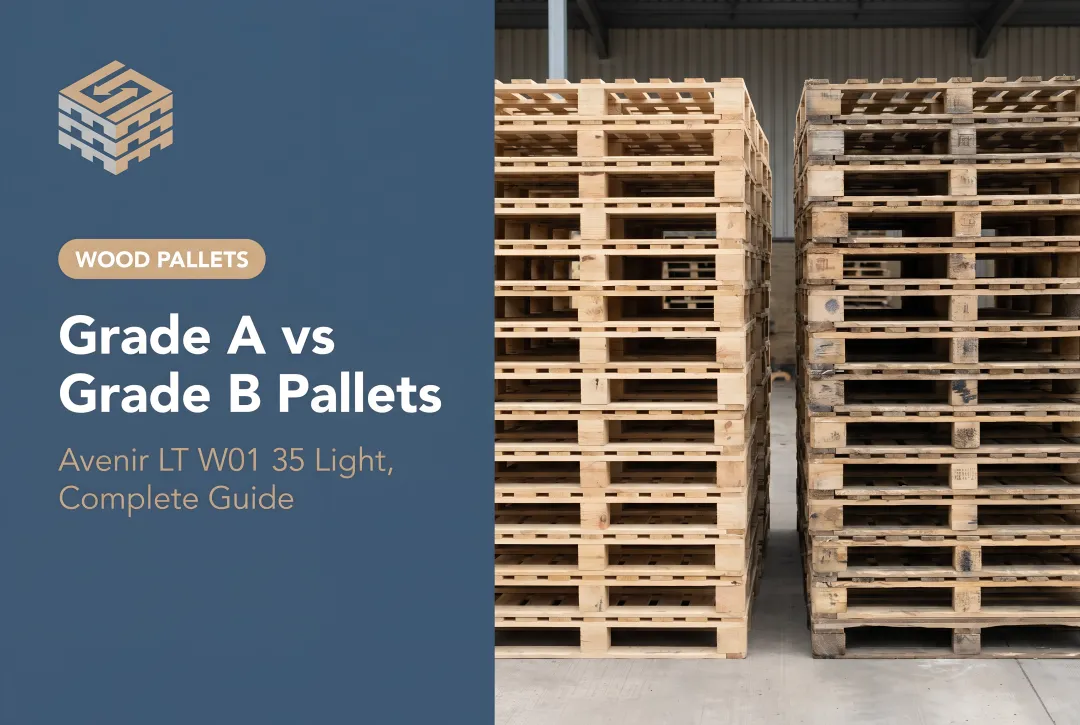
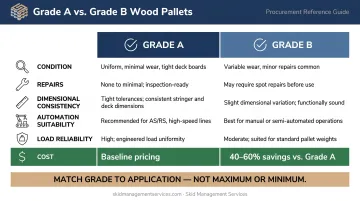
| Factor | Grade A | Grade B |
|---|---|---|
| Condition | Near-new; minimal visible wear | Functional; visible wear and repairs |
| Repairs | Little to none | 1–2 minor board repairs typical |
| Dimensional consistency | High; predictable across units | Moderate; slight variation possible |
| Load reliability | Consistent; closest to spec | Good; verify for heavy or racking loads |
| Automation suitability | Yes | No — tolerances too variable |
| Cost | Higher | Meaningfully lower (40–60% savings vs. new) |
The Decision Framework
Choose Grade A when:
- Your operation runs automated conveyor or AS/RS systems
- Pallets will be inspected by retail customers or auditors
- Loads are heavy, fragile, or destined for high-bay racking
- Food-grade or pharmaceutical compliance is required
Choose Grade B when:
- You need reliable structural performance at reduced cost
- Applications are general warehousing, distribution, or internal manufacturing flow
- Pallets are used in one-way or limited-cycle outbound shipments
- Budget is a constraint but structural failure is not an acceptable risk
Once you know which grade fits each application, the next challenge is sourcing both without managing separate vendor relationships. Skid Management Services carries Grade A and Grade B block pallets through its supplier network, so operations can match grade to application under a single account — with consistent pricing and no supply gaps.
For high-volume accounts running 500+ pallets per month, the closed-loop program — scheduled delivery, simultaneous pickup, and trade-in credits — cuts net pallet cost further while keeping procurement straightforward.
Frequently Asked Questions
What does a Grade B block pallet mean?
A Grade B block pallet is a used block-style pallet that has been repaired — typically including replaced deck boards, reinforced blocks, or added mending plates — but remains structurally sound and safe to load. It shows visible wear and may have slight dimensional variation across units. In commercial grading conventions, Grade B is equivalent to the #2 classification.
What is the weight capacity of a Grade B block pallet?
There's no single universal figure — capacity depends on the unit and extent of repair. Standard 48x40 block pallets generally range from 2,500–3,000 lbs static, 2,000–2,800 lbs dynamic, and 1,500–2,200 lbs racking. Confirm specifications with your supplier before use in racking systems or under heavy loads.
What are Grade C pallets?
Grade C pallets (also called utility or #3 pallets) have extensive wear, multiple significant repairs, and reduced structural reliability. They're generally suited only to one-time non-critical shipments, scrap recovery, or wood recycling programs — not standard warehousing, racking, or repeated-cycle applications.
How do Grade B block pallets differ from Grade B stringer pallets?
Construction is the key distinction. Block pallets use 9 wooden blocks and maintain true 4-way entry even after repairs, while stringer pallets use 3 parallel boards that are harder to fully restore. Block pallets also distribute weight across more contact points, which typically means better load performance post-repair than a comparable Grade B stringer pallet.
Are Grade B block pallets safe to use?
Yes — Grade B reflects repair history and cosmetic wear, not structural failure; these pallets are sound and safe to load. Inspect each pallet visually upon delivery for transit damage, and confirm load ratings match your application before placing them in racking or under heavy loads.