This scenario plays out regularly at US export ports, and the root cause is almost always the same: a mismatch between pallet specifications and ocean freight requirements. Shippers discover too late that the rules governing wood pallets in international trade are stricter — and more specific — than anything they encounter in domestic shipping.
This guide covers the exact specs you need: standard size and dimension limits carriers enforce, ISPM 15 heat treatment requirements for any wood pallet leaving the US, weight and height limits for LCL and FCL shipments, and how to properly secure cargo for ocean transit.
Key Takeaways
- The standard US pallet footprint is 48" × 40" (1,219 mm × 1,016 mm)
- LCL skids are typically capped at 119" L × 80" W × 70" H per carrier CFS guidelines
- Most carriers enforce a 2,200 lb per-skid weight limit at CFS facilities (operational limit, not a federal statute)
- ISPM 15 certification is required on all wood pallets leaving the US for any international destination
- Pallets must provide full forklift and pallet jack clearance for CFS handling — block pallets with 4-way entry are preferred
Ocean Freight Pallet Size and Dimension Requirements
The Standard US Footprint
The 48" × 40" pallet (1,219 mm × 1,016 mm) dominates US ocean export traffic. Its dominance comes from broad industry standardization, near-universal forklift compatibility, and how efficiently it loads into standard container configurations. As a planning benchmark per Freightos, a 20-ft container holds approximately 10 standard pallets, while a 40-ft container holds approximately 20 standard pallets.
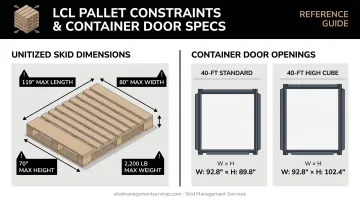
For LCL shipments, carriers and CFS operators typically enforce these operational limits per unitized skid:
- Maximum length: 119 inches
- Maximum width: 80 inches
- Maximum height: 70 inches
- Maximum weight: 2,200 lbs
These are carrier and CFS operational guidelines — not federal statutes. Maersk, for example, publishes different LCL package limits (3,000 kg per single package). Always verify the specific limits with your freight forwarder or CFS before tendering cargo.
Container Door Openings: The Binding Constraint
Many shippers size their palletized units against a container's internal height and miss the real limiting dimension: the door opening.
| Container Type | Internal Height | Door Opening (W × H) |
|---|---|---|
| 40-ft standard dry | ~2.39 m | ~2.34 m × 2.27 m |
| 40-ft high-cube dry | ~2.70 m | ~2.34 m × 2.58 m |
Source: Maersk and MSC container specifications.
A palletized unit must clear the door opening — not just fit inside the container's interior dimensions. High-cube containers offer more vertical flexibility, but only in FCL scenarios.
International Pallet Sizes and Chargeable Volume
Destination pallet formats affect how goods are re-handled after arrival. Common international sizes to be aware of:
- EPAL Euro pallet — 800 mm × 1,200 mm, ~25 kg, safe working load 1,500 kg
- ISO Asia-Pacific — 1,000 mm × 1,200 mm, standard in most Asia-Pacific markets
- Australian standard — 1,165 mm × 1,165 mm
Ocean carriers bill LCL freight on chargeable gross volume — the outermost dimensions of the completed skid (length × width × height), not the actual cargo dimensions. A partially filled skid with an irregular top layer inflates billable cubic meters just as much as a fully loaded one. Keeping your skid profile flat and tight to the pallet edge directly reduces freight costs.
Oversized cargo compliance: Any unit exceeding the standard LCL limits — over 2,200 lbs, 70" height, 119" length, or 80" width — requires carrier pre-approval before the terminal will accept it. Contact your freight forwarder early; last-minute oversized approvals are difficult to secure.
ISPM 15 Compliance: Heat Treatment Requirements for Export Pallets
What the Standard Requires
ISPM 15 (International Standards for Phytosanitary Measures No. 15) requires that all wood packaging material used in international trade be treated to eliminate plant pests. It covers every wood pallet, crate, dunnage, and spool used in a shipment — with a narrow exception for processed wood less than 6 mm thick.
ISPM 15 applies to every wood pallet on every shipment leaving the US for any overseas destination, regardless of shipment size, commodity, or route.
According to USDA APHIS, non-compliant wood packaging material will not be allowed entry into the United States, and IPPC enforcement measures include detention, removal, treatment, destruction, or reshipment — all at the exporter's expense.
Accepted Treatment Methods
Three treatment methods are recognized under ISPM 15:
- Heat Treatment (HT): Wood must reach a core temperature of 56°C for 30 continuous minutes, performed by a USDA APHIS-recognized provider. Accepted by all major signatory countries — the most widely used method for international shipments.
- Dielectric Heating (DH): Requires 60°C for 1 continuous minute throughout the wood profile. Less common but fully compliant.
- Methyl Bromide Fumigation (MB): Still in the ISPM 15 standard but under phase-out pressure from the Montreal Protocol. Country-level acceptance varies — HT is the safer choice for broad international use.
Identifying a Compliant Pallet
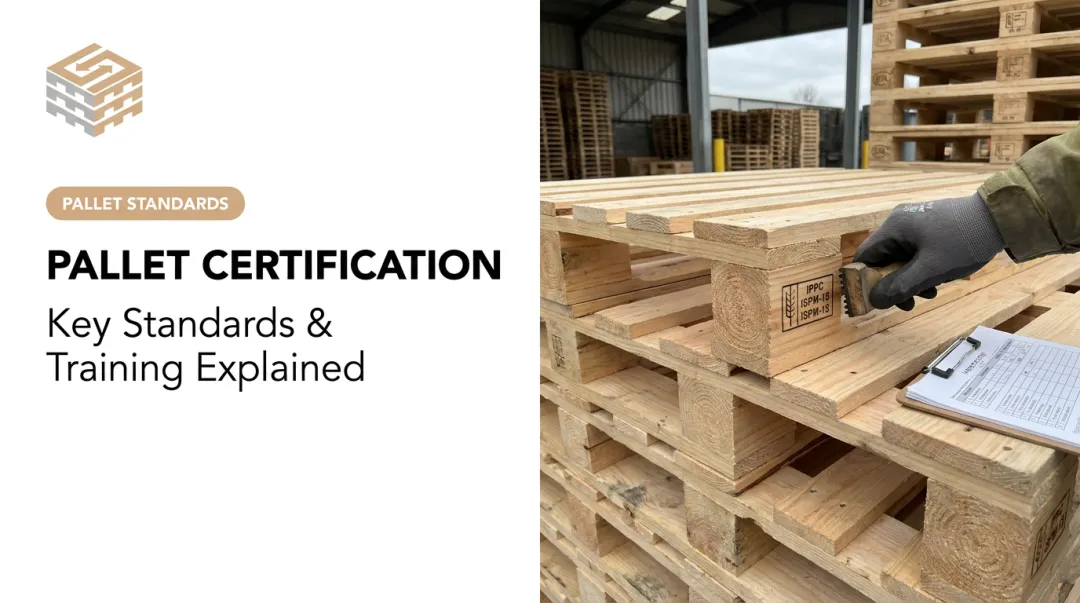
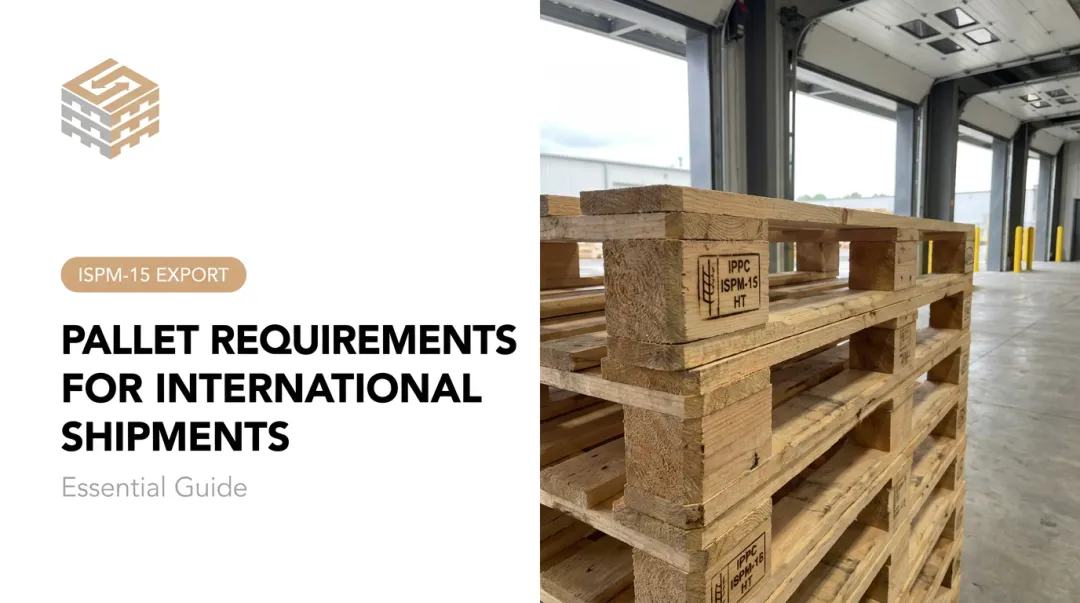
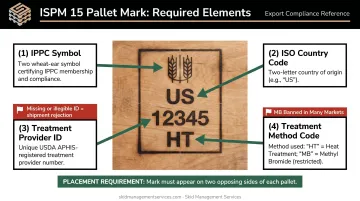
Every ISPM 15-compliant pallet carries a specific mark. Four elements must all be present:
- The IPPC two-leaf symbol
- ISO country code (e.g., "US" for US-treated wood)
- Unique treatment provider ID issued by USDA APHIS
- Treatment method code (HT for heat treatment)
The mark must appear on at least two opposing sides of each pallet, be legible, durable, and applied only by the licensed treatment provider. A smudged mark, a missing element, or a stamp applied by an unauthorized party is grounds for rejection — even if the wood was properly treated.
Why Pallet Sourcing Is Where Compliance Begins
Knowing the four required mark elements is useful — but verification only matters if the pallets were sourced correctly in the first place. Skid Management Services supplies ISPM 15-certified export pallets through USDA APHIS-recognized treatment providers. Before any pallet enters an export shipment, SMS confirms all four required mark elements are present.
If existing inventory lacks valid markings, SMS coordinates re-treatment through its licensed provider network — the only legally permissible way to remediate non-compliant pallets.
One distinction shippers must understand: if you deliver loose cartons to a Container Freight Station for palletizing, the CFS typically assumes responsibility for ISPM 15 compliance on the pallets they supply. If you bring your own pallets, compliance verification falls entirely on you. That distinction should drive your sourcing decision.
Pallet Weight and Height Limits for Ocean Shipping
LCL Weight Limits
The standard LCL operational limit is 2,200 lbs (approximately 1,000 kg) per unitized skid. This is a carrier and CFS operational rule tied to forklift capacity and container floor load ratings — not a regulatory maximum. FCL shipments have more flexibility, but specific limits vary by carrier.
Exceeding 2,200 lbs without advance carrier approval typically results in:
- Refusal at the CFS terminal
- Oversized cargo surcharges if pre-approved
- Delays while approval is sought after arrival
Height Limits and High-Cube Containers
For LCL ocean freight, most CFS operators enforce a maximum assembled height — pallet base, cargo, and stretch wrap combined — in the range of 60–70 inches. This threshold exists because CFS facilities stack pallets in containers; taller loads exceed safe double-stack clearances in standard containers.
High-cube 40-ft containers (internal height ~106 in., door height ~102 in.) offer more vertical room, but access to high-cube equipment is typically limited to FCL scenarios where you control the entire container.
Load Stability and Weight Distribution
As pallet height increases, so does the center of gravity — raising the risk of tip-over during ocean swells. The CTU Code (IMO/ILO/UNECE Code of Practice for Packing of Cargo Transport Units) specifically advises keeping the center of gravity low and securing cargo against both sliding and tipping.
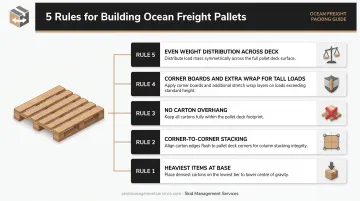
Apply these rules when building ocean freight pallets:
- Place heaviest items at the base, lighter items on top
- Stack boxes corner-to-corner to maximize compression strength — never pyramid-stack
- Ensure no carton overhangs the pallet edge
- Reinforce loads taller than 48" with corner boards and additional stretch wrap passes
- Distribute weight evenly across the entire deck surface
How to Properly Palletize and Secure Cargo for Ocean Freight
Core Palletizing Steps
Ocean freight subjects pallets to significantly more movement, vibration, and humidity than domestic truckload or LTL shipments. The palletizing process needs to account for that.
- Label all cartons before stacking — remove old labels to avoid scanning errors at the CFS
- Build from the bottom up with the heaviest items on the base layer
- Keep the top of the load flat — irregular tops create unstable strapping contact points
- Place angle boards (angled fiberboard) between layers to distribute compression and prevent crushing
- Eliminate overhang — any carton extending beyond the pallet edge creates instability and can trigger terminal rejection
Securing Methods
A properly secured ocean freight pallet uses multiple retention systems working together:
- Stretch wrap: Apply multiple layers, starting with a tight pass at the pallet deck. Heavier gauges provide greater containment force for denser or taller loads.
- Strapping bands: Use at least two tightly tensioned bands (polypropylene, polyester, or steel) threaded through the pallet voids and around all cartons.
- Pallet cover / top sheet: Apply plastic film over the top surface to protect against moisture during transit, a particular concern in ocean containers where temperature swings drive moisture buildup.
Skid Management Services supplies stretch film, strapping, and pallet covers across multiple specifications — making it straightforward to source all three retention systems from a single supplier.
Labeling and Documentation
Each pallet should carry shipper and consignee information on the exterior. Cargo descriptions belong in the commercial invoice and packing list submitted electronically — not written directly on cartons.
Two documents matter most at the CFS:
- Dock receipt: Issued when cargo is delivered to the terminal; records the number of pieces delivered. Failing to note the exact box count leaves no proof of delivery if a dispute arises.
- Warehouse receipt: Confirms the CFS completed palletizing correctly. Retain this as your verification that the shipment was built and accepted per spec.
LCL vs. FCL: How Shipping Method Affects Pallet Requirements
How They Differ in Practice
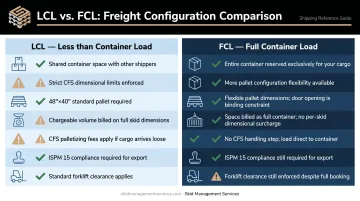
LCL (Less than Container Load): Your cargo shares container space with other shippers' goods and moves through a Container Freight Station for consolidation. Strict dimensional and weight limits apply — the CFS needs to co-load multiple shippers' cargo efficiently. Standard 48" × 40" pallets that conform to CFS limits minimize dead volume charges and keep your freight costs predictable.
FCL (Full Container Load): You book an entire container. More flexibility on pallet configuration, though ISPM 15 and forklift clearance rules still apply. Size your palletized units against the door opening — not just the internal container dimensions — or you'll hit an unexpected obstacle at the loading dock.
CFS Palletizing Fees and Cost Implications
LCL shippers who deliver loose cartons to a CFS without prior unitization will be charged a palletizing fee. Based on available industry data, fees can range from roughly $35 to $129+ per pallet depending on the CFS, labor, materials, and market. One current CFS rate sheet shows charges including $10 per pallet for shrink wrap and $129 for the first pallet.
The CFS will also recalculate your chargeable volume after palletizing — which can increase your freight invoice if the completed skid is larger than your original cargo estimate.
Shippers who arrive with pre-palletized, CFS-ready skids on ISPM 15-compliant pallets gain a clear advantage:
- Avoid the palletizing fee entirely
- Retain direct control over ISPM 15 compliance
- Know their chargeable volume before reaching the terminal
Common Pallet Compliance Mistakes That Delay Shipments
Physical Compliance Failures
Most physical rejections are avoidable. The table below covers the five most common mistakes and what they cost you at the port.
| Mistake | Consequence |
|---|---|
| Non-ISPM 15 pallets (unmarked or reclaimed wood) | Confiscation and destruction at destination; APHIS Emergency Action Notification issued |
| Exceeding size or weight limits without carrier pre-approval | Refusal at origin CFS; shipment misses vessel cutoff |
| Cargo overhanging pallet edges | Terminal rejection; re-palletizing fees and delays |
| Inadequate securing — load shift or collapse during CFS inspection | Carrier liability disputes; potential cargo damage claims |
| Stamps applied by unauthorized parties | Pallet treated as non-compliant regardless of actual wood treatment |
Documentation-Related Mistakes
These are preventable with a simple pre-shipment checklist:
- Not recording the box count on the dock receipt — leaves no proof of delivery if pieces go missing
- Writing cargo contents on carton exteriors instead of capturing them in the commercial invoice and packing list
- Failing to retain the warehouse receipt from the CFS — this is your confirmation that palletizing was completed correctly and to spec
Sourcing ISPM 15-compliant pallets from a verified supplier before cargo reaches the terminal eliminates the most expensive category of delays. Re-palletizing fees, vessel rebooking charges, and destroyed cargo all compound quickly — costs that a proper pallet purchase prevents at the start.
Frequently Asked Questions
How much does it cost to ship a 500 lb pallet via ocean freight?
Ocean freight pricing for a 500 lb pallet depends on chargeable volume, origin and destination ports, and whether the shipment moves LCL or FCL. LCL shipments are typically quoted on a per-cubic-meter basis. Request a quote from your freight forwarder with exact assembled skid dimensions — length, width, and height including stretch wrap.
How tall can a pallet be for ocean freight?
For LCL ocean freight from the US, most carriers and CFS operators enforce a maximum assembled height in the range of 60–70 inches (pallet base + cargo + wrapping). Loads taller than this require carrier pre-approval and are generally only accommodated in FCL shipments using high-cube containers.
What is ISPM 15 and does it apply to all ocean freight pallets?
ISPM 15 is an international phytosanitary standard requiring wood pallets used in international trade to be heat-treated and marked with an official certification stamp. It applies to all wood pallets on any shipment leaving the US for an overseas destination, regardless of shipment size, commodity, or destination country.
What is the maximum weight for a pallet in LCL ocean freight?
The standard LCL operational limit is 2,200 lbs (approximately 1,000 kg) per skid. This is a carrier and CFS operational guideline — specific limits vary by carrier. Units exceeding this weight require advance approval from the ocean carrier and may incur oversized cargo surcharges.
Can I use plastic pallets for ocean freight?
Plastic pallets are not subject to ISPM 15 since they don't carry phytosanitary risk, but they must still meet forklift clearance requirements and carrier size and weight limits. For most international shipments, ISPM 15 heat-treated wood pallets remain the accepted standard — contact Skid Management Services at 717-202-0304 for export-compliant pallet supply.
What happens if my pallets are rejected at the port?
Pallets failing ISPM 15 requirements are typically confiscated and destroyed at the destination country's border at the exporter's expense. Pallets exceeding size or weight limits may be refused at the origin CFS before the vessel loads — either outcome means delays, added costs, and potential cargo loss.
Skid Management Services supplies ISPM 15 heat-treated export pallets in all standard sizes — GMA 48" × 40", 48" × 48", Euro-equivalent, and custom export-spec builds — sourced through USDA APHIS-recognized treatment providers, available 24/7. For urgent export pallet needs or compliance questions, call 717-202-0304 or email Info@SkidManagementServices.com.