
Yet businesses routinely struggle with three specific problems: picking the wrong pallet size for their load, getting surprised by freight bills they didn't expect, and watching goods arrive damaged because of poor load preparation. Each mistake is preventable.
This guide covers all three — pallet types and sizes, what drives shipping costs, and how to properly prepare and secure a palletized shipment.
Key Takeaways
- The North American standard pallet is 48" x 40" (GMA), compatible with most trailers and warehouse systems
- LTL freight pricing depends on weight, dimensions, freight class, and lane — not a flat per-pallet rate
- Overhang beyond pallet edges reduces carton compression strength by up to 32% — zero overhang is the target
- Misclassifying freight class triggers carrier reclassification fees and surprise invoice adjustments
- Every shipment needs a completed Bill of Lading; without one, freight claims cannot be filed
Pallet Types: Choosing the Right Material for Your Shipment
A pallet is a flat, portable platform that supports stacked goods and allows forklift or pallet jack movement. One distinction worth making early: a pallet has both top and bottom deck boards, while a skid has only the top deck. The terms get used interchangeably in practice, but the structures differ — skids are less stable and better suited to light, flat loads.
Wood Pallets
Wood is the dominant choice across North America. A 2023 Modern Materials Handling pallet survey found 94% of respondents used wood pallets in their supply chain — and for good reason: low cost, wide availability, and the ability to handle heavy industrial loads.
Two main designs:
- Stringer pallets — two-way forklift entry, suited for standard domestic shipments; USDA data shows stringer pallets held 76% market share in 2016
- Block pallets — four-way forklift entry, better for heavier loads and international shipments requiring ISPM-15 heat treatment
Skid Management Services stocks new, used, and custom wood pallets — including standard GMA 48x40s and block pallet configurations — supplying food manufacturers and consumer goods companies nationally through their own inventory and a wide supplier network.
When Wood Isn't Enough
For most industrial and food manufacturing applications, wood handles the job. In specialized cases — extreme load weights, highly regulated cleanroom environments — metal or composite materials may come into play, though these are niche applications that fall outside standard supply chain procurement.
If you're unsure whether a standard wood pallet fits your load profile, confirming specs with your supplier before ordering at volume saves rework downstream.
Matching Pallet Type to Your Needs
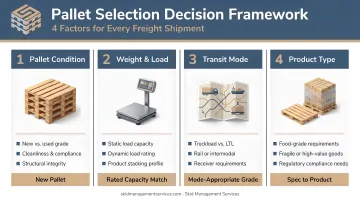
Use this framework before ordering:
- Product weight and fragility — heavy industrial loads need standard or block wood pallets; fragile goods benefit from block pallets with four-way entry for more stable handling
- Single-use vs. return — wood is practical for one-way shipments; high-frequency return loops may warrant a different procurement strategy
- Regulatory requirements — international shipments require ISPM-15 heat-treated wood pallets; confirm compliance before booking freight
- Carrier/3PL compatibility — confirm your pallet size meets the dimensional requirements of your freight carrier or warehouse partner before ordering at volume
Standard Pallet Sizes and Weight Capacities
The North American standard is the 48" x 40" GMA pallet (also called the CBA pallet). It dominates for practical reasons: it fits standard warehouse racking, slides cleanly into 53-foot dry van trailers, and is compatible with virtually every forklift and pallet jack in commercial use. Kamps Pallets notes a minimum static load capacity of 2,500 lb for GMA-spec pallets, though actual capacity varies by pallet grade and condition.
Keep loaded pallet height in mind. Amazon's freight receiving program caps incoming pallets at 72 inches; many carriers and 3PLs set their own limits. Check your carrier's routing guide before stacking high.
Other Common Pallet Sizes
| Size | Typical Industry Use |
|---|---|
| 42" x 42" | Telecom, paint |
| 48" x 48" | Industrial drums, bulk materials |
| 40" x 40" | Dairy industry |
Non-standard sizes can create compatibility issues with warehouse racking and trailer configurations. If your freight regularly moves through a 3PL or dedicated carrier network, confirm size acceptance before switching from the GMA standard.
Pallet dimensions also affect how carriers price your shipment — specifically through freight class.
How Pallet Dimensions Affect Freight Class
LTL carriers price freight based on density — calculated as pounds per cubic foot. A lower-density shipment gets assigned a higher freight class, which means a higher rate.
To calculate density: multiply L × W × H (in inches), divide by 1,728 to get cubic feet, then divide shipment weight by that cubic footage.
A quick density-to-class reference from Estes:
| Density (lb/ft³) | Freight Class |
|---|---|
| Less than 1 | 400 |
| 1–2 | 300 |
| 4–6 | 175 |
| 6–8 | 125 |
| 10–12 | 92.5 |
| 30–35 | 60 |
| 50+ | 50 |
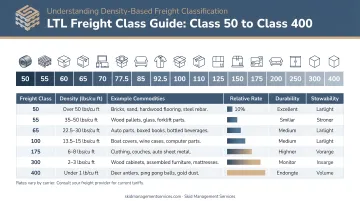
Oversized or non-standard pallets increase your cube, reduce your density, and push you into higher — and more expensive — freight classes.
How Many Pallets Fit in a Truck
- LTL shipments: typically 1–10 pallets per load
- 53-foot dry van: 26 straight floor positions (up to 30 with pinwheeling, carrier-dependent)
- FTL threshold: most carriers consider FTL appropriate at 12+ pallets
Maximizing trailer utilization directly cuts cost-per-pallet at high volume.
Pallet Shipping Costs: What Affects Your Rate
There's no universal flat rate for shipping a pallet. What you pay depends on weight, dimensions, freight class, lane, and any accessorial services applied. uShip's LTL distance estimates give a general sense of the range: $0.50–$2.50 per mile depending on distance, with shorter hauls costing more per mile than longer ones.
Weight, Dimensions, and Freight Class
Carriers bill based on actual weight vs. dimensional weight — whichever is greater. Pallet height, width, and overhang all affect billable weight and freight class assignment.
Freight class runs from 50 to 500 under the National Motor Freight Classification (NMFC) system, determined by four factors:
- Density
- Stowability
- Handling difficulty
- Liability
Misclassifying freight class is one of the most common causes of unexpected invoice adjustments. ODFL's tariff imposes a $25 per shipment fee when the bill of lading description is inaccurate and the freight requires reweighing or reclassification.
Distance, Lane, and Fuel Surcharges
Origin-to-destination distance is a primary cost variable. Regional shipments cost significantly less than cross-country lanes, and carrier network density on specific routes affects pricing. Fuel surcharges compound this — Estes adjusts its surcharge every Tuesday based on DOE diesel prices, and ODFL's LTL surcharge reached 44.32% in mid-2026 tied to diesel at $5.35/gallon.
LTL vs. FTL
| LTL | FTL | |
|---|---|---|
| Best for | 1–10 pallets | 12+ pallets |
| How it works | Shared trailer space | Dedicated trailer |
| Per-pallet cost | Higher | Lower at volume |
| Handling | Multiple touchpoints | Direct |
| Flexibility | High | Requires full load |
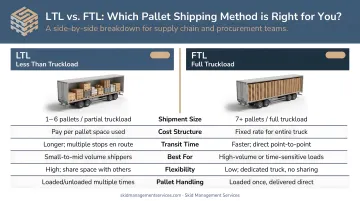
For LTL shipments, pallet consistency affects more than cost. Non-standard or damaged pallets trigger carrier rejections at pickup, forcing re-palletizing — a delay and added fee that's entirely avoidable at the sourcing stage. Skid Management Services supplies consistently sized pallets that meet carrier requirements, reducing rejection risk before the shipment is booked.
Accessorial Charges to Know
These fees frequently surprise shippers. Based on ODFL's current tariff:
- Liftgate service: $4.40/cwt, $105 minimum
- Residential delivery: $7.20/cwt, $115 minimum
- Inside delivery: $7.70/cwt, $115 minimum
- Reweigh/reclassification: $25 per shipment
Liftgate and residential fees are the two most commonly overlooked charges — confirm delivery location type with your consignee before booking to avoid surprises on the back end.
How to Prepare, Stack, and Secure a Pallet Shipment
Pre-Loading Inspection
Before anything goes on the pallet:
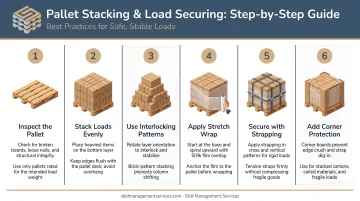
- Inspect the pallet — check for broken boards, protruding nails, and structural damage
- Confirm the pallet fits your load — the load should not extend beyond the pallet edges
- Plan layer order — note product dimensions and weight distribution before stacking
Stacking Methods
XPO's 2024 freight packaging guide identifies two recommended approaches:
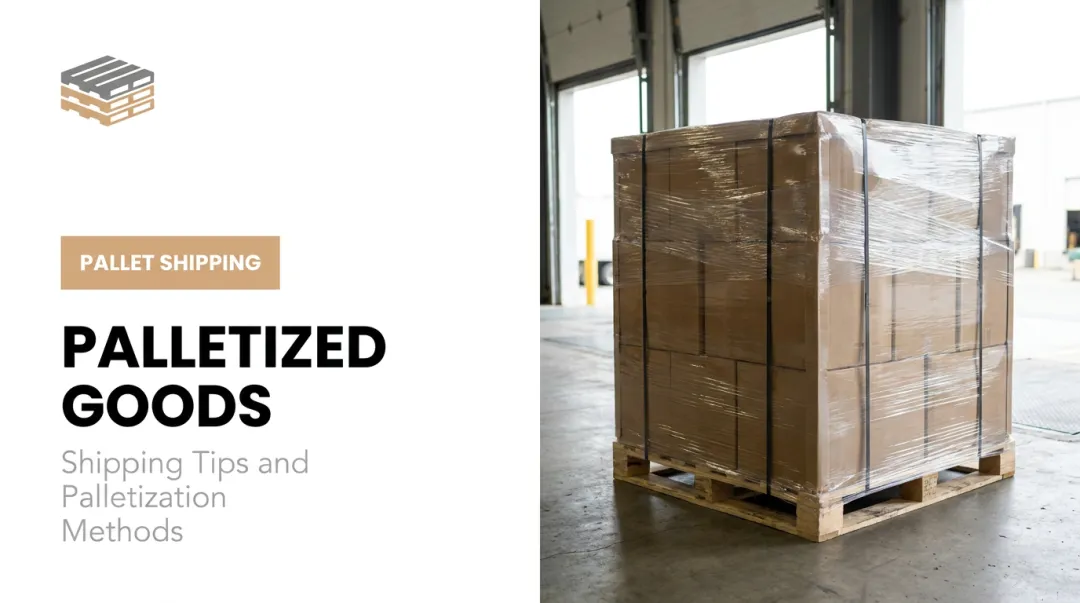
- Column stacking: boxes stacked in straight vertical columns — maximizes compression strength, best when box strength matters
- Interlocking (brick pattern): boxes offset for stability — works well with rigid contents, but XPO notes it can reduce compression strength by up to 50% compared to column stacking
Avoid pyramid stacking entirely. And keep all loads within pallet edges — FedEx confirms that overhang reduces corrugated carton compression strength by up to 32%.
Follow these stacking fundamentals for every load:
- Place heaviest items on the bottom, lighter items on top
- Use flat cardboard layer pads between tiers to distribute weight evenly
- Fill gaps between boxes with cardboard or foam to prevent shifting
Securing the Load
Three securing methods cover most load types. Choose based on weight, shape, and fragility:
- Stretch wrap: start at the base, work upward, double-wrap in opposite direction at the top; Lantech recommends at least three layers at both the top and base
- Strapping/banding: for heavier or irregularly shaped loads where stretch wrap alone isn't sufficient
- Corner and edge boards: protect box edges and increase vertical stacking strength on taller loads
Loads that don't fill the full pallet footprint should be centered and banded to the nearest deck boards.
Labeling and Documentation
Every pallet label must include:
- Sender and receiver name and address
- Origin and destination zip codes
- Special handling instructions ("Fragile," "This Side Up," "Do Not Stack")
Place labels on the side of the pallet at shoulder height for forklift operator visibility.
Every shipment requires a Bill of Lading (BoL). Under 49 CFR Part 373, for-hire carriers must issue a BoL documenting cargo details, carrier information, and the condition of goods at pickup.
At delivery, inspect the shipment and note any damage on the BoL before signing. Without that notation, freight insurance claims cannot be filed.
Common Pallet Shipping Mistakes to Avoid
Structural Mistakes
- Load overhang — any extension beyond pallet edges reduces compression strength by up to 32% and increases damage risk
- Damaged pallets — repaired or structurally compromised pallets can fail under load stress; always inspect before use
- Top-heavy stacking — pyramid or unbalanced loads create unstable center of gravity during transport
Documentation and Labeling Errors
- Incomplete labels — illegible or missing address information leads to rerouting, delivery delays, or lost shipments
- Unsigned BoL damage notation — failing to note arrival damage on the Bill of Lading at delivery voids freight claims; it's the most common reason valid claims get denied
Cost Mistakes
- Freight class misclassification — leads to carrier reclassification fees and unexpected charges; run the NMFTA density calculation before assigning a class
- Skipping rate comparisons — LTL rates can differ by 20–40% between carriers on the same lane; get at least two or three quotes before booking
Frequently Asked Questions
How much does it cost to ship a pallet?
LTL pallet shipping depends on weight, dimensions, freight class, lane distance, and accessorial services. No flat rate applies. Industry estimates generally place LTL costs at roughly $0.50–$2.50 per mile, with short regional hauls landing at the higher end of that range.
What is the standard pallet size in the US?
The North American standard is 48" x 40" (GMA pallet). It's compatible with most freight trailers, warehouse racking systems, and forklift equipment, and carries a minimum static capacity of approximately 2,500 lb.
What is the difference between LTL and FTL pallet shipping?
LTL is shared trailer space for smaller loads (generally 1–10 pallets), while FTL dedicates an entire trailer to one shipper. FTL offers a lower per-pallet rate at high volumes; LTL is more flexible but involves more handling and higher per-unit cost.
How many boxes fit on a standard pallet?
It depends on box dimensions, stacking method, and height limits. A pallet load calculator is the most practical planning tool. Check your carrier's height requirements, as limits typically range from 72 to 84 inches depending on the carrier.
What is the difference between a pallet and a skid?
A pallet has both top and bottom deck boards. A skid has only the top deck. The terms are often used interchangeably, but skids are structurally less stable and better suited to flat, lighter loads.
How do you properly secure a pallet for shipping?
Start stretch wrap at the base with at least three layers, work to the top, and double-wrap back down. Use strapping for heavy or irregular loads, and corner boards on taller stacks. No load should overhang the pallet edges.