Introduction
Supply chain teams are under real pressure right now. U.S. business logistics costs hit $2.3 trillion in 2024, equal to 8.7% of national GDP — and with trucking operating costs reaching $2.26 per mile, every line item in the logistics budget is getting scrutinized.
Pallets rarely top the list of priorities. They should.
Most operations teams don't rethink their pallet strategy until something goes wrong: a damage claim, a racking mismatch, a production line that stops because pallets aren't showing up. By then, the costs are already compounding.
This article breaks down how custom pallet solutions directly improve specific operational outcomes — space utilization, product protection, equipment compatibility, and supply reliability — and how to act before the disruptions start.
Key Takeaways
- Custom pallets are engineered to your product's dimensions, weight, and handling environment — not built to a universal size
- Core advantages: better space utilization in freight and warehousing, fewer damaged goods in transit, and equipment-compatible design for consistent flow
- Standard pallets create hidden costs — wasted truck space, damage claims, and handling delays — that add up across every shipping cycle
- The upfront investment in custom specifications pays back through lower replacement rates, fewer claims, and reduced freight spend
- Supply reliability matters as much as design — custom specs only work if pallets arrive on schedule
What Are Custom Pallet Solutions?
A custom pallet is built to a specific business's actual requirements — load dimensions, weight distribution, material type, and handling environment — rather than defaulting to a standard size like the common 48x40 GMA.
That 48x40 is the most common size in the U.S., but it still only represents about 35% of new wood pallets produced. Custom sizes account for roughly 39% of new wood pallet production, according to a USDA Forest Service study — meaning the industry already builds more custom pallets than standard ones by volume.
Where Custom Pallets Are Typically Used
Custom pallets make sense in several specific situations:
- Products that overhang, underlap, or waste significant space on a 48x40
- Automated warehouse and conveyor systems with tight dimensional tolerances, where inconsistencies cause equipment errors
- Food-grade or pharmaceutical environments where hygiene compliance and load integrity affect regulatory status
- International export shipments requiring ISPM-15 heat-treated wood certified to USDA APHIS standards — Skid Management Services offers a dedicated service for exactly this requirement
- High-value or fragile loads where standard deck spacing doesn't provide sufficient support
Custom pallets aren't a premium upgrade — they're a fit decision. When product dimensions, pallet design, and handling systems align, the operational impact shows up directly in cost and throughput.
Key Advantages of Custom Pallet Solutions
Advantage 1: Maximized Space Utilization Across Freight and Warehousing
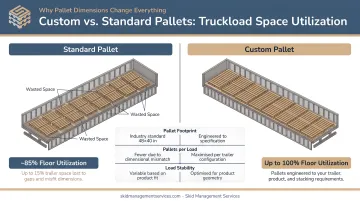
Standard pallets are sized for broad compatibility, not for your specific product. When the pallet footprint doesn't match the load, space gets wasted — in the truck, in the rack, and across every shipment.
The scale of the problem shows up clearly in the numbers. A Flock Freight survey of 1,000 transportation decision-makers found that 43% of truckloads moved partially empty in 2023, with an average of 29 linear feet of unused deck space per shipment.
Right-sized pallets don't solve all of that — but they address a meaningful share, particularly for businesses whose product dimensions don't naturally align with a 48x40 footprint.
What better space utilization looks like in practice:
- Tighter, more stable load stacking per truckload
- Higher pallet density per truck without compromising load safety
- Better alignment with warehouse racking dimensions, freeing up positions
- Fewer trips needed to move the same volume of product
On the warehousing side, national average industrial asking rent hit $10.13 per square foot in Q4 2024, according to Cushman & Wakefield. Every rack position saved through a better-fitting pallet has a real dollar value — especially for operations running near full racking capacity.
KPIs this affects: cost per shipment, trailer utilization rate, warehouse storage density, freight spend as a percentage of revenue.
This advantage is most pronounced at high shipping volumes, in operations paying per truckload or per pallet position, and in warehouses where racking is consistently near capacity.
Advantage 2: Reduced Product Damage and Lower Loss Rates
A pallet that doesn't match the load doesn't just waste space — it creates risk. Incorrect deck board spacing, under-rated construction, and a footprint that doesn't support the product's weight distribution all contribute to load shifting, compression damage, and transit failures.
Custom pallets are engineered to prevent this. Proper deck spacing, load-rated stringer construction, and a footprint sized to the actual product reduce movement during transport and handling — the primary causes of in-transit damage.
The cost of getting this wrong is significant. A Flock Freight benchmark reported an average LTL damage rate of 1.94%, an average claim cost of $3,777, and enterprise shippers spending up to $6.3M annually on damage and loss.
In food and beverage specifically — an industry Skid Management Services actively serves, including customers like Campbell Snacks, Knouse Foods, and Nissin — a 2023 F&B study found damage and loss cost the average shipper more than $6M annually, with 100% of surveyed shippers reporting partially wasted shipments.
Each damage incident generates compounding costs:
- Replacement inventory procurement
- Freight claim processing time and administrative overhead
- Customer relationship strain from missed or short shipments
- Potential compliance exposure in food, pharma, or electronics
KPIs this affects: product damage rate, freight claim frequency and value, cost of goods replaced, customer complaint rate.
This advantage matters most for fragile, high-value, or perishable products; for loads moving long distances or through multi-modal transport; and in industries with strict product integrity standards.
Advantage 3: Operational Consistency Through Equipment Compatibility and Supply Reliability
Custom pallets are specified to work with a business's actual handling equipment — forklifts, conveyors, automated sorters, racking systems. In a high-throughput warehouse, even a small mismatch carries a measurable cost.
The downtime costs add up fast. Pallet Enterprise, citing research from Penn State, reported that bad pallets cost FMCG manufacturers $15,000 or more per production stoppage incident. Disruptions to automated systems can cost approximately $4,000 per minute, with daily downtime costs potentially reaching $480,000.
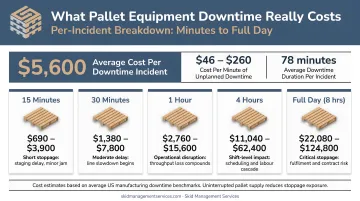
A broken deck board mid-shift, a pallet that doesn't seat correctly in an automated sorter, inconsistent dimensions that slow conveyor throughput — these aren't dramatic failures, but they add up across hundreds of handling cycles per day.
Consistent pallet specifications deliver:
- Predictable handling with fewer interruptions
- Reduced equipment wear from repeated misalignment
- Warehouse workflows that run at planned cycle times
- Lower labor hours spent on pallet-related workarounds
Consistent specs solve the day-to-day handling problem — but none of that matters if the pallets aren't available when you need them. A well-designed custom pallet program that runs dry during peak season creates exactly the kind of disruption it was meant to prevent.
Skid Management Services maintains both its own inventory and an expansive national network of pallet and packaging suppliers. That dual-source model helps ensure uninterrupted supply even when demand spikes or regional availability tightens.
KPIs this affects: equipment downtime rate, order fulfillment cycle time, pallet rejection rate, on-time shipment rate, labor hours lost to pallet-related issues.
This advantage is most critical for automated or high-throughput operations, businesses running just-in-time inventory models, and high-volume manufacturers where a pallet shortage stops production.
What Happens When Custom Pallet Solutions Are Ignored
Most businesses don't make a conscious decision to use standard pallets. They inherit the practice and never revisit it — until the problems become visible.
The typical pattern looks like this:
- Inconsistent load stability generates recurring damage claims, but each claim is handled as a one-off rather than a systemic issue
- Pallets that don't fit racking dimensions create positioning workarounds that directly cut into available storage capacity
- A single-source pallet supplier hits a supply disruption and receiving or shipping halts
What this costs operationally:
- Manual re-palletizing pulls labor from higher-value work
- Equipment workarounds for dimensional mismatches increase wear and slow cycle times
- Management time shifts to damage control, pulling focus from actual process improvement
- Inventory accuracy suffers when inconsistent pallet sizes create gaps in automated scanning or counting systems
These costs are manageable at lower volumes. The scaling problem is where they become structural. Standard pallet programs that were "good enough" at moderate throughput amplify every inefficiency as volume grows — damage rates climb, labor hours compound, and storage workarounds that once seemed minor start constraining capacity. A pallet spec that was never designed for the operation doesn't just underperform at scale. It creates friction at every step that was already working.
How to Get the Most Value from Custom Pallet Solutions
Getting value from a custom pallet program starts before the first order is placed.
Start with an Operational Audit
Document what you actually have before specifying anything:
- Actual product dimensions and weight ranges (not just the SKU with the highest volume)
- Equipment in use — forklift entry configurations, conveyor dimensions, racking specifications
- Environmental factors: temperature ranges, humidity, chemical exposure
- Shipping lanes and transit conditions, including whether export shipments require ISPM-15 compliance
Treat Pallet Design as a Specification Process
Ordering a custom pallet is not like ordering a non-standard size from a catalog. A supplier worth working with will:
- Ask detailed questions about load requirements and handling conditions
- Offer consultation on design decisions rather than defaulting to standard specs
- Provide prototype validation before committing to full production volume
Skid Management Services includes custom design consultation as part of its pallet program, which is particularly useful for businesses that haven't yet documented their requirements in detail.
Build in Ongoing Review
A custom pallet specification is a snapshot of current operational conditions. Product lines change. Shipping volumes grow. Warehouse systems get upgraded. A specification designed for last year's operation may be drifting toward a mismatch by next year.
Schedule periodic reviews at minimum annually, or whenever a significant operational change occurs. The cost of a review is negligible compared to the cost of sourcing pallets against an outdated spec across thousands of shipments.
Conclusion
Custom pallet solutions don't fix operations in a single dramatic move. The gains accumulate steadily: better space use per shipment, fewer damage claims, less unplanned downtime. Over months and years, those incremental improvements add up to real cost advantages.
Realizing that value depends on execution — the right specification for your actual operational conditions, and a supply partner who can deliver consistently as your business changes.
For businesses ready to move past standard pallet programs, Skid Management Services supports that transition — from initial specification through ongoing supply. Contact the team at 717-202-0304 or Info@SkidManagementServices.com.
Frequently Asked Questions
How much does a custom pallet cost?
Custom pallet pricing depends on dimensions, construction complexity, wood grade, and order volume. While the per-unit cost may exceed standard pallets, the reduction in damage claims and freight waste typically offsets the difference for most recurring orders. Contact Skid Management Services for a quote based on your specific requirements.
What is the difference between custom pallets and standard pallets?
Standard pallets like the 48x40 GMA are built to universal dimensions for broad compatibility. Custom pallets are engineered to a specific product's size, weight, and handling environment. Better fit means fewer product shifts in transit, reduced damage, and smoother handling through your facility.
What materials are custom pallets typically made from?
Skid Management Services' custom pallets are wood-based — cost-effective, repairable, and the most widely used material in B2B logistics. Heat-treated ISPM-15 certified wood is also available for export shipments.
Which industries benefit most from custom pallet solutions?
Food and beverage, pharmaceutical, electronics, and manufacturing operations see the strongest benefit — typically because standard pallets fail to meet hygiene requirements, automation tolerances, or fragility thresholds specific to those industries.
How long does it take to receive a custom pallet order?
Lead times vary by design complexity, order volume, and supplier availability. Simple modifications turn around faster than fully engineered builds. Skid Management Services' national supplier network helps reduce lead times and maintain supply continuity even for non-standard specs.
Can custom pallets be reused or recycled?
Yes. Most custom wood pallets can be repaired, remanufactured, or recycled — 95% of wooden pallets are recycled according to NWPCA research. Custom designs built to actual load requirements also tend to last longer than generic alternatives, lowering total cost of ownership.