
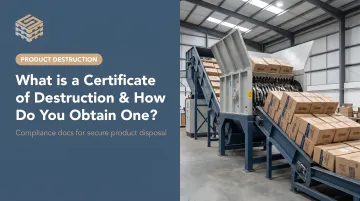
A Certificate of Destruction (COD) is the document that closes that gap. It confirms destruction was completed, transfers documented liability, and gives you something concrete to show during an audit.
This article covers what a COD is, the different forms it takes across industries, what it must include, and exactly how to obtain one.
Key Takeaways
- A COD is a compliance record — not just a receipt — confirming that specific materials were permanently destroyed per applicable regulations
- Without a COD, your business may still be held liable for improper disposal even if you hired a third party
- Different industries use different COD types: document destruction, hazardous waste, vehicle titles, and product disposal
- A valid COD must include material descriptions, destruction date, legal compliance statements, and authorized signatures
- Always verify vendor credentials before initiating destruction; using an uncertified vendor creates legal exposure even if disposal went smoothly
What Is a Certificate of Destruction?
A Certificate of Destruction is a formal compliance record confirming that specific materials, products, data, or equipment have been permanently and properly destroyed in accordance with applicable regulations. Unlike a transaction receipt, it documents that an irreversible, regulated action was completed — not just initiated.
The Liability Transfer Function
The COD's core purpose is to formally transfer responsibility. When you hand materials to a licensed destruction vendor, the COD is the document that records that transfer and confirms it was completed properly. Without it, you remain the last accountable party in the chain.
This connects directly to the "cradle-to-grave" principle under RCRA (Resource Conservation and Recovery Act), which gives the EPA authority to regulate hazardous waste from generation through final disposal. Generators are the first regulated link under 40 CFR Part 262 — meaning legal responsibility doesn't automatically end when you hand materials off. A COD is how that responsibility is formally closed.
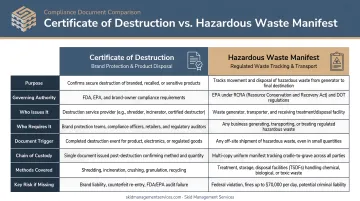
COD vs. Manifest — They're Not the Same
These two documents are frequently confused:
| Document | What It Does |
|---|---|
| Hazardous Waste Manifest | Tracks the shipment and intended destination of hazardous materials |
| Certificate of Destruction | Confirms destruction was actually completed |
Having a manifest is not sufficient on its own. It proves materials were shipped — not that they were destroyed. Both documents are typically required, and neither replaces the other.
Who Issues a COD?
The COD comes from whoever performs the destruction. Depending on the material type, that could be:
- A licensed shredding or data destruction service
- A hazardous waste disposal facility
- A certified product destruction vendor
- A salvage yard handling end-of-life equipment
Once destruction is complete, the vendor delivers the certificate to the original owner — typically within a few business days of the job closing.
Common Types of Certificates of Destruction
CODs appear across several industries, each governed by different regulations and issued under different circumstances.
Document and Data Destruction
When confidential paper records, hard drives, or electronic media are shredded or destroyed, the vendor issues a COD confirming proper disposal. This applies to:
- HIPAA compliance — HHS requires covered entities to implement reasonable safeguards when disposing of protected health information, including paper records and electronic media
- FACTA Disposal Rule (16 CFR Part 682) — requires proper disposal of consumer report information
- GLB Safeguards Rule — applies to financial institutions handling customer data
For electronic media specifically, NIST SP 800-88 Rev. 2 provides a sample Certificate of Sanitization that documents device identifiers, sanitization method, verification, date, and signature. Vendors certified through i-SIGMA's NAID AAA program undergo scheduled and surprise audits to verify compliance standards.
HIPAA documentation must be retained for six years under 45 CFR 164.530(j).
Hazardous Waste and Product Destruction
When regulated materials — chemicals, pharmaceuticals, expired consumer goods, or recalled products — are disposed of, a COD records the destruction event. The EPA's rules around hazardous waste pharmaceuticals and FDA's guidance on voluntary product destruction both recognize signed destruction receipts and related records as appropriate disposition documentation.
For food manufacturing and distribution operations, this category extends to damaged product shipments, contaminated packaging materials, and recalled items that cannot re-enter the supply chain. Complete documentation for these events typically includes a Certificate of Destruction, a witness statement, and video proof of disposal — all of which support FDA and EPA compliance recordkeeping.
Vehicle and Junk Car COD
When an insured vehicle is deemed a total loss, a COD is issued by the salvage yard or dismantler, permanently removing the vehicle from road use. This is distinct from a salvage title:
- Salvage title — allows for rebuilding and reinspection; the vehicle can potentially return to the road
- Certificate of Destruction — the vehicle is designated for parts or scrap only; it cannot be registered or driven again
Florida processes vehicle CODs through Form HSMV 82363. Under Florida procedures, a COD vehicle may only be used to sell for parts or scrap, and the applicant must certify the vehicle will not be operated on Florida highways. California similarly bars re-titling or re-registration once a Non-Repairable Vehicle Certificate is issued.
What Should a Certificate of Destruction Include?
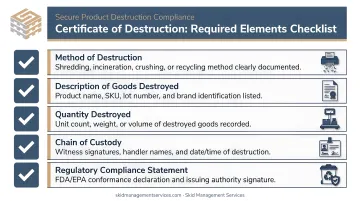
A COD with missing or vague information loses much of its legal value. Frameworks like NIST SP 800-88, Florida HSMV Form 82363, and EPA manifest requirements all specify the same core elements.
Required Identifying Information
- Name of the company or individual receiving the certificate (the generator/owner)
- Name, address, and contact information of the facility performing the destruction
- Name and title of the authorized representative signing the document
Transaction Records
- Work order number that links the COD to the specific service event
- Invoice number connecting the compliance record to the billing record
- Date materials were received and date destruction was performed
Material Description
The COD must specifically describe what was destroyed. Vague entries undermine the document's defensibility. Required specifics vary by context:
- Vehicles: VIN number
- Electronic media: device manufacturer, model, serial number, media type
- Hazardous waste: waste stream description, quantity, EPA waste codes
- Consumer goods: product name, quantity, lot or batch numbers where applicable
Two Critical Statements
Every valid COD should contain:
- Legal/compliance statement certifying destruction was performed in accordance with all applicable federal and state regulations (EPA, DOT, HIPAA, FDA, or others as relevant)
- Accuracy statement certifying all information in the document is true and complete
Signature and Certification Date
The document must be signed by an authorized representative of the destruction company and dated on the day the certification is issued. Unsigned or undated CODs may not hold up during a regulatory audit. Both EPA manifest requirements and NIST's sample sanitization certificate treat signature and date as mandatory fields.
Why Businesses Need a Certificate of Destruction
Compliance and Liability Protection
A COD formally closes your legal responsibility for the material. Under RCRA's cradle-to-grave framework, generators remain regulated parties until proper disposal is documented. The COD is your evidence that due diligence was exercised.
EPA FY 2025 enforcement results reported 2,127 civil enforcement cases and over $650 million in civil penalties. One RCRA case involving UPS resulted in a $5,323,008 civil penalty across 1,160 locations.
HIPAA disposal enforcement carries similar stakes. Parkview Health System paid $800,000 after medical records were found dumped improperly. Cornell Prescription Pharmacy settled for $125,000 after paper records appeared in an unsecured dumpster.
Audit and Regulatory Inspection
During compliance audits — EPA inspections, HIPAA enforcement reviews, internal audits, or state regulatory visits — a COD provides tangible proof that destruction protocols were followed. Without it, you're relying on verbal accounts and the vendor's word.
Brand and Consumer Protection
Defective, expired, or recalled products carry real risk if they reappear in the supply chain. A COD proves those goods were destroyed — protecting both consumers and brand reputation. Food manufacturers working with national retailers need documented proof that retired product is gone, not sitting in a secondary market.
How to Obtain a Certificate of Destruction
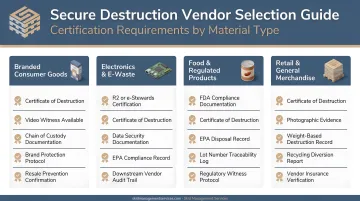
Step 1 — Select a Licensed, Certified Vendor
The vendor must be qualified for the specific type of destruction required:
- Document/data destruction — look for NAID AAA certification through i-SIGMA
- Hazardous waste — the transporter must have an EPA ID number and comply with 40 CFR Part 263; disposal facilities require RCRA permits
- Vehicles — use a licensed salvage yard or dismantler registered with NMVTIS
- Product destruction — verify the vendor provides documented chain-of-custody and issues compliant CODs referencing applicable regulations
Working with an uncertified vendor puts you at legal risk even if the materials are destroyed. The generator's liability doesn't transfer to an unqualified party.
Step 2 — Initiate Service and Document the Handoff
Once you select a vendor, initiate a service order. The vendor generates a work order number and invoice number at this stage (both will appear on your COD). Get written confirmation of the service agreement — including scope, method, and timeline — before any materials are transferred.
Step 3 — Verify Completion and Request the COD
Reputable destruction vendors issue a COD automatically upon completing destruction. If yours doesn't, ask for it explicitly — any qualified vendor will provide one without hesitation. This is a standard deliverable, not a special request.
Step 4 — Authenticate the Certificate
Before filing a COD, verify it is complete and legitimate:
- Confirm all required elements are present (see the checklist in the previous section)
- For vehicle CODs, cross-reference against your state DMV database
- Verify the vendor's license or certification status through the relevant body (i-SIGMA, state environmental agency, DMV, etc.)
Fraudulent and incorrectly named documents do exist across destruction categories. Vehicle CODs are a well-documented example: Florida HSMV explicitly addresses title fraud as altering vehicle condition information or providing false information to obtain a title. The same principle applies broadly — carefully review any document that uses non-standard names or omits required fields.
Step 5 — Store the COD as a Compliance Record
Once authenticated, file the COD with your compliance records. Retention requirements vary by regulation:
- RCRA generator manifests — 3 years under 40 CFR 262.40
- RCRA TSDF manifests — 3 years under 40 CFR 264.71
- Hazardous waste shipping papers — 3 years under 49 CFR 172.201
- HIPAA documentation — 6 years under 45 CFR 164.530(j)
Check your industry's specific requirements. When in doubt, retain longer — a COD that's no longer legally required costs nothing to keep; a missing one during an audit costs considerably more.
Frequently Asked Questions
What is a Certificate of Destruction?
A COD is a formal compliance record confirming that specific materials, products, data, or vehicles have been permanently destroyed in accordance with applicable laws. It transfers documented liability from the original owner to the destruction vendor, and it serves as audit-ready proof that proper disposal occurred.
How do I get a Certificate of Destruction?
Hire a licensed destruction vendor appropriate to your material type — NAID AAA-certified for documents, a permitted hazardous waste transporter for regulated waste, or a licensed salvage yard for vehicles. Complete the service and the vendor should issue the COD automatically. If they don't, request it directly.
Can I repair a car with a Certificate of Destruction?
No. A vehicle with a COD is designated for parts or scrap only — it cannot legally be repaired, registered, or driven on public roads. This differs from a salvage title, which allows for rebuilding and reinspection. A COD is permanent and irrevocable.
What does a Certificate of Destruction mean in Florida?
In Florida, a COD is issued for vehicles deemed suitable only for parts or scrap, permanently barring road use or re-registration. The process uses HSMV Form 82363. Once issued, the vehicle cannot be operated on Florida highways.
Is a Certificate of Destruction the same as a hazardous waste manifest?
No. A manifest tracks the transport and intended destination of hazardous materials. A COD confirms destruction was actually completed. Both documents are typically required for hazardous waste disposal — one does not substitute for the other.
Do I need a Certificate of Destruction for pallet or packaging material disposal?
Not always legally required, but strongly advisable when retiring large volumes of damaged pallets or packaging — especially in food manufacturing. A COD protects you during FDA or EPA audits and documents that retired product cannot re-enter circulation.