The answer isn't as simple as "block pallets win." According to Virginia Tech's unit load research, load capacity depends on the exact pallet design, wood species, fastener type, support condition, and load arrangement — not pallet type alone. This article breaks down how each design works, when one outperforms the other, and how to match the right pallet to your operation.
Key Takeaways
- Stringer pallets hold 76% of the U.S. market — their lower cost and wide availability make them the domestic default
- Block pallets provide true four-way forklift entry; stringer pallets offer two-way access (notched versions add partial four-way)
- Wood species, build quality, and fastener grade drive real-world strength more than pallet type alone
- Block pallets are the standard for international shipping and European distribution; stringer pallets dominate domestic U.S. operations
- Load weight, handling equipment, destination, and reuse frequency determine which type fits your operation
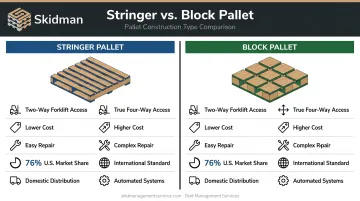
Stringer Pallets vs. Block Pallets: Quick Comparison
Both designs move freight. The differences come down to construction, access, and which fits your operation.
| Factor | Stringer Pallet | Block Pallet |
|---|---|---|
| Structure | 2–3 long boards running lengthwise between deck boards | Nine wooden blocks at corners, sides, and center |
| Forklift Access | Standard two-way; notched versions allow partial four-way | True four-way entry for forklifts and pallet jacks |
| Load Capacity | High when well-built; dynamic loads distributed across continuous boards | High when well-built; compression spread across nine block points |
| Cost | Generally lower due to simpler construction | Typically higher due to additional materials and complexity |
| Repairability | Easy — individual boards or stringers replaced without dismantling | More complex if blocks crack or split |
| Best For | Domestic U.S. distribution, cost-sensitive operations | International shipping, automated systems, four-way access requirements |
What Is a Stringer Pallet?
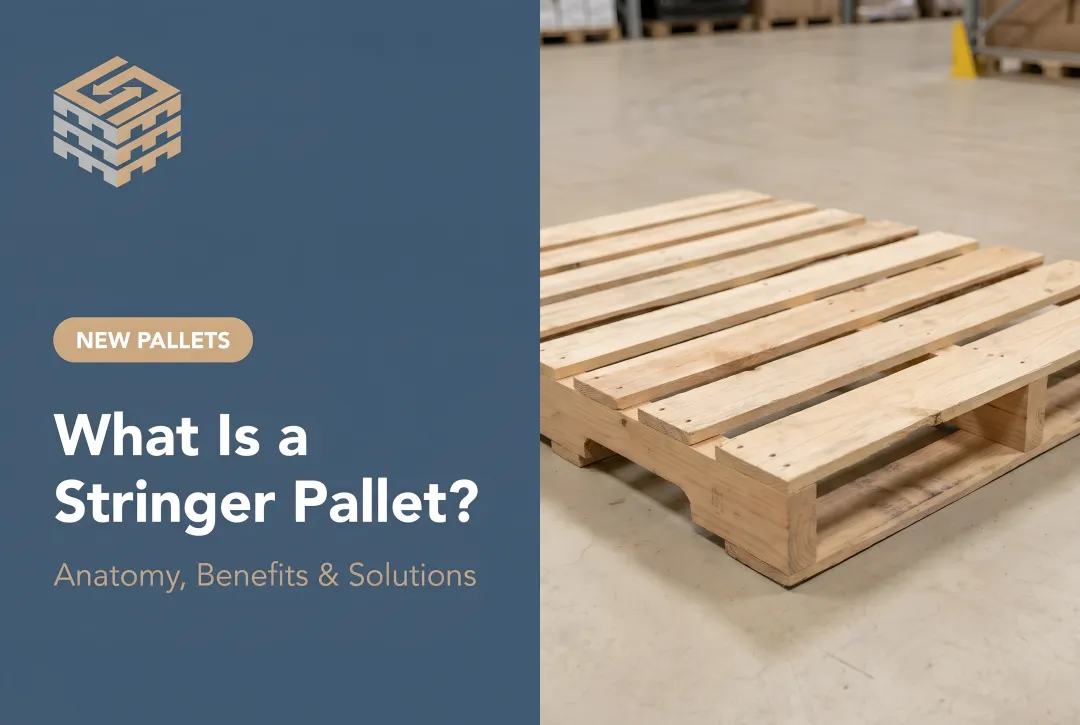
A stringer pallet uses long structural boards — the stringers — running lengthwise between the top and bottom deck boards to bear and distribute the load. Most builds use three stringers as the standard configuration.
A standard GMA 48x40 stringer pallet uses three stringers measuring 1.380 × 3.500 × 48 inches, seven deck boards across the top, and 84 helically threaded machine nails (per NWPCA Pallet Design System data). Doubling the lead boards at each end adds durability in high-cycle applications.
Entry Types
Standard stringer pallets only allow forklift entry from two sides. Notched or chamfered stringers create partial four-way access for forklifts, though pallet jacks typically can't access notched sides the way they can on a true block pallet.
Why Stringer Pallets Dominate U.S. Supply Chains
Those access limitations haven't slowed adoption. A 2020 USDA Forest Service/Virginia Tech study using 2016 market data found that stringer pallets represented 76% of the U.S. pallet market, with block pallets at 21% and skids at 3%.
Three factors drive that dominance:
- Lower manufacturing cost than block construction
- Widespread domestic availability across U.S. suppliers
- Easy repairability using standard lumber and nails
The GMA 48x40 stringer pallet drives much of that volume — that same study found it represented 35% of new wood pallets and 69% of recycled or remanufactured pallets in the U.S.
Use Cases for Stringer Pallets
Stringer pallets are the go-to choice in:
- Food and beverage distribution where two-way access is sufficient
- General retail and consumer goods manufacturing
- Domestic warehouse operations focused on cost control
- High-volume, single-use or limited-cycle shipments where replacement cost outweighs longevity
What Is a Block Pallet?
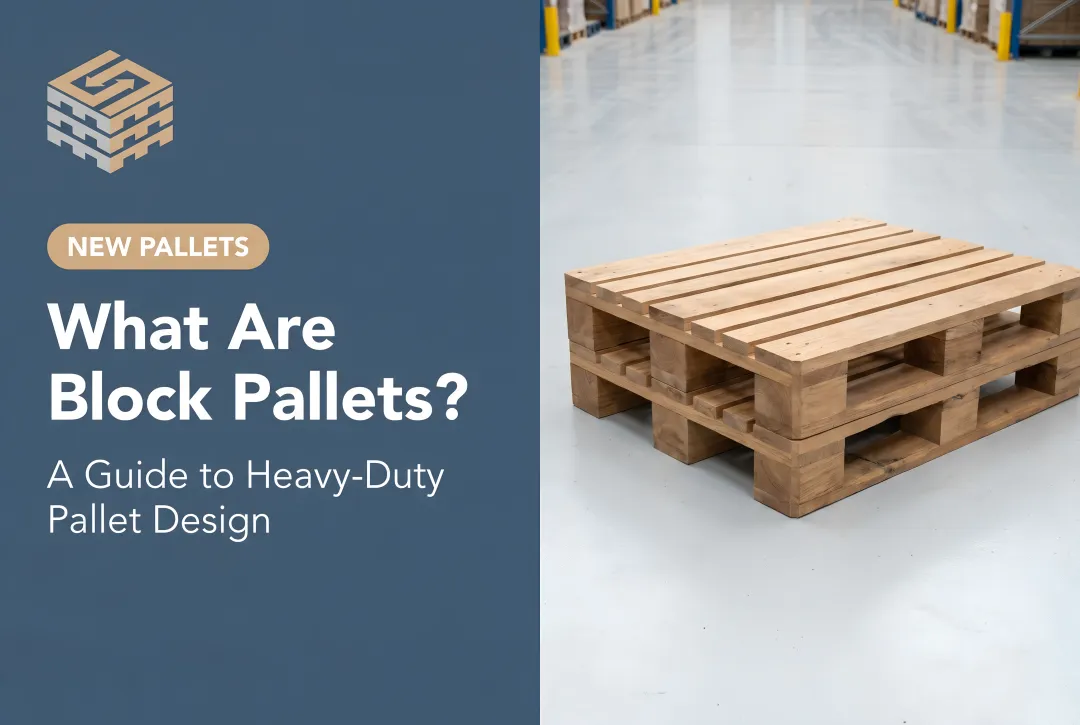
A block pallet replaces long stringers with nine solid wooden blocks — positioned at the four corners, four side centers, and the pallet center — connecting the top and bottom deck boards. That configuration creates a more distributed structural base and, more importantly, eliminates the barriers that restrict side access on stringer pallets.
The Four-Way Access Advantage
Because no continuous stringer runs along the sides, both forklifts and pallet jacks can enter a block pallet from all four sides. In tight warehouse aisles, automated conveyor systems, or high-turnover distribution environments, four-way entry cuts handling time and removes equipment restrictions that two-way pallets create.
International and European Context
Block pallets are the standard format in European logistics. The EPAL Euro pallet (the world's most widely used exchange pallet) is a block design: 9 blocks, 11 boards, 78 nails, measuring 1200 × 800 × 144 mm, with more than 650 million EPAL pallets in global circulation. When shipping internationally, block pallets align with the handling systems and exchange pool standards buyers expect.
Use Cases for Block Pallets
Block pallets are preferred in:
- International shipping and EU distribution (EPAL-compatible handling systems)
- Pharmaceutical and chemical industries requiring consistent four-way handling
- Automated warehouse systems with strict deflection limits
- Operations with heavy or irregularly shaped products where the nine-block base provides a more stable foundation
Which Is Stronger: Stringer or Block Pallets?
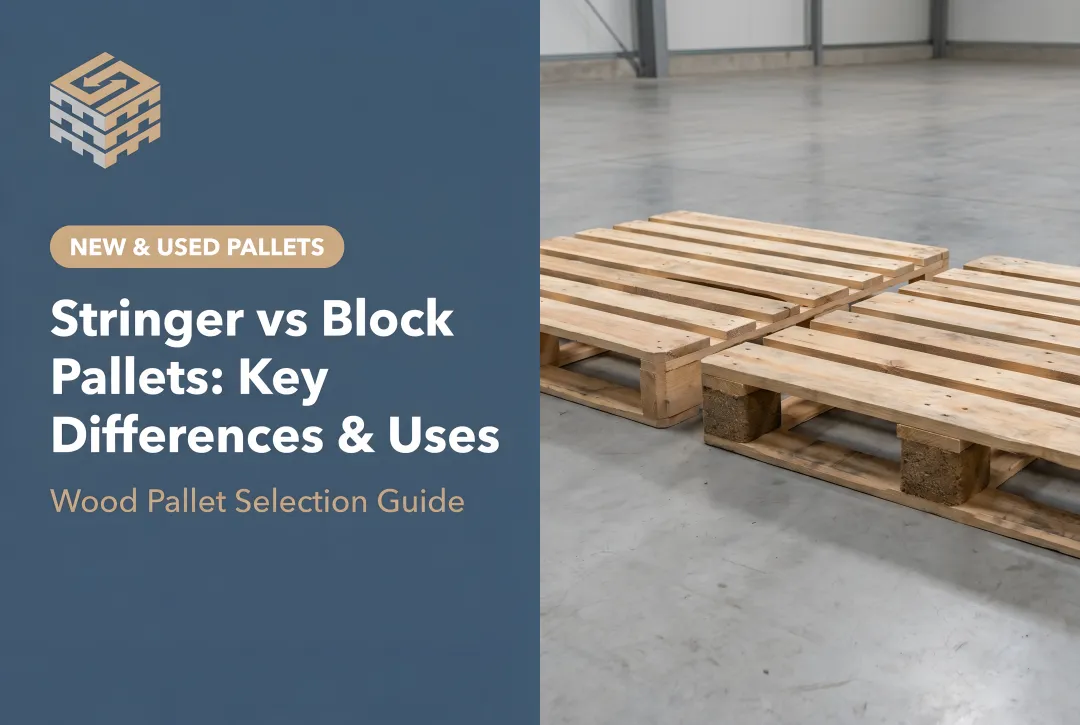
The short answer: neither is universally stronger. Build quality determines the outcome far more than pallet type.
The Build Quality Reality
Block pallets are widely assumed to win on strength — the nine-block base distributes compression across more contact points, which helps resist certain load stress patterns. But that advantage depends entirely on block quality, wood species, and fastener specification. Poorly manufactured blocks split under lateral stress. Low-grade fasteners fail before the wood does.
Stringer pallets, when well-built, carry their own structural advantage: continuous boards distribute dynamic loads (the kind created during transport, drops, and clamping) more evenly than isolated blocks.
A GMA-spec two-way stringer pallet with 1.5-inch Red Oak stringers and five 3.5-inch top deck boards can reach compression values as high as 27,000 lbs under specific support conditions, per Virginia Tech unit load data.
Fasteners Make a Bigger Difference Than Design
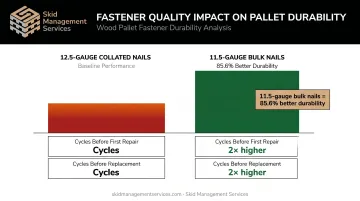
Virginia Tech's research on fastener quality found that 11.5-gauge bulk nails delivered 85.6% better durability than 12.5-gauge collated nails — with pallets lasting twice as many cycles before first repair and twice as many before replacement. That single variable outweighs the stringer-vs.-block debate in most real-world applications.
How Pallets Are Actually Tested
Knowing which fastener or design holds up means nothing without a standardized way to measure it. These are the tests the industry uses:
- ASTM D1185 — performance testing for pallets and related structures under materials handling conditions
- ISTA 3E — simulation testing for unitized loads shipped by truckload
- ASTM D6055 — mechanical handling and clamp attachment testing
- ASTM D6179 — rough handling and drop tests for unitized loads
These tests measure performance under specific conditions: racking, dynamic movement, static storage, and clamping. A pallet's results depend on the exact design being tested, not its general category.
When Block Pallets Do Outperform
Block pallets hold a real structural edge in:
- Repeated four-way handling cycles where omnidirectional rigidity reduces wear
- Automated conveyor systems with strict deflection limits (Virginia Tech cites a 0.5-inch maximum allowable deflection in automated warehouses)
- High-bay racking systems requiring consistent dimensional stability from all entry angles
"Stronger" is a function of design specs, material quality, fastener choice, and the specific load condition — not a fixed property of either pallet type.
How to Choose the Right Pallet for Your Operation
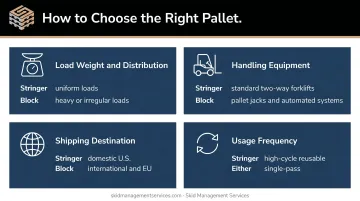
Four Decision Factors
1. Load weight and distribution Heavier or irregularly shaped loads benefit from the nine-block base of a block pallet. For standard uniform loads within GMA weight ranges, a well-spec'd stringer pallet performs comparably.
2. Handling equipment available If your facility only runs standard forklifts entering from two sides, stringer pallets are sufficient. If pallet jacks need side access, or if automated systems require omnidirectional handling, block pallets are the practical choice.
3. Shipping destination Stringer pallets work well for domestic U.S. distribution. For international shipments — particularly to Europe, Canada, Japan, Australia, or any destination covered by ISPM-15 regulations — both pallet types require heat treatment to 56°C core for 30 minutes minimum, marked with a compliant ISPM-15 stamp per USDA APHIS requirements. Block pallets often align better with European handling infrastructure.
4. Usage frequency High-cycle, reusable pallet programs favor stringer pallets: easier to repair, lower replacement cost per cycle. Single-pass shipments can optimize for upfront cost. Operations running mixed programs — outbound domestic on stringers, export on block — can source both through a single vendor relationship.
Product Considerations
Food and beverage, pharmaceutical, or export-regulated goods add compliance requirements on top of pallet type. Those requirements apply regardless of whether you're running stringer or block construction, and typically include:
- Food-grade, chemical-free treatment for FDA and GFSI audits
- ISPM-15 heat treatment for international export destinations
- Documentation for EU import, BRCGS, or SQF program compliance
Skid Management Services supplies both stringer and block wood pallets nationally — including GMA 48x40, 48x48, 42x42, 44x44, 36x36, and custom-dimension builds in both construction types. Both options are available with ISPM-15 heat-treated lumber sourced through USDA APHIS-recognized treatment providers.
For national accounts or custom-spec programs, contact us at 717-202-0304 or Info@SkidManagementServices.com.
Conclusion
Neither stringer nor block pallets hold a universal strength advantage. Stringer pallets win on cost, repairability, and domestic load capacity when built to spec — and their 76% U.S. market share reflects real operational preference, not habit. Block pallets win on handling flexibility, automated system compatibility, and international shipping alignment. The right choice is always specific to the load, the handling equipment, the destination, and how often the pallet gets reused.
Matching pallet type to your actual operation — equipment, load specs, and supply chain requirements — reduces failures, cuts replacement costs, and keeps shipments moving. If you're sourcing either construction type, Skid Management Services supplies both stringer and block pallets across standard and custom dimensions, with same-day availability and nationwide reach.
Frequently Asked Questions
What is the difference between stringer pallets and block pallets?
Stringer pallets use long boards running lengthwise between deck boards, allowing forklift entry from two sides. Block pallets use nine wooden blocks for support and allow true four-way access from all sides. The core differences come down to access, cost, and ideal application — not construction material or raw load capacity.
What is a stringer on a pallet?
A stringer is a long structural board running lengthwise between the top and bottom deck boards. It serves as the primary load-bearing backbone, enabling forklift entry from the two open ends while distributing weight across the pallet's length.
What is a 4 stringer pallet?
A four-stringer pallet adds a fourth stringer board to the standard three-stringer design, increasing load-bearing capacity for heavier or wider loads. Additional stringers can be incorporated into custom builds to meet specific weight or span requirements.
Are block pallets stronger than stringer pallets?
Not automatically. Block pallets are often assumed to be stronger, but tested performance shows a high-quality stringer pallet can match or outperform a block pallet of comparable dimensions. Wood species, fastener grade, and build quality determine real-world strength more than pallet type alone.
Can stringer pallets be used as four-way pallets?
Standard stringer pallets are two-way, but notching the stringers allows partial four-way forklift entry. Pallet jacks typically cannot access notched stringer pallets from the side, which is what separates them from true four-way block pallets.
Which pallet type is easier to repair?
Stringer pallets are easier and cheaper to repair. Individual deck boards or stringers can be replaced without dismantling the pallet. Block pallets are more complex to service if the blocks crack or split, which increases repair time and cost.