
Overloading a pallet doesn't usually cause a dramatic collapse on day one. Instead, it produces bowed deckboards, cracked stringers, and forklift tines that no longer fit cleanly into the entry points. Product gets damaged, workers get hurt, and shipments get delayed — all because someone assumed "average" meant "maximum."
This guide breaks down what actually determines a wooden pallet's weight limit, how that number gets tested in a lab, what capacity looks like across common sizes and materials, and the mistakes that quietly turn a safe pallet into a liability.
Key Takeaways
- Wooden pallet capacity typically ranges from 1,000 to over 4,600 lbs, depending on size and construction
- Three factors set the real limit: strength, stiffness, and support condition
- Standard 48x40 GMA pallets range from 2,500 to 4,600 lbs based on the test standard used
- Exceeding rated limits rarely causes instant failure, but it accelerates cracking and fatigue over time
What Determines a Wooden Pallet's Weight Limit
"Weight limit" refers to the maximum payload a pallet can carry safely, not the pallet's own dead weight, and not a fixed universal number. The same pallet can be rated differently depending on how it's supported.
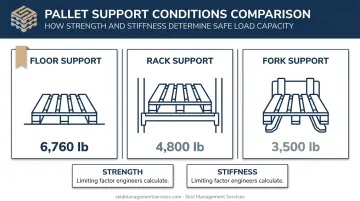
A pallet resting flat on a warehouse floor behaves very differently than the same pallet spanning two rack beams or riding on forklift tines. Support condition changes which components bear the stress, which is why one pallet can carry 6,760 lbs on the floor but only 3,500 lbs on forks, as documented in Uline's 48x48 heat-treated pallet specifications.
Engineers calculate a "safe load" as the lower of two values: the load that causes structural failure (strength) divided by a safety factor, and the load that causes excessive bending, or deflection (stiffness). Whichever number is smaller becomes the rated capacity. A pallet that won't break under a heavy load can still fail the stiffness test if it bends too far to keep product stable or let forks re-enter cleanly.
Factors That Influence Real-World Weight Capacity
Published ratings only tell part of the story. Several variables shift actual capacity in the field:
- Wood species and density: Denser hardwoods like oak generally outperform softer species, though specific gravity (not just the hardwood/softwood label) is the real predictor of strength
- Design type: Block pallets offer four-way entry and spread load across more contact points. Stringer pallets, per Pallet Enterprise's technical review, can lose up to 50% of their racking strength at notched entry points
- Load distribution: A uniformly spread load performs far better than a concentrated point load, which can snap individual deckboards even when total weight is within limits
- Age and wear: Repeated stress, moisture cycling, and visible cracks reduce a pallet's safe capacity well below its original rating
- Environmental exposure: Moisture weakens wood fibers; a pallet rated in a dry lab environment may not hold up the same way in a humid dock or refrigerated facility
Weight Limit by Pallet Size, Type, and Material
Published "average" capacities are useful as a starting benchmark, nothing more. Actual capacity depends on the exact size, construction, and grade combination you're using, not the size alone.
Standard Pallet Sizes and Their Rated Capacities
Even modest dimensional changes shift the numbers meaningfully:
| Pallet Size | Construction | Published Capacity |
|---|---|---|
| 48x40 GMA | Standard stringer | 2,500 lb typical; up to 4,600 lb predicted maximum |
| 42x42 | Recycled wood, two-way | 1,500 lb |
| 48x48 | Heat-treated wood | 3,500 lb on forks; 6,760 lb on floor |
| 40x48 | B-grade wood | 2,500 lb |
How much can a 40x48 pallet hold? One documented B-grade 40x48 wood pallet is rated at 2,500 lbs, close to the standard 48x40 GMA figure. But that number assumes a specific support condition and grade. Change the construction, lumber grade, or how the load is stacked, and the safe number moves with it.
Wood vs Other Pallet Materials
Wood isn't the only option, and material alone doesn't tell you which pallet is "better" for your load:
| Material | Example Capacity |
|---|---|
| Wood stringer | 2,500+ lb, depending on grade |
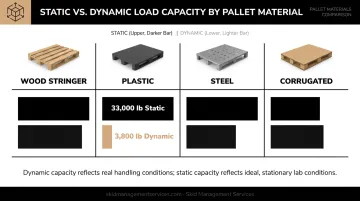
| Plastic (ORBIS 40x48 BulkPal) | 33,000 lb static; 3,800 lb dynamic |
| Steel | 2,000–6,000 lb, by product line |
| Corrugated | 2,800+ lb typical |
Plastic's huge static number looks impressive on paper, but static capacity measures a stationary load, not what happens when the pallet is lifted and moved, which is what dynamic capacity captures. Buyers who chase the highest number without checking reusability, cost per trip, and actual handling conditions often end up paying for capacity they'll never use.
Estimating Practical Load: Real-World Example
Here's a common question: how many 50 lb bags fit on a pallet?
Take a standard 48x40 pallet rated for 2,500 lbs:
- Divide safe capacity by unit weight: 2,500 ÷ 50 = 50 bags
- Leave a stacking-stability margin: most operators load to roughly 90% of rated capacity, not the exact ceiling
- Practical result: around 45 bags, not 50, to account for uneven stacking and handling stress
For heavier or non-standard loads (drums, IBC totes, machinery components), this math changes fast. Skid Management Services works with food, beverage, and industrial manufacturers to match pallet construction and lumber grade to the specific load, rather than forcing a shipment onto a standard pallet rated for lighter general-purpose use.
How Pallet Weight Capacity Is Tested and Rated
Capacity ratings don't come from guesswork. They come from standardized lab testing, primarily ASTM D1185 and ISO 8611, which apply loads under rack, floor, or fork-tine support conditions and measure deformation, damage, and structural failure.
Two rating terms get used inconsistently, and the difference matters:
- Nominal load: A conservative, general-purpose rating independent of any specific product
- Maximum working load: Tied to a known payload and packaging setup; it doesn't transfer to a different product or use case
Here's the detail that explains why published numbers vary so widely between suppliers: safety factors differ by standard. According to Pallet Enterprise's breakdown of the science behind pallet load capacity, the two standards apply different safety margins to the same ultimate-strength data:
| Standard | Safety Factor Applied to Ultimate Strength |
|---|---|
| ISO 8611 | 2 |
| ASTM D1185 | 2.84 |
The same pallet, tested under both standards, can produce two different "safe load" figures. Neither number is wrong. They're just answering slightly different questions.
What Happens When You Exceed the Weight Limit
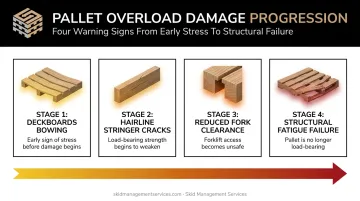
Overloading rarely causes a pallet to snap in half the first time it happens. What actually occurs is more gradual and more dangerous because it's easy to miss.
Progressive damage typically looks like this:
- Deckboards start bowing under repeated overweight loads
- Stringers develop hairline cracks that widen with each handling cycle
- Clearance for forklift tines or pallet jack forks shrinks, making entry harder and riskier
- Structural fatigue accumulates even when no single load causes visible failure
The safety and liability exposure compounds over time. A pallet that's been silently weakened by overloading is far more likely to fail during transit or while sitting in a rack, and both scenarios carry real risk of product loss and workplace injury.
OSHA's materials handling guidance emphasizes that stacked and stored materials must remain stable, blocked, and secure against sliding or collapse — a standard that's much harder to meet with a structurally compromised pallet.
Even when failure never happens, repeated overloading shortens usable pallet life and drives up replacement costs faster than expected.
Common Mistakes That Lead to Overloaded Pallets
Most overloading incidents trace back to a handful of avoidable errors:
- Treating "average" as "maximum": A published 2,500 lb figure for one product doesn't automatically apply to a different size, grade, or construction
- Confusing static, dynamic, and rack capacity: A pallet rated for a stationary floor load may be significantly weaker once it's lifted by a forklift or spanning rack beams
- Reusing aged or damaged pallets at original capacity: A pallet with visible cracks, missing boards, or years of wear doesn't carry the same safe load it did when new
Grade matters here too. Skid Management Services sorts its recycled pallet inventory into tiers for exactly this reason. Grade A pallets hold up to demanding outbound and retail-DC applications, while Grade B suits general internal warehouse flow. Utility-grade pallets are meant for internal movement only, not rack storage or outbound shipping, where a structural failure becomes a safety incident.
Frequently Asked Questions
What is the maximum weight you can put on a pallet?
It depends on size, material, and support condition, but 2,500 lbs is a commonly cited figure for a standard wood pallet. Heavier-rated options like block construction, hardwood builds, or reinforced deck designs exist when loads exceed that range.
How much weight can a 40x48 pallet hold?
A documented B-grade 40x48 wood pallet is rated at 2,500 lbs, comparable to the standard 48x40 GMA benchmark. Construction, grade, and load distribution still determine the actual safe number.
How many 50 lb bags can fit on a pallet?
Divide safe capacity by unit weight: 2,500 lbs ÷ 50 lbs equals 50 bags. Most operators load to about 90% of rated capacity, landing closer to 45 bags to leave a safety margin.
What is the difference between static and dynamic load capacity?
Static capacity applies when the pallet sits stationary, like on a warehouse floor. Dynamic capacity applies while it's being lifted or moved by a forklift or pallet jack, and it's typically the lower number.
Does a wooden pallet's weight limit decrease with age?
Yes. Repeated use, moisture exposure, and micro-fractures reduce a pallet's safe capacity over its usable lifespan, so an old pallet shouldn't be loaded to its original rating.
Can you increase a wooden pallet's weight capacity?
Reinforcing with additional stringers or deckboards, choosing denser hardwood, or switching to a four-way block design can raise capacity. Skid Management Services builds custom-engineered pallets rated from 4,000 lbs up to 10,000+ lbs dynamic for heavy-machinery loads that outgrow a standard pallet.