Pallet pooling offers a different model entirely: instead of owning and managing your own pallet fleet, you rent standardized pallets from a provider that handles everything — procurement, quality control, collection, repair, and redeployment. Think of it as outsourcing your pallet management rather than just your pallet supply.
This article covers what pallet pooling actually is, how it works step by step, the key benefits, and how to assess whether it's the right fit for your operation — or whether direct pallet purchasing makes more sense.
Key Takeaways
- Pallet pooling is a rental-based system where businesses access a shared fleet of standardized pallets managed by a third-party provider
- Pallets move from manufacturer to distributor to retailer, then return to a depot for inspection, repair, and redeployment
- Two models exist: closed-loop (controlled partner network) and open-loop (multi-company, multi-industry network)
- Core benefits include cost predictability, consistent pallet quality, seasonal flexibility, and reduced environmental impact
- Not every operation fits the pooling model; direct purchase or a closed-loop management program may be a better fit
What Is Pallet Pooling?
Pallet pooling is a shared, reusable pallet system in which a provider owns and manages a fleet of pallets that multiple businesses rent on an as-needed basis. CHEP describes it as a circular, share-and-reuse model where companies rent pallets and outsource management instead of buying or exchanging them — sometimes called "Pallet as a Service."
This differs from two common alternatives:
- Traditional ownership — your company buys pallets, stores them, manages repairs, and handles recovery
- Pallet exchange — trading like-for-like pallets between trading partners, often informally and without quality guarantees
Who Participates in a Pooling Network
A typical pooling network includes:
- Manufacturers loading outbound shipments
- Distributors and third-party logistics providers
- Retailers receiving inbound product
- Service depots handling inspection and repair
Pallets circulate through this network rather than sitting idle at a single facility. Major providers operate at significant scale — Brambles (CHEP's parent) manages roughly 348 million pallets, crates, and containers across approximately 60 countries. PECO Pallet handles around 70 million annual pallet issues across its North American network.
Standardization as a Core Feature
All major pooling programs use standardized pallets — typically the GMA 48×40 inch format. CHEP, PECO, and iGPS all supply 48×40 inch block pallets rated at 2,800 lb uniformly distributed load. This consistency simplifies warehouse operations, ensures compatibility with conveyor and AS/RS systems, and meets major retailer inbound requirements. That's a real edge over purchased used pallets, which vary widely in condition and dimension.
Most pooling programs offer two primary pallet materials:
- Wood block pallets — four-way entry, durable, and accepted across virtually all retailer and distributor networks
- Plastic pallets — lighter, hygienic, and RFID-ready; iGPS operates an all-plastic pool with built-in RFID tracking across its entire network
Material choice affects automation compatibility, retailer acceptance, and overall program cost.
How Pallet Pooling Works
The process follows a straightforward cycle: request pallets, ship goods, return pallets, repeat. The provider manages everything outside your four walls.
The Step-by-Step Process
- Order — You request pallets based on upcoming shipment volume. Providers like PECO allow customers to order, track, and pay through a digital service platform
- Deploy — Pallets are delivered to your facility, loaded with goods, and shipped to the next destination
- Deliver — Product arrives at the retailer or distribution center; the pallet travels with it
- Collect — The pooling provider arranges reverse logistics to retrieve pallets from receiving locations
- Recondition & Redeploy — Pallets return to a service depot for inspection, repair, or retirement before re-entering circulation
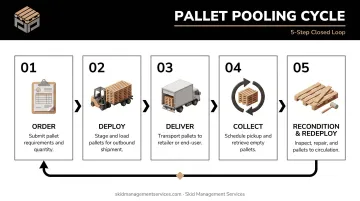
The entire cycle is the provider's responsibility. You're not managing pallet recovery calls or tracking down units stranded at a customer's dock.
Technology and Tracking
Many providers embed tracking technology directly into pallets. iGPS uses RFID tags scanned at inbound and outbound points to monitor pallet location across the network. GPS tracking extends visibility to pallets in transit. The practical result is fewer losses from misplaced or unreturned pallets and cleaner inventory reconciliation.
How pallets move through these networks depends on whether the program is closed-loop or open-loop — a distinction that shapes which model fits your operation.
Closed-Loop vs. Open-Loop Systems
Closed-loop pooling circulates pallets within a controlled, predetermined network — typically one company or a defined group of partners. A manufacturer shipping exclusively to a fixed set of retailer DCs is a classic closed-loop scenario. It suits operations with predictable, repeatable distribution patterns.
Open-loop pooling flows pallets across many unrelated companies and industries within the provider's broader network. More flexible and broadly applicable, but logistically more complex to manage. Most major third-party programs — CHEP, PECO, iGPS — operate on an open-loop model.
Key Benefits of Pallet Pooling
Cost Savings and Predictability
Owning pallets generates costs across multiple categories: purchase price, storage space, repair labor, replacement of damaged units, and reverse logistics to recover strays. Pooling consolidates these into a single, usage-based rental fee.
The fee structure for rental programs typically includes:
- An issue fee per pallet deployed
- A daily hire fee while pallets are in circulation
- Transfer and heat-treating fees where applicable
- Non-participant fees if pallets ship outside the provider's network
While these line items can look complex, they replace a set of costs that most companies don't actively track — which makes total pallet spend easier to measure and control.
Consistent Quality and Reduced Product Damage
Pooled pallets are reconditioned before each deployment cycle. Providers inspect and repair pallets to a defined quality standard, which reduces the risk of broken boards, protruding nails, or warped decks causing product damage in transit.
Consistent dimensions also matter operationally. A PECO case study with Sobeys found that switching to block pallets allowed 30 pallets per trailer versus 24–28 with stringer pallets — a direct capacity improvement from dimensional consistency.
That dimensional consistency also ties directly to retail compliance. Major retailers enforce strict inbound pallet requirements:
- Walmart requires 40×48 inch, four-way-access, solid wood pallets under 2,100 lb per load
- Costco specifies iGPS, PECO, or CHEP U.S. block pallets for North American shipments, or approved whitewood block pallets meeting published spec
Sending substandard pallets to these retailers risks DC rejection, return freight charges, and vendor-performance penalties on top of any product damage.
Flexibility During Demand Fluctuations
Owned pallet fleets are fixed assets. If you buy 10,000 pallets for peak season, those units consume warehouse space year-round. Pooling lets you scale usage up or down based on actual volume.
CHEP's customer success examples include helping major pumpkin growers and produce suppliers manage seasonal retail programs — operations where pallet demand swings sharply between peak harvest and off-season. Rather than tying up capital in excess inventory, a pooling customer simply orders more units when demand rises and returns them when it drops.
Sustainability and ESG Impact
Pooled pallets complete far more trips before retirement than single-use alternatives. Pallet Enterprise's coverage of CHEP lifecycle data notes pooled wood pallets average approximately 30 trips versus 4 for one-way white wood pallets. That's roughly 7x fewer pallets manufactured per unit of freight moved — directly cutting wood consumption, landfill waste, and production emissions.
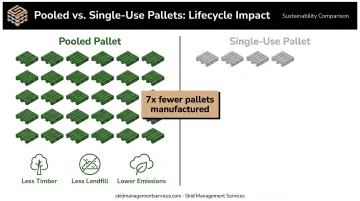
CHEP frames its model explicitly around circular economy principles, noting that composite blocks in its pallets save approximately 4,000 trees annually and that 100% of unserviceable pallets are recycled. For companies with ESG reporting obligations, pooling provides measurable, documented metrics to support sustainability scorecards.
Operational Simplicity
Pallet management — procurement, repair scheduling, tracking, recovery — consumes real staff time at high-volume operations. Pooling removes that overhead. Logistics teams focus on product movement instead of pallet logistics. For multi-destination shippers managing dozens of receiving partners, that reduction in administrative load translates directly into fewer labor hours spent on pallet reconciliation each month.
Pallet Pooling vs. Traditional Pallet Ownership
| Factor | Traditional Ownership | Pallet Pooling |
|---|---|---|
| Upfront cost | Capital investment required | Pay-per-use, no capital outlay |
| Quality control | Degrades without active management | Maintained to provider standard |
| Scalability | Requires advance purchasing | Scales with actual usage |
| Loss/damage risk | Full risk on owner | Provider absorbs pallet losses |
| Administrative burden | Procurement, repair, recovery | Managed by provider |
| Customization | Full flexibility | Limited to pool specifications |
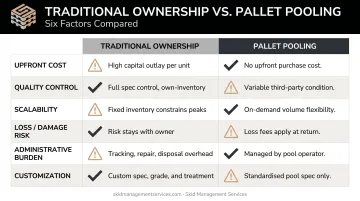
Ownership looks straightforward on paper. In practice, the costs accumulate in categories most companies don't actively track:
- Storage space tied up by idle pallets between production runs
- Staff hours spent on repairs and inspection
- Difficulty recovering pallets from downstream recipients
- Retailer rejections from inconsistent pallet quality
That said, pooling isn't universally superior. Businesses with stable, closed distribution routes and strong pallet recovery processes often find ownership works well. The real test is calculating total cost per trip — factoring in storage, labor, repairs, losses, and recovery logistics, not just the purchase price.
Is Pallet Pooling Right for Your Business?
Strong Indicators for Pooling
You're likely a good candidate if you have:
- High shipment volume across multiple locations
- Difficulty recovering pallets from retail or distribution partners
- Frequent DC rejections due to pallet quality issues
- Seasonal demand swings that make owning a fixed fleet inefficient
- ESG or sustainability reporting targets that require measurable waste reduction
When Direct Purchase Makes More Sense
Pooling isn't the right fit for every operation. Consider direct purchasing if you:
- Run a single-location or tightly controlled distribution loop
- Need specialized pallet specifications the pool doesn't offer
- Want straightforward pallet ownership without rental fee complexity or asset-tracking obligations
- Have an efficient pallet recovery process that keeps ownership costs genuinely low
For businesses in this category, direct purchasing from a national supplier is a viable path. Skid Management Services, headquartered in central Pennsylvania, supplies a full range of GMA-standard and specialty pallet sizes:
- GMA 48×40 block and stringer pallets (new and Grade A recycled)
- Specialty sizes: 48×48, 44×44, 42×42, 36×36, and custom dimensions
- Industries served: food and beverage manufacturing, retail DC supply programs, and more
SMS also offers a closed-loop pallet management program — scheduled delivery and used-pallet pickup on the same trip, with ESG-reportable recycling documentation. That gives direct purchasers access to sustainability metrics without the overhead of a full pooling arrangement.
Run the Numbers First
Many businesses underestimate their true pallet spend until they itemize it. Before concluding that ownership is cheaper, account for:
- Purchase cost per pallet
- Storage space allocated to idle inventory
- Repair labor and replacement costs
- Recovery rate — what percentage of pallets actually come back
- Staff time spent managing procurement and logistics
When that total cost of ownership runs higher than expected, pooling — or a managed closed-loop program — typically pays for itself faster than most operations anticipate.
Frequently Asked Questions
What does pallet pooling mean?
Pallet pooling is a shared, rental-based system where multiple businesses access the same fleet of standardized pallets managed by a third-party provider. Rather than purchasing and managing their own supply, companies pay a usage-based fee and the provider handles all logistics, maintenance, and redistribution.
What is the difference between pallet pooling and pallet exchange?
Pallet exchange is an informal trade of like-for-like pallets between partners, with no guaranteed quality or accountability. Pallet pooling is a managed rental system where one provider owns, maintains, and redistributes pallets across a network — delivering consistent quality and formal oversight that exchange arrangements cannot.
What are the disadvantages of pallet pooling?
Potential drawbacks include dependency on the provider's network size and geographic availability, limited ability to customize pallet specifications beyond what the pool offers, and rental costs that may exceed direct purchase costs in low-volume or highly controlled distribution scenarios.
What is the difference between open-loop and closed-loop pallet pooling?
Closed-loop pooling circulates pallets within a fixed, controlled network of known partners. Open-loop pooling flows pallets across unrelated businesses and industries within the provider's broader network — more flexible but logistically more complex to manage. Most major third-party programs operate open-loop.
Is pallet pooling cost-effective for small businesses?
Pooling eliminates upfront capital costs and provides maintained pallets on demand, which helps smaller operations. That said, the value depends on shipment volume and pallet recovery reliability — businesses with simple, low-volume distribution may find direct purchase more cost-effective.
How do companies get started with pallet pooling?
Start by auditing your current pallet usage, costs, and recovery rates. Then evaluate providers on network coverage, pallet availability, pricing structure, and tracking technology. A side-by-side comparison against your total cost of ownership will clarify whether pooling — or a direct-purchase model with a managed closed-loop program — makes more economic sense for your operation.