This scenario plays out daily across food, retail, and industrial supply chains, and it almost always traces back to a labeling error. Non-compliant pallets get refused at the dock, generating return freight, chargebacks, and vendor demerits that stack up over time.
Pallet labeling standards aren't one rulebook. They're three overlapping layers: global GS1/ISO barcode standards, industry-specific rules for food, pharma, and hazmat, and individual retailer requirements from companies like Walmart and Wakefern. This guide breaks down each layer so shippers, warehouse managers, and suppliers can build a labeling process that actually holds up at receiving.
Key Takeaways
- The SSCC barcode is the only universally mandatory element on a GS1 pallet label
- Required content shifts by industry (food, pharma, hazmat) and by retailer trading partner
- Label size, placement height, and edge clearance follow specific GS1 rules for scannability
- Consistent, well-built pallets are a foundational but often-overlooked piece of compliance
Understanding GS1 Standards and the SSCC Barcode
Nearly every pallet labeling rule in existence traces back to one document: the GS1 Logistic Label Guideline. GS1 is the global standards body behind the barcodes on almost everything shipped, and this guideline is the reference point that industry regulators and retailers build their own rules on top of.
What the SSCC Actually Is
The Serial Shipping Container Code (SSCC) is the single mandatory, unique identifier required on every logistic unit label. Think of it as a license plate for a pallet. It's 18 digits, structured as:
- Extension digit
- GS1 Company Prefix
- Serial reference number
- Check digit (calculated with a modulo-10 formula)
The SSCC gets encoded under Application Identifier (00). Once scanned, it lets warehouse systems match the physical pallet to its electronic shipping data, which is what makes automated receiving, cross-docking, and real-time tracking possible.
Barcode Symbology and the ISO Connection
The SSCC must be carried in a GS1-128 barcode. Supplementary 2D symbols like GS1 DataMatrix or QR codes are increasingly accepted alongside it, but the linear GS1-128 remains the baseline requirement.
Generic barcodes don't cut it:
- Plain Code 128 lacks the FNC1 character that flags it as GS1-128, so scanners can't parse the Application Identifiers correctly
- UPC codes carry a trade-item GTIN, not an 18-digit SSCC, so they identify a product, not a shipment
- Generic QR codes without embedded GS1 Application Identifiers leave warehouse systems unable to extract the SSCC at all
Here's a detail that trips up a lot of shippers: they assume "ISO standard" and "GS1 standard" are competing systems. They're not.
ISO/IEC 15459-1 governs unique identification of transport units, and GS1 explicitly designed the SSCC to comply with that ISO license-plate model. ISO supplies the uniqueness framework, while GS1 defines the format and issuing rules that sit above it.
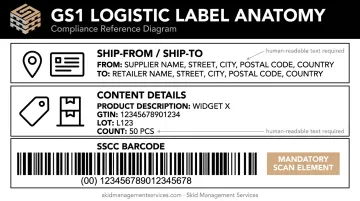
Once those two pieces click into place, the label's physical layout follows a predictable pattern. A compliant label breaks into three building blocks:
- Top section — ship-from/ship-to human-readable data
- Middle section — content details
- Bottom section — the SSCC barcode itself
Essential Information Required on Every Pallet Label
Strip away every industry and retailer overlay, and nearly every pallet label needs the same baseline:
- Ship-from address (origin location)
- Ship-to address (destination location)
- Description of shipment contents
- SSCC barcode (covered above)
Beyond that baseline, GS1 defines optional-but-common Application Identifiers:
| AI Code | Represents |
|---|---|
| (01) | GTIN of the trade item |
| (02) / (37) | GTIN of contained items / item count |
| (10) | Batch or lot number |
| (11), (15), (17) | Production, best-before, and expiration dates |
Homogeneous vs. Heterogeneous Pallets
Whether GTIN data belongs on the label depends entirely on what's stacked on it.
- Homogeneous pallets hold a single product with one GTIN. These can display trade-item data directly under AI (01) or AIs (02)/(37).
- Heterogeneous (mixed) pallets carry multiple products. The label keeps the SSCC but skips GTIN data altogether. Content details move to an electronic Despatch Advice or ASN instead, with the SSCC linking that message back to the physical pallet.
Two rules matter for accuracy: every barcoded data element must also appear as human-readable text with a data title, since not every dock worker has a scanner in hand. Each Application Identifier may only appear once per label, since duplicates create scanning confusion.
This baseline covers only the minimum requirement. Industry regulations and retailer routing guides layer additional fields on top, which we'll cover shortly.
Label Size, Format, and Placement Requirements
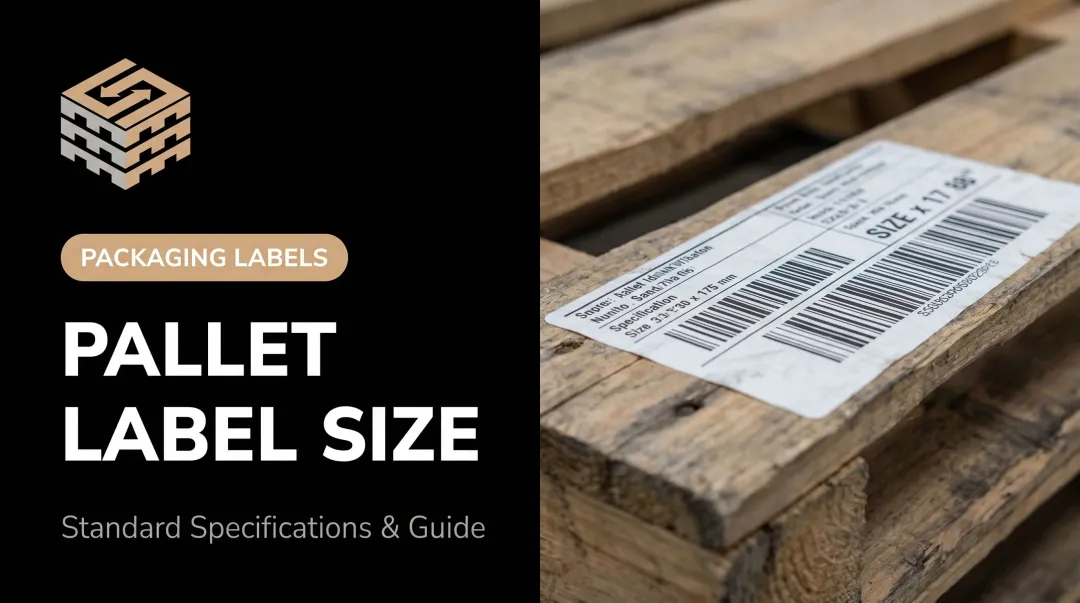
Getting the content right doesn't help if the label itself is unreadable or mounted wrong. GS1 recommends two standard sizes:
| Size | Dimensions | Best For |
|---|---|---|
| A6 | 105 x 148 mm | SSCC-only or minimal-data labels |
| A5 | 148 x 210 mm | Pallets needing trade item data |
Smaller formats are discouraged because they compress the barcode's quiet zones and human-readable text past reliable scanning thresholds.
Placement Height and Edge Clearance
Two rules govern where the label physically sits:
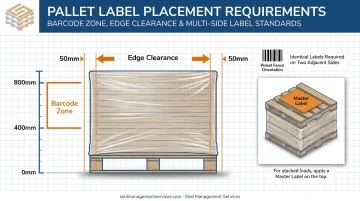
- Height rule: On pallets taller than 400mm, the barcode must sit 400-800mm from the base. Shorter pallets should have the label placed as high as possible while still protected from handling damage.
- Edge clearance rule: The barcode, including its quiet zone, needs at least 50mm from any vertical edge. This keeps forklift tines, straps, and stretch wrap from damaging the printed symbol.
Orientation and Duplication
Barcodes should run in "picket fence" orientation (bars vertical, perpendicular to the pallet base) since this reads more reliably across varying scan angles. Best practice puts identical labels on two adjacent sides, so at least one label remains accessible no matter how the pallet gets turned or racked.
Stacked and Sandwich Pallets
Each pallet in a stack keeps its own SSCC as an independent logistic unit, unless the stack is physically bundled with shrink-wrap or straps and shipped as one combined unit. In that case, a master label goes on the outer wrap with its own new SSCC, layered on top of (not replacing) the individual pallet labels underneath.
Industry-Specific and Retailer-Specific Labeling Requirements
GS1 sets the foundation. Regulated industries and individual retailers build additional requirements on top of it.
Food, Pharma, and Hazmat Overlays
- Food: Under FSMA Section 204, covered foods need traceability lot codes, quantities, and location data logged at shipping and receiving. Pallet labels typically carry the batch/lot AI that links back to those records, not every data point printed on the label.
- Pharmaceuticals: DSCSA requires a product identifier, lot number, and expiration date on each covered drug package, encoded in a 2D Data Matrix. This serialization applies at the package and case level, separate from the pallet's GS1 SSCC.
- Hazardous materials: OSHA's Hazard Communication Standard requires shipped-container labels with a product identifier, signal word, hazard statement, pictogram, and supplier contact information, while DOT adds hazard-class placarding under 49 CFR 172.400. Markings obscured by an overpack or pallet wrap must be reproduced on the outer packaging.
Retailer-Specific Requirements
Major retailers publish their own supply chain packaging guides on top of GS1's foundation.
Walmart requires SSCC-18 as the mandatory barcode format on every pallet label, encoded in GS1-128, with labels on at least two adjacent sides. Wakefern requires temperature-sensitive label stock that resists smearing in freezer conditions, plus a printed "Mixed Pallet" designation whenever multiple lot codes share one pallet.
Distributors who run dedicated retail-DC compliance programs, including Skid Management Services, which supports Walmart, Costco, Target, Home Depot, Lowe's, and Kroger pallet requirements, can flag these gaps before a shipment ships.
For food and beverage manufacturers moving product through big-box and grocery distribution networks, this stacking of requirements is exactly where compliance gets complicated: a pallet can meet every GS1 rule and still get refused for missing a retailer-specific field. Always pull the current routing guide before shipping, since these specs change without much notice.
Best Practices for Compliant, Efficient Pallet Labeling
A few operational habits keep labeling compliance from becoming a recurring headache:
- Standardize label templates and placement across every pallet you ship, so dock workers and scanners encounter the same layout every time.
- Use durable, temperature-resistant label stock so barcodes stay scannable through cold storage, stretch-wrapping, and cross-country transport.
- Build compliance on a consistent pallet foundation, since warped stringers or uneven dimensions make label placement harder to maintain at scale. A dependable national supplier like Skid Management Services, which supports pallet programs for major food and beverage manufacturers, keeps that foundation solid.
- Run periodic label audits to catch barcode issues early, checking visual quality, data accuracy, and symbol grading against ISO/IEC 15416 print-quality standards.
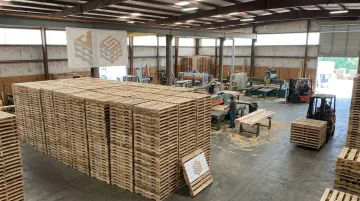
Catching a drifting label spec during an internal audit costs far less than catching it at a retailer's receiving dock.
Frequently Asked Questions
What are the requirements for pallet labels?
Every pallet label needs an SSCC barcode plus ship-from and ship-to details at minimum. Additional required fields depend on your industry's regulations and your specific retailer's routing guide.
What is the ISO standard for labeling?
ISO/IEC 15459 governs unique identification of transport units. GS1's SSCC and Logistic Label standards are built on this foundation.
What barcode is required on a pallet label?
The SSCC encoded in a GS1-128 barcode is the required and only mandatory barcode. A supplementary 2D barcode, like GS1 DataMatrix, can be added but doesn't replace it.
Where exactly should a label be placed on a pallet?
For pallets over 400mm tall, the barcode sits 400-800mm from the base, with at least 50mm clearance from any vertical edge. Shorter pallets should have labels placed as high as protection allows.
Do all retailers require the same pallet labeling format?
No. GS1/SSCC is the common foundation, but retailers like Walmart and Wakefern add their own specific data, materials, and placement requirements through their individual supply chain packaging guides.
What size should a pallet label be?
GS1 recommends A6 (105 x 148mm) as suitable for SSCC-only labels and A5 (148 x 210mm) when additional trade item data needs to be included.