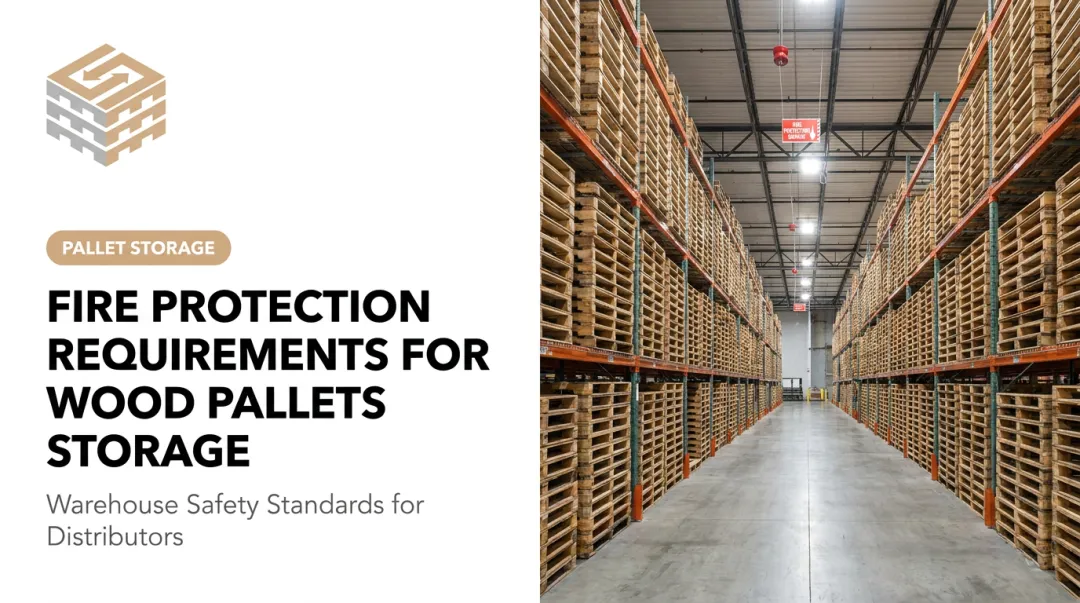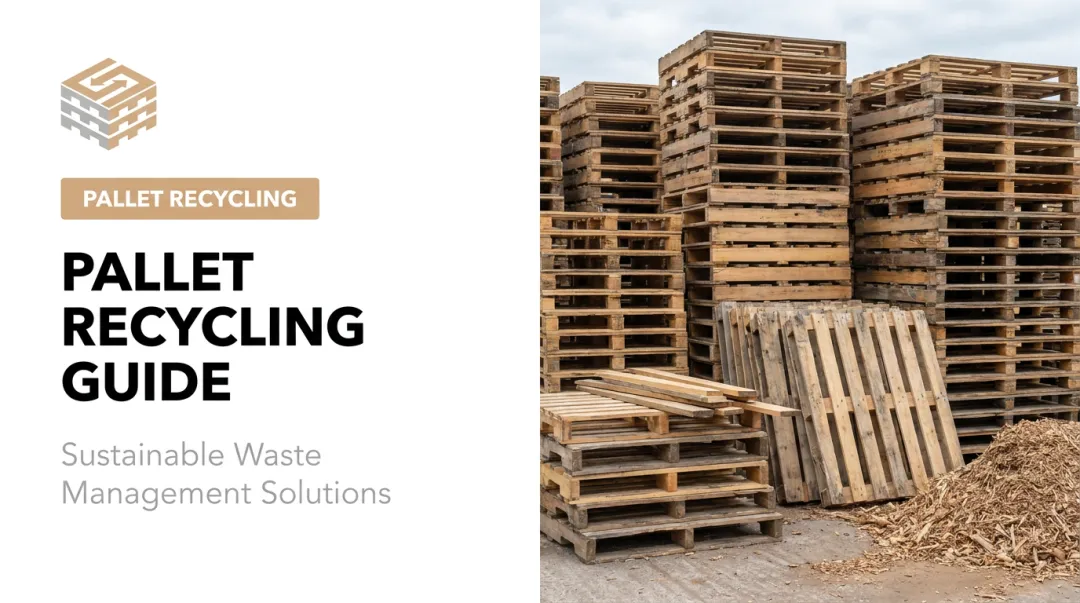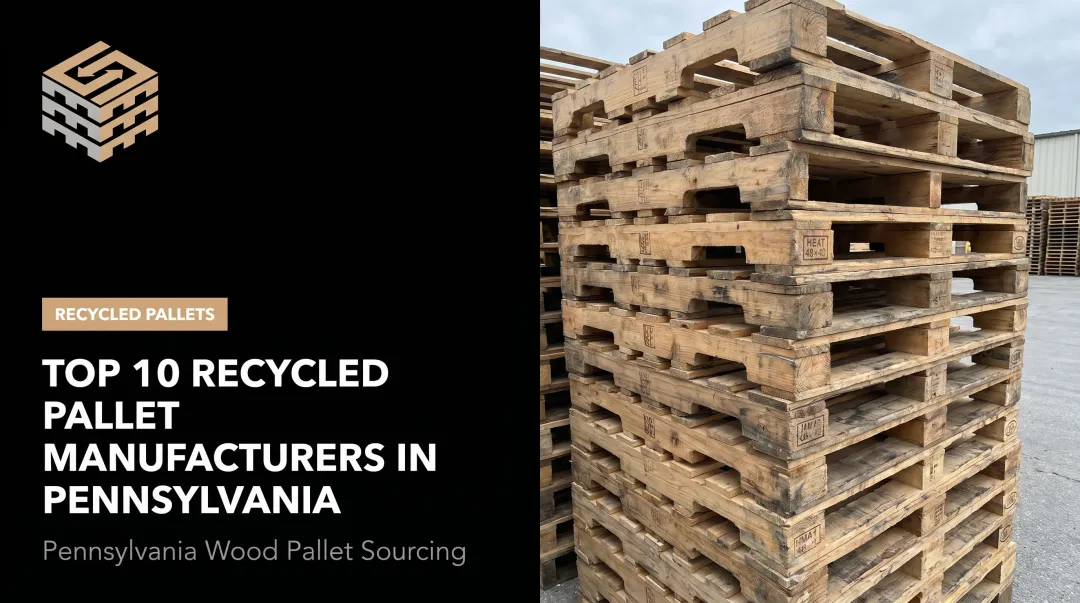
That's why the International Fire Code treats these facilities differently from a general warehouse that stores a few spare pallets near a loading dock. The volume, configuration, and combustibility of outdoor pallet storage at dedicated pallet sites demands its own regulatory framework.
That framework is IFC Section 2810. This article covers what Section 2810 requires, who it applies to, how it differs from related code sections, and how to build a practical compliance plan — whether you're preparing for an AHJ inspection or updating your site safety documentation.
Key Takeaways
- IFC Section 2810 applies specifically to pallet manufacturing and recycling facilities, not general occupancies
- Key requirements include a 20-foot maximum stack height, property line setbacks, site and fire prevention plans, and fire apparatus access roads
- Section 315.7 (all occupancies) and Chapter 32 (indoor storage) are separate provisions with different requirements
- Confirm which IFC edition your local AHJ has adopted before applying any specific dimension from a national source
- Compliance is ongoing: pile configurations shift with inventory levels, so schedule periodic internal audits
Why Bulk Wood Pallet Storage Is a High Fire Hazard
Wood pallets burn fast. The alternating layers of wood boards and open air gaps act as a built-in combustion engine: the gaps supply oxygen directly to the fuel surface, accelerating ignition and fire spread well beyond what you'd see with a solid wood pile or conventional commodity storage.
The numbers back this up. NIST Technical Note 2102 measured peak heat release rates for stacked pine pallets under controlled conditions:
- 2-pallet stack: 934 kW peak at roughly 3.9 minutes
- 8-pallet stack: 3,141 kW peak at 5.9 minutes
- Four 2-pallet stacks (grouped): 4,174 kW peak at just 3.7 minutes
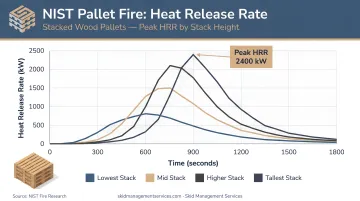
Four modest two-pallet stacks — the kind of arrangement that might sit near a receiving area — can generate more heat release than a single 8-pallet stack, and get there faster. Grouped smaller piles aren't necessarily safer than one large pile.
What This Looks Like in Practice
The April 2024 fire at GMA Pallet Recycling Corp. near Tracy/Banta, California is a clear example of how quickly these fires scale beyond the property line. The blaze involved approximately 5 acres and an estimated 80,000 to 100,000 pallets. At least six nearby homes required evacuation, and Banta Elementary School was closed due to smoke.
Insurance data reinforces the pattern. FM Global's loss history covering 2002–2012 found that 91% of idle-pallet losses involved wood pallet storage, and 65% of those losses occurred in outside storage areas. The outdoor yard — not the building — is where most of the risk lives.
Section 2810 addresses these outdoor yard risks directly — specifying pile dimensions, setback distances, and suppression requirements that general storage chapters don't cover.
What Is IFC Section 2810? Scope and Applicability
IFC Section 2810 — formally titled "Outdoor Storage of Pallets at Pallet Manufacturing and Recycling Facilities" — covers the outside storage of wood and wood composite pallets on the same site as a pallet manufacturing or recycling facility.
The scope distinction matters. A food manufacturer storing 200 spare pallets behind its loading dock isn't governed by Section 2810. A facility whose primary operation is building new pallets or collecting, sorting, repairing, and reselling used pallets is. Both pallet manufacturers and pallet recyclers fall within the section's scope.
Code Editions and Local Adoption
The IFC is published by the International Code Council (ICC) on a three-year cycle. The three most widely referenced editions are:
- 2018 — a significant cycle for this industry, with NWPCA-aligned revisions
- 2021 — expanded adoption across many jurisdictions
- 2024 — the current published edition
Local jurisdictions adopt specific editions (sometimes with local amendments), and there's often a significant lag between ICC publication and AHJ enforcement. A facility in one state may operate under the 2018 IFC while a facility two states over follows the 2021 edition.
The pile dimensions and setbacks that apply to your yard depend entirely on which edition your jurisdiction has adopted.
The 2018 cycle was significant for this industry. The National Wooden Pallet and Container Association (NWPCA) worked with fire safety experts to align Section 2810 with proven industry practices, and the NWPCA released its Fire Code Compliance Manual for Outdoor Storage of Wood Pallets in January 2018 as a free compliance resource for facilities navigating the revised requirements.
NFPA 1 Parallel Provision
IFC Section 2810 isn't the only framework covering this ground. NFPA 1 Section 34.10.4, titled "Outside Storage at Manufacturing and Recycling Facilities," addresses the same operational reality. Depending on which code your jurisdiction has adopted — IFC or NFPA 1 — you may need to comply with one or both. Check with your AHJ to confirm which applies.
Key Requirements Under IFC Section 2810
Stack Height and Setbacks
The ICC-hosted Section 2810 text specifies a maximum stack height of 20 feet. Piles cannot be located within 0.75 times the stack height of any important on-site building. For property lines, the required clearance is the greater of 0.75 times stack height or 8 feet.
So for a 16-foot stack: the property line setback is 12 feet (0.75 × 16), and the setback from important buildings on site is also 12 feet.
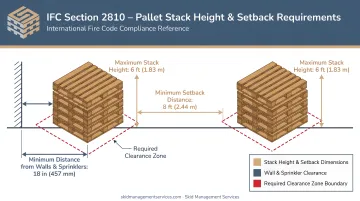
One important note: the ICC-hosted Section 2810 text does not specify a maximum pile footprint. The 400 ft² individual pile area limit you may have seen in other fire code contexts belongs to IFC Section 315.7 — the general outdoor pallet storage provision — not Section 2810. Do not apply that number to a pallet manufacturing or recycling site unless your locally adopted edition explicitly cross-references it.
Required Plans and Documentation
Beyond physical dimensions, Section 2810 requires facilities to prepare and maintain:
- A site plan showing lot lines, buildings, utilities, pallet storage areas, fire protection systems, water supply sources, access roads, smoking areas, and alarm panels
- A fire prevention plan covering walk-through inspection schedules, hot-work permit procedures, and preventive maintenance
- A security management plan based on a documented security risk assessment
All three are code-required deliverables an AHJ can request during any inspection.
Fire Apparatus Access Roads
IFC Section 503 requires fire apparatus access roads with:
- Unobstructed width of at least 20 feet
- Vertical clearance of at least 13 feet 6 inches
Access lanes must allow fire department apparatus to reach all sides of the outdoor storage area. Blocked or narrowed access lanes are among the most common compliance gaps found during inspections, and among the most dangerous. Suppression response time depends directly on apparatus positioning.
Ignition Source Controls
The fire prevention plan must address ignition source controls near outdoor storage:
- Combustible debris must be kept clear of pallet storage areas
- Vegetation around pile areas must be managed
- Smoking and hot-work restrictions apply near outdoor storage
- Electrical equipment in or near storage areas must be assessed as potential ignition sources
Fire Protection System Considerations
Section 2810 is an outdoor yard provision; it does not replace building sprinkler design. Depending on how close pallet piles are to structures, the AHJ may require additional fire protection measures for nearby buildings.
Keep these points in mind for facilities with structures adjacent to outdoor storage:
- NFPA 13 governs sprinkler protection criteria for idle pallet storage inside buildings
- Combined exposure risk — from outdoor piles near building walls — should be evaluated by a fire protection engineer
- AHJ discretion means proximity alone can trigger additional requirements, even when stacks meet Section 2810 setbacks
How Section 2810 Differs from Section 315.7 and Chapter 32
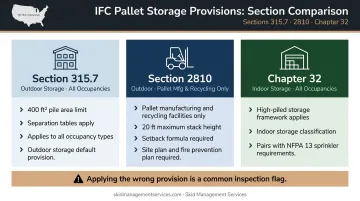
Three separate IFC provisions cover pallet storage — and they don't overlap. Applying the wrong one can leave a facility either over-regulated or quietly out of compliance.
| IFC Provision | Storage Location | Who It Applies To | Key Notes |
|---|---|---|---|
| Section 315.7 | Outdoor | All occupancies | General provision; includes 400 ft² individual pile area limit and separation tables |
| Section 2810 | Outdoor | Pallet manufacturing & recycling facilities only | Facility-specific; 20 ft stack height, setback formula, required site and prevention plans |
| Chapter 32 | Indoor | All occupancies | High-piled combustible storage framework; pairs with NFPA 13 sprinkler criteria |
The practical read comes down to facility type and storage location:
- Pallet manufacturing or recycling, outdoors: Section 2810 applies — not 315.7
- Any building interior, including pallet sites: Chapter 32 governs those areas
- Retailers or manufacturers with incidental outdoor pallet storage: Section 315.7 is your provision
These aren't interchangeable. Using 315.7's pile area limits to justify an outdoor pallet yard at a recycling facility — or assuming Chapter 32 governs your outdoor lot — are common misapplications that inspectors flag. The downstream exposure includes failed inspections, required retrofits, and potential operational shutdowns until corrected.
Steps to Build a Section 2810 Compliance Plan
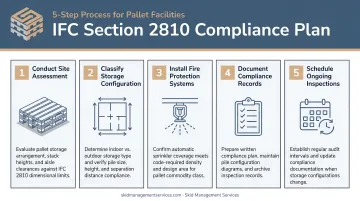
1. Identify Your AHJ and Confirm the Adopted Edition
Contact your local fire marshal or building department before doing anything else. Ask specifically which IFC edition is currently adopted in your jurisdiction and whether local amendments modify any Section 2810 provisions. This one step eliminates the most common compliance error: designing a yard layout around a national code value that doesn't match what your local inspector will enforce.
2. Conduct a Current-State Site Assessment
Map every outdoor pallet storage area. Document:
- Pile footprints and current heights
- Distances from structures and property lines
- Access road widths and clearance heights
- Existing ignition source controls
Compare your findings against the adopted edition requirements to identify gaps before the AHJ does.
3. Develop Written Operational Procedures
Create documented policies covering:
- Maximum pile sizes and configurations
- Pile separation and setback requirements
- Housekeeping schedules and debris removal
- Ignition source controls and hot-work permits
- Employee training frequency and scope
The NWPCA Fire Code Compliance Manual is a practical voluntary resource for structuring these policies. It won't substitute for your locally adopted code text, but it provides useful frameworks for translating code requirements into day-to-day operational procedures.
4. Coordinate with Your AHJ and Fire Protection Professionals
Schedule a pre-compliance walkthrough with the local fire marshal before submitting formal plans. If your facility's storage volumes or proximity to buildings raises questions about suppression system adequacy, bring in a qualified fire protection engineer. Variance requests and alternative compliance approaches need professional support.
5. Maintain Ongoing Compliance
Compliance isn't a one-time checklist. Pallet inventory fluctuates — a seasonal surge can push pile heights or footprints beyond permitted limits within days. Build periodic internal audits into your operational calendar, and update your compliance plan each time a new IFC edition is adopted locally.
Unpredictable pallet inflows are one of the most common drivers of compliance drift. When inbound volumes spike without warning, storage configurations expand beyond permitted footprints before anyone catches it. Stabilizing supply through a consistent national pallet source — one with its own inventory and a broad supplier network — makes it significantly easier to keep outdoor storage within planned limits. Skid Management Services maintains both to support uninterrupted, predictable supply for facilities managing these constraints.
Frequently Asked Questions
What is IFC Section 2810 and who does it apply to?
Section 2810 is the IFC provision governing outdoor storage of wood and wood composite pallets specifically at pallet manufacturing and recycling facilities. It applies only to sites where pallet manufacturing or recycling is the primary operation — not to general occupancies storing spare pallets outdoors.
What is the difference between IFC Section 2810 and Section 315.7?
Section 315.7 applies to all occupancies storing pallets outdoors and includes a 400 ft² individual pile area limit. Section 2810 applies only to dedicated pallet manufacturing or recycling facilities, with different dimensional requirements, required documentation, and no published pile footprint cap in the ICC-hosted text.
Does IFC Section 2810 cover indoor pallet storage areas?
No. Section 2810 addresses outdoor storage only. Indoor pallet storage at any facility — including pallet manufacturers — falls under IFC Chapter 32 and NFPA 13 sprinkler design criteria, not Section 2810.
How often is IFC Section 2810 updated, and how should facilities track changes?
The ICC revises the IFC on a three-year cycle. Facilities should confirm directly with their local AHJ which edition is currently adopted in their jurisdiction, since local adoption often lags the ICC publication date and amendments can alter specific provisions.
What are the pile size and separation distance requirements under IFC Section 2810?
The ICC-hosted text specifies a 20-foot maximum stack height and setback formulas tied to stack height. For exact dimensions, consult the edition your local AHJ has adopted — the NWPCA Fire Code Compliance Manual and a qualified fire protection professional can help interpret requirements for your specific layout.
What are the consequences of failing to comply with IFC Section 2810?
Consequences include stop-work orders, fines, and increased insurance liability. Non-compliant outdoor storage also increases fire risk substantially, threatening workers, adjacent structures, and the surrounding community.