That gap in understanding has real consequences. The wrong pallet choice can create forklift incompatibility at the receiving dock, cause load failures in racking systems, slow down automated lines, or create compliance headaches for international shipments. None of those problems are obvious until they're already costing you money.
This article breaks down the structural differences between stringer and block pallets, identifies where each performs best, and gives you a practical framework for making the right call before placing your next order.
Key Takeaways
- Stringer pallets use parallel boards for support — lower cost, easier to repair, and dominant in U.S. domestic distribution
- Block pallets use a 3×3 grid of nine solid blocks for true four-way entry — standard in automated warehouses and international shipping
- Stringer pallets are typically two-way entry; notched versions allow partial four-way entry for forklifts only
- Load capacity depends more on build quality and wood species than on design type
- Choosing between them comes down to handling equipment, load weight, shipping destination, and whether pallets cycle through a closed-loop system
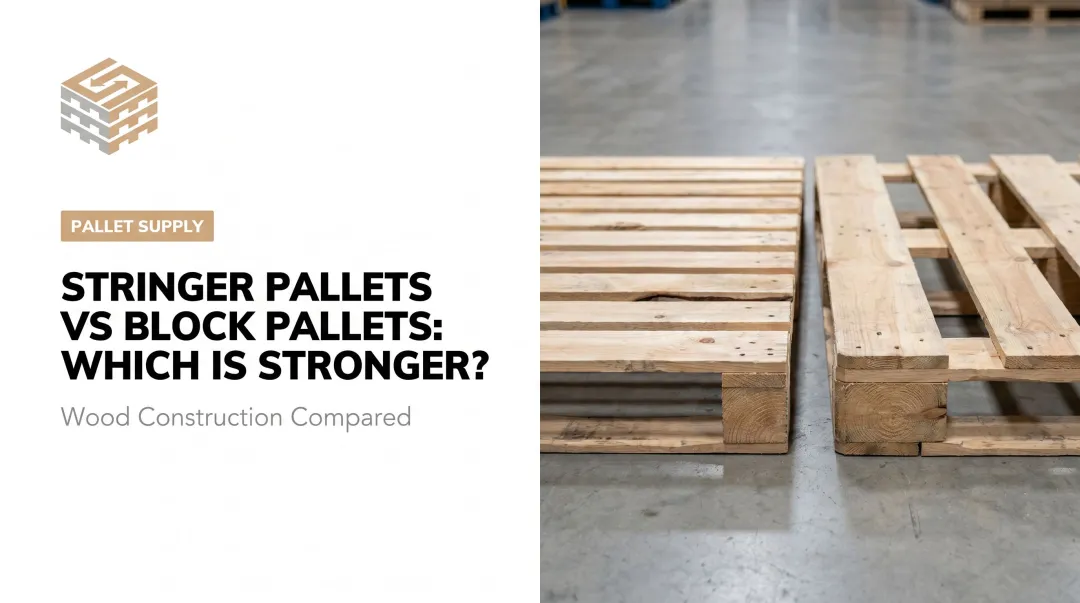
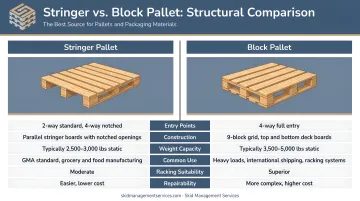
Stringer vs. Block Pallet: Quick Comparison
Both pallet types are defined in the NWPCA's 2025 Uniform Standard for Wood Pallets as the two primary structural classes of wood pallets.
| Attribute | Stringer Pallet | Block Pallet |
|---|---|---|
| Structural support | Parallel longitudinal beams (stringers) | 3×3 grid of nine solid wood blocks |
| Forklift entry | Two-way (four-way if notched) | True four-way (forklifts and pallet jacks) |
| Typical cost | Lower unit cost | Higher due to material and complexity |
| Repairability | Easy — stringers replaced individually | More complex — block replacement requires more labor |
| Best use case | Domestic, high-volume, cost-sensitive distribution | Automated facilities, international shipping, walkie-rider pallet jack operations |
| Common standard | GMA 48"×40" (dominant in North America) | EPAL Euro pallet (800mm×1,200mm, global standard) |
What Is a Stringer Pallet?
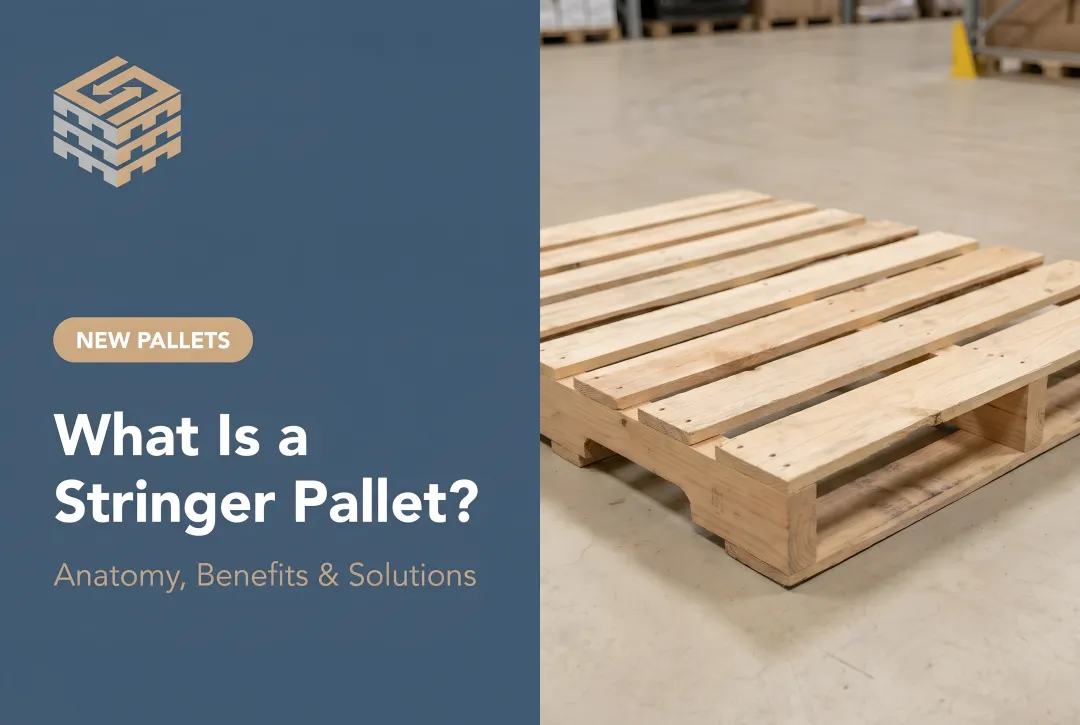
The NWPCA defines a stringer as a "continuous, longitudinal beam component" that supports and spaces deck boards. These parallel boards run the length of the pallet between the top and bottom deck, transferring load along their length — making the stringer the structural spine of the pallet.
Construction and Sizing
The most common stringer pallet is the 48"×40" GMA configuration — a notched three-stringer design with seven top deckboards and five bottom deckboards per the NWPCA standard. This size alone represented 35% of new pallets and 69% of recovered pallets in the U.S. according to USDA Forest Service research.
Wood species vary by application — the NWPCA standard recognizes Southern Yellow Pine and high-density Eastern hardwoods such as beech, hickory, and maple. The same USDA study found softwoods held 55% of the pallet market and hardwoods 45% as of 2016.
Forklift Entry
Standard stringer pallets allow forklift entry from two sides only. Notched stringer pallets (where sections of the stringer are cut away) permit forklift access from all four sides, though walkie-rider pallet jacks remain limited to two-way entry. In busy dock environments, that difference in entry direction directly affects throughput — repositioning a pallet takes time that adds up across a shift.
Practical Advantages
- Lower unit cost than block pallets
- Widely available from domestic suppliers and recyclers across North America
- Straightforward repair process — damaged stringers can be replaced without rebuilding the pallet
- Compatible with the two-way forklift equipment most common in U.S. facilities
Use Cases for Stringer Pallets
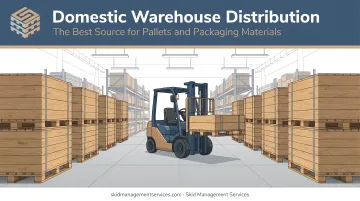
Stringer pallets are the clear default for domestic U.S. operations. The USDA/Virginia Tech data confirms just how dominant they are: stringer-class pallets held 76% of the U.S. wood pallet market, versus 21% for block pallets and 3% for skids. That market share reflects where they genuinely perform best.
They fit best in:
- Domestic-only distribution networks
- One-way or short-cycle shipment lanes
- Retail, grocery, and food and beverage supply chains
- Operations using standard two-way forklift equipment
- High-volume, cost-sensitive procurement environments
What Is a Block Pallet?
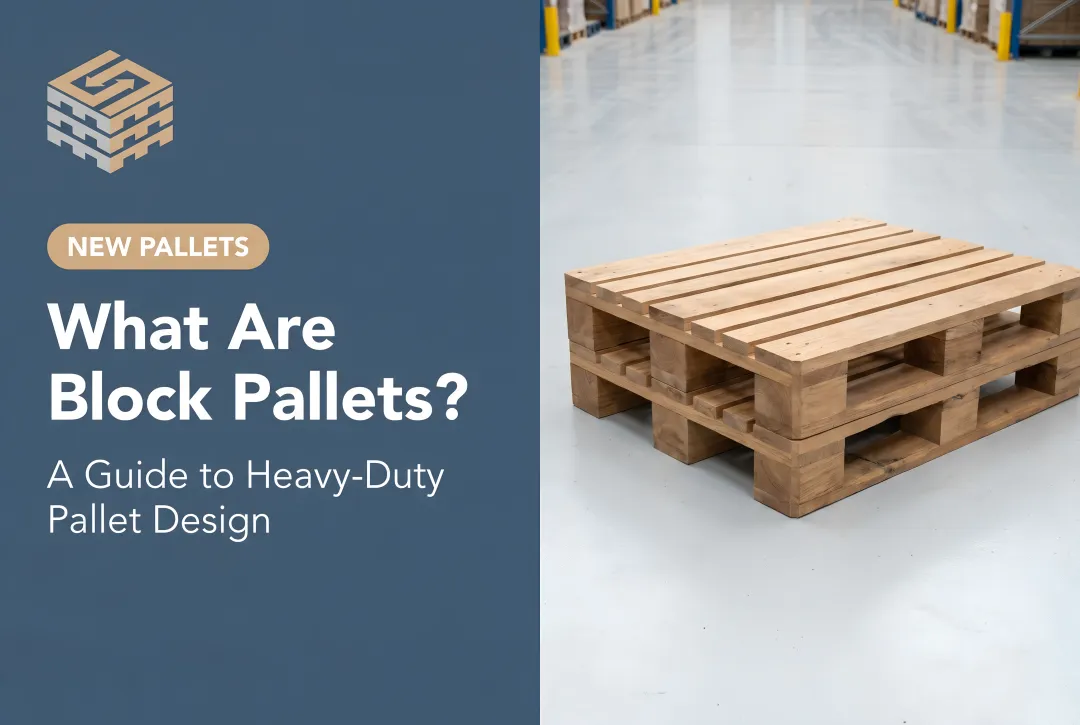
A block pallet replaces the continuous stringer beams with nine solid wood blocks arranged in a 3×3 grid — four corners, four edge midpoints, and one center block. These blocks elevate all four sides of the pallet evenly, which is what makes true four-way entry possible.
Four-Way Entry and Why It Matters
The uniform clearance on all four sides means forklifts and walkie-rider pallet jacks can approach from any direction. That flexibility reduces dock congestion, eliminates load repositioning, and speeds throughput in high-volume receiving and staging areas.
In automated warehouse environments, this stops being a convenience and becomes a requirement. Conveyor systems and AGVs depend on consistent pallet orientation — approach direction can't be a variable.
Bottom Deck Variations
The NWPCA standard identifies several bottom deck configurations for block pallets:
- Unidirectional — bottom deckboards run in one direction only
- Perimeter — boards oriented in both directions with butted and end boards
- Cruciform — includes connector boards for additional base structure
Each configuration affects how the pallet behaves on different surfaces and handling equipment, though specific stacking or conveyor performance claims require application-specific testing to validate.
The "Block Pallets Are Always Stronger" Misconception
Block pallet design does distribute load across nine contact points rather than along parallel beams — but actual strength depends on wood species, fastener selection, and build quality. A well-constructed stringer pallet can outperform a poorly built block pallet in racking and dynamic load scenarios.
Use Cases for Block Pallets
Block pallets are the standard outside North America. The EPAL Euro pallet — an 800mm×1,200mm block pallet built with 9 blocks, 11 boards, and 78 nails — is described by EPAL as the most widely used exchange pallet in the world, with more than 650 million units in global circulation.
That global footprint reflects real operational advantages. Block pallets are the right choice for:
- Automated warehouses with conveyor or AGV systems
- Dock environments running walkie-riders
- International export shipments, particularly to Europe and other non-North American markets
- Industries shipping heavy or fragile goods requiring stable, omnidirectional handling
- Closed-loop pallet programs where higher upfront cost is offset by longer service life
Stringer vs. Block Pallet: Key Differences Explained
Load Distribution
Virginia Tech's Center for Packaging and Unit Load Design found that in stringer-class pallets, pressure redistributes toward the stringers parallel to the direction of pallet bending. The NWPCA structural definitions reinforce this: stringers function as continuous longitudinal beams, while blocks act as discrete spacers identified by position.
In practical terms, stringer pallets carry loads well along their beam axis — racking performance depends on how the pallet is oriented relative to the rack. Block pallets spread load across multiple contact points, which affects how they behave in both static racking and dynamic transport.
Forklift and Dock Compatibility
Two-way stringer pallets require operators to approach from specific ends. In busy dock environments, that constraint creates delays — loads need to be turned or repositioned before they can be moved. Block pallets eliminate that bottleneck entirely by allowing any approach direction.
For facilities running walkie-riders rather than sit-down forklifts, this distinction is even more pronounced. Standard stringer pallets simply don't work with walkie-riders from all sides.
Cost and Repairability
The key cost driver is production complexity. Pallet Enterprise notes that high-quality block pallets require automated nailing systems to produce at volume — that investment translates directly to higher unit cost compared to stringer pallets.
| Factor | Stringer Pallets | Block Pallets |
|---|---|---|
| Unit cost | Lower | Higher |
| Repair ease | Simple — replace one stringer | Labor-intensive, may not be cost-effective |
| Repair speed | Fast | Slower |
International Shipping and ISPM-15
Any wood pallet used in international trade — stringer or block — must comply with ISPM-15, the phytosanitary standard requiring heat treatment, debarking, and certified marking. USDA APHIS enforces this for all wood packaging entering or transiting the U.S., and at least 46 countries have formal ISPM-15 requirements for inbound shipments.
Beyond treatment compliance, block pallets are better suited for international shipping because they match the dimensional and handling infrastructure standards used outside North America.
Skid Management Services supplies ISPM-15 heat-treated pallets for export shipments in both stringer and block configurations.
How to Choose the Right Pallet for Your Operation
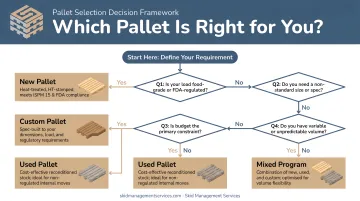
The decision comes down to four questions:
- What's the load weight and unit configuration? Both types handle substantial loads when properly built, but very heavy or irregular loads often call for custom-spec pallets regardless of type.
- What handling equipment is at origin and destination? Two-way forklift setups favor stringer pallets. Walkie-riders, automated systems, or mixed-direction handling favor block pallets.
- Is this domestic or international? Stringer pallets are the default for domestic U.S. distribution. International shipments call for block pallets, which align with global handling infrastructure and exchange pallet standards.
- Single-use or closed-loop? Single-use domestic lanes favor lower-cost stringers. Reusable closed-loop systems can justify the higher upfront cost of block pallets over time.
Quick Decision Guide
| Scenario | Recommended Pallet |
|---|---|
| Domestic retail/grocery distribution | Stringer |
| One-way high-volume shipments | Stringer |
| Automated warehouse or conveyor system | Block |
| Walkie-rider dock operations | Block |
| Export to Europe or Asia | Block (ISPM-15 treated) |
| Mixed domestic + international | Both types in inventory |
Operations with mixed shipping needs typically keep both types in inventory. Skid Management Services supplies new, used, and custom-spec wood pallets nationally — including block pallets for automated and international applications — backed by an expansive supplier network that supports consistent availability at volume. Contact them at 717-202-0304 or Info@SkidManagementServices.com to discuss your requirements.
Frequently Asked Questions
What is the difference between a stringer pallet and a block pallet?
Stringer pallets use parallel longitudinal boards for structural support and typically allow only two-way forklift entry (or partial four-way if notched). Block pallets use nine solid wood blocks in a 3×3 grid, enabling true four-way entry for both forklifts and pallet jacks. Stringer pallets dominate U.S. domestic markets; block pallets are the global standard.
What are the three types of pallets?
The NWPCA classifies wood pallets into two primary structural classes: stringer and block. Within those classes, notched stringer pallets are sometimes treated as a third category given their partial four-way entry capability. Wood pallets account for roughly 95% of pallets in use across U.S. supply chains.
Can a stringer pallet be converted to four-way entry?
Yes. Notching removes sections of the stringer to allow forklift entry from all four sides; chamfering adds angled cuts at the ends to assist pallet jack entry. Either modification improves access, but neither matches the full four-way capability of a block pallet — walkie-rider pallet jacks remain limited to two-way entry on notched stringers.
Are block pallets more expensive than stringer pallets?
Generally, yes. Block pallets require more wood volume and more complex assembly, driving up unit cost. For operations where four-way entry reduces repositioning time or improves trailer utilization, the operational savings can offset the higher purchase price.
Which pallet type is better for international shipping?
Block pallets are the better fit for most international shipments. They align with the pallet dimensions and handling infrastructure used outside North America, particularly in Europe where the EPAL Euro pallet is the dominant exchange format. Both stringer and block pallets must meet ISPM-15 heat treatment requirements for export.
Which pallet is better for heavy loads?
Both types can handle heavy loads when properly built. Actual capacity depends on wood species, fastener type, and overall construction quality — not design class alone. For very heavy or irregular loads, custom-spec pallets with defined load ratings are the safest approach regardless of whether you choose stringer or block construction.