Pallet selection is one of the most consequential procurement decisions in F&B logistics. Get it wrong and you're dealing with product damage, failed retail audits, customs rejections, or worse — a food safety incident. Yet it's a decision many operations treat as routine.
This article covers what F&B procurement and supply chain managers need to know about wood pallets: why wood remains the dominant choice, what food safety and regulatory requirements actually apply, how to choose the right pallet for each application, and how to protect your operation from supply disruptions.
Key Takeaways
- Over 1.8 billion pallets circulate in the U.S., with roughly 90–93% being wood
- Heat-treated (HT) pallets are required for international shipments under ISPM-15 and are best practice for all F&B use
- FDA's FSMA (21 CFR Part 1, Subpart O) requires food transport pallets to be sanitary, cleanable, and structurally sound
- The 48"×40" GMA pallet is used by 72% of operations — the de facto standard for U.S. food retail and distribution
- Pallet prices spiked up to 400% during COVID-era shortages, making supply continuity a direct food operations risk
Why Wood Pallets Remain the Backbone of Food & Beverage Logistics
Wood pallets have been the default choice in U.S. food supply chains for decades. Wood offers a high strength-to-cost ratio, works with every standard forklift and pallet jack, and is available in the volumes that F&B operations actually need.
According to the USDA Forest Service's life-cycle assessment, more than 1.8 billion pallets are in service in the U.S., with approximately 90–93% being wood. No other material comes close to that scale or availability.
Transportation Stability
Wood's rigidity is an underappreciated advantage in F&B applications. A structurally sound wood pallet provides a flat, stable foundation that prevents load shifting during transit. That matters when you're moving glass bottles, stacked beverage cases, or produce packaging that can't absorb impact.
A pallet that flexes under load or fails mid-transit damages product, triggers a claims process, and creates a gap in your fulfillment schedule.
Warehouse and Automation Compatibility
The Modern Materials Handling 2025 Pallet Report found that 72% of respondents use 48"x40" pallets — the GMA standard originally set by the Grocery Manufacturers Association. That uniformity matters operationally:
- Standardized dimensions enable tight vertical stacking and maximize warehouse cubic capacity
- Consistent sizing integrates directly with conveyor systems and automated storage and retrieval systems (AS/RS)
- 89% of pallet users in the same report said minimum pallet specifications are essential for their operations
- For automation specifically, 75% rated absence of broken components as extremely important, and 63% rated dimensional squareness as extremely important
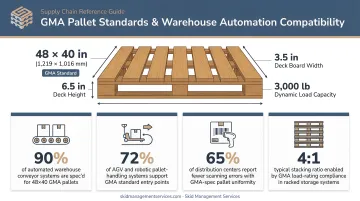
For food manufacturers and distributors running high-throughput facilities, a pallet that doesn't meet dimensional tolerances doesn't just slow down operations. It can shut down an automated line entirely.
Food Safety and Hygiene Standards for Wood Pallets in F&B
Wood pallets are safe for food applications when properly sourced and maintained. Treatment method, physical condition, and prior use history determine whether a pallet belongs in an F&B environment — not the material itself.
A 2010 peer-reviewed study published in Food Protection Trends (Boersig and Cliver) found that bacteria appeared less easily transferred from wood than from plastic, and concluded that pallet material choice likely has only a slight effect on food safety. The condition and history of each individual pallet, however, carry far more weight than the material.
Hygiene Risks from Poor-Quality Pallets
Improperly sourced or poorly maintained pallets introduce real risks in F&B environments:
- Moisture absorption creates conditions for mold and bacterial growth on wet or weathered pallets
- Splinters and board cracks can introduce physical contaminants — wooden splinters are identified in peer-reviewed HACCP literature as an extrinsic physical hazard
- Unknown prior use means recycled pallets may carry chemical residues or pest contamination from non-food cargo
New Pallets vs. Recycled Pallets for F&B
| Use Case | Recommended Pallet Grade |
|---|---|
| Direct food contact / FDA-sensitive shipments | New, heat-treated pallets |
| Retail-facing outbound loads | New or Grade A recycled, verified HT stamp |
| Internal warehouse transfers (non-food-contact) | Grade A recycled, inspected |
| Export shipments | New or Grade A, ISPM-15 compliant |
When inspecting any pallet for food safety suitability, check for:
- HT stamp visibility — confirms heat treatment was applied
- No staining or unusual odor — signs of prior chemical contact
- No protruding nails, cracked boards, or structural repairs that could fail under load
- Dry surface condition — wet boards suggest moisture exposure
Heat treatment is the standard for food-safe pallets. The process heats wood to a core temperature of 56°C for 30 continuous minutes, eliminating insects, larvae, and certain pathogens without chemical fumigants. No chemical residue means HT pallets meet food safety requirements across domestic distribution and international export.
Key Regulatory Requirements: ISPM-15, FDA, and HACCP
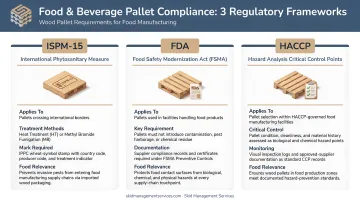
Three regulatory frameworks directly govern pallet use in food and beverage operations. Each carries distinct obligations — and knowing where they overlap (and where they don't) keeps compliance straightforward.
ISPM-15 (International Phytosanitary Standard)
ISPM-15, published by the International Plant Protection Convention under the FAO, governs wood packaging material used in international trade. The requirement: wood pallets must be heat-treated to 56°C for 30 continuous minutes throughout the entire wood profile, including the core, and marked with the official IPPC stamp.
The IPPC mark includes the country code, treatment provider code, and treatment designation (HT for heat treatment). A pallet without this mark on international shipments will not be allowed into the United States under APHIS rules, and can trigger an Emergency Action Notification from U.S. Customs and Border Protection.
For domestic U.S. operations, ISPM-15 is not legally required. That said, major grocery chains and club store buyers routinely require it as a vendor specification — so most retail-facing F&B suppliers treat it as standard practice regardless.
When sourcing export pallets, confirm your supplier can provide ISPM-15 heat-treated stock with proper IPPC documentation — it's a straightforward ask that prevents costly holds at the border.
FDA / FSMA Requirements
Under the Food Safety Modernization Act, the Sanitary Transportation of Human and Animal Food rule (21 CFR Part 1, Subpart O) explicitly includes pallets within the definition of transportation equipment. Section 1.906 requires that transportation equipment be:
- Designed and constructed of suitable materials
- Adequately cleanable for its intended use
- Maintained in sanitary condition so food does not become unsafe
The FDA does not certify individual pallets. The obligation falls on the shipper and carrier to document that pallets in use meet these standards — which makes supplier traceability and pallet condition records a practical audit requirement.
HACCP Considerations
Under HACCP frameworks, physical hazards — including wooden splinters — are classified as extrinsic physical hazards that must be addressed in the facility's hazard analysis. Pallet inspection typically functions as part of a prerequisite program rather than a Critical Control Point.
The exact classification depends on your facility's risk profile, so the controls below may sit at different points in your program depending on how your team has structured the analysis.
Practical HACCP controls for pallets commonly include:
- Routine visual inspection before loading
- Segregation by product type (allergen vs. non-allergen, raw vs. processed)
- Documented cleaning or replacement protocols for damaged pallets
How to Choose the Right Wood Pallet for Your F&B Operation
Matching Size to Application
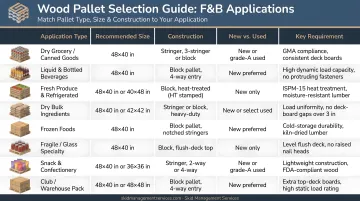
The 48"×40" GMA pallet is the correct starting point for the vast majority of U.S. food retail and distribution applications — it's used by 72% of operations and integrates with standard warehouse racking, conveyor systems, and retail receiving docks.
Other sizes serve specific applications:
- 48"×48" — used by 34% of operations; common for beverage drums and bulk containers
- 42"×42" — used by 15% of operations; suited to certain cylindrical or specialty loads
Matching Construction to Product Type
Block pallets support four-way entry and are more durable under repetitive automated handling — a better fit for high-throughput facilities using AS/RS or multi-directional forklifts.
Stringer pallets are typically lower cost and easier to repair, making them practical for operations with more straightforward manual handling requirements.
Other specification considerations:
- Load capacity — heavy beverage and dairy applications require higher static and dynamic load ratings than packaged snack goods
- Deck board configuration — produce operations need deck board spacing that supports carton corners while allowing return-air passage, per USDA AMS guidance
New vs. Recycled for F&B
The right choice depends on your application:
- New pallets — appropriate for FDA-sensitive, direct food contact, and retail-facing shipments where traceability and appearance matter
- Grade A recycled pallets — suitable for internal warehouse applications and non-food-contact uses at lower cost, provided they're consistently inspected and graded before delivery
- ISPM-15 heat-treated options — required for export shipments; confirm your supplier can certify compliance
The deciding factor is supplier consistency. A recycled pallet that isn't properly graded introduces contamination and structural risk. Skid Management Services supplies new and used pallets across standard GMA dimensions and custom sizes, with heat-treated options for export compliance — sourced from a national supplier network built to keep F&B operations running without interruption.
Sustainability Advantages of Wood Pallets in Food Supply Chains
Wood pallets carry a stronger sustainability case than most F&B operations realize — and the data backs it up.
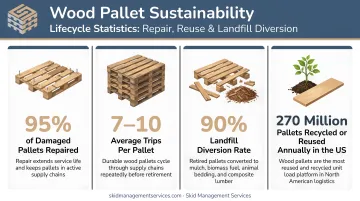
The USDA Forest Service LCA reports a global warming impact of 10.4 kg CO2e per 100,000 lb of pallet loads delivered. The same study found that in 2016, 326 million pallets were repaired or remanufactured alongside 513 million new ones — demonstrating an established repair and reuse cycle.
That reuse cycle extends to end-of-life as well:
- 53% of recovered pallets were repaired and returned to active service
- 87% of recovered pallets moved through repair or remanufacturing facilities
- Only about 5% of pallets produced reached landfill — the rest were diverted through grinding for mulch, animal bedding, or biomass fuel
For F&B companies with ESG reporting obligations, sourcing certified wood pallets from suppliers with documented supply chains supports supplier sustainability disclosures and aligns with responsible sourcing commitments.
Securing a Reliable Wood Pallet Supply for Your F&B Business
Supply continuity is the dimension of pallet procurement that gets the least attention until it fails. In 2021, the United Fresh Produce Association warned of acute pallet shortages threatening fresh produce movement across North America. At the peak of the disruption, pallet prices had risen as much as 400% compared to pre-pandemic levels, driven by lumber scarcity and labor shortages across the pallet manufacturing sector. Production lines can't wait for delayed shipments — and neither can perishable loads.
What to Look for in a Pallet Supplier
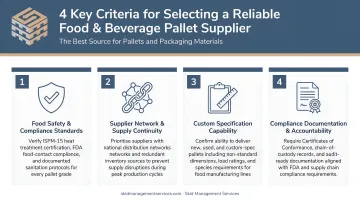
For high-volume F&B operations, supplier selection should go beyond unit price:
- National distribution reach — single-region suppliers create single points of failure when disruptions hit
- Multi-source procurement — dependence on one mill or lumber chain amplifies exposure during shortages
- Verified on-time delivery — ask for a track record with comparable food manufacturing customers, not just references
- Scalability during demand spikes — especially critical around seasonal production peaks
Skid Management Services operates as a national provider, maintaining its own inventory alongside an expansive network of pallet and packaging suppliers across the U.S. Food and beverage operations including Knouse Foods, Campbell Snacks, Nissin, Hain Celestial, Stauffer's, and Plainville rely on Skid Management for consistent pallet supply at competitive pricing — with sourcing structured to keep supply moving before shortages become a crisis.
Frequently Asked Questions
How much do 48x40 pallets sell for?
Pricing depends on grade, region, wood species, and order volume. As of April 2025, Fastmarkets reported new 48"x40" GMA pallets at $10–$14 delivered in the Dallas-Fort Worth market; Grade A used pallets ran $8.50–$10.50. Bulk orders from national suppliers typically carry lower per-unit costs than spot purchases.
What are the FDA requirements for pallets?
The FDA does not certify specific pallets. Under FSMA's Sanitary Transportation rule (21 CFR Part 1, Subpart O), pallets used in food transport must be sanitary, adequately cleanable, and maintained in a condition that prevents food contamination. Heat-treated, chemically untreated wood pallets are the standard approach for compliance.
What is ISPM-15 and why does it matter for food and beverage shipping?
ISPM-15 is an international phytosanitary standard requiring wood pallets used in cross-border shipments to be heat-treated to 56°C for 30 continuous minutes and stamped with the IPPC mark. Non-compliant pallets can be refused entry at U.S. Customs, triggering costly delays and potential Emergency Action Notifications.
Are new wood pallets better than recycled pallets for food transport?
New pallets are preferred for direct food contact and regulated applications — they have no contamination history and consistent structural integrity. Grade A recycled pallets can be appropriate for internal warehouse use or non-food-contact applications when properly inspected and graded by the supplier.
What are heat-treated pallets and are they required for food?
Heat-treated pallets are processed to a core temperature of 56°C for 30 minutes, eliminating pests and pathogens without chemical fumigants. ISPM-15 requires them for international shipments, and they're the recommended standard for all food and beverage applications given the chemical-free processing method.