
This guide covers everything procurement managers and supply chain teams need to know: what the GMA pallet is, its dimensions and grades, which industries depend on it, how it compares to the Euro pallet, and what to look for when choosing a supplier.
Key Takeaways
- GMA stands for Grocery Manufacturers Association (now the Consumer Brands Association)
- Standard footprint is 48" × 40" — the default for virtually all U.S. domestic supply chains
- Recycled pallets come in three grades: Premium, Grade A (#1), and Grade B (#2)
- Used across food & beverage, CPG, pharma, e-commerce, and manufacturing
- Wood pallets require ISPM-15 heat treatment for international export
- Grade and supplier consistency matter; unlike Europe's EPAL system, no central governing body enforces U.S. pallet standards
What Is a GMA Pallet and Where Did It Come From?
GMA stands for the Grocery Manufacturers Association, an industry trade group that rebranded as the Consumer Brands Association (CBA) in January 2020. The organization — active in the U.S. since at least the early 20th century — recommended the 48"×40" pallet footprint to standardize how packaged goods move through the supply chain.
The Problem It Solved
Before the GMA standard took hold, pallet sizes varied widely across industries. That variation created real friction: warehouses couldn't optimize racking, carriers couldn't reliably plan loads, and handling equipment had to accommodate a patchwork of incompatible footprints.
A single standard footprint resolved that friction. With everyone working from the same 48"×40" baseline, carriers could plan loads predictably, rack manufacturers could design to one spec, and distribution centers could operate without exception handling.
That standardization also earned international recognition. The 48"×40" dimension appears in ISO 6780:2003 as one of six principal plan dimensions for flat pallets used in intercontinental materials handling — giving the GMA pallet both domestic dominance and global credibility.
Where It's Used Today
The GMA pallet is the default standard across the United States. Major retail distribution chains don't just prefer it — they require it:
- Walmart Fulfillment Services requires 40"×48" four-way-access solid wood pallets graded to GMA Grade A for LTL/FTL inbound shipments.
- Amazon FBA specifies 40×48 inch, 4-way access wooden pallets for inbound deliveries to fulfillment centers.
One important nuance: unlike Europe's EPAL system — which involves licensed production, independent inspections, and over 25,000 unannounced inspections annually — there is no equivalent centralized licensing body for GMA pallets. Quality, construction, and grading practices vary between suppliers, which is why understanding specifications before you buy matters.
GMA Pallet Dimensions and Technical Specifications
Standard Footprint and Weight
| Specification | Value |
|---|---|
| Length | 48 inches (1,219 mm) |
| Width | 40 inches (1,016 mm) |
| Height (empty) | ~6.5 inches |
| Empty weight (wood) | 44–59 lbs (supplier-reported) |
Load Capacity
| Load Type | Capacity |
|---|---|
| Dynamic load (in motion) | ~2,500 lbs minimum |
| Safe load (design-specific) | up to ~4,600 lbs |
Load capacity varies by construction type, pallet condition, and support configuration. The figures above reflect supplier-reported ranges — design-specific engineering tools like the Pallet Design System (PDS) are used when exact structural performance matters.
Stringer vs. Block Construction
The two structural types perform differently in ways that affect your operation:
- Stringer pallets use three parallel boards running the pallet's length. They may offer 2-way or partial 4-way entry. Most common in the U.S. and cost-effective for standard applications.
- Block pallets use corner and center blocks to provide true 4-way entry from all sides. Preferred in automated environments because conveyors and AGVs can engage from any direction without alignment constraints.
For high-throughput operations or facilities running automated storage and retrieval systems, block pallets are the better fit.
Board Layout
Board configuration matters for GMA compliance — especially when supplying food or retail customers:
- Top deck: Two 5.5" lead/end boards + five 3.5" interior boards
- Bottom deck: Two 5.5" lead/end boards + three 3.5" interior boards between the notches
- Minimum board thickness: 0.5 inches on all deck boards
Material Options
| Material | Best For | Key Trade-off |
|---|---|---|
| Wood | Most applications — cost-effective, repairable | Requires ISPM-15 heat treatment for export |
| Plastic | Food, pharma, automated systems | More expensive; not field-repairable |
| Pressed fiber/cardboard | Air freight, single-use export | Lightweight but not reusable |
Wood dominates domestic U.S. operations for cost and ease of repair. Plastic earns its higher price tag in food processing or pharma settings, where cleanability is a non-negotiable.
GMA Pallet Grades Explained
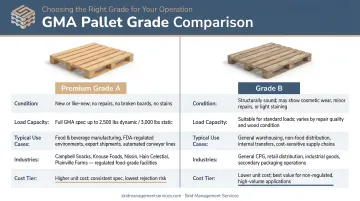
GMA pallets are either new or recycled. Recycled pallets are classified into three grades; terminology can vary by region, so confirm the exact language with your supplier.
Premium (Also Called "Supers" or "Wide-Lead")
The top tier of recycled pallets. Key characteristics:
- Nominal 6" lead boards on both top and bottom decks
- Minor repairs only — mending plates, staples, or corrugated metal fasteners to address splits
- No block, plug, or companion stringer repairs
- Required for automated conveyor systems, food-grade applications, and retail distribution with strict quality standards
Grade A (#1)
Recycled pallets refurbished to near-original condition. Per a USDA Forest Service study, Grade A pallets averaged just 0.15 stringer repairs per unit. Companion runner or block repairs are not acceptable at this grade, same as Premium. Mending plates are acceptable.
Grade B (#2)
Grade B pallets show more wear and carry a longer repair history — still fully functional, but not suited for every application. The same USDA study found Grade B pallets averaged 1.04 stringer repairs per unit. Characteristics include:
- Companion runners, plugs, or double stringers alongside damaged stringers
- Greater discoloration and cosmetic wear
- No more than two extra blocks or stringers at any single point
Grade B works well for internal logistics, outbound bulk shipments, or operations where appearance and automation compatibility are lower priorities. Cost savings over Grade A are typically noticeable; current market pricing is tracked by sources like Pallet Profile Weekly.
Choosing the Right Grade
| Use Case | Recommended Grade |
|---|---|
| Automated conveyors, AS/RS | Premium or Grade A |
| Food retail inbound (e.g., Walmart WFS) | Grade A minimum |
| Internal plant transport | Grade B |
| Bulk outbound, cost-sensitive | Grade B |
| Export (with heat treatment) | Grade A or new |
What Industries and Operations Rely on GMA Pallets?
The GMA pallet originated in grocery and CPG distribution, and that's still where adoption is highest. Food manufacturers — from snack producers to beverage brands — standardize on the 48"×40" footprint because it integrates directly with conveyors, stretch-wrap stations, and palletizers.
Beyond food and grocery, GMA pallets are the standard across:
- Pharmaceuticals: cleanability requirements often push toward block or plastic variants, but the 48"×40" footprint remains standard
- E-commerce fulfillment: Amazon FBA specifies 40"×48" 4-way entry pallets — the same footprint in the 40"-lead orientation
- Home improvement and building materials: heavy-duty GMA configurations handle dense, high-weight loads without special equipment
- Third-party logistics (3PL): running one pallet standard across all clients simplifies handling, reduces damage, and lowers per-unit costs
The Logistics Math
The dimensions aren't arbitrary — they're engineered around the physical constraints of U.S. logistics infrastructure. Two GMA pallets fit side-by-side in a standard 53-foot dry van (interior width ~98.5 inches, with the 40" dimension running across the trailer). The footprint also aligns with selective pallet racking dimensions used across virtually every U.S. distribution center.
Skid Management Services supplies GMA 48×40 pallets to food manufacturers and CPG brands including Campbell Snacks, Knouse Foods, Nissin, Hain Celestial, Stauffer's, and Plainville.
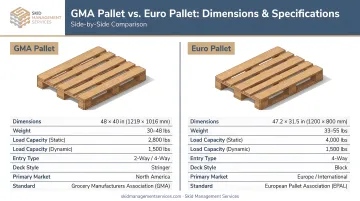
GMA Pallet vs. Euro Pallet: Key Differences
| Attribute | GMA Pallet | Euro Pallet (EPAL) |
|---|---|---|
| Dimensions | 48"×40" (1,219×1,016 mm) | 47.24"×31.50" (1,200×800 mm) |
| Height | ~6.5" | 144 mm (~5.67") |
| Empty weight | 44–59 lbs | ~55 lbs (~25 kg) |
| Safe working load | ~2,500–4,600 lbs (design-specific) | 1,500 kg (~3,300 lbs) per EPAL |
| Governing body | None centralized | EPAL (licensed production + independent inspection) |
| Primary market | North America | Europe |
Practical Implications
Euro pallets are optimized for European truck widths and racking systems — they don't fit North American trailers and standard selective racking as efficiently. Companies shipping internationally should plan for re-palletizing or format conversion at the destination. The two systems are not interchangeable.
ISPM-15 for Export
Any wood GMA pallet used in international shipping must comply with ISPM-15. Per USDA APHIS requirements, compliant wood packaging must display:
- The IPPC logo
- A two-letter country code
- A unique facility number
- The treatment code: HT (heat treatment) or MB (methyl bromide)
Customs agents can reject or detain shipments that arrive without proper ISPM-15 marking. Plastic pallets avoid this requirement entirely — a practical advantage for international exporters.
How to Choose the Right GMA Pallet Supplier
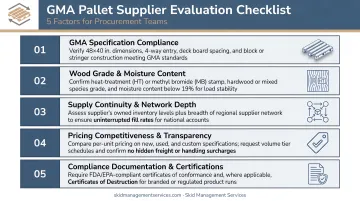
Because there's no EPAL-style governing body for GMA pallets, quality differences between suppliers are real and consequential. Here's what to evaluate:
- Grade consistency — Can the supplier deliver Grade A or Grade B reliably and define those grades in writing? Ask for specifications, not just a verbal assurance.
- New vs. recycled availability — Some operations need new pallets for food-grade compliance; others can use recycled Grade B. A supplier with access to both gives you flexibility.
- ISPM-15 certification — If any of your products ship internationally, confirm the supplier can provide heat-treated, ISPM-15-stamped pallets.
- Geographic coverage — Multi-site operations need a supplier whose network reaches all their facilities, not just one region.
- Supply continuity — Ask how they manage demand surges. A supplier relying on a single production facility carries more risk than one with a distributed network.
Skid Management Services supplies new and recycled GMA pallets (including ISPM-15 heat-treated options) to food manufacturers, CPG brands, and distributors across the country. Their model combines owned inventory with a national supplier network, which supports consistent availability even when regional supply tightens. For multi-site accounts, that means you're not dependent on a single production facility when volume spikes or a regional supplier goes short.
To discuss specific grade requirements, pricing, or ISPM-15 availability, contact Skid Management Services at 717-202-0304 or Info@SkidManagementServices.com.
Frequently Asked Questions
What is a GMA grade pallet?
GMA grade refers to the quality classification of recycled 48"×40" pallets: Premium (Wide-Lead), Grade A (#1), and Grade B (#2). Premium carries the strictest repair limits; Grade B allows more extensive repairs and shows greater wear.
What is the difference between a GMA pallet and a Euro pallet?
A GMA pallet measures 48"×40" (1,219×1,016 mm) and is the North American standard; a Euro pallet measures 47.24"×31.50" (1,200×800 mm) and is the European standard governed by EPAL. The two formats are not interchangeable — switching between them requires re-palletizing at the point of format change.
How much weight can a GMA pallet hold?
Supplier guidelines typically cite a 2,500 lb minimum dynamic load (pallet in motion) and up to approximately 4,600 lbs in specific supported conditions. Actual capacity varies by construction type (block vs. stringer), pallet grade, and support configuration.
How much does a GMA pallet weigh?
A standard wood GMA pallet weighs approximately 44–59 lbs empty, depending on wood species and construction.
Are GMA pallets heat-treated?
Heat treatment is not required to meet GMA guidelines for domestic use. For international shipping, wood pallets must comply with ISPM-15 and display the HT stamp, country code, facility number, and IPPC logo. Confirm ISPM-15 certification with your supplier before any export shipment.
How many GMA pallets fit in a standard truck trailer?
According to ATS, a 53-foot dry van typically holds 26 to 30 GMA pallets in a single layer; double-stacking where load height permits can effectively double that count. Confirm specific loading plans with your carrier based on actual product dimensions and weight.