
This guide covers what gauge actually means, how to read the common ranges, what drives selection decisions, and how to verify you're getting what you paid for.
Key Takeaways
- Gauge measures film thickness: 1 gauge = 0.254 microns = 0.00001 inch; higher gauge = thicker film = greater strength
- The practical range runs from 37 gauge (lightest pre-stretch) to 150 gauge (heavy machine film), with 80 gauge as the general-purpose standard for loads up to 2,400 lbs
- Gauge selection depends on load weight, load shape, hand vs. machine application, and environment
- True-gauge and equivalent-gauge films carry the same number but perform differently — always confirm which type you're buying
- Under-gauging causes load failures; over-gauging wastes material and budget
What Gauge Actually Means in Pallet Wrap
Gauge is a thickness unit specific to plastic film. These conversions come up constantly when reading manufacturer spec sheets:
- 1 gauge = 0.01 mil = 0.00001 inch = 0.254 microns
- 1 mil = 100 gauge = 25.4 microns
- So 80 gauge = 0.80 mil ≈ 20.3 microns
Gauge, mils, and microns all describe the same physical dimension — just on different scales. ASTM D6988-21 is the governing standard for thickness measurement of plastic film specimens, so you'll see it referenced on compliant spec sheets.
Gauge as a Performance Parameter
A thicker film has more material cross-section to resist tension and puncture. Load-holding strength, elongation capacity, and tear resistance all generally scale with gauge — but not always linearly. Modern high-performance resins — including metallocene and nano-layer formulations — can outperform heavier commodity films at lower gauges, which is why gauge alone doesn't tell the whole performance story.
True-Gauge vs. Equivalent-Gauge vs. Pre-Stretched
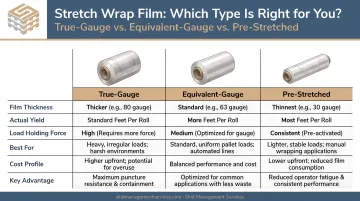
These three film types are not interchangeable, even when they carry the same number:
- True-gauge film measures exactly as labeled under a micrometer (for example, 80 gauge = 0.80 mil)
- Equivalent-gauge film is physically thinner but uses a denser or stiffer resin to deliver comparable containment force — Robopac notes that 47-gauge equivalent film uses a unique resin and performs comparably to 60-gauge true-gauge film for loads up to 1,800 lbs
- Pre-stretched film has been extended near its stretch limit during manufacturing, making it physically thinner on the roll but requiring less application force — 37-gauge film is often an 80-gauge film pre-stretched by the manufacturer
Cast vs. Blown: Same Gauge, Different Field Behavior
The manufacturing process changes how a given gauge performs:
- Cast film: extruded through a slot die onto chilled rollers — produces consistent gauge, high clarity, and quiet unwind
- Blown film: resin extruded into an air-cooled tube — results in variable gauge but higher puncture resistance and better memory
When your loads involve sharp corners, irregular shapes, or outdoor storage, specifying blown film at a given gauge is worth the conversation with your supplier.
Pallet Wrap Gauge Ranges: From Light Duty to Heavy Duty
The practical range spans from approximately 37 gauge to 150 gauge, grouped into three tiers.
Reference Table: Key Gauges at a Glance
| Gauge | Mil | Microns | Typical Load Capacity | Common Application |
|---|---|---|---|---|
| 37 | 0.37 | ~9.4 | Under 800 lbs | Pre-stretched bundling, light loads |
| 60 | 0.60 | 15.2 | Up to ~1,800 lbs | Standard hand wrap, lighter pallets |
| 80 | 0.80 | ~20.3 | Up to ~2,400 lbs | General-purpose hand and machine |
| 100 | 1.00 | ~25.4 | Heavy-duty loads | Drums, machinery, demanding loads |
| 120 | 1.20 | ~30.5 | 2,600+ lbs | Machine wrap, sharp-edged loads |
| 150 | 1.50 | ~38.1 | Extreme/maximum loads | Heavy machine film, maximum puncture resistance |
Load capacity figures are distributor benchmarks based on standard conditions. Actual performance depends on load geometry, wrap pattern, and application method.
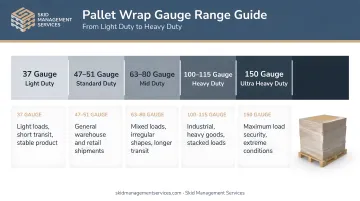
Here's how those gauges break down across the three duty tiers.
Light Duty: 37–60 Gauge
- 37 gauge: Pre-stretched film for loads under 800 lbs and light bundling applications
- 47 gauge equivalent: Despite the lower number, its stiffer resin handles loads up to ~1,800 lbs — a case where a thinner-labeled film outperforms a thicker true-gauge alternative
- 60 gauge true: Standard hand film for loads up to approximately 1,800 lbs
General Purpose: 70–80 Gauge
- 70 gauge: Steps up elongation capacity for loads in the 2,200–2,400 lb range
- 80 gauge: Grainger identifies 80-gauge stretch wrap as the general-purpose standard, rated for loads up to 2,400 lbs — the most widely stocked gauge across hand, machine, and banding formats.
Heavy Duty: 90–150 Gauge
- 90–100 gauge: Entry point for demanding loads — bundled lumber, angle iron, irregularly shaped items
- 115 gauge: Palletized drums, steel beams, heavy machinery
- 150 gauge: Maximum puncture resistance for the heaviest, sharpest, or most unstable loads — typically requires machine application to achieve proper tension
One practical rule: don't select a gauge that exactly matches your load's maximum weight under ideal conditions. Build in at least one gauge tier to account for technique variability, sharp edges, stacking forces, and vibration in transit.
How to Choose the Right Gauge for Your Operation
Measuring and Verifying Gauge
Gauge is physically measured by pressing a micrometer or electronic film thickness gauge against a flat film sample. For accurate results, take measurements at multiple points across the roll width — a film can be on-spec at the center and thinner at the edges.
When reviewing supplier documentation, confirm whether the gauge designation is:
- True gauge: measures exactly as labeled under a micrometer
- Equivalent/performance gauge: intentionally marketed at a performance-equivalent number, not an actual thickness reading
Ask for containment force data alongside thickness specs. ASTM D8314 covers performance testing of applied stretch films: that standard is the relevant performance framework, not just the nominal gauge number.
When supplier documentation isn't enough, a few field checks can reveal what the spec sheet won't.
Field Verification
Two practical checks without lab equipment:
- Fingernail test: simulate sharp-edge pressure on a stretched sample to assess puncture resistance before committing to a roll lot
- Roll yield check: calculate feet of film per pound of material against the manufacturer's published spec — significant deviation suggests the film is thinner than labeled or has been pre-stretched without disclosure
What Happens When You Use the Wrong Gauge
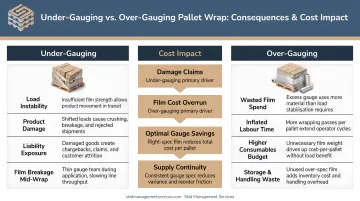
Under-Gauging
A film that's too thin for the load weight or shape will over-stretch beyond its elongation limit, leading to film breakage, loss of containment force, and load shift or pallet failure during transport. Lantech notes that punctures can propagate up the load, compounding the containment failure.
The hidden cost is that under-gauging damage often goes undetected until a freight claim is filed — making it a liability driver beyond material failure alone.
Over-Gauging
Over-gauging doesn't cause safety failures, but it has measurable cost implications:
- More material consumed per pallet
- Shorter roll yield
- Higher per-pallet spend
- In hand-wrap operations, increased worker fatigue from a stiffer, heavier film
According to Industrial Packaging, downgauging stretch film can save 15–30% on cost per wrapped load — which illustrates the cost premium of systematic over-specification.
Compliance Considerations
Cost and safety aren't the only considerations — documented quality programs add a compliance dimension as well. In programs such as 3M's RD-207 corporate pallet stretch wrap specification, the protocol requires specific film selection as part of a formal containment-force standard. For operations where pallet securing is governed by a supplier or corporate quality program, using a non-specified gauge can constitute a process deviation. That risk is sharpest when a load failure results in product damage.
Common Misconceptions About Pallet Wrap Thickness
Several widely held beliefs about pallet wrap gauge lead to poor purchasing decisions. Here's what the specs actually mean.
"All films labeled the same gauge perform identically." Gauge describes thickness, not performance. Two 80-gauge films — one true-gauge cast, one equivalent blown — can have meaningfully different puncture resistance, stretch capacity, and cling. Comparing films requires containment force data, elongation percentage, and film type alongside the gauge number.
"Thicker always means better." Modern resin technology allows a 47-gauge equivalent film to match or exceed the performance of an older 60-gauge true-gauge film. Using a heavier gauge than needed wastes material and money without improving load security for lighter applications.
"Lab ratings apply directly to field conditions." Manufacturer gauge and load capacity ratings are established under controlled conditions with consistent pre-stretch and standard pallet geometry. Real-world variability in wrapping technique, load shape, temperature, and handling means those ratings are a baseline — not an operational guarantee. Build in margin accordingly.
Conclusion
Gauge isn't a passive label attribute. It governs containment force, puncture resistance, stretch capacity, and application method compatibility. Getting it right protects product, reduces waste, and controls per-pallet cost. Getting it wrong drives up costs, increases damage claims, or leaves loads under-secured — none of which show up as obvious line items until the problem compounds.
The selection process requires matching film type, load characteristics, application method, and operating environment. For procurement teams managing high-volume pallet operations, a knowledgeable supplier keeps specifications consistent and prevents lot-to-lot variability from disrupting line efficiency.
Skid Management Services supplies stretch film nationally with competitive pricing and uninterrupted supply. Contact them at 717-202-0304 or Info@SkidManagementServices.com to discuss gauge requirements for your specific operation.
Frequently Asked Questions
How thick is pallet wrap?
Standard pallet wrap ranges from approximately 37 gauge (thinnest, pre-stretched) to 150 gauge (heaviest machine film). The most common thickness is 80 gauge, which equals 0.80 mil or approximately 20.3 microns — the general-purpose standard for most warehouse operations.
Is 60 gauge or 80 gauge plastic wrap thicker?
80 gauge is thicker. In practical terms, 80 gauge offers greater load-holding strength and is rated for loads up to approximately 2,400 lbs, while 60 gauge is better suited to lighter applications up to approximately 1,800 lbs.
How thick is a 120 gauge stretch wrap?
120 gauge equals 1.20 mil or approximately 30.5 microns (0.0305 mm). It's a heavy-duty film used in machine-wrap applications for loads exceeding 2,600 lbs or pallets with sharp edges and irregular profiles.
What is the most common gauge for pallet wrapping?
80 gauge is the industry standard for general-purpose pallet wrapping. It's widely available in hand and machine formats and suited to most standard boxed pallet loads up to approximately 2,400 lbs.
What is the difference between true gauge and equivalent gauge stretch wrap?
True-gauge film measures exactly as labeled under a micrometer. Equivalent-gauge film is physically thinner but uses a denser resin formula to deliver comparable or superior load-holding performance — confirm which type you're buying when comparing products across suppliers.
Does thicker pallet wrap always provide better protection?
Not always. Heavier gauge helps with demanding loads, but over-gauging a light load wastes material and budget. A modern equivalent film at a lower nominal gauge can outperform an older true-gauge film at the same thickness — right specification matters more than maximum weight.