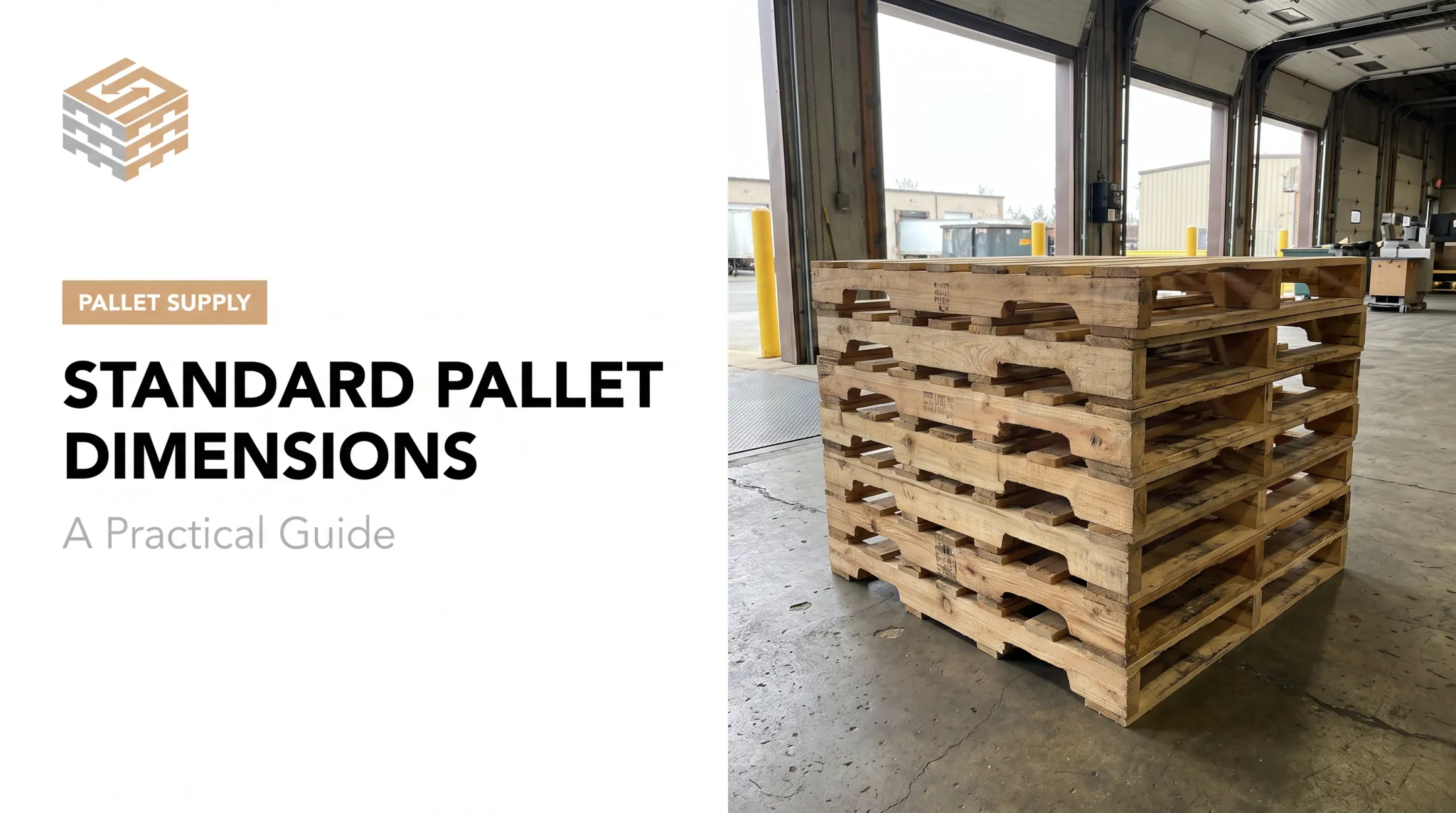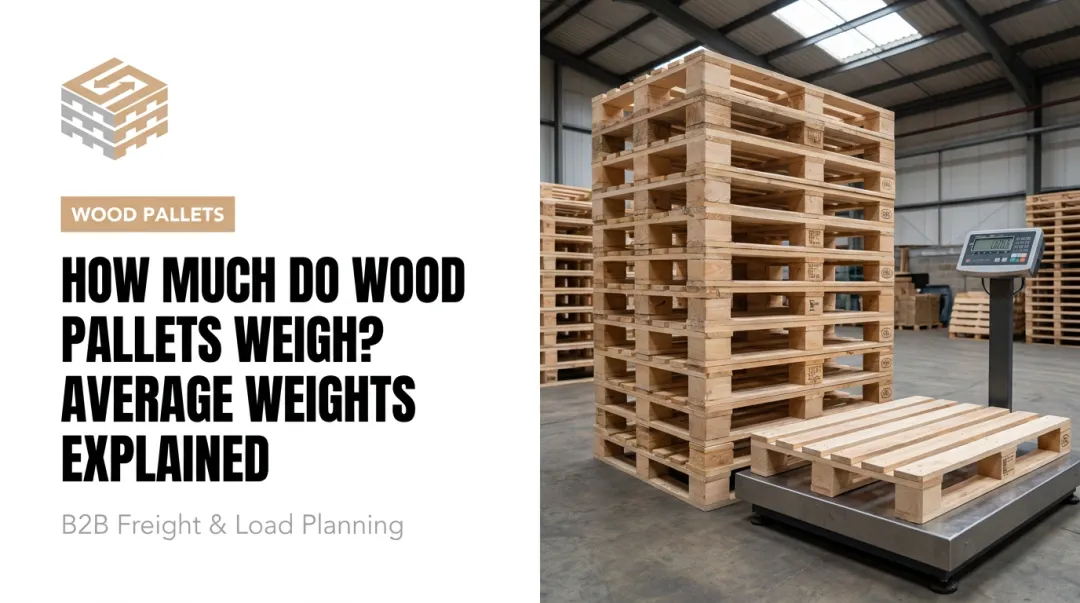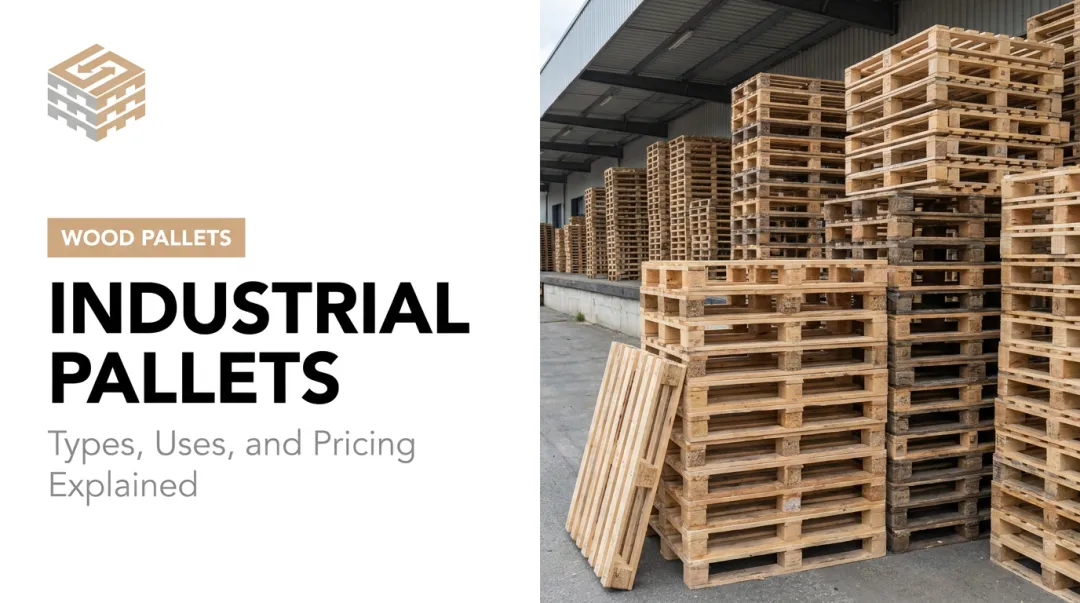
According to USDA Forest Service research, approximately 35% of all pallets produced in the US are 48x40, with roughly 39% of new wood pallets built to GMA-style 48x40 specifications. That dominance isn't accidental — it's the result of deliberate standardization across carriers, warehouse systems, and major retailers.
This guide covers the 48x40's exact dimensions and weight by material type, static vs. dynamic vs. racking load capacity, the real-world factors that shift pallet weight, and how it compares to other common US pallet sizes.
Key Takeaways
- The 48x40 GMA pallet accounts for roughly 35% of all US pallet production — and two fit side-by-side in a standard 53-foot dry van trailer, making trailer utilization straightforward
- Empty weight ranges from 15 lbs (plastic) to 70 lbs (CHEP hardwood block) — directly affecting freight billing
- Load capacity splits into three distinct ratings (static, dynamic, and racking) — mixing them up causes real operational failures
- Moisture content, wood species, and pallet grade shift real-world weight and capacity away from catalog specs
- Non-standard pallet sizes trigger carrier surcharges, racking incompatibility, and dock rejections
What the 48x40 Standard Pallet Is
The 48x40 refers to the deck footprint: 48 inches long × 40 inches wide. Empty height typically falls between 4.75 and 6.5 inches depending on construction type — not the loaded height, which varies by cargo.
Origin and Standardization
The Grocery Manufacturers Association — which relaunched as the Consumer Brands Association in 2020 — standardized this footprint to create interoperability across US grocery and retail supply chains. That decision embedded the 48x40 into nearly every carrier rate structure, warehouse racking system, and major retailer receiving spec across North America.
The physical logistics explain why it stuck: two pallets placed 40-inch side-by-side require 80 inches of width, fitting within the 98–101 inch interior cargo width of a standard 53-foot dry van. Standard selective warehouse racking is also engineered around this footprint. Any deviation from 48x40 creates immediate compatibility and cost consequences.
Two Primary Construction Types
| Construction | Fork Entry | Support Structure |
|---|---|---|
| Stringer | 2-way (4-way if notched) | Three parallel 2x4 boards |
| Block | True 4-way | Nine solid blocks |
Block pallets allow forklift entry from all four sides, making them better suited for automated handling and high-density racking systems. Stringer pallets are the more common US configuration for general distribution.
Skid Management Services carries both stringer and block construction 48x40 GMA pallets, including configurations that work across both handling systems.
Deck Board Specification
A standard GMA build typically includes 7 top deck boards and 5 bottom deck boards, with 3.5-inch-wide boards at roughly 5/16 to ½ inch thickness. This is a common industry build rather than a legally enforced standard, and it directly affects both pallet weight and load rating.
48x40 Pallet Weight by Material Type
Pallet weight has two components that regularly get confused: tare weight (the empty pallet, which affects total shipment weight and freight billing) and load capacity (how much it can carry). This section covers tare weight.
Wood Pallets
Standard softwood GMA pallets (pine) typically weigh 33–40 lbs empty. Hardwood versions (oak, hickory, maple) run 40–48 lbs. Moisture content pushes these numbers higher — and meaningfully so.
USDA Forest Products Laboratory research shows wood at 100% moisture content weighs twice its oven-dry weight; at 20% MC, it weighs 1.2 times oven-dry weight. For a 40 lb dry pallet made from freshly cut or rain-exposed lumber, that translates to real weight variance that affects freight billing on high-volume shipments.
CHEP pallets are a specific subcategory worth separating out. These hardwood block pallets in CHEP's rental pooling system average approximately 64 lbs (29 kg per CHEP's official B4840A specification) due to reinforced construction and thicker boards. Operations using pooled pallet programs need to account for this added tare weight.
Plastic Pallets
Plastic 48x40 pallets weigh 15–30 lbs for standard one-way export models, though heavier rackable reusable models can run 44–52 lbs. They're preferred in food, pharmaceutical, and export applications for hygiene and pest resistance.
USDA APHIS confirms plastic pallets are not subject to ISPM-15 wood packaging regulations, so no heat treatment is required for international shipments.
Presswood and Metal Pallets
- Presswood (compressed fiber): ~34–41 lbs — lightweight, consistent, suited for one-way or export shipping
- Aluminum: ~48–56 lbs — high strength-to-weight ratio, closed-loop industrial applications
- Steel: ~100 lbs — heavy-duty, reserved for the most demanding industrial environments
For operations sourcing wood GMA pallets at scale, Skid Management Services supplies new and recycled wood pallets across the full condition spectrum — Grade A and Grade B — through a combination of their own inventory and a national supplier network. For food and beverage manufacturers like Campbell Snacks and Knouse Foods, where a production line stoppage from a pallet shortage has direct cost consequences, that dual-source model provides a practical supply buffer.
Load Capacity: Static, Dynamic, and Racking
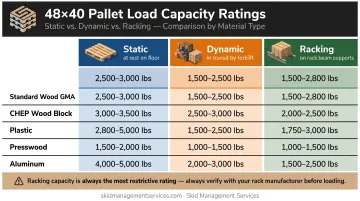
Static, dynamic, and racking load ratings measure three different things — and using the wrong number for your application is one of the most common (and costly) specification mistakes in warehouse operations.
Each rating applies to a specific condition. Understanding which one governs your use case determines whether your pallet program is safe and compliant.
Static Load Capacity
Static load is the maximum weight a pallet supports when stationary on a flat surface. Because the load distributes across the full floor contact area, static ratings are always the highest of the three. Typical ranges by material:
- Standard wood GMA: 4,000–6,000 lbs (one supplier example: 6,000 lbs static, 2,200 lbs dynamic)
- CHEP wood block: ~2,800 lbs maximum loading per official CHEP B4840A specs
- Presswood: 4,500–7,500 lbs depending on density grade
- Aluminum: 30,000 lbs for industrial-grade models
Dynamic Load Capacity
Dynamic load is the maximum weight the pallet can carry while in motion (forklift, pallet jack, conveyor). This is the most operationally critical rating for warehouse and distribution environments.
Typical dynamic ranges:
- Standard wood GMA: 1,500–2,500 lbs
- Plastic (standard): 1,500–2,000 lbs
- CHEP: ~2,800 lbs
- Presswood: 1,500–2,500 lbs
- Aluminum: 5,000 lbs
LTL carrier caps provide a useful reality check on dynamic limits:
| Carrier | Weight Cap Per Pallet |
|---|---|
| Estes Express | 2,500 lbs (standard guidance) |
| Old Dominion ODFL | 3,000 lbs (pallet-rate program) |
| FedEx Freight | 3,150 lbs per piece |
Racking Load Capacity
Racking load is the most restrictive rating — the weight a pallet supports when stored on warehouse rack beams, where it's only supported at two points rather than across its full deck. Exceeding this rating is a structural safety hazard, not just a specification miss.
Typical racking ranges:
- Wood GMA: 1,500–3,000 lbs
- Plastic (rackable models): 2,000–2,800 lbs
- Presswood: Not rated for open-beam rack storage — point loading at two beams exceeds structural design limits
- Steel: ~2,200 lbs
For demanding food manufacturing, chemical, and automotive applications, custom-engineered heavy-duty 48x40 pallets can push dynamic ratings to 4,000 lbs and above. Reinforced 4-stringer and double-wing stringer configurations — including builds Skid Management Services supplies for high-load programs — are the typical path to those ratings.
Key Factors That Affect 48x40 Pallet Weight in Practice
Published catalog specs and real-world pallet weight often diverge. Operations that rely solely on nominal figures encounter billing discrepancies and load failures.
Wood Species and Construction Quality
Softwood (pine, spruce, fir) and hardwood (oak, maple) produce noticeably different pallet weights even at identical dimensions. Board count and thickness add further variance.
Construction type compounds this further:
- 7-board top deck weighs more than a 4-board build of the same footprint
- Block construction runs heavier than stringer construction
- Heavier builds generally carry higher load capacity — but increase total shipment weight per pallet
Uline explicitly notes on its GMA 48x40 product page that pallet weight may vary based on moisture content and wood species — which means the 40 lb published weight is a reference point, not a guarantee.
Moisture Content and Pallet Age
Wood absorbs moisture from its environment. A freshly manufactured or rain-exposed pallet carries meaningfully more water weight than a kiln-dried equivalent. At 20% moisture content, a pallet weighs 20% more than its oven-dry baseline — and green lumber can double the oven-dry weight at 100% MC.
Kiln-dried heat-treated pallets maintain lower moisture content, which stabilizes weight for freight billing and slows structural degradation in cold storage environments where humidity cycling is constant. For cold storage and frozen food operations, kiln-dried lumber is the standard baseline specification — moisture variability in those environments directly affects pallet integrity over time.
Older pallets introduce a related variable: board replacements that can shift both weight and load rating away from the original build spec — sometimes significantly.
Pallet Grade and Condition
Grade A and Grade B recycled GMA pallets differ in ways that go beyond appearance — they affect load reliability and food-safety compliance:
| Criteria | Grade A (#1) | Grade B (#2) |
|---|---|---|
| All 7 deck boards present | Yes | 1–2 boards repaired |
| Stringer condition | Intact, no broken stringers | May include repaired stringers |
| Repair history | Minimal | 1–2 visible repairs |
| Suitable for food-grade programs | Yes | Case-by-case |
| Typical cost vs. new | 40–60% less | 40–60% less |
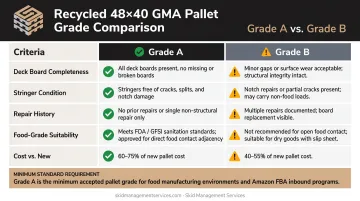
Grade B pallets carry lower consistent load ratings due to repair history, and may not meet food-safety compliance requirements in regulated environments. For programs supplying food manufacturers or Amazon FBA fulfillment centers, Grade A is generally the minimum acceptable recycled specification.
Other Standard Pallet Sizes Compared to the 48x40
The 48x40 dominates North American freight, but several other standard sizes serve specific industries — and using the wrong one for standard freight carries real cost consequences.
Common US Pallet Sizes by Industry
| Size | Primary Industry | Key Reason for Non-Standard Footprint |
|---|---|---|
| 48x40 | Grocery, retail, general distribution | US standard — fits two wide in 53-ft trailer |
| 42x42 | Telecommunications, paint, specialty chemicals | Square footprint fits equipment cabinet dimensions |
| 48x48 | Drums, chemicals | Fits four 55-gallon drums (2x2 configuration) |
| 48x45 | Automotive | Fits automotive component packaging dimensions |
| 36x36 | Beverage | Fits beer keg and bottle case configurations |
| 47.24x31.5 (EUR/EPAL) | International shipping | ISO standard for European and global freight |
The EUR/EPAL pallet measures 800mm × 1,200mm per official EPAL specifications — roughly 31.5 × 47.2 inches. Euro pallets are not interchangeable with 48x40 GMA pallets for US domestic freight; the narrower width creates trailer loading gaps and racking incompatibilities that add cost.
Consequences of Using Non-Standard Sizes for Standard Freight
- Carriers may bill for two LTL pallet positions when your footprint exceeds standard dimensions
- Standard selective racking built for 48x40 won't fit wider footprints without reconfiguration
- Non-standard sizes that don't load two-wide reduce single-layer trailer capacity, raising freight cost per unit
Skid Management Services supplies the full range of these sizes — in new and recycled condition — so operations switching between domestic and export programs don't need a separate vendor for ISPM-15 heat-treated export pallets.
Frequently Asked Questions
How much does a 48x40 pallet weigh?
Wood pallets typically weigh 33–48 lbs depending on lumber species (softwood to hardwood), with reinforced block pallets like CHEP averaging around 64 lbs. Weight varies by construction grade, moisture content, and board thickness.
How many empty 48x40 pallets fit on a truck?
A standard 53-foot dry van holds approximately 26 GMA pallets in a single layer (two pallets wide), or up to 52 double-stacked. Empty pallets can be nested or tightly stacked, significantly increasing density beyond loaded configurations.
How many square feet is a 48x40 pallet?
A 48x40 pallet covers 1,920 square inches — equal to 13.33 square feet of deck surface area.
How many 48x40 pallets fit in a 40-foot shipping container?
A standard 40-foot ISO container typically accommodates 20–21 GMA pallets in a single layer, based on standard interior dimensions. Double-stacking within height limits can reach approximately 40 pallets, depending on cargo height.
What is the load capacity of a standard 48x40 pallet?
A standard wood GMA pallet supports roughly 4,000–6,000 lbs static, 1,500–2,500 lbs dynamic, and 1,500–3,000 lbs on warehouse racking. Capacity varies by material type, construction grade, and pallet condition.
What is a GMA pallet?
GMA pallets are four-way entry wood pallets in the 48x40 format — the default North American freight pallet used across grocery, retail, and general warehousing. GMA stands for Grocery Manufacturers Association, rebranded as the Consumer Brands Association in 2020.