The stakes are real: brands that ignore packaging sustainability risk losing shelf space, retail compliance status, and customer trust. This guide breaks down what sustainable packaging actually means, the materials driving the shift, and a practical framework for transitioning your operation without disrupting supply.
Key Takeaways
- Sustainable packaging demand is surging through 2030, driven by regulation and consumer pressure
- Wood pallets, corrugated cardboard, and glass anchor most industrial sustainability programs
- Reusable systems (pallets, totes, crates) cut both waste and long-term shipping costs
- Higher upfront costs are offset by supplier partnerships, bulk pricing, and material longevity
What Is Sustainable Packaging?
Sustainable packaging is packaging designed to minimize environmental impact across its entire lifecycle, from raw material sourcing through production, use, and disposal. Rather than a single material or certification, it's a framework applied to every packaging decision a business makes.
The Packaging Lifecycle Approach
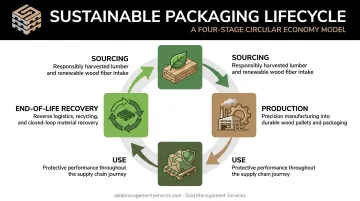
A genuinely sustainable packaging strategy addresses four stages:
- Sourcing — using renewable, recycled, or responsibly harvested inputs
- Production — manufacturing with minimal energy and water waste
- Use — functional design that protects the product without excess material
- End-of-life recovery — ensuring the packaging can be recycled, composted, or reused rather than landfilled
Biodegradable, Compostable, Recyclable, Reusable: What's the Difference?
These terms get used interchangeably, and that's a problem. Each one means something specific:
- Biodegradable — breaks down naturally over time, but not necessarily into anything soil-friendly
- Compostable — breaks down into soil-conditioning material under specific, verified conditions (per the EPA, all compostable plastic is biodegradable, but not all biodegradable plastic is compostable)
- Recyclable — depends entirely on whether local collection infrastructure can actually process it
- Reusable — built for multiple trips, not a single shipment, which is why pallets, crates, and totes dominate this category
Why Certifications Matter
Third-party certifications like FSC Chain of Custody, BPI compostability testing, and How2Recycle labeling exist because unqualified claims such as "green" or "eco-friendly" are nearly impossible to substantiate on their own. Certifications don't replace a company's duty to back up its specific claims, but they give buyers a verifiable standard instead of marketing language.
These certification standards apply well beyond consumer retail, too. Sustainable packaging spans food processing, e-commerce fulfillment, pharmaceutical distribution, and industrial shipping, each with different performance and compliance requirements.
Why Sustainable Packaging Matters for Businesses Today
The financial case for sustainable packaging has moved well past niche appeal. Grand View Research valued the global sustainable packaging market at $272.9 billion in 2023, projecting growth to $448.5 billion by 2030, a 7.6% annual growth rate.
Consumer behavior backs up that trajectory. In Trivium's 2023 Buying Green Report surveying more than 9,000 consumers across Europe and the Americas, 71% said they actively chose products based on packaging sustainability, and 82% said they'd pay more for it.
Beyond consumer demand, regulation is tightening the compliance timeline. Seven states have enacted comprehensive Extended Producer Responsibility (EPR) laws that shift packaging waste costs onto producers:
- California
- Colorado
- Maine
- Maryland
- Minnesota
- Oregon
- Washington
Combined with state-level restrictions on single-use plastics, the compliance clock is running for any business that hasn't started planning.
For B2B suppliers, there's a competitive angle too. Food, beverage, and CPG manufacturers increasingly require their vendors to support documented sustainability metrics. Suppliers who can't provide that documentation risk losing contracts to those who can. Distributors like Skid Management Services now meet this demand with ESG-documented pallet recycling programs for food and beverage clients.
Types and Real-World Examples of Sustainable Packaging Materials
Recyclable Packaging
Recyclable packaging includes corrugated cardboard, paperboard, glass, aluminum, and wood, all materials with established collection and reprocessing infrastructure. Wood pallets deserve special mention here.
A Virginia Tech study cited by NWPCA found that 95% of wooden pallets are recycled, either reused directly or converted into mulch, biofuel, or new board material. That's one of the highest recovery rates of any industrial packaging material.
Skid Management Services structures its recycled pallet inventory around three grades:
- Grade A: premium recycled, all deck boards intact, functionally equivalent to new
- Grade B: minor board repairs, full structural integrity, ideal for general warehouse use
- Utility Grade (#2): cost-effective option for internal-flow applications
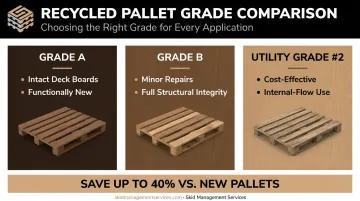
This grading system lets businesses re-enter recovered pallets directly into their supply chain, displacing new production and cutting costs by 40% to 60% compared to buying new.
Reusable Packaging
Reusable systems, such as pallets, crates, totes, and refillable containers, support circular supply chains by staying in active use across many cycles instead of a single trip. Ghirardelli's reusable-tote program produced nearly $2 million in annual packaging savings while avoiding almost 400 tons of cardboard waste per year.
Skid Management Services runs a closed-loop pallet management program built on the same principle: new pallets are delivered and used pallets are picked up on the same trip, sorted by grade, and either redistributed or repaired. Businesses moving 500-plus pallets monthly typically see the strongest returns from this round-trip model.
Compostable and Biodegradable Packaging
Compostable packaging breaks down into non-toxic material under defined composting conditions; biodegradable simply means it breaks down over time, with fewer guarantees. Common plant-based examples include:
- Cornstarch-based loose-fill packing material
- Bagasse (sugarcane fiber) food containers
- Mushroom mycelium packaging grown from agricultural byproducts
Minimalist and Recycled-Content Packaging
Reducing material volume and incorporating post-consumer recycled content lowers environmental footprint without sacrificing protection. Reconditioned wood pallets follow this same logic. Repairing and redistributing a Grade B pallet uses far less raw lumber than milling a new one, while still meeting warehouse and distribution performance standards.
Innovative and Emerging Materials
Material science is moving fast. Seaweed-based films from companies like Notpla have replaced more than 16 million single-use items across European markets. Agricultural byproduct packaging, made from things like wheat straw and rice husks, is expanding into food service applications once dominated by plastic.
Benefits of Switching to Sustainable Packaging
Cost savings compound over time. According to Cisco's packaging sustainability report, the company redesigned its packaging portfolio and saved $24 million annually; one product line alone used 33% less material and generated $1.3 million in yearly savings through better transport-load utilization.
Beyond cost, sustainable packaging drives measurable business outcomes:
- Brand reputation: buyers increasingly favor suppliers who can document sustainable practices, as consumer research consistently shows
- Supply chain efficiency: right-sized packaging and reusable systems reduce handling time and product damage rates
- Reduced disposal costs: lighter materials and reuse programs cut waste-hauling fees
For manufacturers working with anchor food and beverage clients, this data already feeds directly into compliance reporting: companies like Campbell Snacks, Knouse Foods, and Hain Celestial Group fold pallet recycling data into their corporate ESG scorecards, turning a packaging decision into a reportable sustainability metric.
Common Challenges in Adopting Sustainable Packaging (and How to Overcome Them)
Sustainable packaging adoption isn't frictionless. Three challenges show up consistently:
- Higher upfront costs: Sustainable materials often carry a price premium at first, but bulk purchasing and reliable supplier relationships close the gap. Recycled and remanufactured pallets, for example, run 40% to 60% cheaper than new stock while meeting the same performance specs.
- Material availability and consistency: Limited supply of sustainable inputs can derail a rollout mid-project, making a supplier's sourcing network more valuable than its catalog. Skid Management Services pairs owned inventory with a national network of pallet and packaging suppliers, keeping supply moving even when one source tightens up.
- Balancing protection with lighter materials: Heavy or fragile goods can't simply go into a lighter box. Custom-engineered pallets, rated from 4,000 to 10,000-plus pounds dynamic load, match construction (block, stringer, or reinforced double-wing) to the actual load instead of defaulting to over-built standard pallets.
How to Transition to Sustainable Packaging: A Step-by-Step Strategy
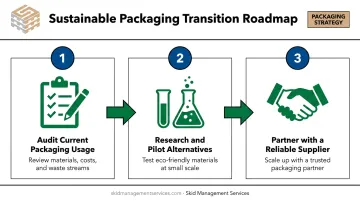
Moving to sustainable packaging works best as a phased process, not a single overhaul.
Audit your current packaging usage. Document every material type, volume, and disposal cost across your operation. This identifies which packaging categories carry the highest environmental and financial impact, usually the best place to start.
Research and pilot alternatives. Test sustainable materials against your product's actual weight, fragility, and shipping conditions before committing at scale. A pilot run catches performance issues before they become customer complaints.
Partner with a reliable, experienced supplier. Supply consistency is where most transitions stall. Skid Management Services combines a national supplier network with its own maintained inventory to keep sustainable programs supplied without interruption. This model also supports pool-exit transitions away from CHEP or PECO, helping businesses avoid the price spikes that often derail these switches.
Frequently Asked Questions
What is sustainable packaging?
Sustainable packaging refers to materials and designs engineered to reduce environmental impact across the full product lifecycle, covering sourcing, production, use, and disposal. It prioritizes recyclability, reuse, or safe decomposition over single-use convenience.
What are examples of sustainable packaging?
Common examples include recycled cardboard, wood pallets, compostable bagasse containers, reusable crates and totes, and emerging materials like mushroom mycelium and seaweed-based films.
Is wood packaging, like pallets, actually sustainable?
Yes. Wood pallets are renewable and reusable across many trips, with an industry recycling rate around 95%. Few industrial packaging materials match that combination of reuse and recovery.
Does sustainable packaging cost more than traditional packaging?
Upfront costs can run higher for newer materials, but savings from lighter weight and reuse programs typically offset the difference within a year or two. Reduced waste disposal fees add further savings over time.
What should I look for when choosing a sustainable packaging supplier?
Look for supply consistency, competitive pricing, a broad material selection, and a documented track record of on-time delivery. A supplier with both owned inventory and a wider network offers extra protection against shortages.
Can sustainable packaging withstand heavy industrial or shipping use?
Yes. Materials like wood pallets and reinforced recycled cardboard are designed to meet demanding load and durability standards, including heavy-duty configurations rated for thousands of pounds of dynamic load.