Introduction
A truck backs up to the dock, the doors swing open, and half the boxes have shifted three feet to the left. Some are crushed. Others are missing labels entirely.
The receiving team now has to sort, inspect, and reconcile everything by hand before it even hits the warehouse floor.
This scenario plays out daily across American supply chains, and it's almost always preventable.
Palletized goods move everything from grocery shipments to chemical drums to automotive parts. When products are consolidated onto a pallet correctly, they travel as one stable unit instead of a hundred separate risks.
Avoiding that scenario starts with the fundamentals. This guide covers what palletized goods are, why palletization matters for your bottom line, how to build a load that survives transit, and how to choose the right pallet for your shipment.
Key Takeaways
- Palletized goods are products consolidated onto a single pallet to form one stable "unit load"
- Correct palletization cuts damage rates and speeds up dock operations, while also reducing manual lifting injuries
- Weight distribution, stacking pattern, and wrap tightness make or break load stability
- Pallet type and size matter as much as loading technique, and so does the right sourcing partner
What Are Palletized Goods?
Palletization is the process of stacking and securing individual boxes, cases, or products onto a pallet so they move as a single unit. Instead of a forklift operator handling 40 separate cartons, they lift one consolidated load.
The pallet itself does the heavy lifting, literally. Built from wood, plastic, or metal, it provides a flat, stable platform that supports the goods through handling, storage, and transit. Without it, cargo has no consistent base to rest on and no easy way to be moved by a forklift or pallet jack.
What holds it all together:
- Stretch wrap: plastic film wrapped tightly around the load
- Strapping: plastic or steel bands for heavier or taller loads
- Shrink wrap: heat-applied film for a tighter, weather-resistant seal
These same materials show up across industries in slightly different combinations, depending on the load.
What Is an Example of Palletized Cargo?
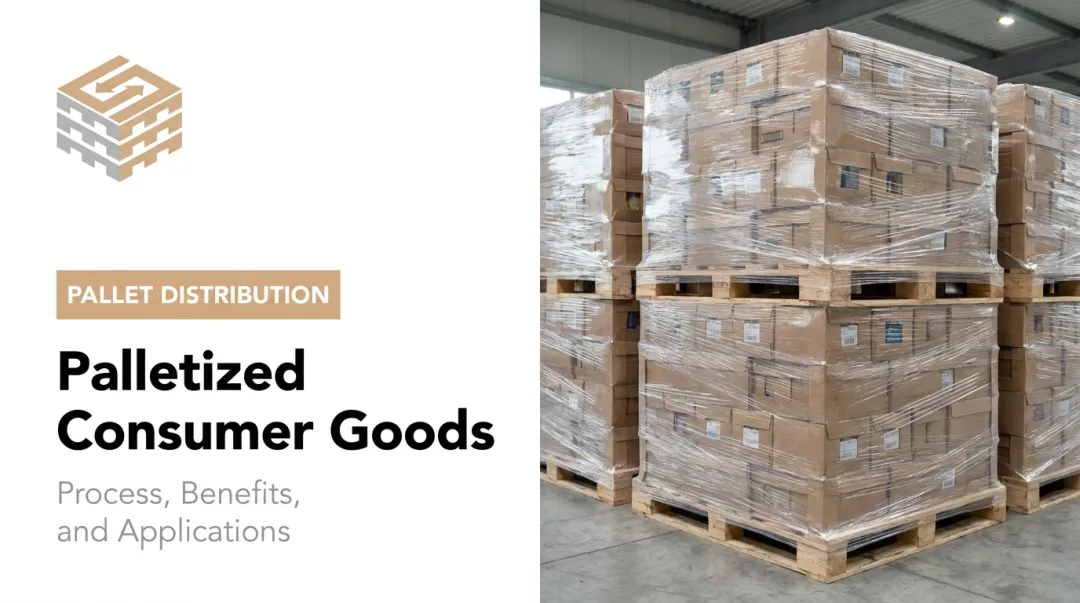
Picture a grocery distributor receiving a shipment of bottled beverages. Cases are stacked in a repeating pattern, wrapped tight, and moved as one 1,500-pound unit instead of 60 individual cases.
Other common examples include:
- Chemical drums secured on 48x48-inch pallets
- Automotive parts staged for just-in-time delivery
- Retail cartons bound for a distribution center
- Industrial packaging materials shipped between plants
Palletized cargo still dominates food, industrial, and automotive supply chains. E-commerce has pushed more single-box shipping into the mix, but the pallet remains the default unit load wherever bulk product moves.
Why Palletize Your Shipments? Key Benefits
Switching from floor-loading to palletized freight affects handling speed, labor safety, damage rates, and inventory accuracy all at once.
Faster Handling, Lower Labor Costs
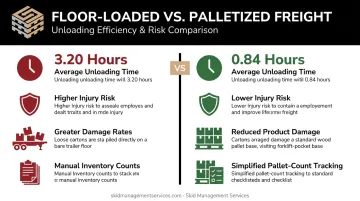
Moving one pallet beats moving 40 boxes by hand, every time. A Virginia Tech study comparing unloading methods found palletized unloading averaged just 0.84 hours, compared to 3.20 hours for floor-loaded freight handled by lumpers. That's not a universal benchmark for every dock, but it illustrates the scale of the time gap.
That same efficiency applies to worker safety. Lifting one pallet is safer than lifting 40 boxes repeatedly. NIOSH's ergonomic guidance recommends moving entire pallet loads instead of handling individual items, reducing manual lifting strain and protecting warehouse staff long-term. Fewer hours on the dock also mean lower payroll costs and less overtime for receiving crews.
Damage Prevention and Inventory Control
Palletizing also protects the freight itself and keeps inventory counts accurate:
- Reduced product damage: Consolidating and wrapping goods limits shifting during transit, preventing boxes from bouncing, sliding, and crushing each other on rough roads.
- Improved load stability: A well-built pallet lowers the load's center of gravity, reducing the odds of tipping or collapsing when a trailer hits a pothole.
- Better inventory control: Standardized loads simplify stock counts, letting warehouse managers glance at pallet counts instead of tallying individual units.
How to Palletize a Shipment: Step-by-Step Best Practices
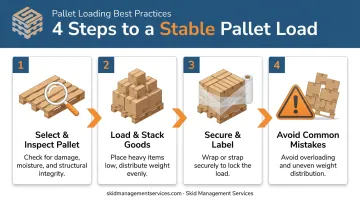
Selecting and Inspecting the Pallet
Start with the right pallet for the job. A GMA-style 48x40 works for grocery and general retail. Heavier industrial loads often need a reversible or winged pallet built for higher weight capacity.
Before loading anything, inspect the pallet itself:
- Check for cracked or split boards
- Look for protruding nails or staples
- Confirm the deck isn't warped or bowed
- Verify all stringers or blocks are intact
A damaged pallet under a full load is a collapse waiting to happen.
Loading and Stacking the Goods
Weight distribution rules everything here: place heavier items at the bottom, lighter or fragile items on top. This keeps the center of gravity low and the load stable.
Two stacking approaches dominate:
- Column stacking: boxes stacked directly on top of one another, preserving each box's vertical compression strength
- Interlocking (brick pattern): boxes offset row by row for better lateral stability
Neither approach is universally "correct," since column stacking protects box strength while interlocking resists shifting. Choose based on what the product needs most, and never let goods overhang the pallet's edges.
Securing and Labeling the Load
Under OSHA's general materials-handling standard, stacked materials must be blocked, interlocked, and limited in height so they stay stable against sliding or collapse. Stretch wrap and strapping are how most shippers meet that bar in practice.
- Apply stretch wrap with multiple passes, reinforced at the top and bottom
- Use strapping instead of (or in addition to) wrap for heavy, dense loads
- Add corner protectors on tall stacks to prevent strap damage
Once wrapped, label the pallet clearly and verify contents against the shipping manifest, since a mislabeled pallet causes just as many delays as a poorly built one.
Common Palletizing Mistakes to Avoid
Even experienced crews fall into these traps:
- Overloading beyond the pallet's rated capacity
- Uneven weight distribution that tips the load sideways
- Reusing a cracked or warped pallet to save time
- Skimpy wrapping that lets the load shift mid-transit
Any one of these mistakes can turn a routine shipment into a damage claim.
Choosing the Right Pallet: Types, Materials & Standard Sizes
Wood, Plastic, and Metal : Which One Fits?
| Material | Best Fit | Trade-Off |
|---|---|---|
| Wood | General/food industry, cost-conscious shippers | Most widely used; requires ISPM-15 treatment for export |
| Plastic | Sanitation-sensitive shipments, reusable programs | Higher upfront cost, easier to clean |
| Metal | Heavy-duty, repeat-use industrial loads | Highest cost, longest lifespan |
Wood remains the default choice for most U.S. shippers. A 2025 survey of Modern Materials Handling readers found wood made up 92% of pallets used by respondents, and 72% of respondents relied on the 48x40-inch footprint. That's not a claim about all U.S. freight, but it confirms how standardized wood and that footprint have become across manufacturing, wholesale, and retail operations.
Standard Sizes That Matter
- 48x40 inches: the GMA/ISO standard used across North American food, retail, and general distribution
- Euro pallet (roughly 40x48-inch equivalent, 800x1,200mm): the standard across European supply chains
- 48x48 inches: common footprint for drum and heavy-load pallets in chemical, industrial, and IBC tote programs
Matching pallet footprint to your truck or container dimensions reduces wasted space in every load you ship. A mismatched pallet size means empty gaps in the trailer, and empty space is money left on the table.
Sourcing Consistency Matters as Much as the Pallet Itself
A quality pallet loaded correctly still fails if your supplier can't deliver it on time. Tight lumber markets and recycled-pallet shortages happen regularly, and a single-source supplier has nowhere to turn when their own inventory runs dry.
This is where a dual-sourcing model earns its keep. Skid Management Services, for instance, pairs its own on-hand inventory with an expansive supplier network, so when demand spikes or regional supply tightens, there's a second channel to fall back on.
That combination keeps food and beverage manufacturers running without a pallet-driven line stop. The need might be a standard GMA 48x40, a 48x48 drum pallet, or a custom ISPM-15 heat-treated build for export through the Port of Baltimore corridor.
Single-Item vs. Mixed-Case Palletizing
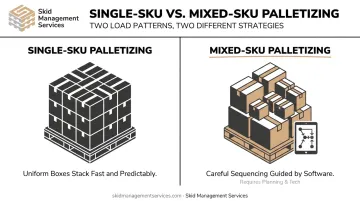
Single-SKU Palletizing
One product, repeated in a uniform pattern, all the way up the pallet. Bulk manufacturers and high-volume distributors favor this approach because it's predictable: every case is the same size, weight, and shape, so the stacking pattern barely changes from load to load. Not every shipment fits that mold, though.
Mixed-SKU (Mixed-Case) Palletizing
Retail and e-commerce fulfillment often need one pallet carrying an assortment of products bound for a single store or customer. That means different box sizes, different weights, and different crush tolerances all stacked together.
Mixed loads demand more careful sequencing:
- Place heavier, sturdier cases on the bottom
- Position lighter, more crushable items on top
- Minimize gaps between mismatched box sizes
Because this sequencing gets complicated at scale, many operations now lean on palletizing software or semi-automated tools to keep mixed loads stable. A manual crew can struggle to replicate that consistency across hundreds of daily pallets.
Frequently Asked Questions
What are palletized goods?
Palletized goods are products consolidated and secured onto a pallet to form one stable unit load. This makes handling, storage, and shipping far more efficient than moving individual items.
What is an example of palletized cargo?
Cases of bottled beverages or boxed food products stacked, wrapped, and shipped to a distributor on a single pallet are a common example. Chemical drums and automotive parts on standardized pallets are others.
What is the standard size of a shipping pallet?
The 48x40-inch GMA/ISO pallet is the widely used standard across North America. Other regions use different footprints, such as the Euro pallet's 800x1,200mm size.
How much weight can a standard pallet hold?
Capacity varies by material, construction, and support method (floor, rack, or fork-tine). Standard wood pallets typically handle several hundred to a few thousand pounds, depending on design.
What is the best way to secure goods on a pallet?
Stretch wrap applied in multiple passes, reinforced at the top and bottom, works for most loads. Heavier shipments often need strapping, plus corner protectors on taller stacks to prevent damage.
What is the difference between palletized and non-palletized shipping?
Palletized shipping moves goods as one consolidated, secured unit, cutting handling time and reducing shift-related damage. Non-palletized (loose) freight requires individual handling, which takes longer and carries a higher damage risk.