Pick the wrong film, and you'll see it in your damage claims. Too thin without the right resin technology, and loads shift or tear open mid-transit. Too thick, and you're overspending on material with every single wrap cycle. The choice affects labor costs, packaging spend, and how many products arrive intact.
This guide breaks down the stretch film manufacturers most US businesses rely on heading into 2026, along with a practical framework for evaluating them against your own operation.
TL;DR
- Cast, blown, and pre-stretch films each meet different stability and cost needs.
- Sigma, IPG, Paragon, and Amcor/Berry dominate national supply with deep technical support.
- Certifications, puncture resistance, cling, and compatibility matter more than price.
- Source pallets and packaging together through networks like Skid Management Services.
Overview of Stretch Film in the US Packaging Industry
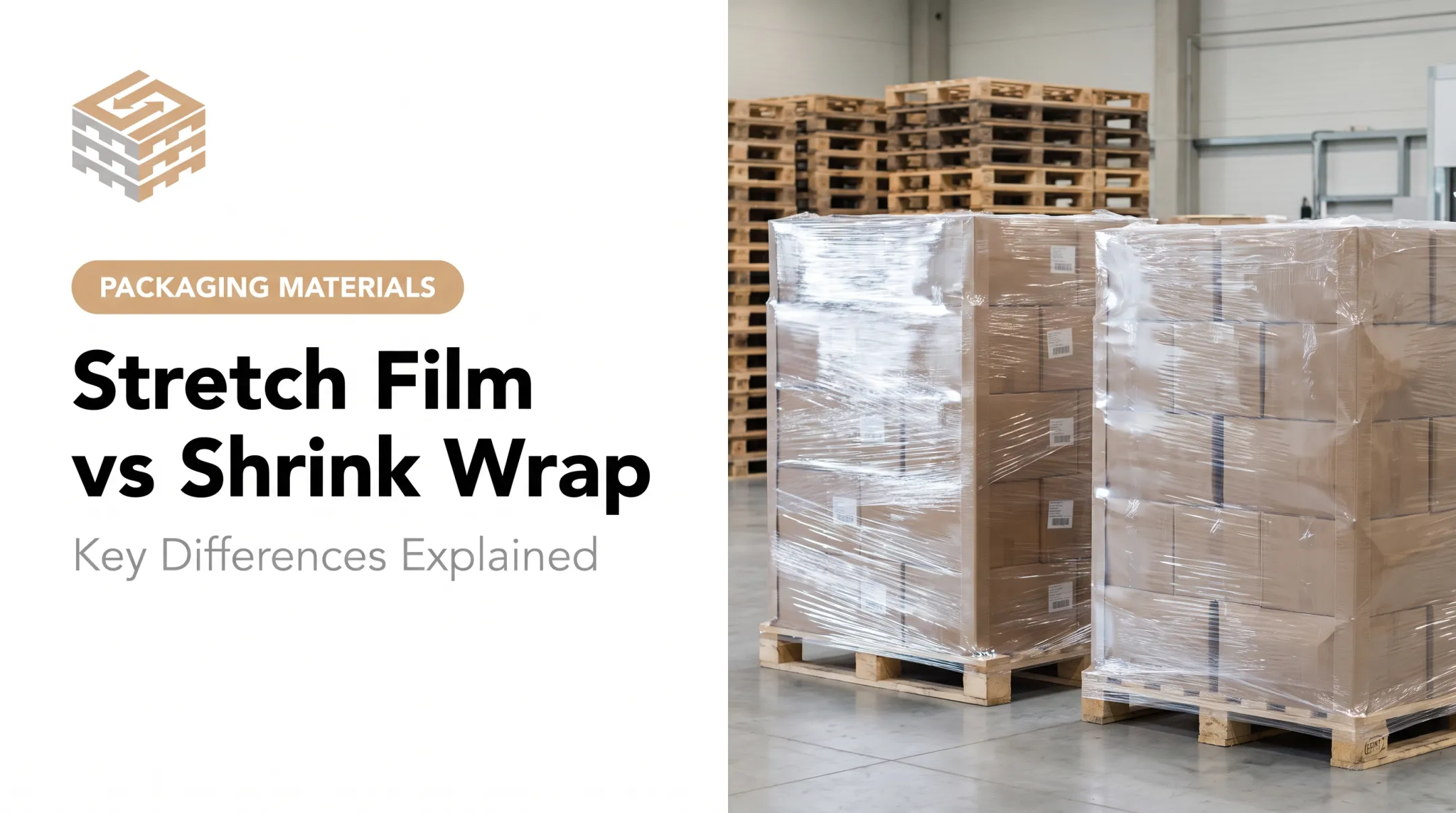
Stretch film is a stretchable LLDPE-based plastic wrap used to bundle, secure, and protect palletized goods during storage and transit. It's the difference between a pallet arriving intact and one arriving as a pile of loose boxes.
That reliability requirement has turned stretch film into a sizable, fast-growing category. Fortune Business Insights values the global stretch wrap market at $4.68 billion in 2025, projecting growth to $7.49 billion by 2034 at a 5.42% CAGR. That growth tracks directly with e-commerce expansion, cold chain logistics, and tighter damage-reduction requirements from retailers like Walmart and Costco.
Blown vs. Cast, Hand vs. Machine, and Pre-Stretch Explained
Meeting that demand means choosing the right film for each job, since not all stretch film behaves the same way. The manufacturing process and application method both shape performance:
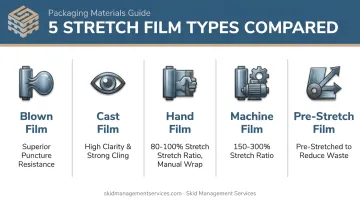
- Blown film: Extruded through a bubble process, delivering very high puncture and tear resistance with aggressive cling, according to IPG's technical documentation. Better suited for irregular or sharp-edged loads.
- Cast film: Made through a flat-cast process, offering superior optical clarity and a quieter, smoother unwind. Popular where product visibility or noise-sensitive warehouse floors matter.
- Hand film: Lower gauge and stretch force, designed for manual wrapping of lower-volume pallets.
- Machine film: Engineered for higher stretch ratios and consistency on automated wrapping lines, typically stretched 150% to 300% during application.
- Pre-stretch film: Stretched at the factory before it reaches your dock, so a 6,000-foot roll can yield 12,000+ applied feet, cutting material purchased per load.
Below is a rundown of the manufacturers most frequently relied upon by US businesses for quality, capacity, and reliability.
Top Stretch Film Manufacturers in the USA for 2026
This list weighs manufacturing scale, industry certifications, technological innovation, product breadth, and reputation among industrial buyers. A brief note before diving in: the packaging industry consolidated heavily over the past decade, and 2025 brought the biggest shift yet.
Berry Global (Now Part of Amcor)
Berry Global was long headquartered at 101 Oakley Street in Evansville, Indiana, and reported $12.26 billion in fiscal 2024 net sales. Amcor completed an all-stock combination with Berry on April 30, 2025, meaning Berry now operates as part of the larger Amcor organization rather than as an independent company.
That consolidation doesn't erase Berry's stretch film footprint. The company invested roughly $30 million expanding ultra-high-performance machine and hand stretch film capacity across nine North American plants, and added a 25,000-square-foot Tennessee facility with three cast lines in 2023.
| Category | Details |
|---|---|
| Headquarters & Scale | Evansville, Indiana legacy operations; now integrated into Amcor's global packaging network |
| Product Range | Transcend and Stratos machine films, plus broader hand stretch film lines |
| Best Suited For | Large-volume buyers needing broad product variety through an established production base |
Sigma Stretch Film (Sigma Plastics Group)
Sigma is one of the few remaining independent, vertically integrated US stretch film producers. It operates six extrusion facilities across the US and Canada, backed by more than 30 years of production experience and manufacturing flexibility across 3-, 5-, 7-, and 9-layer film structures.
What sets Sigma apart is its engineering-first approach. The ECOSUPREME family uses proprietary pre-stretch technology to reduce plastic consumption per pallet, while Sigma Steel is a one-sided cling cast hand film engineered to lock up at 75% stretch.
| Category | Details |
|---|---|
| Headquarters & Scale | US-based; six extrusion facilities across North America |
| Product Range | ECOSUPREME pre-stretch hand films, machine films, Sigma Steel for heavy loads |
| Best Suited For | Businesses wanting engineering support to optimize film usage and cut waste |
Intertape Polymer Group (IPG)
IPG runs ISO 9001:2015-certified manufacturing facilities using Six Sigma and Lean Manufacturing practices, a combination that appeals to procurement teams focused on documented quality systems rather than marketing claims.
Its dual production capability is the real differentiator. IPG makes both cast and blown film under two brand families, giving buyers a single-source option depending on load type.
| Category | Details |
|---|---|
| Headquarters & Scale | Sarasota, Florida; ISO-certified facilities across North America |
| Product Range | Light-gauge SuperFLEX and standard-duty StretchFLEX hand/machine films |
| Best Suited For | Buyers prioritizing certified quality systems and consistent large-scale supply |
Paragon Films
Paragon has manufactured stretch film exclusively since 1988, and that singular focus shows in its cast film optics. The company built its reputation on crystal-clear hand film and has held patents tied to specific formulas, including its Torque line.
- Torque: patented formula, higher containment at lower gauge
- Spartan: general-purpose hand film
- Edge: engineered to exceed 250% stretch
- Titus: ultra-thin-gauge, source-reduction focused
| Category | Details |
|---|---|
| Headquarters & Scale | US-based cast film specialist |
| Product Range | Torque, Spartan, Edge, Titus hand films, plus machine stretch film |
| Best Suited For | Buyers seeking thinner, source-reduced films without sacrificing load security |
AEP Industries (Legacy Brand, Now Under Amcor)
AEP built its reputation as a major North American flexible-plastic-film converter, founded in 1970. By the time Berry Plastics acquired it in January 2017, the company reported roughly $1.1 billion in annual net sales across 14 manufacturing facilities. Since Berry's own combination with Amcor in 2025, AEP now exists as a legacy brand within that larger organization rather than an independent supplier.
For buyers, this means AEP-branded film specs and formulations may still be available, but sourcing relationships now run through Amcor's broader distribution network.
| Category | Details |
|---|---|
| Headquarters & Scale | Legacy North American converting operations, now part of Amcor |
| Product Range | Hand and machine stretch films for industrial and distribution use |
| Best Suited For | Buyers already working with Amcor's distribution network who want AEP-formulated film |
Amcor
Amcor traces its roots to the 1860s and now, following its Berry combination, reports roughly 70,000 employees, $23 billion in annualized sales, and operations across more than 40 countries. That scale gives it one of the broadest stretch film manufacturing footprints in the US.
Sustainability is where Amcor pushes hardest. Its Bontite Sustane stretch films use 30% recycled content and can achieve up to 220% stretch, while its 11.4-micron Stratos film reportedly cuts annual plastic use by 44.6% compared to traditional 23-micron cast film.
| Category | Details |
|---|---|
| Headquarters & Scale | Global operations, major inherited US production capacity |
| Product Range | Blown and pre-stretched machine films alongside broader flexible packaging lines |
| Best Suited For | Enterprises prioritizing sustainability credentials alongside performance |
How We Chose the Best Manufacturers
The most common buyer mistake is chasing the lowest price-per-roll and ignoring everything else. A cheaper roll that breaks mid-wrap or under-contains a load costs more in damaged freight than it ever saved on the invoice.
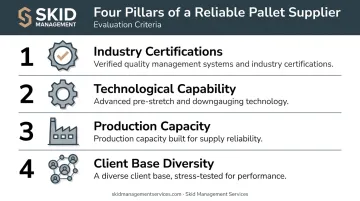
We weighted four factors, each tied to a business outcome:
- Industry certifications (ISO, Six Sigma): These signal a documented quality-management system, correlating with fewer defective rolls and more consistent gauge tolerance.
- Technological capability, particularly pre-stretch and downgauging innovation, directly reduces film waste and material spend per pallet.
- Production capacity determines whether a manufacturer can maintain supply during demand spikes or regional disruptions.
- Client base diversity: manufacturers serving food, retail, and industrial sectors have typically stress-tested their film across more load types.
None of these factors alone guarantees performance. Containment force, not gauge or price, is what actually determines whether a pallet survives transit, and that depends on the interaction between film type, wrap pattern, and application equipment.
Conclusion
There's no single "best" stretch film manufacturer. The right one depends on your load types, your wrapping equipment, your volume, and how much weight sustainability carries in your purchasing decisions.
Before committing to a long-term supplier relationship:
- Request film samples and test them against your actual loads
- Verify certifications rather than taking marketing claims at face value
- Evaluate scalability against your seasonal demand swings
- Calculate total landed cost, not just price per roll
Businesses juggling multiple packaging categories (pallets, stretch film, strapping, corner boards) often find it easier to consolidate. Skid Management Services supplies stretch film alongside wood pallets and a full line of packaging materials through an expansive supplier network, giving businesses competitive pricing and uninterrupted supply without managing multiple separate vendor relationships.
Frequently Asked Questions
How much does a stretch film machine cost?
Machine stretch wrapper pricing varies widely based on automation level, from semi-automatic turntables to fully automatic rotary arm systems. Request quotes based on your throughput needs, load types, and film compatibility rather than shopping on price alone.
What is the difference between blown and cast stretch film?
Blown film offers superior puncture and tear resistance, making it better for irregular or sharp-edged loads. Cast film delivers better clarity, a quieter unwind, and consistent performance for standard palletized goods.
What is the difference between hand stretch film and machine stretch film?
Hand film is designed for manual wrapping with lower gauge and force requirements. Machine film is engineered for higher stretch ratios, typically 150% to 300%, and consistency across automated wrapping lines.
How do I choose the right stretch film manufacturer for my business?
Test film performance against your actual loads, verify certifications like ISO 9001, confirm machine compatibility, and calculate total landed cost rather than focusing on unit price alone.
Is thinner (downgauged) stretch film actually better than thicker film?
Modern downgauged films using advanced resin technology can match or exceed thicker film's load containment. One documented case reduced gauge and reported 25-30% system-wide film savings, though results depend heavily on consistent wrap patterns.
Can I source stretch film alongside pallets and other packaging materials from one supplier?
Yes. National suppliers with broad packaging networks, such as Skid Management Services, combine pallet and stretch film procurement under a single account, simplifying logistics and cutting down on the number of vendors you manage.