Introduction
Wood pallets are the backbone of American commerce. More than 1.8 billion pallets are in service in the United States every day, and roughly 93% of them are made of wood — a share that reflects the material's unmatched balance of strength, cost, and repairability.
For procurement teams, this isn't a background detail. The pallets you source directly affect warehouse throughput, load integrity, freight cost, and regulatory compliance. Export shipments require ISPM 15-certified heat-treated pallets. Automated facilities demand specific forklift entry configurations. And a single-source supplier that goes down during a lumber price spike can stall your entire distribution network.
Pallet sourcing is a strategic supply chain decision that carries real operational risk. This guide reviews the top wood pallet manufacturers and suppliers in the U.S. — Skid Management Services, CHEP, Millwood Inc., Kamps Inc., and PalletOne — covering product range, pricing models, and what each supplier does best.
Key Takeaways
- Wood pallets account for 93% of U.S. pallet use, with the 48×40 GMA pallet representing over 30% of all new pallets produced
- Supplier selection should weigh total cost of ownership: unit price, damage rates, supply reliability, and ISPM 15 compliance for exports
- Top national suppliers span direct manufacturers (PalletOne, Millwood), a pooling service (CHEP), recycling-focused networks (Kamps), and multi-vendor distributors (Skid Management Services)
- A national supplier network delivers better price stability and supply continuity than a single-plant manufacturer — especially during lumber market disruptions
Overview of Wood Pallets in the U.S. Market
A wood pallet is a flat structural platform — typically made from hardwood or softwood lumber — designed to support goods for stacking, storage, and transport via forklift or pallet jack. The U.S. wood pallet and skid manufacturing industry is valued at $17.8 billion in 2026, with over 2,300 businesses active in the sector. Wood's dominance over plastic and composite alternatives comes down to four practical factors:
- Lower upfront cost per unit
- Easy field repair without specialized equipment
- Compatibility with virtually all existing warehouse and freight infrastructure
- High availability through an established national supplier base
Demand is driven by food and beverage manufacturing, general manufacturing (chemicals, automotive, electronics), warehousing and distribution, and construction. These sectors require consistent, high-volume pallet supply, and they depend on suppliers who can scale with seasonal swings and maintain consistent availability when the market gets tight.
Not all suppliers are built to handle that kind of pressure. The sections below break down the top national manufacturers by product capability, pricing structure, and operational fit.
Top Wood Pallet Manufacturers & Suppliers in the U.S.
The suppliers below were selected based on national coverage, product breadth, ISPM 15 compliance capabilities, and demonstrated track record with commercial and industrial buyers.
Skid Management Services
Skid Management Services is a national B2B supplier of wood pallets and packaging products, operating through its own inventory and an expansive network of pallet and packaging suppliers across the U.S. Major customers include Campbell Snacks, Knouse Foods, Nissin, Hain Celestial Group, Stauffer's, and Plainville — a client roster concentrated in food manufacturing and consumer goods.
Unlike direct manufacturers, Skid Management Services draws from multiple suppliers rather than a single production facility — maintaining supply continuity when regional shortages or lumber price surges affect individual plants. The company operates 24/7, which matters for time-sensitive procurement scenarios.
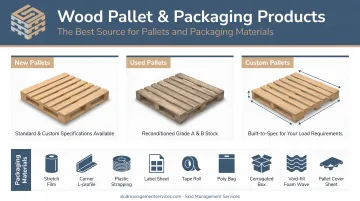
Product coverage spans both pallets and packaging materials, allowing buyers to consolidate procurement through a single supplier:
- Pallets: New and used wood pallets, 48×40 GMA, block, custom-sized, and ISPM 15 heat-treated for export
- Packaging: Stretch film, strapping, corner boards, poly bags, boxes, void fill, pallet covers, labels, and tape
| Category | Details |
|---|---|
| Product Range | New and used wood pallets, 48×40 GMA, block, custom sizing, ISPM 15 heat-treated; full packaging materials line; national coverage via supplier network |
| Pricing Model | Competitive market-rate pricing; all quotes on request — contact Info@SkidManagementServices.com or call 717-202-0304 |
| Best For | Food & beverage manufacturers, consumer goods companies, and multi-site operations requiring reliable national supply and packaging consolidation |
CHEP
CHEP (a Brambles company) operates the world's largest pallet pooling network, managing a global platform pool of approximately 348 million pallets, crates, and containers across around 60 countries. In North America, its blue pallets are accepted at more than 24,000 retailers.
CHEP's model differs from purchasing pallets outright. Customers pay rental fees per trip rather than buying and recovering pallets themselves — a structure that suits high-volume operations that would otherwise need to manage pallet retrieval logistics. ISPM 15-compliant pallets are available for international shipments through their MyCHEP platform.
| Category | Details |
|---|---|
| Product Range | Primarily 48×40 GMA-standard wood pallets; pallet pooling/rental model |
| Pricing Model | Per-trip rental fees; pricing varies by volume and contract terms |
| Best For | High-volume grocery, retail, and CPG companies seeking to outsource pallet management entirely |
Millwood Inc.
Millwood operates more than 40 company-run locations and a strategic partner network of over 250 locations across North America, reporting more than $500 million in FY2024 revenue. The company manufactures new stringer and block pallets, custom crating, and wood packaging solutions for sectors including automotive, food and beverage, aerospace, pharmaceuticals, and chemicals.
Key differentiators include in-house ISTA-certified packaging engineering and ISPM 15 heat treatment certified to 56°C for 30 minutes. Its recycling operation repairs more than 50 million pallets annually and processes over 100 million board feet of lumber. Millwood sources within 150 miles of customer locations where possible and partners with FSC and SFI certified lumber suppliers.
| Category | Details |
|---|---|
| Product Range | New stringer and block pallets, ISPM 15 heat-treated, custom crating, wood packaging; 40+ operated locations |
| Pricing Model | Direct manufacturer pricing; contact for volume quotes |
| Best For | Industrial manufacturers, exporters, and buyers needing custom-engineered pallet solutions at scale |
Kamps Inc.
Kamps is one of the largest pallet management companies in the U.S., managing over 544 million pallets annually across more than 400 servicing locations nationwide. As of 2023, the company operated 63 asset-based locations, approximately 9,000 trailers, and more than 4,000 employees.
Kamps' strength is in recycling and reconditioning. Notable programs include:
- Graded pallet inventory: New, Grade A, and Grade B reconditioned pallets with published definitions that reduce ambiguity at purchase
- We Buy Pallets: A buyback program for businesses offloading surplus inventory
- Green Scorecard: Sustainability reporting tool based on EPA WARM v16 methodology, suited for buyers with ESG or cost-optimization requirements
| Category | Details |
|---|---|
| Product Range | New, Grade A and Grade B reconditioned pallets; pallet recycling, buyback, and full pallet management programs |
| Pricing Model | Tiered pricing for new vs. reconditioned; volume discounts available |
| Best For | Businesses seeking cost-optimized pallet programs with sustainability reporting requirements |
PalletOne
PalletOne is widely cited as the largest new pallet manufacturer in the U.S., operating over 70 company-owned wood packaging and pallet manufacturing facilities. Vertical integration — owning sawmills throughout the eastern United States — means PalletOne controls its lumber input, which supports price consistency and material quality in a way that pure distributors cannot replicate.
The company processes over 200 million board feet annually and produces GMA pallets, CP pallets, automotive pallets, wood skids, recycled pallets, crates, and bins. All locations are annually audited and certified by third-party inspectors for IPPC ISPM 15 compliance.
| Category | Details |
|---|---|
| Product Range | New custom and standard wood pallets (stringer and block), ISPM 15 certified heat-treated options, recycled pallets, crates and bins |
| Pricing Model | Manufacturer-direct pricing with volume scale; contact for regional quotes |
| Best For | High-volume buyers in agriculture, food distribution, and manufacturing requiring consistent new-wood quality |
Key Wood Pallet Types & Products Explained
Stringer vs. Block Pallets
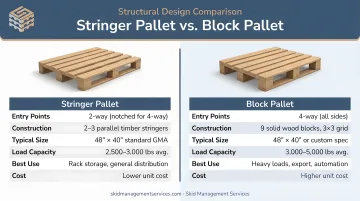
These are the two primary structural designs buyers will encounter:
- Stringer pallets use three parallel lumber runners (stringers) supporting top and bottom deck boards. They're the most common design in the U.S., lower cost, and typically offer two-way forklift entry (from the ends). Best for standard storage and transport where four-way access isn't required.
- Block pallets use both parallel and perpendicular spacers between deck layers, enabling true four-way forklift entry. They're more durable, better suited for automated warehouse environments and heavier loads, and are the preferred format for high-cycle operations.
Pallet Grades and Treatments
| Grade/Treatment | Description | When to Use |
|---|---|---|
| Grade A (New or Like-New) | Minimal or no repairs; no stringer replacements | Food contact, pharmaceutical, high-turn operations |
| Grade B (Reconditioned) | More extensive repairs including companion/double stringers | General warehousing, non-food applications |
| Heat-Treated (HT) | Heated to 56°C for 30 minutes; ISPM 15 compliant | Any cross-border international shipment |
| Methyl Bromide (MB) | Chemical fumigation; banned in the EU since 2010 | Avoid for any EU-bound shipments |
Standard Pallet Sizes
The 48×40 GMA pallet is the industry standard, accounting for over 30% of all new wood pallets produced in the U.S. and recognized under ISO 6780 for intercontinental materials handling. Other common sizes include:
- 42×42 inches — telecom equipment, paint, technical coatings
- 48×48 inches — four 55-gallon drums
- 48×45 inches — automotive
- 40×48 inches — military, cement bags
Matching pallet size to your product dimensions and racking specs before ordering avoids costly mid-project retrofits.
How to Choose the Right Wood Pallet Manufacturer
Start with Total Cost, Not Unit Price
The most common procurement mistake is optimizing on per-pallet price while ignoring what damaged pallets actually cost. According to Supply Chain Management Review, damaged pallets create safety risks, product damage, unplanned downtime, and warehouse disruption — costs that don't appear on the original invoice.
True cost of ownership factors in damage rates, replacement frequency, freight surcharges, and the administrative load of managing supplier relationships — all invisible in the unit price.
Key Evaluation Criteria
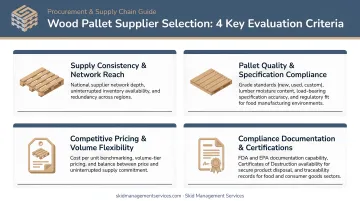
Work through these four factors before committing to a supplier:
- Geographic coverage — Multi-site operations need a supplier that can deliver consistently across regions, not just to a primary DC
- Product mix flexibility — Can the supplier provide both new and reconditioned pallets as your application mix changes?
- ISPM 15 certification — If any portion of your supply chain involves international shipments, non-compliant pallets mean customs delays; confirm certification before assuming compliance
- Equipment compatibility — Verify forklift entry type (two-way vs. four-way) and load capacity specs match your material handling setup
Why Network Breadth Matters
Single-manufacturer sourcing creates exposure. IBISWorld notes the U.S. pallet industry has faced extreme lumber-price volatility and supply chain disruptions that have elevated production costs — and a manufacturer running a single plant has limited ability to absorb that pressure without passing it to buyers.
A supplier operating through a national multi-vendor network can shift sourcing when one region tightens, protecting both pricing and availability. For procurement teams managing national accounts, that redundancy translates to:
- Stable pricing during lumber market swings
- Uninterrupted supply when a single plant faces capacity issues
- Flexibility to scale volume without qualifying a new vendor
Scalability and Service Flexibility
Before finalizing a supplier relationship, confirm:
- Can they meet volume spikes during peak seasons?
- Do they offer custom sizing for non-standard pallet requirements?
- What is the lead time for large or emergency orders?
- Do they supply packaging materials alongside pallets, reducing the number of vendor relationships you're managing?
Conclusion
The U.S. wood pallet market offers genuinely different supplier models: direct manufacturers with vertical integration (PalletOne), engineering-focused multi-location manufacturers (Millwood), pooling and rental services (CHEP), recycling-centered networks (Kamps), and national multi-vendor distributors (Skid Management Services). Each suits a different type of buyer.
The right choice depends on your volume, geographic footprint, product specifications, export needs, and tolerance for single-source supply risk. The clearest decision factors are:
- Volume and frequency — high-volume accounts benefit from dedicated manufacturer relationships
- Geographic spread — multi-location operations need suppliers with national reach
- Grade consistency — food and consumer goods manufacturers need reliable spec compliance
- Total cost — reliability and scalability matter more than unit price alone
Procurement teams that evaluate on total cost consistently make better long-term sourcing decisions than those focused on price per pallet.
For businesses that need a dependable national source of wood pallets and packaging materials, with competitive pricing backed by a multi-vendor supplier network, Skid Management Services supplies new, used, and custom pallets to national accounts across food manufacturing and consumer goods. Reach their team at Info@SkidManagementServices.com or call 717-202-0304 — available 24/7.
Frequently Asked Questions
Frequently Asked Questions
How much does a brand new wood pallet cost?
New wood pallet prices vary based on size, lumber grade, regional freight, and current lumber market conditions (the Producer Price Index for wood pallets fluctuated around 340 in early 2026). The standard 48×40 GMA pallet is generally the most cost-effective option in volume. Contact suppliers directly for current pricing, as no single published rate applies across the market.
How do you tell if wood pallets are chemically treated?
Look for the IPPC stamp burned or stenciled onto the pallet stringer. "HT" indicates heat-treated and ISPM 15 compliant; "MB" indicates methyl bromide fumigation, which is banned in the EU. Pallets with no visible stamp or unknown origin should be avoided for food, pharmaceutical, or export applications.
What is the difference between stringer pallets and block pallets?
Stringer pallets use three parallel boards and typically allow two-way forklift entry. Block pallets use both parallel and perpendicular supports for four-way entry, higher load capacity, and better performance in automated environments. Block pallets cost more upfront but hold up longer in high-cycle operations.
What is a GMA pallet and why is it the industry standard?
The GMA (Grocery Manufacturers Association) pallet is a 48×40-inch wood pallet standardized for grocery and consumer goods supply chains. It accounts for over 30% of all new wood pallets produced in the U.S. and is recognized under ISO 6780 as an intercontinental standard size, making it compatible with virtually all North American warehouse racking and freight systems.
What is ISPM 15 and do all wood pallets need to comply?
ISPM 15 is an international phytosanitary standard requiring wood packaging material used in cross-border shipments to be heat-treated or fumigated to prevent the spread of invasive insects and plant diseases. It applies to international trade only, not domestic U.S. shipments. Over 100 countries have adopted ISPM 15 regulations.
What is the weight capacity of a standard wood pallet?
Capacity varies by design, wood species, and use conditions. PalletOne states a standard GMA pallet can support up to 4,600 lbs and must meet a minimum load-bearing capacity of 2,500 lbs. For racked or dynamic loading scenarios, consult the pallet's design specification, as safe loads differ significantly by support configuration.