For businesses moving product on wood pallets every day, that gap between "recycled" and "landfilled" translates directly into rising disposal costs, tightening landfill bans, and mounting pressure from customers and investors to prove sustainability isn't just a slide in a deck.
This guide breaks down why pallet recycling matters, how the process actually works from dock to end-of-life, and the practical steps your business can take to reuse, recycle, or offload old pallets without losing money in the process.
Key Takeaways
- Recycling pallets cuts landfill waste and disposal costs while conserving valuable timber resources
- Wood and metal pallets each need a different repair and recycling path to maximize value
- Reuse first, recycle second, dispose last - that order should guide every pallet decision
- A national supplier network combines buyback, recycling, and resupply into a single relationship
Why Pallet Recycling Is Essential for Sustainable Waste Management
The Environmental and Circular Economy Case
Discarded pallets take up real landfill space and add pressure on timber supply chains. Yet the industry's own count-based tracking tells a more encouraging story than raw EPA tonnage suggests.
The National Wooden Pallet and Container Association reports a 95% pallet recycling rate. That figure reflects roughly 508 million new pallets produced against about 25 million landfilled in 2016, down sharply from 178.5 million landfilled in 1998.
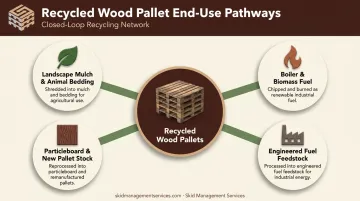
That recovered wood doesn't just disappear. It gets a second life as:
- Landscape mulch and animal bedding
- Boiler and biomass fuel
- Particleboard or new pallet stock
- Feedstock for engineered fuel programs
Cost Comparison: Disposal vs. Recycling
Recycling isn't just an environmental win: it changes the economics of disposal, too. Landfill tipping fees averaged $56.80 to $57.63 per ton nationally in 2023, according to the Environmental Research & Education Foundation. Regional rates can run even higher: Portland's Metro Central transfer station charges $176.70 per ton for general garbage, versus $97.13 per ton for separated clean wood, pallets included.
Compare that to a recycling partnership. Skid Management Services structures its closed-loop programs so clients earn a 15% to 40% trade-in credit against new-pallet spend, depending on grade mix and volume. That structure turns what used to be a disposal cost into a discount.
Regulatory Pressure and Job Impact
Regulatory pressure adds another layer to this calculus. States like Massachusetts now ban wood waste from landfills outright, forcing businesses to find recycling or reuse pathways instead of a dumpster. Beyond compliance, the wood pallet and container manufacturing industry supports well over 170,000 American jobs, spanning production, repair, and reconditioning work nationwide.
The Pallet Recycling Process Explained: From Collection to Reuse
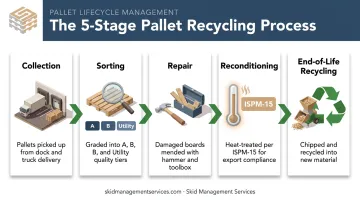
Most recycled pallets move through five distinct stages before they're either back in circulation or converted into raw material.
Collection: Pallets accumulate at warehouses, retailers, and distribution centers before moving out via a scheduled pickup route or a drop-off at a collection point. SMS runs this as recurring pickups (weekly, biweekly, or on-call) directly from a client's dock, with no need to transport anything offsite.
Sorting: Facilities separate incoming pallets by material, size, and condition. SMS, for example, grades wood pallets into three tiers: Grade A (all seven deck boards intact, no broken stringers), Grade B (one to two minor repairs, full structural integrity), and Utility/#2 for lower-demand applications.
Repair: Common fixes include replacing broken deck boards and reinforcing blocks. Most wood pallets can go through this cycle several times before retirement makes more sense than another patch job.
Reconditioning: Technicians clean, inspect, and check pallets for pest compliance. Export-bound pallets need valid ISPM-15 heat-treatment stamps, which require the wood core to hit at least 56°C for 30 continuous minutes, plus a legible mark showing the IPPC logo, country code, and treatment code.
End-of-life recycling: Facilities chip or shred pallets too damaged to repair into mulch, particleboard, or biomass fuel rather than sending them to a landfill.
One notable example of that last step comes from a joint U.S. Department of Energy and Auburn University study, which tested shredded construction-and-demolition wood, including pallets, as engineered fuel at Lafarge North America's cement plant in Roberta, Alabama.
Researchers dried the material, cleaned it of metal and glass, and burned it successfully in full-scale kiln trials, proof that pallet wood has a real second act beyond mulch.
Types of Pallets and Best Recycling Methods
Not every pallet material recycles the same way, and knowing the difference helps you route each type correctly instead of treating them all like trash.
| Material | Recycling Path | Notes |
|---|---|---|
| Wood | Repaired and reused, or chipped into mulch/biomass fuel at end of life | Most common type; can be repaired multiple times |
| Plastic | Shredded and reprocessed into new pallets | Highly durable, built for many reuse cycles |
| Metal | Melted down as scrap for new steel or aluminum products | Recyclable indefinitely; strongest long-term choice |
Wood pallets dominate the market because they're cheap to repair and easy to break down for parts. Plastic pallets cost more upfront but last through dozens of cycles before shredding makes sense.
Metal takes that durability advantage even further. Metal pallets, including steel sheet pallets, recycle indefinitely as scrap, making them the strongest long-term choice despite higher upfront costs. Not every supplier handles metal take-back the same way as wood, though, so if you're running steel pallets alongside a wood recycling program, confirm with your vendor whether scrap-metal recovery is bundled in or billed separately.
How to Dispose of Old Pallets: Reuse, Recycle, or Partner With a Trusted Supplier
Reuse First
Before anything else, ask if the pallet can go back into service. Options include:
- Returning pallets to the original vendor
- Starting an in-house reuse program between departments
- Repurposing small quantities into furniture or storage shelving
Free Pickup Services
Many recyclers and suppliers pick up used pallets at no charge, but eligibility usually depends on volume. Skid Management Services offers free removal for qualifying accounts where pallet volume offsets the cost of the pickup route.
This option typically fits operations generating 500 or more pallets monthly on a two-way basis. Lower-volume generators may still qualify for paid pickup or trade-in credit instead.
Sell or Trade
Selling used pallets in bulk beats paying disposal fees outright. Buyback pricing generally depends on three factors:
- Grade: Premium Grade A pallets command more than repair candidates
- Volume: Higher monthly throughput unlocks better rates
- Distance: Pickup location relative to the recycler's hub affects freight cost
Locate a Certified Recycler
Use industry directories like the National Wooden Pallet & Container Association (NWPCA) or your municipal solid waste resources to find compliant options nearby. If you're outside a supplier's core service area — say, in Portland, Oregon rather than the Mid-Atlantic — check local databases first, then ask a national network whether they can coordinate through a partner in your region.
Partner With a National Supplier Network
Juggling separate vendors for buyback, recycling, and resupply eats up time most operations teams don't have. Skid Management Services combines its own pallet inventory with an expansive supplier network to act as a single point of contact, handling pickup, grading, ESG-ready recycling documentation, and resupply on the same logistics run.
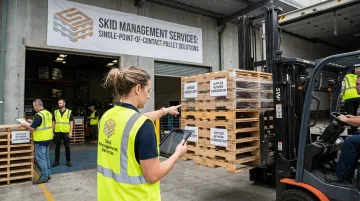
For food and beverage manufacturers like the ones SMS already serves, that means one phone call replaces three separate vendor relationships.
Overcoming Common Pallet Recycling Challenges
Even solid recycling programs run into snags. Here's how to work through the three most common ones:
Damage and wear. Even heavily damaged pallets rarely need to hit a landfill. Professional repair handles the moderately damaged stock, while shredding or chipping absorbs whatever can't be fixed.
Market and volume fluctuations. Inconsistent pallet volume makes it hard to lock in reliable buyers on your own. An established supplier relationship smooths this out: Skid Management Services' dual-inventory model (owned stock plus supplier network) means clients aren't stuck when their own volume swings up or down.
Finding a compliant, reliable partner. Vetting local recyclers one by one takes time most teams don't have. Leaning on a supplier with an existing recycler and reuse network, one that already provides diverted-tonnage and recycling-rate documentation for ESG reporting, saves that legwork entirely.
Frequently Asked Questions
Who collects pallets for free?
Many pallet recycling companies, suppliers, and local haulers offer free pickup for businesses generating consistent volume. Check with local recyclers or a national supplier network like SMS to confirm scheduled collection eligibility in your area.
How do you dispose of old pallets?
Reuse or repair first, then sell or donate what's still usable. What's left should go to a recycler or supplier take-back program. Save landfill disposal for pallets with no recycling or take-back option available.
Where can I recycle pallets in Central Pennsylvania or the Lehigh Valley?
Check your county's local recycler directory or contact a regional supplier like SMS for pickup and drop-off options across Central PA and the Lehigh Valley. A national supplier network can also connect you to certified recyclers if local options are limited.
What is the difference between reusing and recycling a pallet?
Reuse means the pallet keeps working as-is or after a repair, extending its life without changing its form. Recycling breaks it down into raw material, like mulch or fuel, for an entirely new product.
Can damaged pallets still be recycled?
Yes. Damaged pallets are typically dismantled or shredded into mulch, biomass fuel, or particleboard rather than thrown away as waste.
Is pallet recycling cost-effective for small businesses?
Small volumes can still be sold to local recyclers or bundled in with regular waste hauler pickups. Larger businesses tend to see bigger savings through dedicated supplier partnerships and trade-in credit programs.