Introduction
Wooden pallets move roughly $10 trillion worth of goods through the U.S. supply chain every year — and the stringer pallet accounts for the majority of that movement. It's the most widely used pallet design in the country, found in grocery distribution centers, manufacturing plants, and export docks from Pennsylvania to California.
Yet most buyers select pallets on habit or price alone — without factoring in entry type, fastener quality, or build configuration. That oversight has real consequences: forklift incompatibilities, load failures, and customs rejections that could have been avoided with better upfront decisions.
This guide gives procurement and logistics professionals a practical breakdown of stringer pallet anatomy, standard sizing, performance benefits, and how to match the right configuration to your operation.
Key Takeaways
- Stringer pallets use continuous lengthwise boards called stringers, sandwiched between top and bottom deck boards, to support unit loads.
- The North American standard is 48"×40" (stringer length × deck board width), also called the GMA pallet.
- Standard entry is two-way — notching or chamfering the stringers upgrades them to partial four-way access.
- They account for 76% of new U.S. wood pallet production — the dominant choice for domestic shipping and warehousing.
What Is a Stringer Pallet?
A stringer pallet is a wood pallet whose structural support comes from two or three continuous boards — called stringers or runners — that run lengthwise between the top and bottom deck boards. These boards bear and distribute the load placed on the pallet's surface.
Two-Way vs. Partial Four-Way Entry
Standard stringer pallets allow forklift access from the front and back only (two-way entry). However, stringers can be modified to enable side entry:
- Notched stringers: a rectangular cut in the lower stringer section lets forklift tines enter from the side
- Chamfered bottom boards: an angled cut at the base enables pallet jack access from all four sides (partial four-way)
Two-way pallets limit rack orientation and floor traffic patterns; partial four-way entry adds flexibility without the cost of a full block pallet redesign.
The GMA Connection
Stringer pallets are the dominant pallet type in the United States. When built to the 48"×40" specification associated with the Grocery Manufacturers Association (now Consumer Brands Association), they're commonly called GMA pallets.
The 48"×40" footprint became the de facto North American shipping standard through widespread adoption in grocery and retail supply chains.
The Anatomy of a Stringer Pallet
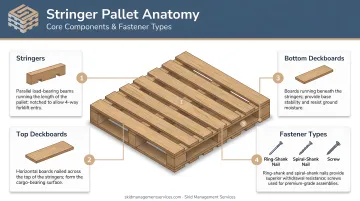
A stringer pallet has four core component categories: top deck boards, stringers, bottom deck boards, and fasteners. Knowing how each component works helps buyers evaluate quality and nail down accurate specs.
Top Deck Boards
Top deck boards form the flat surface on which cargo sits. On a standard 48"×40" GMA pallet, the typical configuration is:
- Two lead boards (outermost): 5½" wide × 40" long
- Five interior boards: 3½" wide × 40" long
- Minimum thickness: ½" per GMA guidance, with ⅝"+ common in heavier-duty builds
Lead boards absorb the impact of forklift tines during loading. Doubling lead boards — adding a second board directly alongside each outer edge — is a standard durability upgrade for high-cycle applications.
Stringers
The stringers carry the load. These continuous lengthwise beams are the structural backbone of the pallet. Key specs:
- Typical dimensions: 3.5" height × 1.5" width (actual dimensions for nominal 2×4 lumber)
- Standard configuration: three stringers — two outer, one center
- Adding a fourth or fifth stringer increases load capacity for heavy or unevenly distributed products
Notching converts a two-way pallet to partial four-way: a rectangular notch cut into the stringer's lower section allows forklift tines to slide through from the side. Chamfering the bottom deck boards (angling the edges) allows pallet jack entry. These are different modifications, and confusing them leads to equipment incompatibility.
Bottom Deck Boards
On a standard 48"×40" GMA pallet, the bottom deck uses five boards: two wide lead boards at each end and three narrower interior boards between the notches. Running parallel to the top deck, they provide a stable base for floor storage and conveyor movement.
Coverage width affects weight distribution on conveyor rollers. Buyers running pallets through automated lines should confirm board spacing against conveyor specifications before ordering.
Fasteners
Fastener quality directly affects pallet durability. The two preferred types:
- Helically threaded (drive-screw) nails: spiral threads grip wood fibers for strong withdrawal resistance
- Annularly threaded (ring-shank) nails: rings along the shank resist pull-out under repeated dynamic loading
Both outperform smooth-shank nails in withdrawal strength. Research from Virginia Tech's Center for Packaging and Unit Load Design found that upgrading from 12.5-gauge collated nails to 11.5-gauge bulk nails improved pallet durability by 85.6%. Standard practice is 2–3 nails per deck board at each stringer connection.
Standard Sizes and Dimensions
The Sizing Convention
For stringer pallets, the first number is always the stringer length and the second is the deck board width. A 48"×40" pallet has 48" stringers and 40" deck boards — not the reverse. This is one of the most common points of buyer confusion.
Common North American Stringer Pallet Sizes
| Size | Primary Industries |
|---|---|
| 48"×40" | Grocery, retail, consumer goods (GMA standard) |
| 48"×45" | Automotive |
| 48"×48" | Manufacturing, construction, heavy/oversized items |
| 48"×36" | Paper products |
| 42"×42" | Telecommunications, paint, medical |
| 40"×40" | Dairy |
The 48"×40" size alone represented 35% of new U.S. wood pallet production and 69% of the recycled market in a large-scale national study.
Load Capacity
Capacity varies by design, lumber species, and moisture content — no single universal figure applies. As reference points:
- PalletOne's GMA pallet guidance cites a minimum of 2,500 lb
- A dry-environment PDS design example reached 5,659 lb for uniformly distributed loads
Always confirm capacity with your supplier for the specific build you're ordering.
ISPM-15 Heat Treatment for Export
Beyond load specs, buyers sourcing pallets for international shipment face a separate compliance layer. Any stringer pallet crossing borders must comply with ISPM-15 phytosanitary regulations. Per USDA APHIS, this means:
- Heat treated to 56°C at the core for at least 30 minutes
- Stamped with the official IPPC mark
This requirement catches buyers off guard more often than most — shipments have been rejected at customs for missing documentation alone. Skid Management Services handles ISPM-15 treatment, stamping, and compliance documentation for export orders.
Key Benefits of Stringer Pallets
Cost-Effectiveness
Stringer pallets require fewer raw materials and simpler manufacturing than block pallets. Block pallet production demands more labor, multiple nail sizes, clinching capability, block cutters, and often more expensive automated nailing systems. That complexity means higher unit cost. For high-volume domestic shipping, the cost difference adds up fast.
Market Availability
Stringer-class pallets account for 76% of new U.S. wood pallet production and 91% of the recycled/recovered market, according to USDA Forest Service research. That market dominance means wider sourcing options, shorter lead times, and better pricing stability than any other pallet type.
For procurement teams managing national accounts, supply consistency matters as much as unit price. That's where stringer pallets have a clear edge: their market share supports a broad supplier base, making them easier to source consistently at scale.
Repairability
Individual boards and stringers can be replaced without scrapping the entire pallet. Common repair techniques include:
- Replace cracked or split deck boards individually without pulling the whole pallet
- Sister a new stringer ("plug") alongside a damaged one to restore load-bearing capacity
This repairability is why stringer pallets dominate the recycled market. A well-maintained stringer pallet can complete many service cycles, steadily reducing per-trip cost.
Customizability
Stringer pallets can be spec'd in dozens of configurations:
- Add stringers to increase load capacity for heavier applications
- Specify heavier lumber grades where durability is critical
- Notch or chamfer to match specific forklifts or conveyor systems
- Heat treat to ISPM-15 standards for international export compliance
This flexibility makes them practical across food and beverage, retail, manufacturing, and export applications. Skid Management Services sources custom configurations through its own inventory and national supplier network, with consistent availability for both standard specs and specialty orders.
Stringer Pallets vs. Block Pallets
How Block Pallets Are Built Differently
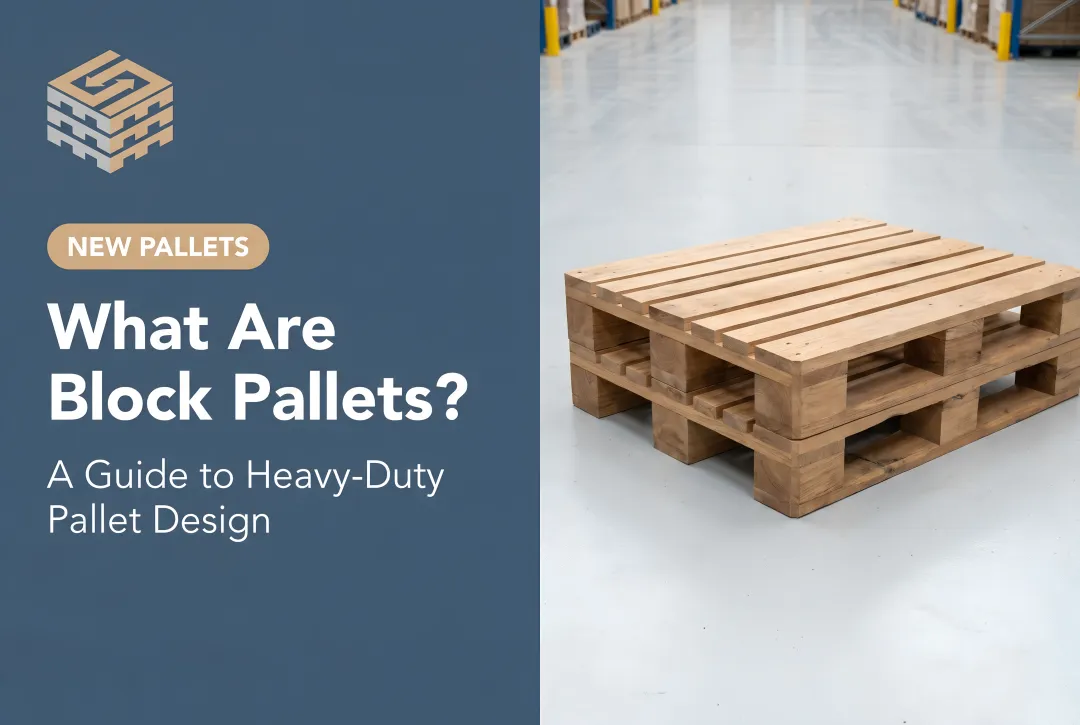
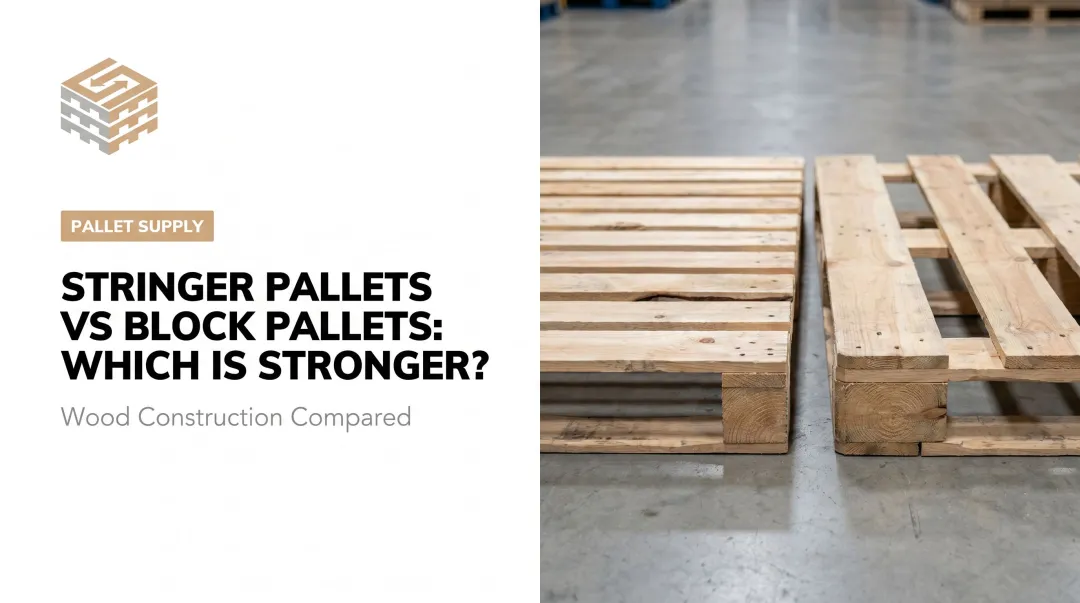
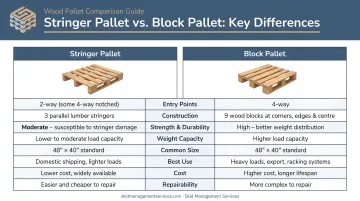
Block pallets use nine individual wood blocks (four corners, four mid-sides, one center) instead of continuous stringers. Those blocks create open space on all four sides, giving block pallets true four-way entry by both forklifts and pallet jacks — no notching required.
Stringer pallets offer two-way or partial four-way entry. For most domestic U.S. operations, that's sufficient. Where it becomes a deciding factor is in facilities with specific rack configurations or frequent side-loading — the comparison below breaks that down.
Side-by-Side Comparison
| Factor | Stringer Pallet | Block Pallet |
|--------|----------------|--------------|
| Entry type | Two-way / partial four-way | True four-way |
| Manufacturing complexity | Lower | Higher |
| Typical cost | Lower | Higher |
| Repairability | High | More complex |
| U.S. market share | ~76% new production | ~21% new production |
| International prevalence | U.S. dominant | European/global standard |
| Common use | Domestic shipping, retail, food | Automated systems, export |
Matching the Right Pallet to Your Operation
Stringer pallets are the better-value choice for most domestic U.S. operations, high-volume shipping, and cost-sensitive programs. Block pallets make sense when:
- True four-way access is required by warehouse equipment or rack systems
- Loads are extremely heavy and uniformly distributed
- The destination country's handling infrastructure is built around block pallet standards (common in Europe)
Skid Management Services supplies both types and can help match pallet type to your specific operational requirements.
How to Choose the Right Stringer Pallet for Your Operation
The right stringer pallet depends on more than just load weight. Run through these decision points before placing an order.
Key Decision Factors
Before specifying a stringer pallet, work through these variables:
- Load weight and distribution — determines stringer count, lumber dimensions, and board thickness
- Product type — food and beverage operations may have additional hygiene or material requirements under FDA sanitary transportation rules
- Handling equipment — confirm whether your forklifts and pallet jacks require two-way or four-way entry
- Warehouse layout — racking orientation affects which entry configuration is practical
Choosing a Build Type
| Build Type | What It Is | Best For |
|---|---|---|
| New | Virgin lumber and fasteners throughout | Critical loads, food-grade requirements, maximum cycle life |
| Combo | New stringers + recycled deck boards | Reduces cost while maintaining load capacity |
| Remanufactured | Disassembled and rebuilt from recovered parts | Budget programs with standard, predictable load requirements |
| Recycled | Sorted, repaired used pallets | High-volume, low-cost applications where appearance is secondary |
If you're shipping internationally, there's an additional layer of specification to work through.
Export and Compliance Checklist
Before placing an export order:
- Confirm the destination country requires ISPM-15 (over 180 countries require it)
- Verify pallet dimensions fit receiving country standards and available handling equipment
- Ensure the supplier can provide stamped, documented HT pallets — not just treated ones
Frequently Asked Questions
What is a standard stringer pallet?
A standard stringer pallet is a 48"×40" wood pallet built with three parallel stringers running lengthwise between top and bottom deck boards. It's also called a GMA pallet and is the most widely used pallet in the United States, with the 48"×40" footprint accounting for 35% of new U.S. wood pallet production.
Is a standard pallet 40×48 or 48×40?
The correct notation is 48"×40": the first number is the stringer length (48"), the second is the deck board width (40"). Reversing the numbers is a common mistake but doesn't change the physical pallet. Use 48"×40" when ordering to avoid ambiguity with your supplier.
What is the difference between a stringer pallet and a block pallet?
Stringer pallets use continuous boards for structural support and allow two-way or partial four-way entry. Block pallets use nine individual wood blocks and offer true four-way entry from all sides. Stringer pallets are generally less expensive to produce and dominate U.S. domestic logistics; block pallets are more common in European and international supply chains.
What are the main components of a stringer pallet?
The four core components are: top deck boards (the cargo surface), stringers (lengthwise support beams), bottom deck boards (the base layer), and fasteners (threaded nails). Each component can be customized in size, grade, and configuration to match specific load requirements.
How much weight can a stringer pallet hold?
Capacity varies by design and lumber species — GMA guidance cites a minimum of 2,500 lb, while specific engineered designs can reach 5,659 lb under uniform load in dry conditions. Confirm capacity with your supplier based on your exact build specification.
Can stringer pallets be heat treated for export?
Yes. Stringer pallets can be heat treated to ISPM-15 standards (56°C at core for 30+ minutes) and stamped with the IPPC mark, which is required for most international destinations. Confirm the requirement with your freight forwarder and verify your supplier can provide proper documentation.