Introduction
A shipment rejected at port. Packaging destroyed under customs supervision. Cargo sitting in a foreign warehouse while storage fees accumulate daily. These aren't rare horror stories—they're predictable outcomes when US exporters treat international freight like a domestic run.
The difference usually comes down to two things: whether the wood packaging is ISPM 15-certified, and whether the packaging was actually designed for the shipment it's carrying. According to TT Club's cargo insurance analysis, 65% of cargo damage claims stem from inadequate packing, blocking, or securing—a statistic that makes a strong case for getting this right before the container door closes.
This guide covers what US exporters need to know before the first pallet ships:
- ISPM 15 compliance requirements
- Choosing between pallets, crates, and hybrid solutions
- Documentation requirements
- Proper loading practices
- Cost strategies that don't compromise compliance
Key Takeaways
- Wooden packaging used in international trade must carry an ISPM 15 mark—non-compliant materials face destruction or re-export at your expense
- The right packaging (pallet, crate, or pallet-crate) depends on cargo weight, fragility, value, and how many handling touchpoints it will pass through
- Five core documents—Bill of Lading, Commercial Invoice, Packing List, Certificate of Origin, and Export Declaration—are required for most international shipments
- Internal bracing and external strapping are what actually protect cargo; an intact crate can still contain damaged goods if the contents shift
- Custom-built, ISPM 15-compliant packaging pays for itself: non-compliance fines and damage claims routinely exceed proper material costs
ISPM 15 and International Compliance: What Every US Exporter Must Know
What the Standard Requires
ISPM 15 (International Standards for Phytosanitary Measures No. 15) is an international regulation under the International Plant Protection Convention (IPPC). It requires all wooden packaging materials used in international trade to be treated before crossing borders—the goal being to prevent the spread of invasive insects, pests, and pathogens that live in raw wood.
The standard applies to a broad range of materials:
- Wood pallets, skids, and box pallets
- Wooden crates and packing cases
- Dunnage and pallet collars
- Drums made of raw wood
Approved Treatment Methods
The ISPM 15 standard specifies several approved treatment methods. The two most common for US exporters are:
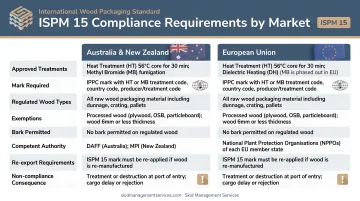
- Heat Treatment (HT): The entire wood profile, including the core, must reach 56°C for a minimum of 30 continuous minutes. This is the most widely accepted method globally.
- Methyl Bromide Fumigation (MB): Still an approved treatment code under the standard, though many countries and regions encourage alternatives due to phase-out pressures under the Montreal Protocol.
Heat treatment is the standard choice for most export applications—it's broadly accepted, independently verifiable, and free from MB's regulatory uncertainty.
The ISPM 15 Mark
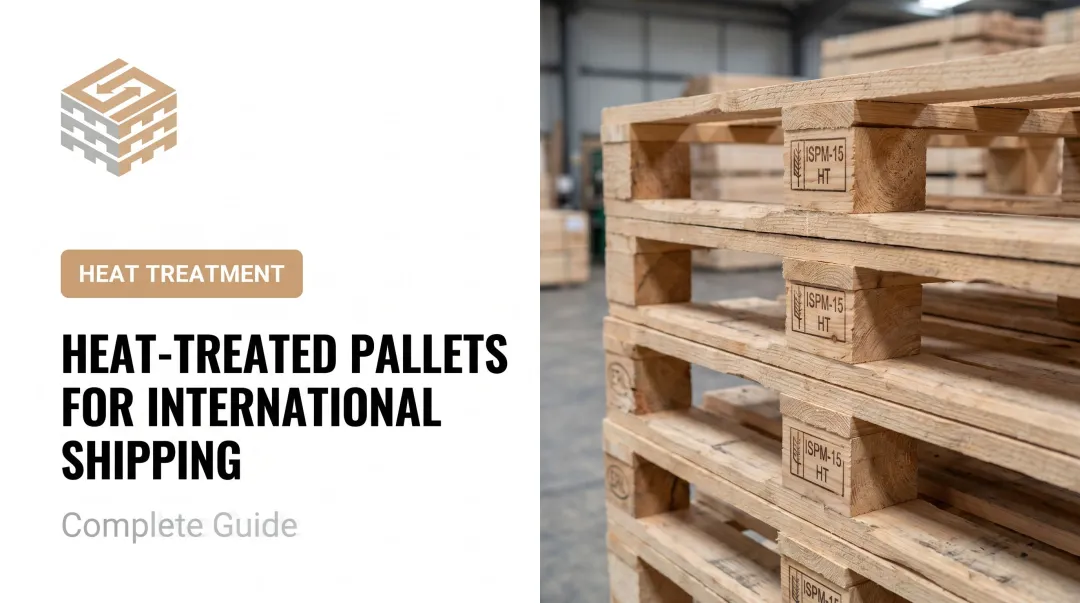
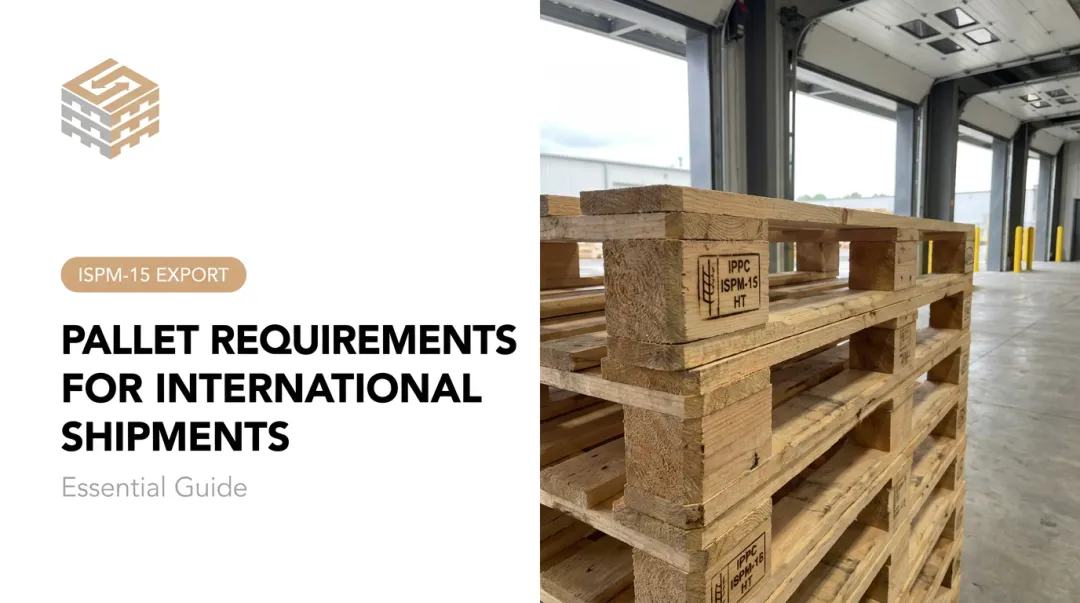
The official mark must be stamped directly into the wood—not on a paper label, not on shrink wrap. It must be legible, durable, non-transferable, and visible, ideally on at least two opposite sides of the packaging. The mark includes the IPPC symbol, the ISO two-letter country code, the producer/treatment provider code, and the treatment abbreviation (HT, MB, DH, or SF).
Before any international shipment leaves your facility, physically verify that stamp is present and readable on every piece of wood packaging. Missing or illegible marks are among the most common reasons for customs holds.
Consequences of Non-Compliance
That mark isn't just a formality—when it's absent or unreadable, non-compliant wood packaging doesn't get a second chance at the border. APHIS and CBP have clear authority to:
- Require immediate re-export at the importer or interested party's expense
- Order destruction of the packaging under supervision
- Impose penalties and liquidated damages for violations
Destination-Specific Requirements
The enforcement consequences above apply to US border entry—but compliance exposure runs both directions. ISPM 15 sets the global baseline, and several destination markets add their own layers on top of it:
- Australia: Incorporates ISPM 15 into import conditions for solid wood packaging, with specific DAFF compliance requirements
- New Zealand: Biosecurity requirements apply; importers should review the relevant import health standard
- EU: Wood packaging from non-EU countries must be debarked, treated under approved phytosanitary treatment, and carry the official ISPM 15 mark
Skid Management Services supplies ISPM 15 heat-treated export pallets with proper stamping and compliance documentation for US exporters across food manufacturing, consumer goods, and other regulated supply chains.
Custom Pallets vs. Crates vs. Pallet-Crates: Choosing the Right Solution
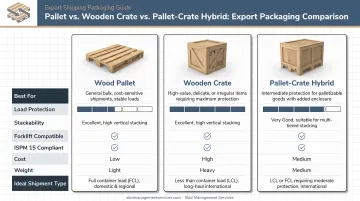
The right packaging format comes down to four variables: cargo weight and dimensions, fragility and surface sensitivity, total value, and the number of handling touchpoints across the route. Mismatching packaging to cargo is one of the leading causes of international freight damage—and it's entirely avoidable.
Pallets for International Shipping
A custom export pallet is the right choice when:
- Cargo is uniform, stackable, and can be secured with stretch film or banding
- Full enclosure isn't required
- Weight is distributed evenly across the deck
The standard GMA pallet footprint is 48" x 40" with a minimum load-bearing capacity of 2,500 lb and 4-way forklift entry—useful for international shipments where different handling equipment is used at various ports.
For non-standard loads, a custom-built pallet matters. Deck failure and uneven weight distribution are common when heavy or irregularly sized loads get placed on pallets not built for them. Custom pallets are engineered to specific load dimensions, weight requirements, and material thicknesses—not just the nearest standard size.
For export-bound shipments, Skid Management Services builds custom wood pallets to exact customer specifications, including ISPM 15 heat treatment and certification.
Wooden Crates and Pallet-Crates
Full wooden crates are appropriate for:
- Fragile or high-value goods that can't tolerate surface contact or shifting
- Industrial machinery, medical equipment, and irregularly shaped cargo
- Shipments facing severe handling conditions across multi-leg sea or air routes
ASTM D7478 covers heavy-duty sheathed wood crates built for net loads up to 30,000 lb, designed specifically for severe overseas shipping and storage conditions: protection from atmospheric elements, rough handling, stacking, and prolonged outdoor storage.
Pallet-Crate Hybrids
The pallet-crate hybrid (covered under ASTM D6256) combines a skidded, load-bearing base with an enclosed crate structure. Standard forklift handling is preserved while the cargo stays fully protected, making it effective for heavy equipment, automotive components, and oversized industrial parts.
ASTM D6256 covers skidded wood-cleated boxes for loads under 2,500 lb and not exceeding 16 ft in length.
Other crate formats worth knowing:
- Open-slat/skeleton crates: For cargo requiring ventilation or inspection access
- Knock-down crates: For returnable or reusable shipping programs
- Heavy-duty sheathed crates: For machinery or equipment exceeding standard weight thresholds
Key Documents and Labeling Required for International Shipments
The Five Core Documents
Most international shipments from the US require these documents:
- Bill of Lading: The contract between shipper and carrier; defines the route and serves as title to the goods
- Commercial Invoice: Proof of sale showing value, quantity, and description; used by customs to assess duties
- Packing List: Itemizes package type, gross and net weights (in kg), dimensions, and package markings
- Certificate of Origin: Certifies where goods were manufactured; required by most destination countries
- Export Declaration (EEI/AES filing): Required when shipment value exceeds $2,500 per Schedule B commodity code, or for any shipment requiring an export license, ITAR items, or restricted destinations regardless of value
For complex or high-value shipments—especially regulated goods like chemicals, electronics, or pharmaceuticals—a licensed customs broker catches documentation errors before they cause storage fees at the destination port. For straightforward commercial shipments, your freight forwarder can often handle filings directly.
Labeling Requirements
Labels on international crates and pallets must include:
- Shipper and consignee name and address
- Country of origin
- Gross and net weight
- Package dimensions
- Handling instructions (for example: "This Side Up," "Fragile," hazard indicators where applicable)
Labels must meet the destination country's language and format requirements, and must be durable enough to survive the full journey—not just the first leg.
The ISPM 15 mark is separate from all commercial labels. It's stamped into the wood itself. Verify it's present and legible on every piece of wood packaging before the shipment leaves your facility—treat it as a physical inspection step, not a box to check on your documentation list.
How to Properly Secure and Load International Shipments
Poor packing, blocking, and securing account for roughly 65% of cargo damage claims in international freight. A structurally sound crate can still deliver damaged goods if the contents aren't properly secured inside it.
Poor packing, blocking, and securing account for roughly 65% of cargo damage claims in international freight. A structurally sound crate can still arrive with damaged goods if the contents shift in transit. The sections below cover internal bracing, external securing, and handling oversized cargo.
Internal Bracing and Weight Distribution
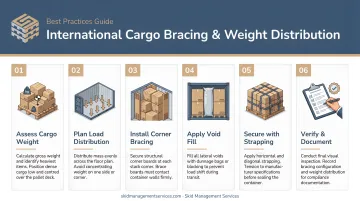
- Place the heaviest components at the bottom to lower the center of gravity
- Use blocking boards, bracing, and foam padding to eliminate any movement inside the crate
- Ensure there is zero internal void space that would allow cargo to shift during rough sea transit or air turbulence
- For metal components on long ocean voyages, wrap in VCI (Volatile Corrosion Inhibitor) film, a military-specification material (MIL-PRF-3420) that prevents moisture-induced corrosion during extended transit
External Securing
- Use strapping to secure crates and pallets within the shipping container
- Add screwed-down fasteners where the load warrants it
- Apply stretch film over pallet loads as a base layer before strapping
- Corner boards protect pallet edges and help distribute strapping pressure evenly
Stretch film, strapping, corner boards, and pallet covers are all stocked by Skid Management Services for shippers preparing export loads.
Oversized and Overweight Cargo
Cargo that exceeds standard container dimensions must be declared as Out of Gauge (OOG). Maersk and other major carriers require OOG and breakbulk shipments to receive terminal and vessel approval before loading. There's no single universal dimensional threshold—limits vary by carrier, vessel, and terminal. Confirm weight and dimensional limits with your freight carrier before loading to avoid approval delays at the port.
Cost-Saving Tips for International Pallet and Crate Shipping
Right-Size the Packaging
Air freight charges are based on the higher of actual weight or volumetric (dimensional) weight. According to Maersk's 2025 guide, volumetric weight = length × width × height (cm) ÷ 6,000—the IATA-recommended divisor. An oversized crate that leaves unnecessary void space adds directly to your freight bill.
Custom-built packaging that matches exact cargo dimensions:
- Eliminates wasted volumetric weight allowances
- Reduces material costs compared to oversizing
- Lowers carrier fees on both air and ocean routes
Volume Pricing and Consolidation
Businesses with recurring international shipments should consolidate where possible—combining multiple items into one shipment reduces per-unit handling costs. For ongoing export programs, volume pricing or blanket order arrangements with your supplier lock in competitive rates. Skid Management Services maintains an expansive national supplier network specifically designed to keep certified custom packaging available at volume, so exporters avoid supply gaps when shipment windows are tight.
The Real Cost of Non-Compliance
Non-compliant packaging doesn't just cause inconvenience—it generates compounding costs:
- Re-export or destruction of packaging at the importer's expense
- Cargo storage fees accumulating daily at the destination port
- Re-packaging fees if goods need to be repacked before release
- Potential penalties and liquidated damages from CBP
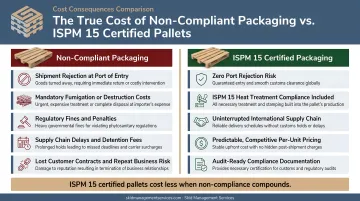
The upfront cost of ISPM 15-certified, properly constructed custom packaging is a fraction of what a single rejected shipment costs. Budget for it as you would insurance on high-value cargo—because that's exactly what it is.
Frequently Asked Questions
What pallets are approved for international shipping?
Wooden pallets must carry an ISPM 15 mark indicating heat treatment (HT) or methyl bromide fumigation (MB). Non-wood pallets (plastic, metal) are exempt from ISPM 15, but those are covered in the plastic pallet question below.
How much does it cost to ship a crate overseas?
Costs vary too widely for a reliable general range. Crate dimensions, chargeable weight, shipping mode (sea vs. air), origin/destination ports, and OOG status all drive the final number. Get multiple freight quotes and factor in customs fees, port handling, and insurance.
What is ISPM 15 and do all wooden pallets need it?
ISPM 15 is the international phytosanitary standard requiring wood packaging to be treated before crossing borders, preventing pest spread. It covers virtually all wooden packaging in international trade—pallets, crates, dunnage, and skids—and the compliance mark is stamped into the wood itself, not added as a label.
Can I use plastic pallets for international shipping?
Yes. Plastic pallets are outside the scope of ISPM 15 since they are not wood-based. However, load capacity and forklift-entry compatibility are model-specific—check the manufacturer's specifications before using plastic pallets for heavy or non-standard loads.
What documents are required when shipping pallets and crates internationally?
Core documents typically required include:
- Bill of Lading
- Commercial Invoice
- Packing List
- Certificate of Origin
- Export Declaration (EEI/AES)
Specific destination countries may require additional permits or licenses depending on the goods being shipped.
What is the difference between a shipping pallet and a shipping crate?
A pallet is an open platform for stacking and moving goods with a forklift. A crate is an enclosed wood structure that fully surrounds and protects cargo. Pallet-crate hybrids combine a load-bearing pallet base with an enclosed crate, making them the practical choice for heavy or high-value international shipments.