U.S. logistics rents fell 7% in 2024, yet year-end 2024 rents were still 59% higher than 2019 levels, according to Prologis. That base cost hasn't disappeared — it's been redistributed into storage rates, labor surcharges, and accessorial fees that now compound on every invoice.
The result: businesses routinely underbudget 3PL costs by 30–50% because they evaluate only the storage line. Per-pallet pricing varies by location, volume, pallet type, inventory turnover, billing method, and service scope. This guide breaks down every major fee category, explains what drives costs up or down, and gives you the inputs needed to build an accurate monthly budget.
Key Takeaways
- Standard U.S. ambient pallet storage runs $15–$40/pallet/month, with a 2024 survey average of $20.37
- Storage fees are only part of the invoice — receiving, handling, and minimums can double your monthly bill
- Location is the single biggest pricing lever: coastal/port markets command a 55% rent premium over inland markets
- Non-standard pallet sizes trigger restacking and handling surcharges at most 3PLs
- Low-volume shippers and slow-moving inventory face the highest effective per-pallet costs
How Much Does 3PL Cost Per Pallet?
3PL per-pallet pricing is a composite of receiving, storage, handling, and accessorial charges (add-on fees for services like liftgate, labeling, or returns) that stack across a monthly billing cycle. Misreading that structure is where most budget surprises originate.
Common cost mistakes to avoid:
- Underbudgeting causes cash flow surprises mid-contract
- Low storage rate selections lead to hidden surcharges that wipe out the savings
- Overestimating pallet counts triggers minimum-fee penalties during slow months
Typical Cost Range by Volume Tier
The cleanest published benchmark comes from a 2024 warehousing pricing survey, which found an average pallet storage rate of $20.37/pallet/month. Volume changes that number significantly:
| Volume Tier | Typical Rate | Notes |
|---|---|---|
| Under 100 pallets | ~$22–$30/pallet/month | Per-pallet billing; most services billed separately |
| 100–500 pallets | ~$15–$22/pallet/month | Hybrid models become available; some volume discounts |
| 500+ pallets | ~$13–$17/pallet/month | Dedicated space and cost-plus models more common |
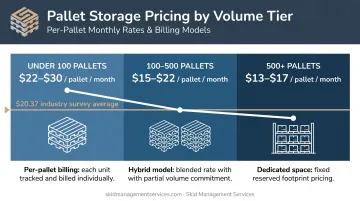
For context, Cart.com's 2025 volume examples show approximately $22.50 at 50 pallets, $17.50 at 100 pallets, and $14.00 at 500 pallets — a useful illustration of how the curve actually behaves.
Important: These ranges cover storage only. Once you add receiving, handling, and accessorial charges, your all-in per-pallet cost is meaningfully higher — often 1.5–2x the storage fee alone.
Key Factors That Affect 3PL Per-Pallet Pricing
Understanding which variables apply to your operation is the foundation of accurate budgeting.
Storage Model and Billing Method
Three main billing approaches exist, and each suits a different business type:
- Per pallet — Best for standard, uniform inventory. Most common for B2B shippers using GMA 48"×40" pallets
- Per cubic foot — More precise for small, irregular SKUs where pallet count overstates actual space used
- Dedicated space (per square foot) — A fixed monthly cost regardless of inventory level; best for large or peak-heavy operations
The billing measurement date matters more than most shippers realize. Daily-average billing charges for inventory held every day of the month, while end-of-month snapshot billing charges only for what's on hand at month-end. For businesses that build inventory mid-month and deplete it before month-end, daily-average billing can add 20–40% to the storage line versus a snapshot model.
Volume, Inventory Turnover, and SKU Count
Higher volumes unlock tiered pricing. The less-discussed side of that equation is what slow inventory does to your invoice.
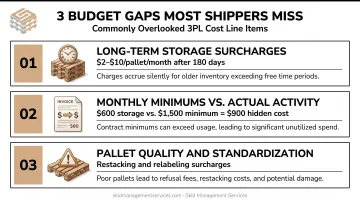
Most 3PLs impose long-term storage surcharges for inventory sitting beyond 90–180 days. One published guide cites typical long-term surcharges of $2–$10 per pallet/month after 180 days — on top of your standard storage rate. For slow-moving SKUs, that stacks up quickly.
High SKU counts relative to order volume are also a cost driver. Providers note that orders with 5+ SKUs can double pick fees, and a high-SKU, low-velocity profile often leads to higher quoted rates or storage minimums during initial negotiations.
Location and Warehouse Geography
Warehouse location is the single largest pricing lever in 3PL pricing. According to Cushman & Wakefield's Q1 2026 U.S. Industrial MarketBeat, U.S. industrial asking rents averaged $10.20/SF, with port-proximate markets commanding a 55% rent premium over the rest of the country.
Practical implication:
- Coastal/port markets (LA/Long Beach, NY/NJ): highest storage rates, often 30–50% above national averages
- Inland Empire (CA): Still elevated — direct asking rents averaged $1.13/SF/month NNN even after an 11.6% YoY decline
- Midwest and Southeast markets (Chicago, Dallas): More competitive, though Chicago net rents are rising at 5.2% YoY
- Central PA, Lehigh Valley, and Mid-Atlantic inland: Remain among the more cost-competitive U.S. locations
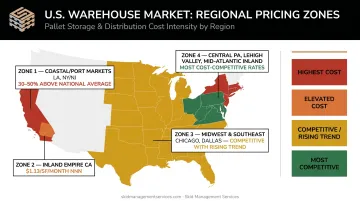
If your customer base doesn't require coastal proximity, choosing an inland 3PL can be the single most effective pricing lever available.
Pallet Quality, Size, and Standardization
Non-standard pallet sizes are a hidden cost most shippers don't anticipate until they get their first invoice.
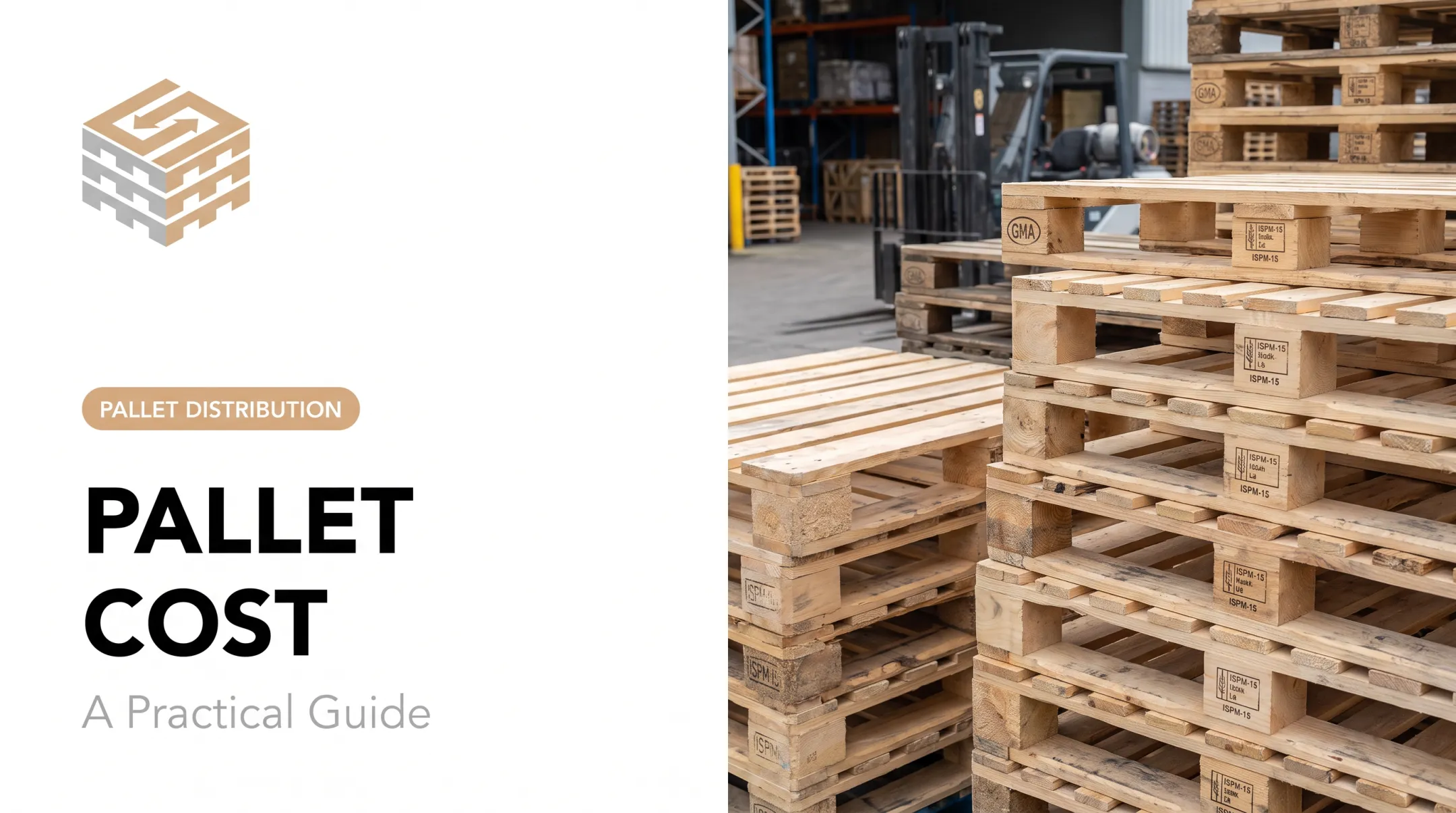
When a 3PL quotes a "standard pallet" rate, they're pricing against the GMA 48"×40" footprint — the U.S. grocery and general merchandise benchmark. Anything outside that dimension creates operational friction:
- 48"×48" drum pallets, 44"×44" IBC tote pallets, and 42"×42" chemical pallets occupy larger floor and rack footprints, often triggering a different rate tier
- Undersized or fractional pallets may not rack properly and require manual placement
- Pallets stacked below standard height or in poor structural condition require restacking or down-stacking — each of which typically triggers an accessorial fee
Skid Management Services supplies GMA 48"×40" pallets in new, Grade A recycled, and Grade B recycled grades, along with the full non-GMA size range for industry-specific applications. Sending consistently sized, structurally sound pallets reduces receiving friction at the 3PL and avoids rework surcharges that won't appear in your original quote.
Special Storage Requirements
Climate-controlled, frozen, or hazmat storage adds a meaningful premium to ambient rates. No single authoritative U.S. benchmark exists for cold-storage premiums, but the cost differential is real — refrigerated facilities carry higher construction, energy, and labor costs that flow directly into per-pallet rates. For hazmat storage, surcharges are substantial but vary by product classification and regulatory requirements. Budget for cold-chain storage at a significant premium to ambient rates and get a specific quote rather than applying a generic multiplier.
Complete 3PL Cost Breakdown: What You're Actually Paying For
Storage is just one line on a 3PL invoice. A realistic monthly budget also includes receiving, handling, accessorial fees, and minimum charges — each of which can rival or exceed storage costs depending on your operation.
Receiving Fees (Inbound Processing)
Receiving covers unloading, counting, verification against packing lists, labeling, and put-away. It's billed per pallet, per carton, or per hour, and it's often the most variable line on the invoice depending on how your freight arrives.
Typical ranges from the 2024 warehousing pricing survey:
- Per pallet: $12.91 average; $5–$75 depending on inspection depth
- Per carton: $2.50–$3.00 average
- Container receiving: $350 average; $250–$500 range
Floor-loaded containers cost more than palletized shipments — the labor required to hand-stack product onto pallets at the dock is significant. If your freight arrives floor-loaded and you're being quoted a per-pallet receiving rate, clarify how the 3PL calculates inbound labor before signing.
Storage Fees
Storage is billed per pallet per month and covers the ongoing rent for the space your inventory occupies. As noted above, the U.S. ambient range runs $15–$40/pallet/month, with a survey average of $20.37. The billing method (daily average vs. month-end snapshot) directly affects this line for businesses with fluctuating inventory.
Handling and Accessorial Fees
These are often the most variable part of a 3PL invoice and are consistently underestimated at budgeting time:
| Fee Type | Typical Range |
|---|---|
| Pallet in / pallet out | $3.50–$12 per move |
| Kitting / light VAS labor | $30–$50/hour |
| Warehouse VAS labor | $35–$65/hour |
| Stretch wrap / re-wrapping | $15–$25/pallet |
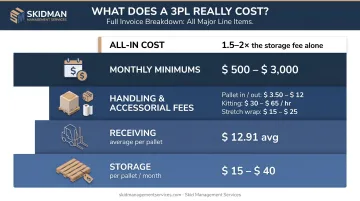
Kitting, relabeling, repackaging, and other value-added work all bill separately. If your product requires any special handling after it arrives, these lines add up quickly.
Monthly Minimums and Account Fees
Most 3PLs impose a monthly minimum billing threshold: if your activity fees fall below the floor, you're charged up to the minimum regardless. Typical ranges:
- Standard range: $500–$3,000/month
- Lower-end providers: $250–$500/month
For small or seasonal shippers, this is often the hidden cost that breaks the per-pallet math. A business storing 30 pallets at $20/pallet ($600/month in storage) that hits a $1,500 minimum pays $900 more than their storage line suggests.
Many 3PLs also charge flat monthly account management or WMS technology fees, typically $100–$300/month. These recurring charges appear regardless of volume.
Low-Cost vs. High-Cost 3PL: What's the Real Difference?
The gap between budget and premium 3PL providers is not just price — it reflects differences in infrastructure, service reliability, and total cost over the contract term.
| Dimension | Budget 3PL | Premium 3PL |
|---|---|---|
| Pallet storage rate | Lower headline rate | Higher headline rate |
| Minimums and contract flexibility | Rigid minimums, longer lock-in | More flexible, lower minimums |
| Geographic coverage | Single location | Multi-site, closer to customers |
| Inventory visibility / WMS | Basic or manual | Real-time tracking, API integration |
| Order accuracy | Variable; 97–99% typical | 99%+ standard; 99.8% best-in-class |
| Handling of non-standard freight | More surcharges, less flexibility | Better processes, fewer surprises |
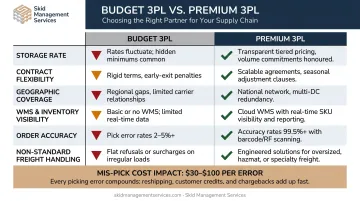
Voxware estimates the average cost of a single mis-pick at $30 to over $100. At a 1% error rate on 1,000 monthly orders, that's $3,000–$10,000 in downstream costs that never appear on the 3PL invoice but directly hit your P&L.
When evaluating providers, calculate total cost of ownership across the contract term — factoring in error-related returns, re-shipments, and customer chargebacks alongside the headline storage rate. That full picture often reverses which option looks cheaper.
How to Estimate the Right 3PL Budget for Your Business
A well-structured 3PL budget starts with your actual operational data, not the 3PL's published rate card.
Inputs You Need Before Requesting a Quote
- Average pallet count in storage per month
- Monthly inbound pallets received (and whether they arrive palletized or floor-loaded)
- Monthly outbound pallet moves
- SKU count and average order complexity
- Inventory turnover rate and percentage of slow-moving SKUs
- Return rate
- Any special storage requirements (temperature-controlled, hazmat, ISPM-15 export)
- Pallet sizes used (GMA 48"×40" or non-standard)
What Most Businesses Overlook
Three cost items consistently get missed at budgeting time:
Long-term storage surcharges — Inventory that sits 90–180+ days accrues additional fees. Map your slow-moving SKUs before you sign.
Monthly minimums vs. actual activity — Calculate whether your expected monthly fees will consistently exceed the minimum threshold. If not, your effective per-pallet cost is higher than the quoted rate.
Pallet quality and standardization — Non-standard or poorly constructed pallets trigger restacking and relabeling surcharges that don't appear in the initial quote. Sourcing GMA 48"×40" pallets in consistent condition — along with stretch film, corner boards, and strapping from a supplier like Skid Management Services — cuts out this cost and reduces dock refusals at receiving.
One more budgeting trap: over-specifying the 3PL relationship. Signing for dedicated space, high minimums, or premium features at aspirational volume levels is expensive when you're still growing into those volumes. Match the pricing model to where your operation is today, not where you hope it will be in 18 months.
Frequently Asked Questions
How much does 3PL storage cost per pallet per month?
Standard U.S. ambient pallet storage typically runs $15–$40/pallet/month, with a 2024 survey average of $20.37. Rates vary by volume — small shippers pay closer to $22–$30, while high-volume accounts may negotiate down to $13–$17. Coastal and port-adjacent markets price notably higher than Midwest and Southeast benchmarks.
What is a typical 3PL receiving fee per pallet?
Receiving fees average $12.91/pallet based on 2024 survey data, with a broad range of $5–$75 depending on inspection depth and inbound freight method. Floor-loaded containers bill differently — often $250–$500 per container for labor-heavy unloading — rather than a straight per-pallet rate.
What is the difference between on-demand and dedicated 3PL storage?
On-demand storage fluctuates with your inventory level and is ideal for seasonal businesses — you pay only for the space you use. Dedicated space is a fixed monthly cost regardless of how much inventory you hold, which suits high-volume operations that need guaranteed capacity year-round.
How do 3PLs calculate storage — per pallet vs. per cubic foot?
Per-pallet billing suits standard, uniform pallets and is the most common model for B2B shippers using GMA 48"×40". Cubic-foot billing fits irregular or small SKUs where pallet count overstates actual space. Also watch the measurement method — daily average vs. month-end snapshot — which can shift your total cost when inventory fluctuates.
What factors cause 3PL per-pallet costs to increase?
The main cost escalators:
- Slow inventory turnover triggering long-term storage surcharges
- Non-standard pallet sizes requiring special handling or restacking
- High SKU counts relative to order volume
- Climate-controlled or hazmat storage requirements
- Low monthly activity that falls below minimum billing thresholds
How can I reduce my per-pallet costs at a 3PL?
Several levers work well in combination:
- Consolidate inbound shipments to lower per-pallet receiving fees
- Improve inventory turnover to avoid long-term storage surcharges
- Use standard GMA 48"×40" pallets to eliminate restacking charges
- Negotiate tiered rate reductions tied to volume growth commitments
- Audit your monthly minimum — if you're consistently hitting it, renegotiate or find a provider whose threshold matches your actual volume