Introduction
The 48×40 pallet isn't just a common shipping platform — it's the structural foundation of North American logistics. Nearly every dry van trailer, warehouse racking system, and major retailer's receiving dock is built around this single footprint.
Procurement teams still regularly face shipments rejected at retail docks, pallets that fail mid-transit, and customs holds. Most trace back to specification errors. Grade, construction type, load rating, and ISPM-15 compliance each carry consequences — and getting any one wrong means delays, chargebacks, or rejected loads at the dock.
According to USDA Forest Service research, the 48×40 accounts for roughly 35% of all new wood pallets produced in the US and 69% of the recycled/remanufactured pallet market — numbers that reflect just how thoroughly this format dominates the supply chain.
What follows is a practical reference for specifying, sourcing, and using 48×40 GMA pallets correctly: exact dimensions, structural configurations, grading, load limits, compliance requirements, and the procurement mistakes that cost operations the most.
Key Takeaways
- The standard US pallet is 48×40 inches (GMA spec) — the default format for North American trucking, warehousing, and retail
- Empty weight runs approximately 44 lbs (softwood) to 59 lbs (hardwood); dynamic load capacity ranges from 2,500 to 4,600 lbs depending on construction
- Pallets come in stringer (2-way or notched 4-way entry) and block (full 4-way) configurations
- Grade determines load rating and reuse potential: Grade A (#1) for heavy-duty use, Grade B (#2) for lighter applications
- Wood pallets used in international shipments must carry an ISPM-15 heat-treat stamp without exception
- Not all 48×40 pallets are interchangeable: wrong grade, construction type, or compliance status leads to carrier surcharges, racking failures, and retailer rejections
What the 48×40 GMA Standard Represents in North American Logistics
The GMA pallet was designed by the Grocery Manufacturers Association (rebranded as the Consumer Brands Association in 2020) to create a single interchangeable unit load format. The goal: move goods from producer to distributor to retailer without re-palletizing at each handoff.
Why 48×40 Specifically
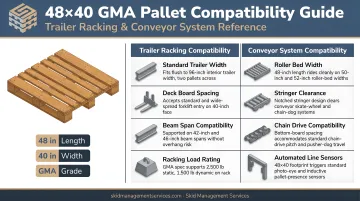
The dimensions weren't arbitrary. Two 48-inch pallet lengths placed across the interior width of a standard 53-foot dry van trailer (interior width: 98.5 inches) consume 96 inches — leaving just enough clearance. That fit allows 26 pallets loaded straight, up to 30 when turned, maximizing trailer utilization without wasted floor space.
The footprint also aligns with standard warehouse infrastructure:
- Selective racking: Standard beam lengths of 96, 108, or 144 inches accommodate 2–3 GMA pallets per bay
- Conveyor systems: Most industrial conveyor widths are designed around 40–48 inch pallet profiles
- Stretch wrappers and ASRS: Automated systems across North America are calibrated to this footprint
The 48×40 format is a prerequisite for compatibility with the entire North American material handling ecosystem. Deviating from it means potentially re-engineering warehouse infrastructure, renegotiating carrier rates, or absorbing retailer compliance penalties.
The US pallet pool is enormous. The Forest Products Laboratory estimates more than 1.8 billion pallets in service overall across the country, and the 48×40 format commands the largest share of that pool.
Key Specifications: Dimensions, Weight, and Load Capacity
Physical Dimensions
| Specification | Value |
|---|---|
| Length × Width | 48 in × 40 in (121.9 cm × 101.6 cm) |
| Height (stringer) | ~4.5 inches |
| Height (block/GMA) | ~6.5 inches |
| Deck board width | 3.5 in (center boards), 5.5 in (lead boards) |
| Deck board thickness | 5/16 in to ½ in (varies by spec) |
Weight by Wood Type
Empty pallet weight affects total shipment weight and freight billing — a direct factor for high-volume shippers managing carrier weight limits.
- Softwood pallets: approximately 44 lbs
- Hardwood pallets: approximately 59 lbs
Load Capacity
Load capacity varies by construction type, board thickness, wood species, and pallet condition. Ranges below reflect product-specific benchmarks:
- Dynamic capacity (in motion via forklift or pallet jack): 2,500 to 4,600 lbs
- Static capacity (at rest on flat surface): up to 7,528 lbs for evenly distributed loads
Exceeding dynamic limits during handling is a leading cause of structural failure. A pallet that holds 7,000 lbs sitting on a warehouse floor can fail at 3,000 lbs if hit by a forklift at an angle.
Trailer Height and Double-Stacking
Standard 53-foot dry van interior height runs 108–110 inches. For double-stacked loads, each pallet-plus-product layer must stay under 48–52 inches to maintain clearance. At 6.5 inches of pallet height, that leaves roughly 41–45 inches of product height per tier. Calculate that ceiling before locking in packaging dimensions.
Structural Variations and Grades of the 48×40 GMA Pallet
Stringer vs. Block: Operational Differences
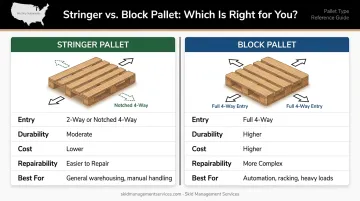
Stringer pallets run three parallel 2×4 lumber stringers the length of the pallet. Unnotched stringers allow 2-way entry only; notched stringers permit partial 4-way entry. They're the more common configuration in recycled pallet markets and easier to repair — individual boards swap out without dismantling the frame.
Block pallets use solid wood or composite blocks at corners, sides, and center, enabling full 4-way entry from all sides. They offer greater structural rigidity and are generally preferred for automated storage and retrieval systems and conveyor-based fulfillment operations.
| Feature | Stringer | Block |
|---|---|---|
| Forklift entry | 2-way or notched 4-way | Full 4-way |
| Durability | Moderate | Higher |
| Automation compatibility | Limited | Preferred |
| Repair complexity | Lower | Higher |
| Typical cost | Lower | Higher |
GMA Grading: Grade A vs. Grade B
The GMA grading system — applied to recycled and reconditioned pallets — is where many procurement errors originate.
Grade A (#1):
- No stringer repairs (mending plates for minor splits are acceptable)
- Dry, free of contaminants
- Meets food-grade cleanliness standards
- Required for food, pharmaceutical, and retail supply chains
Grade B (#2):
- May have companion stringer repairs, plugs, or notched blocks
- Broader allowance for surface board damage and discoloration
- Lower cost
- Appropriate for less regulated applications — internal warehouse moves, agricultural, industrial storage
Food manufacturers serving major retailers — the kind of operations that supply accounts like Campbell Snacks or Knouse Foods — should specify Grade A by default. Retail receiving departments often inspect incoming pallets, and Grade B units can trigger rejection even when the product itself is fine.
Deck Configuration Modifications
Grade and structure determine how a pallet performs under load and through automation. Deck configuration determines what it can carry and how it handles at the point of use:
- Solid deck pallets have no gaps between boards, making them essential for bagged goods, small-format products, or anything that could fall through standard spacing
- Double-face pallets carry deck boards on both top and bottom surfaces, providing bottom-side rigidity for heavy loads
- Winged deck pallets extend boards past the stringer edges, which aids stretch wrapping and accommodates loads slightly wider than the standard footprint
Each modification adds weight and cost. Solid deck pallets are heavier than standard open-deck versions, which affects both per-pallet cost and total shipment weight.
How the 48×40 Compares to Other Common North American Pallet Sizes
Pallet Size Comparison by Industry and Capacity
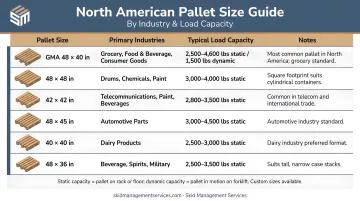
| Size | Typical Industry | Load Capacity | Trade-off vs. 48×40 |
|---|---|---|---|
| 48×40 | Grocery, retail, general warehousing | 2,500–4,600 lbs dynamic | Baseline standard |
| 42×42 | Telecom, paint, coatings | ~4,445 lbs | Doesn't optimize standard racking bays |
| 48×48 | Chemical drums | ~4,673 lbs | Wastes racking bay width; two pallets exceed standard 80-inch beam span |
| 36×36 | Beverage | ~3,544 lbs | Small footprint, poor racking bay utilization |
| 48×45 | Automotive parts | Not standardized | Wide format, limited carrier acceptance |
| 48×20 | Retail store aisles | Not standardized | Half-pallet format, not rack-compatible |
The Real Cost of Non-Standard Sizes
A 48×48 pallet looks like a minor change on paper, but those extra 8 inches disrupts the side-by-side loading pattern that makes the 48×40 so efficient. Standard racking beams sized for two 40-inch pallet widths (80 inches) don't accommodate two 48-inch widths (96 inches) without beam upgrades.
The 42×42 and 36×36 formats serve specific product geometries well — telecom equipment and beverage containers, respectively — but they won't optimize a racking bay designed for GMA dimensions.
EUR/EPAL Pallets and International Shipping
The European standard EPAL Euro pallet measures 1,200×800 mm (47.24×31.50 inches) — close to, but not interchangeable with, the 48×40 GMA footprint. Businesses shipping between North America and Europe need to account for both pallet ecosystems, because GMA infrastructure (racking, conveyors, trailer loading patterns) is not configured for Euro pallet dimensions and vice versa.
Key practical gaps when mixing GMA and Euro pallet systems:
- Racking beam spans sized for 40-inch widths leave gaps under 31.5-inch Euro pallets
- Conveyor systems calibrated for GMA dimensions can't reliably handle Euro pallet proportions
- Trailer loading patterns optimized for 48×40 don't translate to Euro pallet footprints
Compliance Requirements: ISPM-15 and Wood Pallet Regulations
What ISPM-15 Requires
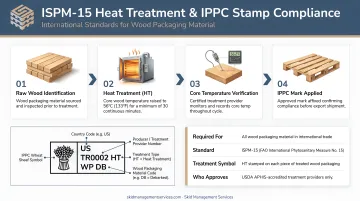
ISPM-15 (International Standards for Phytosanitary Measures No. 15) mandates that any solid wood pallet or packaging material used in international trade must be treated to eliminate pests — specifically wood-boring insects — that could spread across borders.
Required treatment and marking:
- Heat treatment (HT): Wood must reach 56°C at its core for a minimum of 30 continuous minutes
- Methyl bromide fumigation (MB): An alternative, though increasingly restricted
- IPPC stamp: Must show the IPPC "wheat stalk" symbol, country code, unique producer registration number, and treatment type (HT or MB)
USDA APHIS enforces ISPM-15 compliance for all wood packaging entering the United States. Non-compliant wood packaging material (WPM) can be destroyed under APHIS supervision or the shipment re-exported to the country of origin at the importer's expense.
Which Pallets Are Exempt
Not all pallets require ISPM-15 treatment:
- Plastic pallets: Not solid wood — no treatment required
- Presswood/engineered wood pallets: Plywood, OSB, pressboard, and parallel strand lumber are all processed wood products exempt from WPM requirements
- Standard wood pallets for domestic US use: Domestic-only shipments fall outside ISPM-15 scope entirely
For companies with international shipping requirements, Skid Management Services supplies ISPM-15 heat-treated export pallets — stamped, documented, and compliant — so shipments clear customs without issues.
Common Mistakes When Specifying or Sourcing 48×40 Pallets
Treating All 48×40 Pallets as Interchangeable
This is the most frequent and costly mistake. Two pallets with identical footprints can have very different:
- Load ratings (block vs. stringer, board thickness, wood species)
- Grade compliance (Grade A vs. Grade B)
- ISPM-15 status (heat-treated vs. untreated)
- Deck configuration (open vs. solid vs. winged)
Buyers who specify only dimensions — without grade, construction type, or compliance requirements — often receive pallets that fail under load or are rejected at their customer's dock. Specifying the correct pallet for the application is as important as getting the size right.
Ignoring Load Capacity Differences Across Construction Types
A buyer accustomed to block pallets who switches to stringer pallets without adjusting load limits is working with a different rated capacity. The numbers aren't the same. Applying block pallet load specs to a stringer pallet order can result in in-transit failures, product damage, and liability exposure.
Always verify rated capacity with your supplier when changing pallet construction type — not just dimensions.
Inconsistent or Ad-Hoc Sourcing
Capacity risk compounds sourcing risk. Operations that piece together pallet supply from multiple unrelated vendors often face shortages during peak production cycles. Food manufacturers running continuous lines can't absorb a two-day pallet shortage without production consequences.
Establishing a supply relationship with a national pallet provider addresses this directly. Skid Management Services holds its own inventory and draws on a broad supplier network across the US — so availability and pricing stay stable even when spot market supply tightens.
Frequently Asked Questions
What is the size of a standard US pallet?
The standard US pallet is 48 inches long by 40 inches wide (the GMA/Grocery Manufacturers Association format), with height ranging from approximately 4.5 to 6.5 inches depending on construction type. It's the dominant pallet size across North American supply chains.
How much does a 40×48 pallet cost?
Pricing varies by grade (A vs. B), new vs. recycled, wood species, and regional lumber market conditions. Used Grade B pallets typically run lower than new Grade A stock, with wide variation based on volume and location. Contact a supplier for current quotes, as lumber markets shift frequently enough to make static benchmarks unreliable.
What is the load capacity of a standard 48×40 GMA pallet?
Dynamic capacity (in motion) ranges from 2,500 to 4,600 lbs depending on construction and board thickness. Static capacity (at rest) can reach approximately 7,500 lbs for evenly distributed loads. Actual limits vary by pallet type and condition — always verify with your supplier for the specific pallet you're sourcing.
What is the difference between a Grade A and Grade B GMA pallet?
Grade A (#1) pallets have no stringer repairs, are dry, contaminant-free, and meet food-grade standards. Grade B (#2) pallets show stringer repairs and heavier wear, making them a lower-cost option but unsuitable for food, pharmaceutical, or retail-facing supply chains.
What is the difference between a stringer pallet and a block pallet?
Stringer pallets use three parallel boards running lengthwise, allowing 2-way or notched 4-way forklift entry. Block pallets use corner and center blocks for full 4-way entry, offering greater structural rigidity and better compatibility with automated handling systems.
Do 48×40 wood pallets need to be heat-treated for international shipping?
Yes. Any solid wood pallet used in international shipments must comply with ISPM-15 : heat-treated, debarked, and stamped with the IPPC mark showing country code, producer number, and treatment type. Non-compliant pallets can be destroyed or the shipment re-exported at the importer's cost.