That gap between reliance and attention is exactly where supply chain risk hides.
This article breaks down what wooden pallets actually deliver operationally, what goes wrong when they're mismanaged, and what a well-run pallet program looks like in practice.
Key Takeaways
- Over 1.8 billion wooden pallets are in service in the US daily — they are the foundational unit of movement in virtually every physical supply chain
- Wood's real advantages go beyond cost: repairability, universal equipment fit, and compatibility with virtually any load configuration
- Pallet shortages cascade fast — triggering delayed shipments, spot-market price spikes, and product damage downstream
- 95% of wooden pallets are recycled or recovered — making wood a stronger sustainability story than most procurement teams realize
- Choosing a pallet supplier is a supply continuity decision, not just a price comparison
What Are Wooden Pallets?
A wooden pallet is a flat, load-bearing platform, most commonly 48" × 40" in the US, that serves as the base unit for storing, moving, and transporting goods. Every node in a physical supply chain touches them:
- Manufacturing floors and production lines
- Warehouses and distribution centers
- Freight carriers and cross-docks
- Retail backrooms and staging areas
Pallets are infrastructure, not packaging. They are the physical interface between your product and every piece of material handling equipment in the chain: forklifts, pallet jacks, conveyors, racking systems, and automated guided vehicles.
According to a 2025 industry survey by Modern Materials Handling, wood pallets account for 92% of pallet usage among respondents, and the 48" × 40" GMA footprint is used by 72% of operations surveyed. Those numbers reflect a format that works: standardized dimensions that fit nearly every forklift, rack, and trailer in North American logistics without modification.
Key Advantages of Wooden Pallets in the Supply Chain
The advantages below aren't theoretical. They map directly to the metrics supply chain managers track: cost per unit, damage rates, throughput speed, compliance exposure, and supply continuity.
Cost Efficiency and Repairability
Wooden pallets carry one of the lowest upfront costs of any pallet type. While precise national averages fluctuate with lumber markets — the wood pallet price index rose 51.7% through its April 2022 peak before declining — the structural cost advantage over plastic or composite alternatives remains consistent.
The longer-lasting cost advantage, though, is repairability. A broken board, a cracked stringer, a loose nail — none of these require full pallet replacement. Wood pallets can be returned to service without buying new, extending usable life and reducing replacement frequency. That option doesn't exist with most alternatives.
The wooden pallet industry represents a $31 billion US market, which reflects how central this cost center is across supply chains. For operations running thousands of pallet moves per month, even modest per-unit cost advantages compound quickly.
The cost impact shows up across several key metrics:
- Cost per pallet move
- Total annual pallet spend
- Repair-versus-replace ratio
- Damage replacement rate
Operations with high pallet turnover, domestic freight lanes, or tighter logistics budgets — food manufacturers, regional distributors, and consumer goods companies — see the most pronounced benefit from wood's cost structure.
Load Strength, Versatility, and Operational Compatibility
The GMA 48" × 40" pallet is engineered for serious loads. A standard new wood GMA pallet carries a 2,500 lb capacity under typical use conditions, with rackable configurations supporting significantly higher static loads depending on design.
Beyond raw capacity, the compatibility advantage is what separates wood from alternatives at scale. The 48" × 40" footprint has shaped how the entire material handling ecosystem is built:
- Standard forklift tine spacing
- Pallet jack dimensions
- Warehouse racking layouts
- Trailer loading configurations
- Retail compliance requirements
When your pallet fits every system your goods touch — your supplier's dock, your 3PL's racking, your customer's receiving area — handoffs happen faster and with fewer errors. Specification mismatches create friction; the GMA standard eliminates it.
For supply chain managers tracking operational performance, this compatibility affects load damage rate, throughput speed, equipment downtime from incompatibility, and order accuracy at handoff points.
Multi-step supply chains where pallets change hands repeatedly — food and beverage, consumer packaged goods, industrial manufacturing — gain the most from this universal fit. Skid Management Services supplies GMA 48" × 40" pallets to customers including Campbell Snacks, Knouse Foods, and Nissin, all of whom operate exactly this kind of complex, high-volume distribution environment.
Sustainability, Recyclability, and ESG Alignment
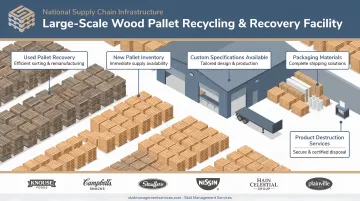
Wood's end-of-life story is stronger than most procurement teams recognize. Research backed by NWPCA shows that 95% of wooden pallets are recycled or recovered — repaired and returned to service, or converted into mulch, animal bedding, biofuel, or composite material when beyond repair. Very little goes to landfill.
That circular lifecycle plays out at significant scale. In 2016 alone, 849 million pallets were produced in the US — including 341 million recycled units re-entering the supply chain. The global wood pallets market is projected to reach $17.88 billion by 2030, growing at a 4.5% CAGR, driven in part by demand for sustainable, renewable packaging materials.
For businesses with formal ESG commitments, this matters practically. Procurement teams increasingly need to document reduced environmental impact. Wood pallets, when sourced from responsibly managed forests (FSC or SFI certified supply chains), support that documentation trail in ways that synthetic alternatives typically don't.
The ESG impact tracks across measurable outcomes:
- Recycling and landfill diversion rate
- Carbon footprint per shipment
- Percentage of packaging from renewable sources
- ESG compliance documentation
This is especially relevant for companies in regulated industries like food and pharma, organizations preparing for retailer compliance audits, and any operation with active sustainability reporting requirements.
What Happens When Wooden Pallets Are Mismanaged or Unavailable
Pallet disruptions don't stay on the loading dock. They move through the supply chain fast.
The COVID era made this concrete. By April 2022, the wood pallet price index had risen 51.7% from its pre-pandemic baseline. California #1 recycled pallet prices doubled — from $9.15 to $18.75 — between April 2021 and April 2022. In a 2021 Modern Materials Handling survey, 47% of respondents reported fewer used wood pallets were available, up from 27% the prior year.
The downstream effects of pallet shortages or mismanagement:
- Goods can't be palletized on schedule, stalling shipments out of the facility
- Spot market dependence drives freight costs up sharply when normal supply dries up
- Structurally compromised pallets pressed into service cause product damage and waste
- Damaged pallets create OSHA hazards or fail food-grade standards under 29 CFR 1910.176
- Procurement and logistics teams get pulled into reactive firefighting instead of strategic work
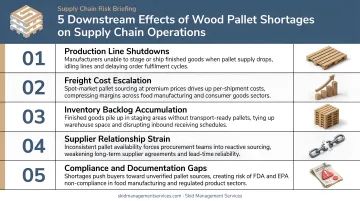
The pattern is consistent: pallet problems look like logistics problems, warehouse problems, and customer service problems by the time they surface. By the time procurement is identified as the source, the costs — in delays, damaged goods, and strained relationships — have already compounded.
How to Get the Most Value from Your Wooden Pallet Program
Wooden pallets deliver their full value when sourced consistently, inspected regularly, and treated as a strategic input — not a commodity line item.
What a well-run pallet program looks like:
- Standardize specifications across facilities — consistent dimensions and grades reduce equipment conflicts, prevent load failures, and keep operations uniform across every location
- Build an inspection cycle — regular inspection catches damage before it causes product loss or safety incidents; replacing damaged pallets promptly reduces downstream disruption
- Evaluate suppliers on supply continuity, not just unit price — the lowest quote on a single order can become the most expensive decision when that supplier can't deliver under pressure
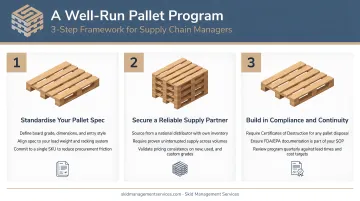
For businesses with national distribution footprints, supplier network depth matters as much as pricing. Skid Management Services maintains its own inventory alongside a broad network of regional suppliers across the US — giving national accounts a reliable fallback when a single source can't meet volume or timing requirements. That redundancy is what prevents the spot-market scrambles that drive up cost and slow down operations.
The distinction worth drawing: pallet procurement is a supply chain risk management decision. Treating it as a pure price comparison leaves operations exposed to exactly the kind of disruption the COVID era illustrated.
Conclusion
Wooden pallets are load-bearing infrastructure. They determine whether goods move on time, at cost, and in good condition — across every node of a physical supply chain.
Those advantages build over time — but only when pallet procurement is managed consistently:
- Cost efficiency improves as repair cycles reduce how often pallets need replacing
- Operational compatibility pays off when every handler in a multi-step chain works with the same footprint
- Sustainability becomes a documented asset when end-of-life diversion rates are tracked and certified sourcing is in place
As supply chains face continued cost pressure and sustainability scrutiny, the businesses that treat pallet procurement as an ongoing strategic priority — rather than a one-time transaction — will be better positioned to absorb disruptions and protect margins.
Frequently Asked Questions
What is a pallet in the supply chain?
A pallet is a flat, structured platform — most commonly wooden — used to consolidate and transport goods throughout the supply chain. It serves as the interface between products and material handling equipment like forklifts, pallet jacks, and conveyors at every stage of distribution.
What are the OSHA regulations for wooden pallets?
OSHA's 29 CFR 1910.176 requires that stored materials not create hazards and that stacked, tiered materials remain stable and secure against sliding or collapse. Employers are responsible for ensuring palletized storage meets these conditions and removing structurally compromised pallets from service.
How much do companies pay for wooden pallets?
Pallet pricing fluctuates with lumber markets and demand cycles — the wood pallet price index rose over 51% through the April 2022 peak before declining. Pricing varies by grade, specification, volume, and geography, so contact a supplier for current quotes on new, used, or custom pallets.
Why are wooden pallets still the most widely used pallet type?
Wood dominates because of low upfront cost, repairability, load-bearing strength, and universal compatibility with standard warehouse and freight equipment. In a 2025 industry survey, wood accounted for 92% of pallet usage.
What is the standard size of a wooden pallet in the US?
The most common US standard is the GMA (Grocery Manufacturers Association) pallet at 48" × 40", used by 72% of operations in a 2025 industry survey. This standardization ensures compatibility across suppliers, 3PLs, carriers, and retailers throughout the supply chain.
How do pallet shortages affect supply chain operations?
Shortages delay shipments, force spot-market purchases at premium prices, and increase product damage when compromised pallets are pressed into service. During the 2021–2022 supply disruption, 47% of industry respondents reported reduced used pallet availability.