But not all pallets are created equal — and choosing the wrong grade for your application creates real problems. Grade A costs more upfront; Grade B stretches the budget. Pick Grade A when you need Grade B, and you're overspending. Pick Grade B when you need Grade A, and you're risking damaged product, retailer chargebacks, or compliance failures.
This guide covers what each grade actually means, how to compare them structurally, where each belongs in a supply chain, and a practical framework for making the right call.
Key Takeaways
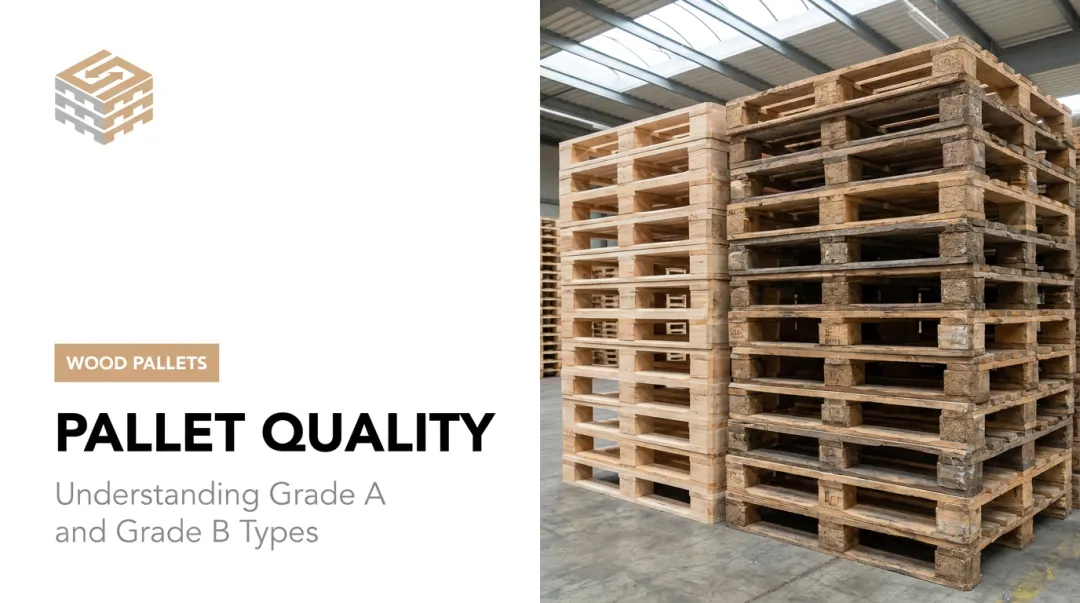
- Grade A pallets are refurbished to near-new condition with uniform boards and no repairs — best for food, pharma, retail, and customer-facing shipments
- Grade B pallets are structurally sound but show visible repairs such as companion stringers and replaced boards — ideal for internal warehousing and one-way shipments
- Pallet grading is not federally standardized in the U.S. — always confirm definitions with your supplier before ordering
- Grade A costs more per unit but typically delivers 10–15+ trips vs. 5–10 for Grade B, making total cost of ownership a key factor
- The right grade depends on your application, load requirements, and whether pallets are customer-facing or internal
Grade A vs Grade B Pallets: Quick Comparison
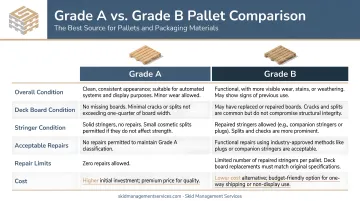
The table below reflects common industry definitions. Because pallet grading isn't nationally standardized in the U.S., specifications can vary by supplier. Confirm exact criteria before placing an order.
| Attribute | Grade A (#1) | Grade B (#2) |
|---|---|---|
| Physical Condition | Near-new; minimal cosmetic wear | Visible wear, discoloration, prior use |
| Board Configuration | 7 top / 5 bottom deck boards (standard 48x40) | 5–7 top / minimum 3 bottom boards (supplier-specific) |
| Structural Repairs | No companion stringers or plugs; repair plates permitted | Companion stringers, metal plates, replaced boards accepted |
| Typical Applications | Food, pharma, retail, customer-facing shipments | Manufacturing, internal moves, one-way industrial shipping |
| Relative Cost | Higher per-unit cost | Lower per-unit cost |
| Lifespan/Durability | ~10–15+ additional trips | ~5–10 additional trips |
What Are Grade A Pallets?
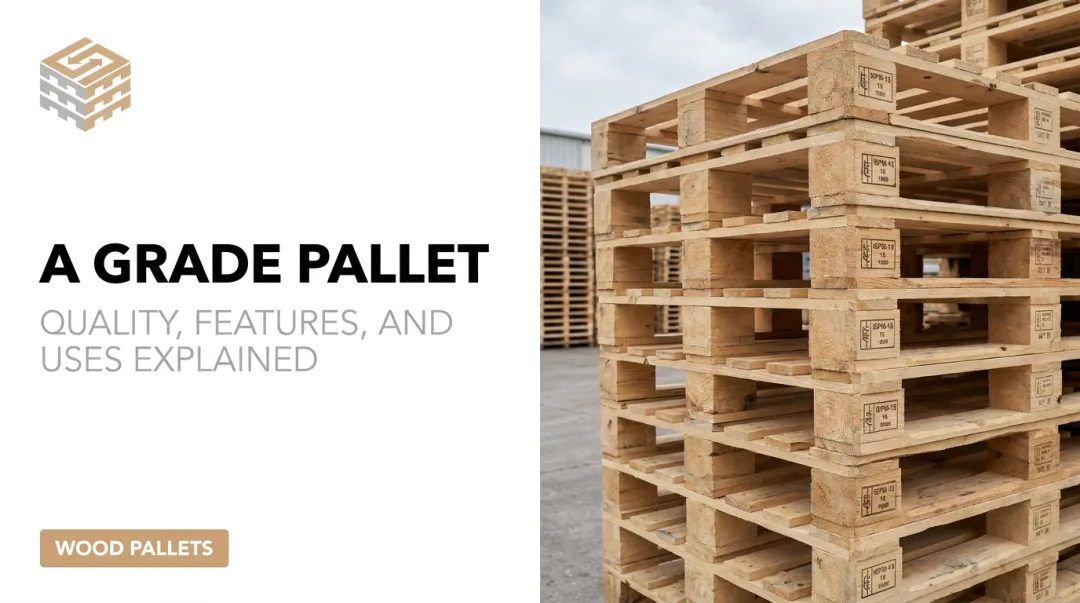
Grade A pallets — also called #1 or premium pallets — are refurbished used pallets restored to near-new condition. For a standard 48x40 pallet, that typically means 7 top deck boards and 5 bottom deck boards, with uniform stringers and no companion stringer repairs. They show minimal cosmetic wear and are free from significant cracks, splits, or plugs.
Structural Characteristics
Grade A pallets are defined structurally by the absence of major repairs:
- No companion stringers or plugs on the stringers (repair plates are generally acceptable)
- Consistent board spacing across the top deck
- Intact 4-way entry design for forklift compatibility
- No metal repair plates on stringer faces
A 1997 USDA Forest Service study found Grade A pallets averaged just 0.15 stringer repairs per pallet, compared to 1.04 for Grade B — a meaningful difference in prior intervention history that affects how predictably the pallet performs over time.
Grade A Sub-Tiers
Some suppliers break Grade A into sub-tiers:
- Premium A / AAA — little to no prior repairs, near-new in both structure and appearance; may feature 6-inch nominal lead boards on both top and bottom decks
- Standard A — meets core Grade A criteria but may have slightly more cosmetic wear or lead boards only on the top deck
Premium A is most commonly required in pharmaceutical supply chains or retailer programs with strict appearance mandates. For most food and beverage operations, standard Grade A is sufficient.
Use Cases for Grade A Pallets
Grade A is the standard choice in supply chains where appearance, cleanliness, or structural consistency is non-negotiable. Its lower rate of prior repairs means fewer mid-cycle failures, less product damage from broken boards, and reduced labor costs from pulling damaged units mid-shift.
- Food and beverage — FDA sanitary transportation rules require pallets to be suitable and adequately cleanable; Grade A's intact surface and absence of deep cracks supports compliance
- Pharmaceutical — NWPCA guidance calls for "household clean" pallets with no grease, chemical residue, or gross contaminants; Grade A meets this bar
- Grocery and retail — Walmart Fulfillment Services, for example, explicitly requires Grade A pallets for WFS inbound shipments
- Customer-facing distribution — any shipment where the pallet arrives on a retail floor or visible receiving area reflects on the brand
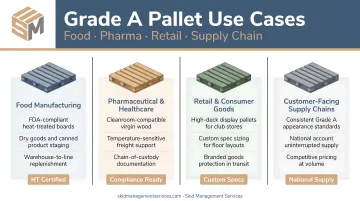
Food manufacturers like Knouse Foods and Campbell Snacks — customers of Skid Management Services — operate in exactly these sectors, where Grade A is the baseline requirement rather than an optional upgrade.
What Are Grade B Pallets?
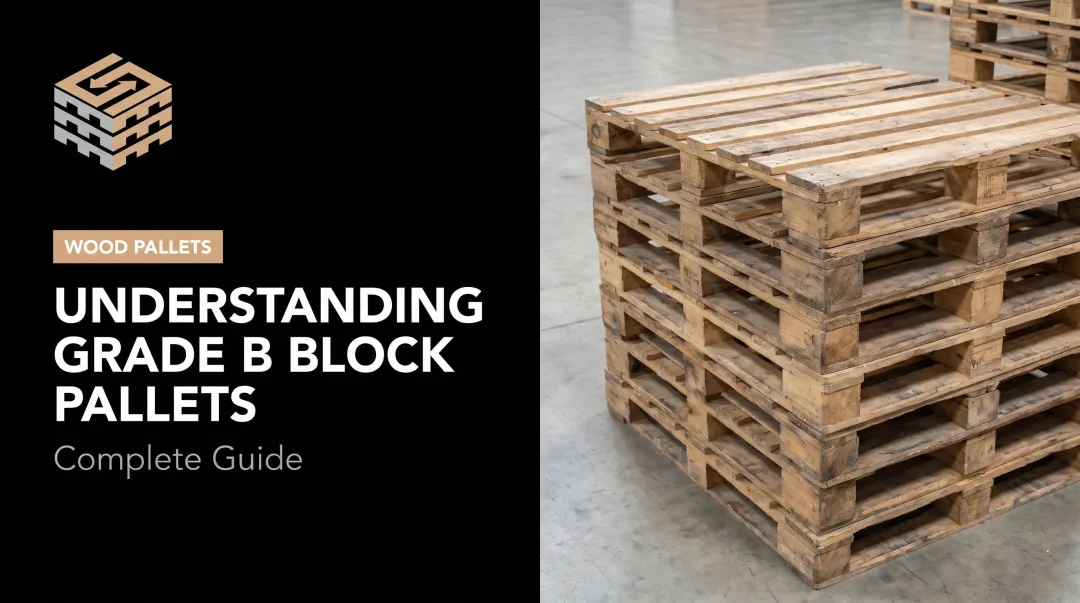
Grade B pallets — also called #2 or standard pallets — are used pallets that remain fully functional but show clear evidence of prior repair cycles. Accepted repair types typically include companion stringers, metal repair plates, and replaced deck boards. Board configuration varies by supplier, but a common specification is 5–7 top boards and at least 3 bottom boards, with top-deck spacing up to 4 inches.
What "Structurally Sound but Repaired" Actually Means
Grade B does not mean borderline or unsafe. It means the pallet has been restored to functional capacity through repairs rather than cosmetic restoration. On load capacity, standard 48x40 GMA pallets generally support:
- ~2,500 lb dynamic load (moving via forklift)
- ~4,600 lb static load (stationary storage)
These figures apply broadly to 48x40 GMA pallets; Grade B-specific capacity ratings vary by supplier and aren't universally standardized. A supplier guide from Gruber Pallets notes recycled Grade A pallets typically handle 3,500–4,000 lb static and 2,000–2,500 lb dynamic, which shows repaired pallets retain the capacity for demanding loads.
Common Misconceptions
Two things buyers frequently get wrong about Grade B:
- Companion stringers don't indicate weakness — they're a standard repair that adds material to a damaged stringer, often restoring full load capacity
- Visible wear isn't the same as structural compromise — discoloration, minor surface checks, and mismatched board colors are cosmetic, not structural
Many manufacturing and distribution operations actively prefer Grade B because load capacity and cost matter more than uniformity.
Use Cases for Grade B Pallets
Grade B pallets work well in any application where performance matters more than appearance:
- Internal warehouse movement — moving product between zones or facilities where pallets aren't seen by customers
- Manufacturing plant floors — high-cycle, high-wear environments where aesthetics are irrelevant
- One-way domestic shipments — pallets that won't be returned, making per-unit cost the dominant factor
- Construction material transport — heavy loads, rough handling, no appearance requirement
- Agricultural supply and general non-perishable goods — cost-efficient movement where Grade A specs add no value
For one-way shipments especially, the per-unit savings on Grade B add up quickly at scale.
Grade A vs Grade B: Which Is Right for Your Operation?
Five Questions to Ask Before Choosing
Before defaulting to one grade or the other, work through these:
- Will the pallet be visible to the end customer? If yes, Grade A.
- Does the product require hygiene compliance (food contact, pharma)? If yes, Grade A.
- Is this a one-way or return-trip application? One-way favors Grade B; return-trip programs benefit from Grade A's longer service life.
- What is the load weight and sensitivity? Both grades handle standard loads, but Grade A's consistent board configuration offers more predictable performance under repetitive high-stress conditions.
- What is the total cost per pallet over time, not just upfront?
Total Cost of Ownership
The upfront price gap between grades is real. Repackify's pallet price index currently shows Grade A (Like New) averaging $6.70/unit vs. Grade B (Good) at $5.37/unit — roughly a 25% premium for Grade A.
But the service life difference changes that math. Grade A pallets typically complete 10–15+ additional trips; Grade B pallets typically have 5–10 trips remaining. For a fleet cycling 1,000 pallets per month in a closed-loop return program, Grade A's longer life reduces replacement frequency and the cumulative cost of sourcing, receiving, and managing inventory.
That savings at purchase can erode quickly. Grade B's lower sticker price is often offset by:
- More frequent replacement cycles
- Higher per-unit repair rates
- Potential product damage from board failure
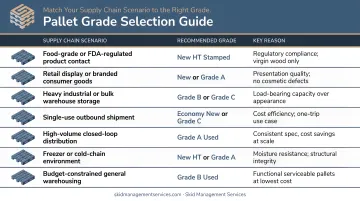
Situational Recommendations
| Scenario | Recommended Grade |
|---|---|
| Ongoing customer-facing distribution | Grade A |
| Food, pharma, or regulated products | Grade A |
| Retailer-mandated (e.g., Walmart WFS) | Grade A |
| High-volume internal warehouse moves | Grade B |
| One-way industrial or construction shipments | Grade B |
| Seasonal or temporary operations | Grade B |
| Closed-loop return program, high cycle count | Grade A |
A Note on ISPM 15 and Export Compliance
ISPM 15 — the international standard regulating wood packaging material in cross-border trade — is entirely separate from pallet grade. It's a treatment and marking standard, not a quality grade. Both Grade A and Grade B pallets can be fully ISPM 15-compliant if properly heat-treated (wood core reaching 56°C for at least 30 continuous minutes) and stamped with the IPPC mark, country code, and treatment provider code. USDA APHIS requires all wood packaging material entering the U.S. to meet these standards.
If you're sourcing pallets for export, ask your supplier specifically about ISPM 15 certification — don't assume it's included. Skid Management Services offers ISPM 15 heat-treated export pallet services, handling treatment, certification, and stamping for customers shipping internationally.
Working with a National Supplier
Grade selection only matters if your supplier can actually deliver at the volume and consistency your operation requires. Skid Management Services carries its own inventory of both Grade A and Grade B pallets and sources through a national supplier network — so buyers at volume have a stable channel when demand surges or regional supply tightens.
Conclusion
Neither grade is universally better. Grade A is the right investment when your pallet touches a retail shelf, enters a food-safe facility, or ships under a retailer compliance program. Grade B is the right call when cost efficiency, internal use, or one-way shipping is the priority.
For consistent volume supply of either grade — at competitive pricing and without single-source risk — contact Skid Management Services directly at 717-202-0304 or Info@SkidManagementServices.com. Their network of national suppliers keeps supply moving even when individual sources fall short.
Frequently Asked Questions
What does a Grade A pallet mean?
Grade A pallets are refurbished used pallets restored to near-new condition, featuring 7 top and 5 bottom deck boards with no companion stringer repairs. They're the standard choice for customer-facing, food, and pharmaceutical applications where appearance and cleanliness matter.
What is the difference between Grade A and Grade B pallets?
Grade A has minimal wear and no visible major repairs, while Grade B shows accepted repairs like companion stringers, metal plates, or replaced boards but remains structurally sound. Grade A costs more per unit and lasts longer; Grade B is more affordable and better suited for one-way or internal use.
How much is a Grade A pallet worth?
Market benchmarks show Grade A 48x40 pallets averaging around $6.70/unit, though prices vary by order volume, location, and whether heat treatment is required. Grade B runs closer to $5.37/unit. Contact suppliers directly for bulk pricing.
Are pallet grades standardized across all suppliers?
No — pallet grading is not federally regulated in the U.S. Definitions for Grade A and Grade B can vary meaningfully between suppliers. Always ask your supplier to define their grading criteria, request samples when possible, and confirm repair standards before placing a large order.
Can Grade B pallets be used for food and beverage shipments?
Grade B can work in certain food and beverage contexts — particularly closed-loop or non-direct-contact scenarios — but industries with strict hygiene requirements or retailer appearance mandates typically require Grade A. Check retailer compliance programs and FDA sanitary transportation requirements before substituting grades.
What is the load capacity difference between Grade A and Grade B pallets?
Both grades on a standard 48x40 pallet handle around 2,500 lb dynamic and up to 4,600 lb static load, though figures vary by construction and supplier. Grade A's more consistent board configuration tends to deliver more predictable performance under repetitive high-stress loads.