Now, heading into 2026, prices are moving again. The BLS commodity PPI for wood pallets climbed from 336.965 in December 2025 to 346.876 by April 2026 — a clear upward signal after years of correction.
If you're budgeting for used pallets this year, a lot depends on grade, size, region, and how much you're buying. This article covers current 2026 price ranges by grade, the factors that move costs up or down, and practical guidance on getting better value from every pallet dollar.
Key Takeaways
- Grade A used 48×40" pallets run approximately $6–$8 nationally; Grade B runs $4–$6; damaged cores are typically $2–$3
- Condition is the biggest cost driver — Grade A can cost nearly double Grade B at the same size
- Geography matters: buyers in states like Mississippi pay less than those in California, New York, or Washington
- High-volume buyers get meaningfully lower per-unit prices than spot buyers
- Grade B is the smarter buy for general warehouse use; Grade A makes sense for display-ready or food-adjacent applications
How Much Do Used Wooden Pallets Cost in 2026?
Used pallet prices don't follow a single national rate. The same pallet can cost $4 in one state and $7 in another, depending on local supply, demand, and transportation realities. Misreading that can mean overbudgeting — or sourcing pallets that don't meet operational needs.
The standard 48×40" GMA pallet dominates the used market. According to Repackify's 2026 pallet price index, marketplace data shows the following national averages:
| Grade | Typical 2026 Price Range (48×40") |
|---|---|
| Grade A (Good Condition) | $6.00 – $8.00 |
| Grade B (Repaired/Used) | $4.00 – $6.00 |
| Damaged Cores | $2.00 – $3.00 |
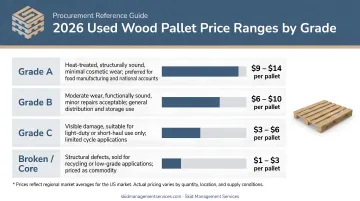
These are marketplace-based figures and should be treated as directional benchmarks. For high-volume procurement, paid pricing services like Fastmarkets or direct supplier quotes will give more precise figures.
Here's what each grade means in practice:
Grade A — Used, Good Condition
- No significant stringer damage; minimal cosmetic wear
- No companion board repairs; may include metal-plated reinforcement
- Best for display applications, food, and consumer goods where appearance matters
- Delivers near-new performance at a lower price point than new pallets
Grade B — Used, Repaired
- Visible stringer repairs (companion boards or plugs), surface wear, discoloration
- Structurally sound but cosmetically imperfect
- Best for general warehouse and logistics use where load capacity matters more than looks
- The workhorse grade for cost-conscious operations
Damaged Cores
- Broken or missing boards, protruding nails, compromised stringers
- Not safe for reuse without repair
- Appropriate only for pallet recyclers or repair operations — should not enter active warehouse or production environments
Regional Price Variation
Where you buy matters almost as much as what grade you buy. Repackify's 2026 state-level data shows Mississippi averaging around $4.40 per unit, while California averages closer to $6.06. High-cost states like New York and Washington tend to track toward the upper end of those ranges.
The drivers are straightforward: local cost of living, proximity to pallet recycling hubs, regional industry demand, and inbound freight costs to the buyer's location.
Key Factors That Affect the Cost of Used Wooden Pallets
Used pallet pricing is shaped by physical condition, geography, order size, and broader market dynamics. Understanding each factor helps you anticipate changes and negotiate from a more informed position.
Pallet Grade and Condition
Condition is the single largest cost variable. A Grade A pallet can cost nearly double a Grade B — sometimes more in tight supply markets. Damaged cores sit at a fraction of either grade's price, but that low cost comes with a hidden trade-off: they require repair before deployment, adding labor and time costs that close much of the apparent gap.
Pallet Enterprise reported in 2025 that Grade A supply in major distribution hubs was tight, with demand described as "very strong," while Grade B demand was "relatively soft." Grade A prices are holding firmer as a result, while B-grade has softened across most markets.
Pallet Size and Specifications
The 48×40" GMA pallet dominates the used pallet market by a wide margin. A 2025 industry study found that 74% of received pallet cores and 80% of repaired/remanufactured pallets sold were 48×40 stringer pallets. That volume creates pricing competition and keeps costs lower.
Less common sizes — 42×42", 48×48", 36×36" — see less trading volume in the used market, which typically means higher prices and less predictable availability. If your operation can standardize on 48×40", you'll have more supplier options and better pricing leverage.
Regional Location and Transportation Costs
Geography affects pricing two ways: local supply-demand balance, and the cost of getting pallets to your door. Where you're located relative to supply determines how much freight eats into your savings:
- Buyers near major distribution hubs or pallet recycling centers pay the lowest landed costs
- Remote locations add per-pallet freight that can offset any sticker price advantage
- Consolidating orders into full truckloads reduces per-unit shipping cost regardless of location
Order Volume and Buying Frequency
Volume is one of the most direct ways to reduce per-pallet cost. How you buy matters as much as how much you buy:
- Truckload orders consistently get better pricing than partial loads or one-off purchases
- Repeat purchasing from a single supplier builds pricing stability over time
- Suppliers prioritize reliable customers over spot buyers — especially when supply tightens
Market Conditions and Lumber Prices
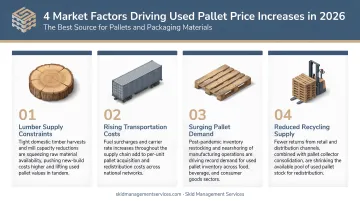
Used pallet prices don't move in isolation. They're indirectly tied to new pallet and lumber costs — when new pallet prices rise, used pallets become more attractive, and prices follow. The BLS softwood lumber PPI climbed from 250.132 in December 2025 to 283.044 by April 2026, adding upward pressure on input costs.
Tariffs are a compounding factor. Pallet Enterprise reported that Canadian lumber duties increased from 14.5% to 35%, with countervailing duty rates rising from 6.74% to 14.63%. When raw material costs climb that sharply, used pallet prices typically follow within one to two buying cycles.
Used vs. New Wooden Pallets — What's the Price Difference?
New pallets offer consistent spec, uniform appearance, and predictable load performance. Used pallets deliver functional value at a lower price. For most general logistics and warehousing applications, the performance gap between a Grade A used pallet and a new pallet is small — the price gap is not.
| New Pallet | Grade A Used | Grade B Used | |
|---|---|---|---|
| Typical price range | $12–$25+ | $6–$8 | $4–$6 |
| Condition | Pristine, uniform | Minor wear, no damage | Visible repairs, worn |
| Best use case | Regulated industries, display | Display, food-adjacent | General warehouse/logistics |
| Food/pharma suitability | Yes (with HT stamp) | Conditional | Conditional |
The "conditional" flag on used pallets for regulated industries matters. Used pallets can be appropriate for food-adjacent applications when they carry a heat treatment (HT) stamp meeting ISPM-15 standards, which requires wood to reach a minimum core temperature of 56°C for at least 30 minutes.
That said, some regulated industries impose more specific requirements. Buyers should verify compliance before assuming used pallets qualify rather than relying on the HT stamp alone.
Skid Management Services supplies both new and used wooden pallets, including heat-treated options with ISPM-15 certification. For food manufacturing customers who need documented compliance, that combination of verified sourcing and pricing flexibility is worth asking about directly.
Beyond the Sticker Price: Hidden Costs of Used Pallets
The per-pallet price is only one line in your actual cost equation. Freight, labor, and failure rates routinely add more to pallet spend than the purchase price itself.
Delivery and freight costs add real cost per unit, particularly for buyers far from major supply centers. Consolidating orders into full truckloads reduces the freight-per-pallet cost substantially versus smaller, more frequent shipments. A national supplier network helps here — sourcing from the location closest to your facility cuts per-unit freight without sacrificing supply continuity.
Sorting and quality inspection is a hidden labor cost most buyers undercount. If your receiving team spends an hour sorting a mixed-grade delivery, that time has a real dollar value — it just doesn't show up on the pallet invoice. Suppliers who guarantee consistent grading eliminate most of that sorting labor.
Failure rate is where the math on cheap pallets breaks down most visibly. A pallet bought at $3.50 that fails after two cycles costs more per trip than a $5.50 Grade B running six. Total cost per trip — not sticker price — is the number that reflects actual pallet economics.
Pallet Enterprise reported that bad pallets cost FMCG manufacturers an average of $15,000 or more per production stoppage incident. Any savings from buying the cheapest available grade evaporate fast when one failure shuts down a line.
How to Get the Best Value on Used Wooden Pallets in 2026
Getting good value on used pallets comes down to three things: matching grade to application, buying smart, and thinking beyond the unit price.
Match Grade to Use Case
Over-specifying is expensive. Using Grade A pallets in applications where Grade B performs equally well adds unnecessary cost at scale. Under-specifying is worse. Deploying damaged cores in active warehouse operations creates safety risks and product loss that cost more than the savings.
A simple rule: use Grade A where appearance or food-proximity requirements demand it, Grade B for standard warehouse and logistics applications, and leave cores to repair operations.
Buy in Volume and Build Supplier Relationships
Consolidating orders — even if it means slightly higher inventory on hand — generally produces lower per-unit pricing. More importantly, consistent purchasing relationships with a single supplier tend to generate better pricing stability and supply priority during tight markets.
Spot buying when prices are low is a reasonable tactic. But relying on spot buys as a strategy leaves you exposed when supply tightens and prices spike.
Work With a National Supplier for Pricing and Supply Stability
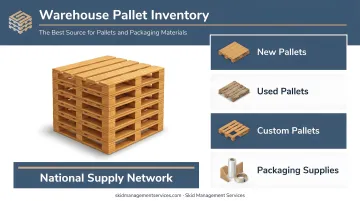
Volume buying only protects you when supply is available. Regional shortages, logistics disruptions, or local demand spikes can create supply gaps that halt operations regardless of how much you've stockpiled. A supplier with a national network, like Skid Management Services, can source from multiple supply points to maintain consistent availability when one region tightens.
Skid Management Services operates with its own inventory plus an expansive national supplier network. That combination is how it maintains competitive pricing and uninterrupted supply for food and consumer goods customers like Campbell Snacks, Knouse Foods, and Nissin — businesses where pallet shortages translate directly to production stoppages.
Avoid These Common Budgeting Mistakes
- Ignoring freight and sorting costs when comparing supplier prices — total landed cost is what matters
- Choosing the cheapest grade without evaluating rejection and replacement rates over a full cycle
- Failing to lock in pricing during low-market periods — post-correction windows don't last indefinitely, and current upward movement in lumber and pallet PPIs suggests 2026 is not the bottom
Frequently Asked Questions
What is the average price of a wood pallet?
For used 48×40" pallets in 2026, marketplace data points to roughly $6–$8 for Grade A and $4–$6 for Grade B nationally. New pallets typically run $12–$25 or more depending on spec and supplier. Regional variation means your actual price could fall above or below these averages.
How much do pallet recyclers pay per pallet?
Recyclers pay below standard market rates because they factor in repair costs and resale margin. Current market data suggests Grade A 48×40" buyback prices around $4–$5, with mixed-condition pallets in the $2.50–$4 range. Prices vary by region and local recycler.
What is the difference between Grade A and Grade B used pallets?
Grade A pallets have no significant stringer damage and minimal repairs, looking close to new. Grade B pallets have undergone visible stringer repairs but are equally load-bearing. The practical difference is cosmetic condition and price, not structural performance.
Why do used pallet prices vary by state?
Regional cost of living, proximity to pallet recycling hubs, local industry demand, and inbound transportation costs all contribute. States with active manufacturing and distribution infrastructure tend to have more used pallet supply — and lower prices — than remote or lower-density markets.
Are used wooden pallets safe for food or pharmaceutical supply chains?
Used pallets can be appropriate when they carry a valid ISPM-15 heat treatment (HT) stamp, are free from contamination, and come from a reputable supplier with documented sourcing. Some regulated industries require new or certified pallets. Verify your specific compliance requirements before sourcing used.
How does order volume affect used pallet pricing?
Higher volumes consistently produce lower per-unit prices. Truckload quantities unlock the most meaningful savings. Consistent, repeat purchasing from a single supplier also tends to yield better pricing stability than one-off spot buys, especially when supply tightens.