The answer splits into two separate questions that buyers frequently conflate. First, there's physical lifespan — how long the wood structure withstands daily loading, cycling, and storage. Second, there's certification permanence — how long the ISPM 15 stamp remains valid. Confusing the two leads to either costly over-ordering or compliance violations on export shipments.
This guide breaks down the typical lifespan range, the four variables that compress or extend it, how heat treatment itself affects wood durability, and the practical signals that tell you when a pallet is due for retirement.
Key Takeaways
- FEFPEB data puts average timber pallet lifespan at 5–7 years; lightly used, well-maintained pallets can push toward the higher end
- The ISPM 15 certification does not expire — it lasts the full life of the original wood unless repairs introduce new untreated lumber
- Four variables determine where a pallet lands in that range: load weight, usage frequency, storage environment, and wood species
- Heat treatment lowers moisture content, reducing susceptibility to mold, fungal decay, and structural rot
- Inspect pallets regularly — timely minor repairs are the most cost-effective way to extend usable life
How Long Do Heat-Treated Pallets Actually Last?
According to FEFPEB, the average lifespan of a timber pallet is 5–7 years. Lower-end industry sources put it closer to 3 years for pallets subject to frequent cycling and rough handling. The range exists because pallet lifespan is operationally determined, not factory-set. The same pallet in a climate-controlled distribution center will outlast an identical pallet cycling through outdoor yard storage by years.
Physical Lifespan vs. ISPM 15 Certification Life
These are two distinct concepts, and mixing them up creates real compliance problems.
Physical lifespan degrades with every load cycle, handling event, and exposure to moisture. It ends when the wood structure can no longer safely bear loads.
ISPM 15 certification works differently. Per IPPC and APHIS guidance, treated and marked wood packaging material that has not been repaired, remanufactured, or altered does not require re-treatment or re-stamping during its service life. The treatment does not expire: a 6-year-old pallet with its original stamp intact is still ISPM 15 compliant, provided it hasn't been repaired with new untreated wood.
The Repair and Re-Treatment Rule
Many operations run into trouble here. IPPC defines two repair categories:
- Repaired WPM — no more than one-third of components replaced; replacement wood must be treated
- Remanufactured WPM — more than one-third of components replaced; previous marks must be obliterated, pallet re-treated, and new mark applied
APHIS confirms that any repaired or remanufactured pallet must be retreated and remarked before being used in export shipments. Shipping a repaired pallet under the original stamp is a compliance violation that can trigger an Emergency Action Notification at the border.
Hardwood vs. Softwood Lifespan Difference
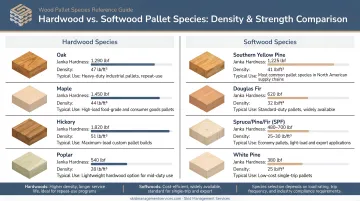
Wood species is a procurement decision that directly affects how long a pallet holds up. A USDA Forest Service and Virginia Tech study found that mixed hardwood pallet parts were 41% stronger and 40% stiffer than mixed softwood parts recovered from used pallets.
The density data bears this out:
| Species | Type | Specific Gravity |
|---|---|---|
| White Oak | Hardwood | 0.68 |
| Sugar Maple | Hardwood | 0.63 |
| Ponderosa Pine | Softwood | 0.40 |
| White Spruce | Softwood | 0.40 |
For high-rotation applications — daily cycling through forklifts, racking systems, and conveyors — specifying hardwood pallets at procurement can cut replacement costs over a 3–5 year horizon. Softwood pallets are a reasonable choice for lighter loads and slower supply chains where the density premium isn't justified.
Key Factors That Determine How Long Heat-Treated Pallets Last
The 5–7 year average is a starting point, not a guarantee. Four operational variables determine where any specific pallet lands on that range.
Load Weight and Stress Cycles
Pallets loaded beyond their rated capacity suffer accelerated board compression, joint loosening, and nail fatigue. Virginia Tech identifies three distinct load conditions that each require separate testing and ratings:
- Floor (static) support — pallet sitting on a flat surface
- Fork tine (dynamic) support — pallet under load during forklift entry
- Rack support — pallet spanning racking beams with no center support
A pallet rated for floor support may fail prematurely in a racking application. Matching load requirements to the correct pallet specification at procurement is one of the most effective ways to extend usable life.
Storage and Environmental Conditions
Virginia Tech research establishes that wood below 20% moisture content will not support mold, mildew, decay, or fungal attack. Heat treatment reduces initial moisture levels, but prolonged outdoor storage reintroduces moisture and reopens that vulnerability.
Optimal storage conditions that preserve pallet lifespan:
- Elevated off the ground on a flat surface or rack, not directly on concrete
- Protected from direct precipitation and prolonged humidity exposure
- Stacked in stable columns with adequate airflow between layers
- Rotated so oldest pallets are used first
Each deviation from these conditions shortens usable life. Outdoor yard storage is one of the fastest ways to compress a 7-year pallet into a 2-year pallet.
Usage Frequency and Handling
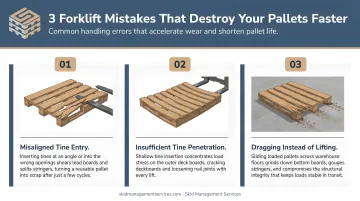
High-rotation pallets cycling daily through forklifts, conveyors, and automated racking systems accumulate physical damage far faster than pallets in slower supply chains. Beyond frequency, handling practices matter:
- Incorrect forklift entry angle causes board splitting at the lead boards
- Side-loading stresses joints not designed for lateral force
- Dropping loaded pallets even from small heights accelerates nail fatigue
These are preventable wear drivers. Handling training and consistent forklift protocols will extend pallet life in high-throughput operations.
Wood Quality and Sourcing
Not all heat-treated pallets are built the same. Lumber grade, nail pattern, and construction quality vary across suppliers, and a pallet built to lower standards will degrade faster regardless of what its HT stamp says. Sourcing from a supplier with a vetted national network — Skid Management Services maintains its own inventory alongside relationships with suppliers across the country — means pallets meet both ISPM 15 compliance and consistent construction standards from the start.
How Heat Treatment Affects Pallet Durability
ISPM 15 requires wood to reach 56°C for at least 30 continuous minutes throughout the entire wood profile, including the core. The primary purpose is phytosanitary — killing insects and pathogens to prevent cross-border pest spread. But the drying effect has a structural benefit worth understanding.
The Moisture-Durability Connection
Kiln-dried lumber can weigh 40–50% less than wet, undried lumber, according to USDA Forest Products Laboratory data. Drier wood is also substantially stronger — the USDA FPL reports dry lumber is typically more than twice as strong and nearly twice as stiff as wet lumber.
Heat treatment achieves similar moisture reduction. Compared to untreated alternatives, heat-treated pallets start their service life with lower moisture content and greater structural integrity. That difference matters in practice:
- Suppresses mold and fungus growth during storage and transit
- Reduces early-stage decay that shortens pallet service life
- Produces a lighter pallet that puts less stress on handling equipment
Will Heat-Treated Pallets Rot?
Yes — but more slowly, and only under poor storage conditions.
Heat treatment significantly reduces initial moisture content and associated rot risk. It does not permanently waterproof the wood. Per NWPCA/WoodPack guidance, ISPM 15 heat treatment is designed to kill insects, not prevent future mold. If pallets are stored in persistently wet or humid conditions after treatment, moisture re-enters the wood and decay risk returns. Mold germination can occur within 24–48 hours when oxygen, moisture, and warmth are present simultaneously.
The treatment protects — it doesn't eliminate the need for proper storage.
Steam vs. Dry Heat Treatment
Buyers sometimes ask whether steam or dry heat produces a more durable pallet — particularly when sourcing for food-grade or export applications. Both methods meet ISPM 15 requirements, and no authoritative technical source has established that either produces measurably longer service life under real-world conditions.
No evidence supports claims that one method outperforms the other in structural longevity. For most procurement decisions, compliance verification and proper post-treatment storage matter far more than the specific heat method used.
How to Extend the Lifespan of Heat-Treated Pallets
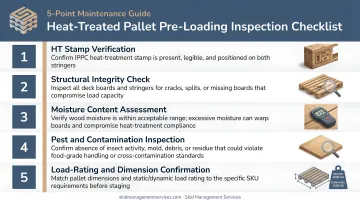
A simple pre-loading inspection catches most issues before they become structural failures. Check each pallet for:
- Broken or cracked deck boards
- Protruding or backing-out nails
- Loose blocks or stringers
- Surface mold or visible moisture damage
- Joint separation at fastener points
Minor damage caught early can be repaired before it cascades into full structural failure. The key constraint: any repair introducing new untreated wood voids the existing ISPM 15 certification. The entire pallet must then be re-treated and re-stamped before it can be used in export shipments. For operations running certified HT pallets at volume, the repair-vs.-replace calculation often favors replacement, particularly when re-treatment costs and downtime are factored in.
Keeping pallets in good condition from the start reduces how often that decision comes up.
Storage practices that preserve lifespan:
- Stack on a flat surface or rack — never directly on concrete, which wicks moisture
- Shelter from rain, prolonged humidity, and direct UV exposure
- Rotate stock so the oldest pallets enter circulation first
- Avoid stacking configurations that place excessive concentrated weight on bottom pallets
When to Retire a Heat-Treated Pallet
Remove a pallet from active circulation when it shows any of these conditions:
- Broken or missing deck boards creating load gaps
- Split or cracked stringers or blocks compromising load-bearing capacity
- Visible mold penetrating into the wood grain (not just surface discoloration)
- Severe nail pull-through or joint separation
Broken boards catch forklift tines and cause tip-overs; compromised stringers fail under rated loads. Both are preventable failures when inspection catches the problem early.
For export operations, the compliance risk adds another layer. A structurally degraded pallet carrying an ISPM 15 stamp creates customs liability — authorities can issue an Emergency Action Notification for wood packaging material that appears non-compliant, even if the original heat treatment was valid.
End-of-life pallets don't have to be a write-off. NWPCA data shows that 95% of wooden pallets are recycled in the U.S. When degraded pallets need replacing, Skid Management Services supplies new, used, and custom wood pallets to national accounts — ensuring uninterrupted supply as you cycle out non-compliant or damaged inventory.
Frequently Asked Questions
Will heat-treated pallets rot?
Heat treatment reduces initial moisture content, which sharply lowers rot and mold risk. However, it doesn't permanently seal the wood — if pallets are stored in wet or humid conditions after treatment, moisture re-enters and decay can develop over time. Proper storage is a separate control from the treatment itself.
How long does the ISPM 15 heat treatment certification last?
The certification does not expire and remains valid for the pallet's full physical lifetime — provided no new untreated wood has been added during repair. If it has, the old stamp must be removed and the pallet re-treated and re-stamped.
Do heat-treated pallets last longer than untreated pallets?
Yes. Heat treatment reduces moisture content, and drier wood resists mold, fungus, and structural decay more effectively than wet or untreated lumber. USDA data shows dry lumber can be more than twice as strong as wet lumber — that durability advantage carries through to pallet service life.
Can you repair a heat-treated pallet without losing its certification?
Cosmetic fixes and reuse of the pallet's original treated wood don't affect certification. Adding any new untreated lumber voids the ISPM 15 stamp; the pallet must be fully re-treated and re-stamped before returning to export shipments.
How do I know when a heat-treated pallet needs to be replaced?
Retire a pallet when you see broken or missing deck boards, cracked stringers or blocks, severe nail pull-through, or mold that has penetrated into the wood grain rather than sitting on the surface. Any of these conditions compromise load capacity.
Does outdoor storage significantly reduce heat-treated pallet lifespan?
Yes — it's one of the most impactful lifespan reducers. Prolonged exposure to rain, humidity, and UV reintroduces the moisture that heat treatment removed, accelerating decay and board degradation. Covered, elevated indoor storage can extend usable pallet life by multiple years compared to unprotected outdoor stacking.