The challenge is that pallet shipping isn't as simple as setting a box on a skid and calling a carrier. Pallet selection, load configuration, securing method, documentation, and carrier requirements all determine whether your freight arrives intact — or triggers damage claims, carrier rejections, and surprise surcharges.
This guide walks through every step, from assessing your item to scheduling pickup, so you can ship oversized freight with confidence.
Key Takeaways
- Items over 150 lbs or exceeding standard dimensional limits must ship as freight — pallets are the foundation for doing this safely
- The pallet must fully cover your item's footprint — any overhang can reduce load compression strength by up to 40%
- Combining stretch wrap AND strapping creates a unitized load; neither method alone holds up to freight handling
- Freight class (ranging from 50 to 500 per NMFTA guidelines) directly drives your base rate, and denser loads always cost less
- Choose LTL for one to a few pallets; reserve FTL for large volumes or when you need an exclusive trailer
How to Ship Oversized Items Using Pallets
Step 1: Assess Your Item and Determine Freight Requirements
Before loading anything, get your numbers right.
Measure and weigh accurately:
- Record total dimensions: length, width, and height including all packaging
- Weigh the complete shipment — item plus packaging, not just the product
- These figures determine your freight class, pallet size, and carrier options
Confirm freight classification triggers:
- Weight over 150 lbs → freight required
- Length over 108 inches → freight required
- Combined length plus girth over 165 inches → freight required
Check for special requirements:
- "Do Not Stack," "Fragile," or "This Side Up" designations your carrier must honor
- Hazmat classifications if applicable
- ISPM 15 heat-treated pallets with official stamps if shipping internationally — required for wood packaging crossing most international borders
Every freight shipment also requires a Bill of Lading (BOL). Under 49 CFR Part 373, regulated motor carriers must issue a BOL for property tendered in interstate or foreign commerce. Get this right before pickup.
Step 2: Select, Inspect, and Prepare Your Pallet
The pallet is the structural foundation of your shipment. A wrong choice here undermines everything else.
Choosing the right size:
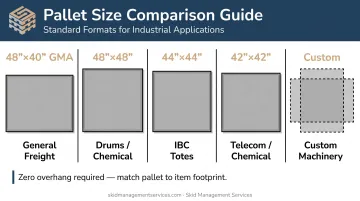
The standard 48" × 40" GMA pallet works for many loads, but oversized items often require something larger. The item's footprint must sit entirely within the pallet deck — no overhang.
Common non-standard sizes for heavier or larger freight include:
- 48" × 48" — drum/chemical industry standard, fits four 55-gallon drums
- 44" × 44" — IBC tote standard
- 42" × 42" — chemical and telecom applications
- Fully custom dimensions — built to match your item's exact footprint
Skid Management Services stocks all of these sizes and builds fully custom pallets across any dimension, with load ratings from standard capacity up to 10,000+ lbs dynamic for heavy-machinery applications.
Choosing the right material:
For heavy or oversized loads, wood species matters. USDA/Virginia Tech research found that mixed hardwood pallet parts are 41% stronger and 40% stiffer than mixed softwood parts. For maximum load-bearing capacity, hardwood (oak, maple) is the clear choice.
Before loading, inspect the pallet:
- No broken or cracked boards
- No missing stringers
- No exposed nail heads
- No moisture damage or rot
- Confirmed load capacity exceeds your shipment's total weight
For heavy freight, use new pallets or Grade A recycled pallets. Block pallet construction — with true four-way forklift entry — provides better handling compatibility across freight terminals and warehouses.
Step 3: Load and Secure the Oversized Item
Loading correctly:
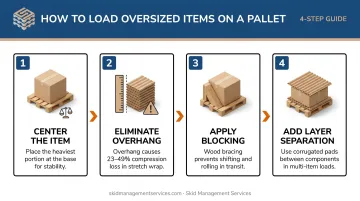
- Center the item on the pallet deck, heaviest portion at the base
- Eliminate all overhang — research shows overhang reduces box compression strength by 23% to 49% depending on magnitude
- Use blocking for items that can shift or roll — wood bracing fastened to the pallet prevents movement in all directions
- Use corrugated pads between layers if palletizing multiple components
Securing the load:
A single layer of stretch wrap is not enough. The goal is a unitized load — the item and pallet move as one rigid unit, able to withstand forklift handling, stacking, and road vibration.
Use this combination:
- Stretch wrap: Multiple layers wrapping both the load and the pallet base together, per ASTM D4649 unitizing guidelines
- Banding/strapping: Minimum two straps looped through the pallet forks and tightened firmly — PP, PET, or steel depending on load weight
- Edge boards: Along load corners to protect edges and increase vertical stacking strength
Step 4: Label, Document, and Schedule Pickup
Required labels (visible on multiple sides):
- Shipper and consignee address labels
- Weight alert labels where carrier-required
- Special handling indicators: "This Side Up," "Do Not Stack," "Fragile" as applicable
Complete the BOL accurately. Errors here are one of the most common causes of freight delays and invoice adjustments. Required elements include:
- Item description and freight class
- Declared weight and number of handling units
- Special handling instructions
- Consignor, consignee, origin, and destination
Schedule pickup:
- Confirm access requirements at pickup — dock height, forklift availability, appointment windows
- Verify the carrier can handle your specific dimensions before booking
- Obtain a PRO/tracking number to monitor the shipment
Choosing the Right Pallet for Oversized Items
The pallet selection decision comes down to three variables: size, material, and construction type.
Size: Match the Footprint
Using an undersized pallet forces overhang — a direct cause of freight damage. If your item's base exceeds 48" × 40", you need a larger pallet. Common options:
| Pallet Size | Primary Application |
|---|---|
| 48" × 40" GMA | General freight, most standard loads |
| 48" × 48" | Drums, heavy chemical/industrial |
| 44" × 44" | IBC totes (275 & 330 gallon) |
| 42" × 42" | Chemical, telecom specialty |
| Custom dimensions | Heavy machinery, oversized equipment |
Material: Hardwood for Heavy Loads
For demanding freight, hardwood is the right call: USDA/Virginia Tech research puts hardwood's strength advantage at 41% over softwood, which translates directly to load integrity under forklift handling and stacking stress. Skid Management Services supplies hardwood (oak, maple, mixed), softwood, and mixed-species configurations across its custom pallet program.
For oversized and heavy loads specifically, stick with wood. Plastic pallets introduce slick surfaces that complicate load securing and carry substantially higher per-unit cost.
Construction Type: Block vs. Solid-Deck
Block pallets provide true four-way forklift entry without the structural compromise of notched stringers. For heavy or irregularly weighted loads, this matters — it ensures standard warehouse equipment can move the pallet from any direction without restrictions.
Where the load itself creates the challenge — irregular base shapes, sharp contact points, or components prone to shifting — solid-deck pallets are the better fit. Continuous surface coverage eliminates the gaps in standard spaced-board decks where edges could catch or parts could migrate during transit.
ISPM 15 for International Shipments
Any wood pallet crossing international borders must comply with ISPM 15. Heat treatment requires a minimum temperature of 56°C sustained for 30 continuous minutes, penetrating the full wood profile including the core. The pallet must carry the required four-element stamp: IPPC symbol, ISO country code, treatment provider code, and treatment abbreviation (HT for heat treatment).
APHIS resumed enforcement of the hyphen requirement between the country code and provider code on January 1, 2026 — verify your stamps are current. Skid Management Services sources export pallets through USDA APHIS-recognized treatment providers and offers stamp verification services for existing inventory.
Key Factors That Affect Oversized Pallet Shipping Costs
Freight Class
NMFTA's NMFC system classifies freight on a scale from 50 to 500, based on density, handling, stowability, and liability. Lower class numbers mean lower base rates.
Density drives classification more than anything else. A rough guide:
| Density (lbs/cubic ft) | Approximate Class |
|---|---|
| Less than 1 pcf | Class 400 |
| 4–6 pcf | Class 175 |
| 10–12 pcf | Class 92.5 |
| 15–22.5 pcf | Class 70 |
| Over 50 pcf | Class 50 |
Compact, dense loads cost substantially less to ship than large, lightweight ones. Efficient pallet configuration directly reduces freight class and base rate.
Dimensional Weight vs. Actual Weight
LTL carriers bill based on the greater of actual weight or dimensional weight. Cubic capacity is calculated by multiplying length × width × height in inches and dividing by 1,728 (per cubic foot). For large but lightweight oversized items, dimensional billing can push costs well above the actual-weight rate. Compact pallet configuration keeps both numbers in check.
LTL vs. FTL
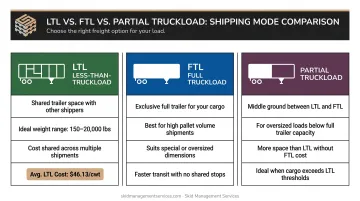
- LTL (Less-Than-Truckload): Best for one to a few pallets. FedEx Freight notes LTL is typically ideal for shipments between 150 lbs and 20,000 lbs. You share trailer space — and cost — with other shippers' freight. FreightWaves reported all-in LTL revenue at $46.13 per hundredweight in June 2026.
- FTL (Full Truckload): More economical when you have high pallet volume or when your oversized item requires exclusive trailer use due to dimensions or special handling
- Partial Truckload: A middle option for loads too large for LTL but not filling a full trailer
Distance and Carrier Selection
Zone-based pricing scales cost with distance. Not all carriers handle all oversized dimensions, so confirm carrier-specific size restrictions before booking. Some carriers will only flag a dimension problem when they arrive at your dock — by then, you're rescheduling a pickup.
Common Mistakes When Shipping Oversized Items on Pallets
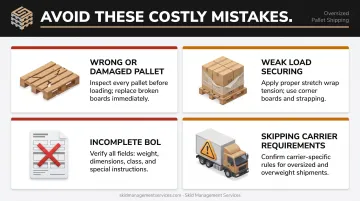
Most oversized shipment problems trace back to four avoidable errors. Catching them before pickup saves money, time, and freight claims.
- Wrong or damaged pallet: Defaulting to the nearest standard size when your load demands a larger footprint is the single most preventable cause of freight damage. Even a few inches of overhang dramatically reduces compression strength. Reusing cracked or repaired pallets under heavy loads compounds the risk.
- Weak load securing: One layer of stretch wrap — or loosely applied strapping — won't hold through forklift handling and road vibration. The item and pallet must move as one rigid unit. Use stretch wrap and banding together on every shipment, not as alternatives.
- Incomplete or incorrect BOL: Wrong freight class, inaccurate weight, missing special handling instructions — any of these trigger carrier invoice adjustments, delivery delays, or destination refusal. Cross-check the BOL against the actual shipment before scheduling pickup.
- Skipping carrier-specific requirements: Each LTL carrier sets its own dimensional limits, surcharge thresholds, and handling restrictions. Confirm them in advance, and arrange appropriate loading and unloading equipment at both origin and destination. Missing this step leads to missed pickups, redelivery fees, and damaged freight.
Frequently Asked Questions
What's the cheapest way to ship a pallet?
LTL freight is typically the most cost-effective option for single or small numbers of pallets. A few tactics that consistently lower the bill:
- Compare rates across multiple carriers before booking
- Verify your freight class upfront — misclassification triggers costly corrections
- Schedule shipments during off-peak periods when capacity is less constrained
What size pallet do I need for an oversized item?
The pallet must fully cover the item's footprint with zero overhang. Oversized items often require custom sizes beyond the standard 48" × 40" GMA pallet, and the pallet's rated load capacity must exceed the item's total weight.
How is freight class determined for oversized pallet shipments?
Freight class follows NMFC guidelines and is based on four factors: density (weight ÷ cubic footage), stowability, handling difficulty, and liability. Denser, compact loads earn lower (cheaper) classes; large, lightweight items land in higher, more expensive ones.
Can I ship an oversized item on a standard pallet?
It depends on whether the item's footprint fits within the standard pallet's dimensions without any overhang. If the item extends beyond the pallet edges, a larger custom pallet is required — both to prevent damage and to comply with carrier requirements.
What is the maximum weight a pallet can hold?
A standard 48" × 40" GMA pallet carries a minimum of 2,500 lbs, though actual capacity varies by condition, material, and construction. For heavy or dense loads, custom-engineered pallets rated from 4,000 lbs up to 10,000+ lbs dynamic are better suited for the job.
Do I need heat-treated pallets for international shipments?
Yes. Any wood pallet crossing international borders must comply with ISPM 15 — heat-treated to 56°C for a minimum of 30 continuous minutes, with the official four-element ISPM 15 stamp. Verify this certification when sourcing pallets for any export shipment.