The confusion is understandable. "GMA pallet" and "heat-treated pallet" get used interchangeably in conversations, but they describe two completely different things. One is a dimensional specification. The other is a phytosanitary treatment process.
This article covers what the GMA standard actually requires, when heat treatment becomes mandatory, how to read the ISPM-15 stamp, and what to verify before placing an order.
Key Takeaways
- GMA refers to a 48" x 40" dimensional standard — heat treatment is never automatically included
- ISPM-15 heat treatment is required for any solid wood pallet crossing an international border
- A valid HT mark must be permanently branded or stamped into the wood — stickers don't count
- Major retailers like Costco require ISPM-15 compliance even for pallets crossing the US-Canada border
- Non-compliant pallets can be seized, destroyed, or returned at the port of entry at the importer's expense
What Is a GMA Pallet?
GMA stands for Grocery Manufacturers Association — now the Consumer Brands Association as of 2020. When someone says "GMA pallet," they mean a 48" x 40" standardized wood pallet: the most widely used pallet format in North American warehousing and distribution.
The term describes a size and structural configuration — not how the wood was treated or whether it meets any phytosanitary standard.
GMA Structural Specifications
Industry and supplier benchmarks list the following specifications for a standard GMA 48x40:
- Four-way forklift entry for flexible handling
- 5.5" wide lead boards on the top and bottom deck ends
- Minimum 0.5" board thickness across deck boards
- Typical load capacity of 2,500 lbs dynamic / 4,600 lbs static
- Seven top deck boards / five bottom deck boards in the standard configuration
These specifications cover dimensions and structural performance. They say nothing about how the wood was treated.
Grades Don't Change This
GMA pallets come in multiple grades — Premium (Grade A), Grade B, and utility/reconditioned — and can be purchased new or refurbished. None of those grade designations automatically include or require heat treatment. Grade describes structural condition, not phytosanitary status.
Are GMA Pallets Heat Treated by Default?
No. Heat treatment is not a default requirement of the GMA pallet specification.
The GMA/CBA guidelines define dimensions, deck board layout, and structural standards. USDA APHIS frames ISPM-15 treatment as an export requirement applied on top of whatever pallet type is used — not a universal feature of any pallet construction standard. The NWPCA's 2025 Uniform Standard for Wood Pallets similarly treats construction specifications and phytosanitary treatment as separate categories.
Two Independent Attributes
GMA spec and heat treatment status are entirely independent. A pallet can fall into any of these combinations:
- GMA-spec, not heat treated — the most common domestic pallet
- GMA-spec AND heat treated — required for most international export
- Heat treated, non-GMA dimensions — a treated pallet in a different size
- Neither — an untreated, non-standard pallet
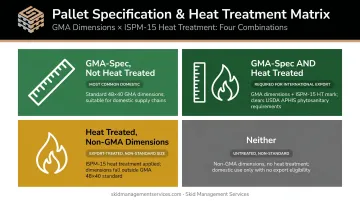
Meeting GMA specs doesn't tell you anything about treatment. Having a heat treatment stamp doesn't tell you anything about dimensions.
When Heat Treatment Gets Added to GMA Pallets
Two situations require heat treatment on top of the GMA standard:
- International shipping — any GMA pallet made of solid wood crossing an international border must comply with ISPM-15
- Customer or industry mandates — retailers, food manufacturers, and pharmaceutical distributors often require HT pallets for domestic shipments through their supplier compliance programs
For purely domestic US shipments with no regulatory mandate, standard non-HT GMA pallets may be sufficient. The moment any international movement enters the picture — or your customer's contract specifies HT — you must request and verify it when ordering.
A Note on Food-Grade GMA Pallets
Food-grade GMA pallets are a related but distinct category, and they're a common source of this confusion. Food-grade pallets are typically new, kiln-dried, and heat treated — not because ISPM-15 requires it, but because heat treatment eliminates surface pests and pathogens without leaving chemical residue, making it compatible with FDA and GFSI sanitation standards. If you've only sourced pallets for food or pharma applications, HT may feel like the default — but outside those regulated supply chains, it's an add-on you need to request explicitly.
Understanding ISPM-15: The Heat Treatment Standard for Wood Pallets
ISPM-15 (International Standards for Phytosanitary Measures No. 15) is the international regulation requiring wood packaging materials — including pallets — used in international trade to be treated against invasive insects and plant diseases.
The IPPC currently lists 185 contracting parties, making ISPM-15 one of the most widely enforced trade compliance standards in global logistics.
The Heat Treatment Process
Per the official IPPC ISPM-15 standard, compliant heat treatment (HT) requires:
- Wood core must reach a minimum temperature of 56°C (132.8°F)
- Held at that temperature for a continuous 30-minute period throughout the entire wood profile
- Treatment must occur in a closed chamber (conventional steam or dry kiln)
This is distinct from standard kiln drying (KD), which reduces moisture content but doesn't automatically satisfy ISPM-15. The full temperature and duration requirements must both be met, and the pallet must be marked by an accredited facility.
Approved Treatment Methods
| Code | Method | Status |
|---|---|---|
| HT | Heat treatment (56°C for 30 min) | Dominant method; fully compliant |
| DH | Dielectric heating (microwave energy) | ISPM-15 approved alternative |
| MB | Methyl bromide fumigation | Being phased out globally due to ozone concerns |
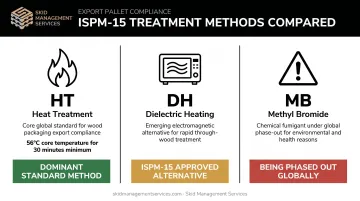
HT is now the standard approach. Methyl bromide is still technically listed by IPPC but is being phased out in most trading regions.
That distinction matters when evaluating which materials actually require treatment — and which don't.
What's Exempt from ISPM-15
Not all wood packaging requires treatment. The following are generally exempt:
- Wood 6mm or less in thickness
- Plywood, particleboard, OSB, and veneer — manufacturing processes eliminate pest risk
- Metal or synthetic foam packaging components
Standard solid sawn lumber above 6mm — the material used in GMA wood pallets — is not exempt and requires treatment for international shipment.
How to Read the HT Stamp on a GMA Pallet
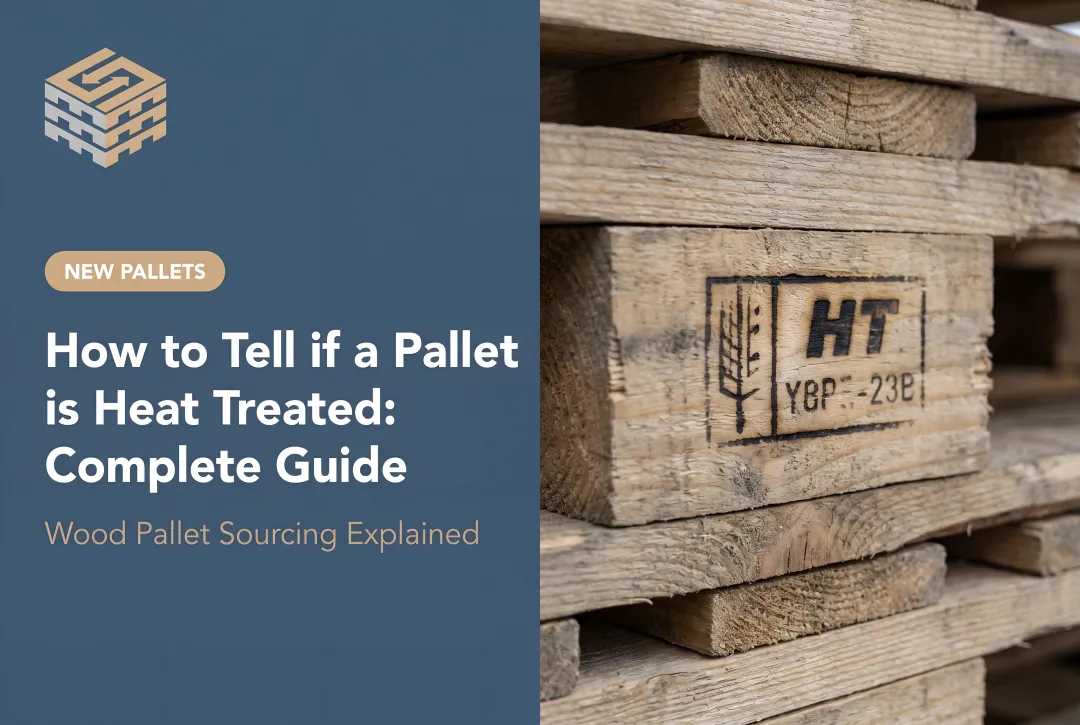
Every legitimately heat-treated pallet must carry a permanent IPPC mark directly on the wood. Not a sticker. Not a paint mark. Not a hand-written notation. The mark must be burned, branded, or deeply stamped into the wood itself.
The Four Required Elements
A valid ISPM-15 HT mark contains:
- The IPPC wheat-stalk symbol — the internationally recognized logo of the International Plant Protection Convention
- Two-letter ISO country code — "US" for United States-treated pallets
- Unique producer/treatment facility number — issued by USDA APHIS to the licensed treatment provider
- Treatment code — "HT" for heat treated, "DH" for dielectric heating
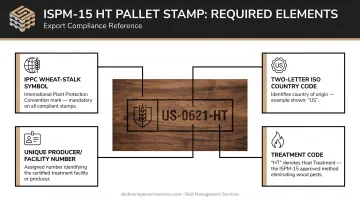
The mark is typically found on the stringer or block faces. IPPC requires it to appear on at least two opposite sides of the pallet, and it must be legible, durable, and non-transferable.
Common Verification Mistakes
- Stickers aren't compliant. Tags are explicitly prohibited under ALSC enforcement regulations.
- Smudged or partial marks fail inspection. All four elements must be present and legible. A mark missing the facility number or treatment code is grounds for rejection at port of entry.
- Inspect physically on receipt. Don't rely on supplier documentation — verify the mark is present on each pallet before it enters an export shipment.
What Happens When HT Pallets Are Repaired
The IPPC repair threshold matters for compliance decisions:
- Less than one-third of wood replaced — Original HT mark remains valid; added components must be treated, but full re-marking isn't required
- More than one-third of wood replaced — Pallet is considered remanufactured; a certified accredited facility must obliterate previous marks, then re-treat and re-stamp the pallet
When Do You Need Heat-Treated GMA Pallets?
International Shipping
Any GMA pallet made of solid wood crossing an international border must be ISPM-15 compliant. This applies to:
- US exports to any of the 185 IPPC signatory countries
- US imports — APHIS requires all regulated wood packaging material entering or transiting the US to carry a valid ISPM-15 mark
One notable exception: Wood packaging material moving between the continental US and Canada is currently exempt from ISPM-15 under a bilateral arrangement, provided specific origin and documentation conditions are met.
The exemption does not cover:
- Hawaii or other US territories
- Offshore-origin wood
- Pallets with visible pest contamination
That said, Costco's pallet policy explicitly requires ISPM-15 HT for border entry — even at the Canada/US border — and requires the mark to be visible on both long pallet sides. Retailer-specific requirements can be stricter than the regulatory baseline.
Retailer and Industry Mandates
Several situations trigger HT requirements for domestic shipments:
- Big-box retailers — Costco mandates it; comparable programs exist at Walmart, Target, and Kroger to reduce pest risk across their distribution centers
- Food and beverage manufacturers — SQF, BRCGS, and FSSC 22000 audits frequently specify HT pallets to eliminate chemical contamination risk
- Pharmaceutical distributors — HT removes pest and pathogen risk without chemical residue, keeping pallets compatible with FDA 21 CFR Part 211 and cGMP environments
Confirm your customer's supplier compliance requirements before defaulting to non-HT pallets. A single rejected load — including re-inspection fees, carrier diversions, and reprocessing — routinely costs more than upgrading the entire pallet order to HT spec.
Sourcing Heat-Treated GMA Pallets: Key Considerations
Verify ISPM-15 Accreditation
When sourcing HT GMA pallets, confirm your supplier draws from USDA APHIS-recognized treatment providers. In the US, the American Lumber Standard Committee (ALSC) administers the WPM program with APHIS oversight. ALSC currently accredits 15 independent third-party agencies operating across approximately 5,300 facilities nationwide.
What to check:
- Does the supplier source from APHIS-recognized providers?
- Is the ISPM-15 stamp legible and permanent on the wood?
- Can the supplier identify the producer/facility number on the pallets?
Supply Consistency and Cost
Heat treatment adds cost through chamber time, quality-control program enrollment, and inspection oversight. No authoritative published price differential is available for HT vs. non-HT GMA pallets — pricing is program-specific and varies by volume, lumber grade, and market conditions.
Lead times can extend during high-demand periods, so supplier capacity matters. Skid Management Services sources ISPM-15 heat-treated GMA pallets through USDA APHIS-recognized treatment providers and maintains supply through both its own inventory and an expansive national supplier network. That combination supports uninterrupted supply across large or variable-volume programs.
Documentation for Export Shipments
For export shipments, ensure your supplier can provide:
- Confirmation that pallets carry valid ISPM-15 markings (all four required elements)
- Documentation linking pallets to the APHIS-recognized treatment provider
- Support for export-compliance audits if required by your freight forwarder or destination customs authority
Proper documentation reduces the risk of holds or rejection at the point of entry, along with the delays and costs those situations create.
Frequently Asked Questions
How do you tell if a pallet is heat treated?
Look for a permanent mark burned, branded, or stamped into the wood — typically on the stringer or block face. A valid mark includes the IPPC wheat symbol, a two-letter country code, a treatment provider number, and the code "HT." Stickers or painted-on markings indicate non-compliance.
What does GMA mean on a pallet?
GMA stands for Grocery Manufacturers Association (now the Consumer Brands Association) and refers to a standardized 48" x 40" pallet specification. The term describes the pallet's dimensions and structural design, not how the wood was treated or what grade the pallet is.
What wood is exempt from ISPM-15?
Wood under 6mm thick is exempt, as are processed wood products — plywood, particleboard, oriented strand board (OSB), and veneer — because manufacturing processes destroy pest risk. Solid sawn lumber above 6mm, used in standard wood pallets, is not exempt and requires treatment for international shipment.
Are heat-treated GMA pallets required for domestic shipping in the US?
No legal requirement mandates HT pallets for purely domestic US shipments. However, specific customers, retailers, or regulated industries (food, pharma) may require them through supplier compliance programs. Confirm requirements with your customer before ordering.
Can a heat-treated pallet be repaired and still keep its HT certification?
Yes, provided less than one-third of the wood is replaced — the original ISPM-15 mark stays valid. Replace more than one-third and the pallet must be re-treated and re-stamped by an accredited facility to regain compliance.