
Kiln drying is about moisture control. Heat treatment is about pest elimination and export compliance. Confuse them, and you risk product damage, failed customs inspections, or shipments stuck at a port.
Getting this wrong isn't cheap. A pallet load rejected at customs because it lacks the correct ISPM-15 stamp can mean demurrage fees, delayed delivery windows, and unhappy customers overseas. This guide breaks down what each process actually does, when you need one, the other, or both, and how to source the right pallet without guessing.
Skid Management Services works with food, beverage, and industrial manufacturers across the country, sourcing both kiln-dried and heat-treated pallets through owned inventory and an expansive supplier network.
TL;DR
- Kiln drying lowers wood moisture for drier, more stable pallets
- Heat treatment (ISPM-15) kills pests and is required for most export shipments
- Kiln-dried pallets fit moisture-sensitive goods and long-term storage
- One pallet can be both kiln-dried and heat-treated for moisture control plus export compliance
- Choose based on destination, product moisture sensitivity, and storage conditions
Kiln Dried vs Heat Treated Pallets: Quick Comparison
| Factor | Kiln Dried | Heat Treated (ISPM-15) |
|---|---|---|
| Purpose | Reduces moisture content for stability | Eradicates pests for compliance |
| Process | Slow heating to target moisture content | Core temp of 56°C (132.8°F) for 30+ minutes |
| Regulatory marking | No official stamp; supplier documentation only | Requires ISPM-15 "wheat stamp" for export |
| Cost | Varies by program and volume | Varies by program and volume |
| Best use case | Food, pharma, moisture-sensitive storage | Any international/export shipment |

According to Virginia Tech's Center for Packaging and Unit Load Design, kiln-dried softwood lumber tops out at 15% to 19% moisture content depending on grade, with cants around 23%.
Wood below 20% moisture generally won't support mold, mildew, or fungal decay.
Pricing for both treatments is quoted per program rather than as a flat rate. Volume, lane, lumber grade, and construction all factor in.
What Is Kiln Drying?
Kiln drying is a controlled lumber-drying process. Wood is loaded into heated chambers and slowly brought down to a target internal moisture percentage, typically 15% to 19%, depending on end use.
Why does this matter for pallets? Dry wood is stronger, lighter, and far less prone to warping, cracking, or mold growth than green (undried) lumber.
Core benefits of kiln-dried pallets:
- Dimensional stability during storage and transit
- Reduced warping and cracking under load
- Lighter weight — dry pallets can weigh 25-30% less than green ones, per Virginia Tech's pallet lab findings
- Lower mold and fungus risk
- Longer service life with fewer replacements
One Virginia Tech example describes a kiln operating at 100-110°F that reduced deck-board moisture from 85% down to 20% in about five days. That's a dramatic shift, and it explains why dry pallets perform so differently under real-world shipping stress.

Use Cases for Kiln-Dried Pallets
Kiln-dried pallets show up most often where moisture control isn't optional:
- Food and beverage — beverage loads especially can wick moisture into pallet wood, creating contamination risk
- Pharmaceutical and nutraceutical — often paired with no-chemical-treatment specs and chain-of-custody documentation
- Cold storage and frozen foods — lower starting moisture means slower reabsorption in freezers and better durability through freeze-thaw cycles
Skid Management Services sources kiln-dried inventory for customers in these categories. For food-grade applications, new kiln-dried, heat-treated pallets are often recommended because they avoid prior-load contamination history and residual treatment chemicals.
What Is Heat Treatment (ISPM-15)?
Heat treatment is a phytosanitary process required under ISPM-15, the International Plant Protection Convention's standard for wood packaging material in international trade. The process kills pests, insects, and larvae that could hitch a ride across borders inside pallet wood. It does not control moisture. Core benefits:
- Legal compliance for export shipments
- Prevents invasive species from spreading between countries
- Protects agricultural and forest ecosystems at the destination Heat treatment does not guarantee low moisture content. The process can even accelerate sugar migration in the wood, which raises staining risk on light-colored products. Moisture control and pest treatment are separate problems.
Use Cases of Heat Treated Pallets
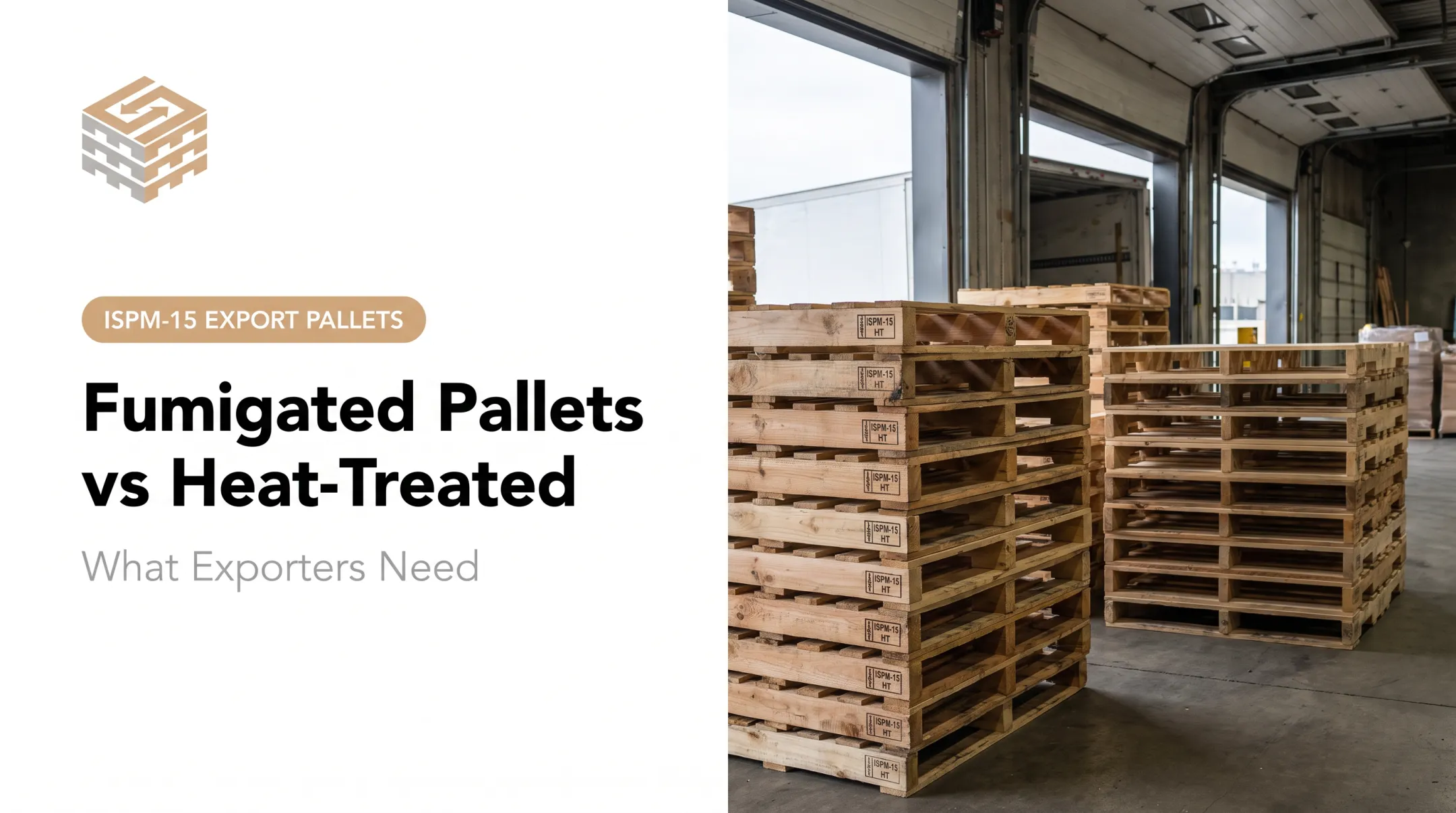
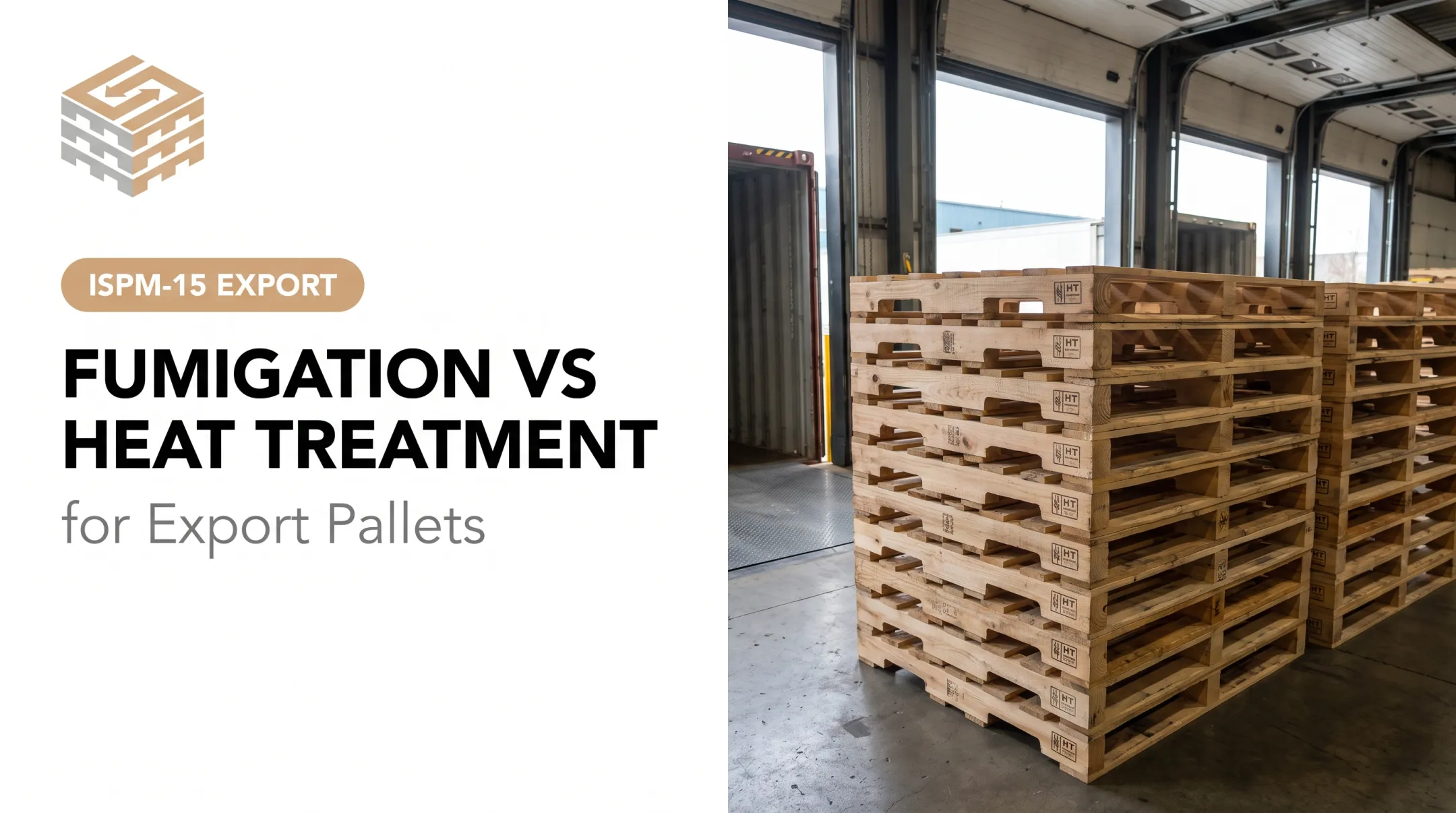
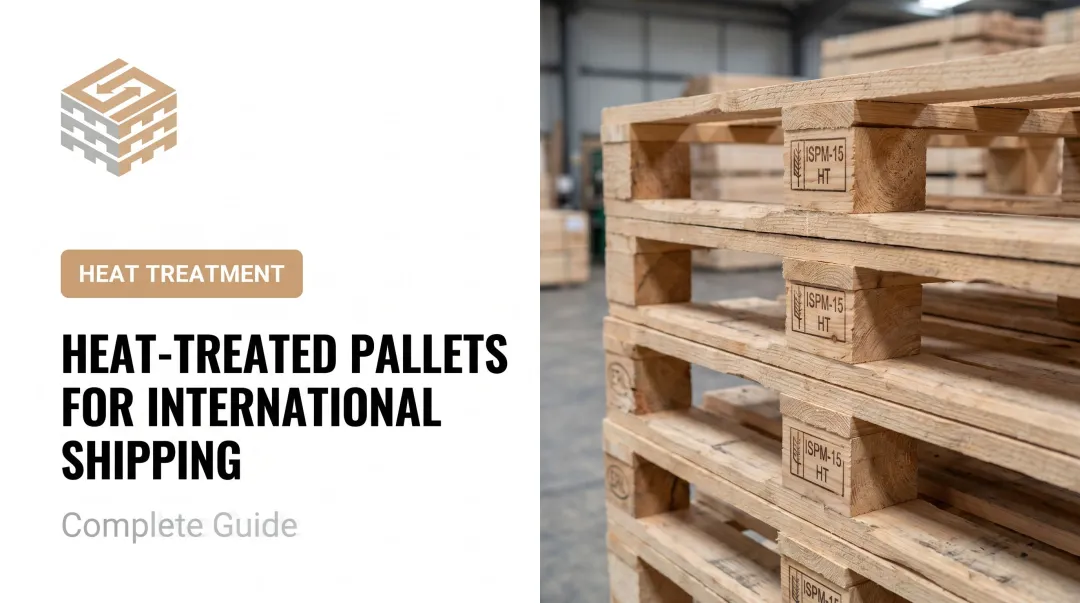
For export, heat treatment is not optional. Any ocean freight or air cargo shipment requires ISPM-15-compliant wood packaging. USDA APHIS is blunt about the consequences. Regulated wood packaging entering or transiting the United States must be pest-free, debarked, treated, and marked with a compliant ISPM-15 logo, according to APHIS import guidance. Noncompliant shipments will not be allowed to enter. Customs officers can also issue an Emergency Action Notification when wood packaging fails inspection, which stalls the shipment until the issue is resolved. That compliant mark isn't decorative. It has to show the IPPC logo, country code, treatment-provider ID, and a treatment code — HT for heat treatment. Skid Management Services sources ISPM-15-compliant pallets through a USDA APHIS-recognized treatment provider network, verifies existing stamps on inventory pallets, and coordinates re-treatment or re-stamping when needed. Service is available nationwide, with corridor coverage across Greater Philadelphia, the Lehigh Valley, and the Lancaster/Berks/York/Harrisburg region—supporting export activity through PHL Airport and the Port of Philadelphia.

Kiln Dried vs Heat Treated: Which Is Better for Your Business?
Neither one wins outright. It comes down to four factors:
- Shipping destination: domestic vs. international
- Product sensitivity: does moisture ruin your goods?
- Storage duration and environment: long-term storage, cold storage, high humidity?
- Budget: treatment adds cost regardless of type
Choose kiln-dried if you're prioritizing product protection and moisture control for domestic shipping or extended storage. Food, beverage, and pharma operations lean this way most often.
Choose heat-treated if you're shipping internationally. ISPM-15 compliance is mandatory and enforced at the border.
You can also order pallets that are both kiln-dried and heat-treated. The combined spec gives you moisture control for product protection plus the ISPM-15 stamp needed for export.
Skid Management Services offers this as a standard option across common sizes (GMA 48x40, 48x48, 42x42, 44x44, 36x36, and Euro-size) as well as custom-dimension builds.
Real World Example: Choosing the Right Pallet Treatment
Picture a mid-sized food or beverage manufacturer running a busy production floor. Product ships out on pallets sourced from whatever supplier had inventory that week: some kiln-dried, some green, quality inconsistent.
Over a few months, warehouse staff start noticing something off:
- Increased product damage claims tied to pallet failure
- Mold spotted on wood surfaces during humid stretches
- Inconsistent load stability during transit
Wood pallets are hygroscopic by nature. Humidity, condensation, and freeze-thaw cycling all contribute to moisture absorption, which drives mold growth and weakens structural integrity over time. A manufacturer facing this pattern typically traces it back to one root cause: inconsistent pallet quality from unreliable sourcing.

The manufacturer standardizes on kiln-dried pallets sourced through a supplier with steady inventory, rather than whatever's cheapest that week. For frozen or refrigerated product lines, this often means pairing kiln-dried lumber with heat treatment for facilities that also export product internationally.
The takeaway: sourcing consistency matters as much as treatment type. A supplier who can guarantee the same spec, order after order, prevents the damage claims and storage headaches that come from mixed-quality inventory.
If your operation is dealing with similar inconsistency, Skid Management Services supplies competitively priced, reliably stocked kiln-dried and heat-treated pallets. Reach out at 717-202-0304 or Info@SkidManagementServices.com to talk through your program.
Conclusion
There's no universal winner between kiln-dried and heat-treated pallets. The right choice depends on three factors:
- Where your product is going
- How sensitive it is to moisture
- How long it sits in storage before it ships
Either way, supply consistency matters most. Partnering with a national pallet supplier that maintains its own inventory alongside a broad supplier network gets you the correct treatment type without disrupting your production schedule. That directly protects both your costs and your uptime.
Frequently Asked Questions
How much is a Euro pallet worth?
Euro pallet pricing varies based on condition, treatment type, and current market rates. Contact a supplier directly for an accurate, up-to-date quote based on your volume and specs.
What is the main difference between a Euro pallet and a standard pallet?
Euro pallets measure 1,200mm x 800mm, following EPAL design standards common in Europe. Standard U.S. pallets, often called GMA pallets, typically measure 48x40 inches and follow different construction conventions.
Are all Euro pallets heat-treated?
No. Heat treatment under ISPM-15 is only required for international shipments, not for every Euro pallet by default. Domestic or regional use within compliant zones doesn't require the HT stamp.
Can a pallet be both kiln-dried and heat-treated?
Yes. This combination gives you moisture control for product protection plus the ISPM-15 compliance stamp needed for export, all in a single pallet order.
Do kiln-dried pallets prevent mold?
Reduced moisture content significantly lowers mold risk, since wood below roughly 20% moisture generally won't support fungal growth. Proper storage and ventilation are still necessary alongside the treatment.
Which pallet type is required for international shipping?
Heat-treated, ISPM-15-compliant pallets are mandatory for export shipments. Wood must reach a core temperature of 56°C (132.8°F) for at least 30 minutes and carry the required compliance stamp.