For consumer goods brands, though, the numbers behind the pallet matter less than what happens when the system breaks down. Product arrives crushed. Loading crews fall behind schedule. A supplier can't deliver pallets on time, and suddenly the production line sits idle.
This guide walks through how palletization actually works for consumer goods, the real benefits it delivers, and where it shows up across the supply chain. We'll also cover what to look for in a pallet partner who won't leave you scrambling.
Key Takeaways
- Palletized consumer goods consolidate products into one unit load for safer, faster handling.
- The process breaks into two phases: loading/stacking and securing/wrapping.
- Benefits include less product damage, faster dock times, and better inventory tracking and safety.
- Pallet material and size vary by category, from wood GMA pallets to specialized cold-storage builds.
- Supply reliability from your pallet partner keeps your production line running.
What Are Palletized Consumer Goods?
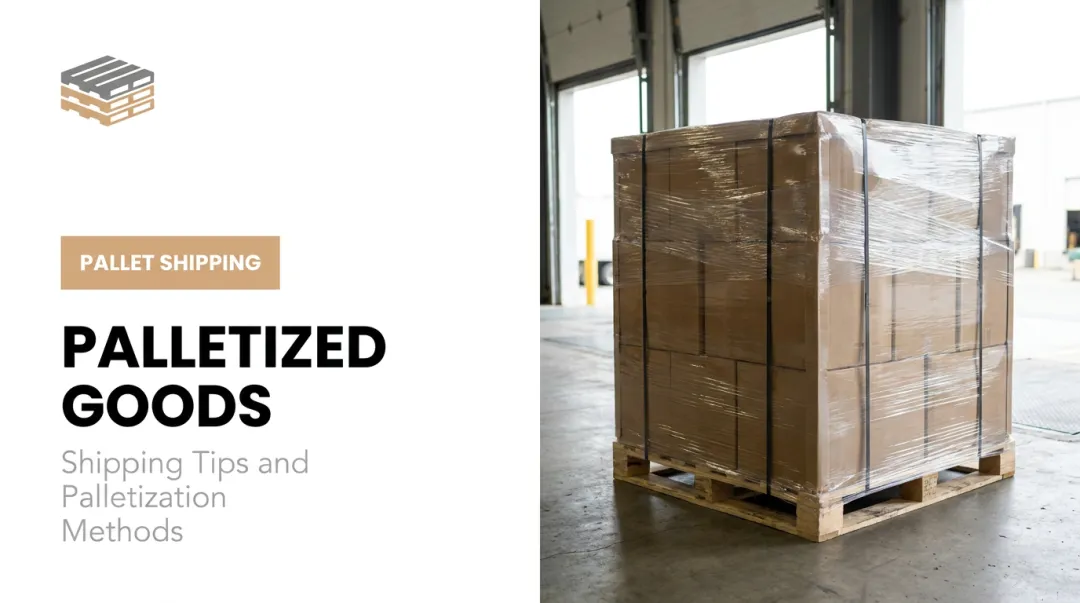
Palletized consumer goods are packaged products, think canned soup, snack bags, bottled beverages, or laundry detergent, consolidated onto a pallet to form a single unit load. Instead of handling hundreds of individual cases, workers and equipment move one stabilized load at a time.
This concept matters more for consumer goods brands than for bulk industrial shippers. CPG products come in smaller SKU sizes, turn over faster at retail, and often require mixed-case configurations. A single truck might carry pallets bound for a dozen different store locations.
Few industries depend on palletization as heavily as food and snack manufacturing. Production lines running thousands of cases per hour depend on consistent, well-built pallets to keep goods moving from packaging to the dock without a bottleneck.
Palletized or Palletised: Clearing Up the Spelling
Both spellings describe the same process. Palletized is the American English spelling, used throughout the U.S. logistics industry. Palletised is the British and Commonwealth spelling. If you're sourcing suppliers or reading industry documentation, don't let the extra "s" throw you. It's the same practice either way.
Palletizing vs. Related Terms
Buyers sourcing materials sometimes confuse "skid" and "pallet." Here's the distinction:
- Skid: A single-deck platform, typically two or more parallel wood runners with no bottom deck.
- Pallet: A double-deck platform with both a top (load-bearing) deck and a bottom deck, supported by stringers or blocks.
Skids work fine for some internal handling, but most CPG distribution requires the added stability and forklift compatibility of a true double-deck pallet.
The Palletization Process for Consumer Goods
Palletization for consumer goods breaks into two connected phases: loading and securing. Skip a step in either phase, and you risk toppled loads, crushed cartons, or rejected shipments at the receiving dock.
Phase 1: Loading and Stacking
Weight distribution comes first. Heavier cases and cans go on the bottom; lighter or more fragile packaging goes on top. Get this wrong, and the bottom layers crush under weight they were never designed to carry.
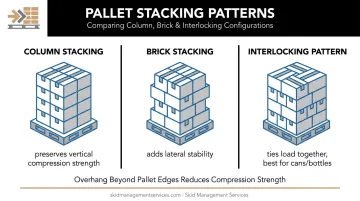
Stacking pattern matters just as much:
- Column stacking aligns cases directly on top of each other, preserving the corrugated box's vertical compression strength.
- Brick stacking offsets successive layers, adding some lateral stability while shifting edge alignment.
- Interlocking patterns alternate layer orientation to tie the load together, which works well for rigid canned or bottled goods that don't rely on the box itself for compression strength.
One detail brands often overlook: overhang. When cases extend even slightly past the pallet edge, that overhang loses support and can reduce the load's compression strength, in some tested configurations by nearly a third.
Corners crush, columns buckle, and the whole load becomes unstable. Match your stacking pattern to your package type rather than assuming interlocking is always the safer bet.
Phase 2: Securing the Load
Once stacked, the load needs to stay put through transit, storage, and handling. Two methods dominate:
- Stretch wrapping: machine-grade pre-stretch film or hand-applied rolls wrap tightly around the load, holding cases in place and shielding them from dust and moisture.
- Shrink wrapping: heat-applied film shrinks tightly around the load, offering a more rigid seal for certain product types.
For heavier loads, strapping adds a second layer of security. Polypropylene and polyester strapping handle most consumer goods applications, while steel strapping steps in for the heaviest industrial-weight loads. Corner boards and edge protectors round out the securing process, preventing strap or wrap pressure from crushing package corners during transit.
Skid Management Services (SMS) supplies all three, machine and hand-grade stretch film (including vented film for moisture-sensitive goods), PP/PET/steel strapping, and paper-fiber corner boards, as part of its packaging materials line for CPG clients.
Manual vs. Automated Palletizing
Manual palletizing still works for lower-volume operations, but high-speed CPG manufacturers are shifting toward automation. Semi-automated systems assist workers with lifting and positioning, while fully robotic palletizers handle the entire stacking sequence.
One equipment case study reported a cobot palletizer hitting 13 boxes per minute, compared to an industry benchmark closer to 8 boxes per minute for manual operations. Cascade Coffee, a food manufacturer facing turnover rates above 100% in physically demanding roles, installed six cobot palletizing units to address both throughput and staffing pressure.
Results like these are equipment-specific rather than universal, but the direction is clear: labor shortages are pushing more CPG plants toward automated palletizing.
Key Benefits of Palletizing Consumer Goods
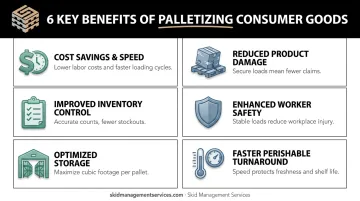
Palletization changes the economics of moving consumer goods through the supply chain, cutting costs and reducing risk at every touchpoint.
- Cost Savings and Speed: Consolidated unit loads reduce the number of touchpoints between production and truck, cutting labor hours and truck dwell time at the dock compared to loose-carton handling.
- Reduced Product Damage: Wrapped, properly stacked loads minimize handling touches. Since overhang and poor stacking are proven causes of compression failure, correct palletization directly protects packaging integrity.
- Improved Inventory Control: A palletized load lets warehouse managers estimate SKU volume at a glance, tightening stock accuracy for fast-moving consumer goods with frequent turnover.
- Enhanced Worker and Product Safety: Manual handling drives a large share of the 500,000+ musculoskeletal disorder cases reported annually, per NIOSH ergonomic guidelines, while palletized loads cut repetitive lifting and shifting risk.
- Optimized Storage and Space Utilization: Standardized pallet footprints maximize warehouse racking and trailer cube space, a critical factor in high-volume CPG distribution centers running tight on square footage.
- Faster Turnaround for Perishables: Quick palletized handling shortens the time temperature-sensitive goods spend in transit, lowering spoilage risk for perishable food and beverage shipments.
Types of Pallets Used for Consumer Goods
Not every pallet fits every product. Material and construction choices depend on the goods being shipped, the handling environment, and compliance requirements.
Wood Pallets
Wood remains the dominant material, with an industry association estimating that 93% of pallets in the U.S. are made of wood, according to Wood Packaging Global. Cost-effectiveness and durability make wood the standard choice for most food, snack, and beverage distribution.
SMS supplies wood pallets across multiple tiers to fit different budget and compliance needs:
| Grade | Best For |
|---|---|
| New kiln-dried heat-treated | FDA-regulated, food-grade, ISPM-15 export |
| Grade A recycled | Near-new performance at 40–60% cost savings |
| Grade B recycled | General warehouse and DC use |
| Sanitation-grade recycled | Internal food-facility handling |
Plastic Pallets
Plastic pallets show up in hygiene-sensitive food processing environments where sanitation standards call for easy washdown. SMS specializes exclusively in wood pallets, but understanding this distinction helps explain the mix seen in some facilities: food-safety guidelines often recommend keeping wood pallets out of open-product areas unless there's a justified need. Plastic fills that specific niche rather than replacing wood as the primary material.
Standard Sizing
The GMA 48x40-inch pallet is the industry benchmark for grocery and consumer goods, used widely across new wood pallet production. Actual load capacity depends heavily on construction, support method, and lumber grade, so confirm the specific rating with your supplier rather than assuming a one-size-fits-all number.
Applications of Palletized Goods Across the Consumer Supply Chain
Food and Beverage Manufacturing
High-speed production lines moving canned, bottled, or packaged food rely on palletization to keep goods flowing from packaging to distribution centers without delay.
SMS supports anchor clients like Campbell Snacks, Knouse Foods, Nissin Foods, Stauffer's, and Hain Celestial Group with food-specific pallet programs:
- GMA 48x40 pallets for standard production runs
- Custom food-zone pallets with solid top decks for small-format snack products
- Sanitation-grade recycled options meeting FDA FSMA and GFSI audit requirements
Retail and Grocery Distribution
Retailers depend on palletized deliveries to restock shelves quickly and keep store-level inventory accurate. Big-box compliance adds another layer: Walmart, Costco, Target, and Kroger each publish their own vendor pallet specifications covering deck-board configuration and fork-entry type.
Pallets that miss spec get refused at the DC, with the supplier absorbing freight both ways plus a chargeback. SMS's retail-DC compliance program is built specifically to avoid that outcome.
E-commerce and Mixed-SKU Fulfillment
Omnichannel retail is pushing mixed-case palletizing into more complex territory: smaller batch sizes, more SKU variety, and stricter fulfillment-center receiving standards. Amazon FBA, for example, refuses non-compliant pallets outright.
SMS's FBA-compliant program covers:
- GMA 48x40 pallets verified for 4-way entry
- Custom builds for oversized or multi-SKU loads
- Coverage for Walmart Marketplace, Target+, and Shopify D2C sellers
Partnering with a Reliable Pallet Supplier
A single pallet supply interruption can halt an entire production or shipping line. This is a recurring risk for CPG manufacturers running tight production schedules with little buffer inventory.
SMS addresses this with a two-layer supply model: owned inventory for immediate, same-day availability, plus an expansive supplier network that provides surge capacity when demand spikes beyond on-hand stock.
For manufacturers running roughly 500 or more pallets monthly, SMS's closed-loop program combines scheduled delivery with used-pallet pickup on the same trip, often applying 15–40% trade-in credit against new-pallet spend.
When evaluating a pallet partner, look for:
- Network breadth: Can they flex when your volume spikes unexpectedly?
- Pricing consistency: Do rates hold steady, or swing with every lumber market shift?
- Proven reliability: Do they already serve established consumer goods brands at your scale?
SMS's client roster, including Campbell Snacks, Knouse Foods, and Hain Celestial Group, reflects exactly that kind of track record. Reach the team at 717-202-0304 or Info@SkidManagementServices.com to discuss program specifics.
Frequently Asked Questions
What are palletized goods?
Palletized goods are products consolidated and stacked on a pallet to form a single unit load, making them easier to handle, store, and transport through the supply chain.
Is it palletized or palletised?
"Palletized" is the American English spelling, while "palletised" is the British spelling. Both describe the identical logistics process of consolidating goods onto a pallet.
What is the difference between a pallet and a skid?
A skid has only a single top platform with no bottom deck. A pallet includes both a top and bottom deck, supported by stringers or blocks, giving it more stability and forklift compatibility.
How much weight can a standard pallet hold?
Load capacity varies based on construction, lumber grade, and support method (racked, floor, or fork-supported). Ask your supplier for the specific engineering rating rather than assuming a universal number.
What is the standard pallet size for consumer goods?
The GMA 48x40-inch pallet is the most common standard across the grocery and consumer goods industry, widely used for both distribution and retail DC compliance.
What are the main benefits of palletizing shipments?
Palletizing reduces product damage, speeds up loading and unloading, and improves inventory tracking accuracy, while also lowering the risk of manual-handling injuries in the warehouse.