The reasons vary: pricing that doesn't flex with volume, regional service gaps, or a need for more customized supply arrangements. Whatever the trigger, choosing the wrong pallet partner can ripple through your entire supply chain—driving up costs, stalling production lines, and undermining sustainability commitments.
This guide breaks down the top Kamps alternatives worth evaluating for 2026, the criteria that actually matter when comparing them, and how to match a supplier to your specific operational needs.
Key Takeaways
- Rigid pricing, regional gaps, and inflexible offerings push buyers away from Kamps
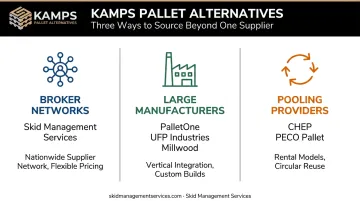
- Alternatives fall into three types: broker networks, large manufacturers, and pooling providers
- Network depth, pricing transparency, and customization matter more than brand recognition
- Skid Management Services offers a national supplier network with consistent pricing and reliable supply
Overview of Kamps Pallets and Why Businesses Seek Alternatives
Bernie Kamps founded the company in Grand Rapids, Michigan, in 1973, and it has since grown into a nationwide recycling and manufacturing operation headquartered there. Decades of expansion have made Kamps a household name in pallet management, but scale brings its own trade-offs.
Businesses commonly cite three friction points when they start shopping around:
- Regional service gaps: coverage that looks national on paper but thins out fast outside core facility clusters
- Standardized offerings: less flexibility for custom sizing, load ratings, or niche compliance requirements
- Pricing that doesn't scale: rate structures tied to single-facility overhead rather than volume-driven market pricing
The timing matters too. The U.S. pallet and skid rental market reached $4.2 billion by the end of 2025, growing at a 6.0% CAGR from 2020 to 2025, according to IBISWorld's industry analysis. That growth has pulled more suppliers into the space, giving buyers real negotiating power for the first time in years.
The alternatives below are evaluated on network reach, pricing approach, and supply reliability.
Top Kamps Pallets Alternatives for 2026
Each provider below was assessed against five criteria: supplier network breadth, pricing competitiveness, supply consistency, customization ability, and industry reputation.
Skid Management Services
Skid Management Services (SMS) is a national provider of wood pallets and packaging products, built around a hybrid model: its own inventory combined with an expansive network of pallet and packaging suppliers. That combination is what lets SMS avoid the single-facility bottleneck that trips up other providers.
SMS's client roster includes major food and consumer goods brands—Knouse Foods, Campbell Snacks, Stauffer's, Nissin Foods, Hain Celestial Group, and Plainville Farms—all operating in compliance-sensitive, high-volume environments where a supply gap simply isn't an option.
Beyond standard new and used pallets, SMS supplies custom-engineered builds, ISPM-15 heat-treated export pallets, and closed-loop programs that fold pickup, grading, and ESG reporting into one relationship.
SMS's advantage comes from its broad supplier base, which absorbs demand spikes without passing scarcity pricing on to customers.
| Criteria | Details |
|---|---|
| Network & Coverage | Nationwide network of pallet and packaging suppliers, providing redundancy and consistent availability |
| Pricing Approach | Competitive, market-driven pricing backed by a broad supplier base rather than single-plant overhead |
| Best Suited For | Mid-to-large manufacturers and food/beverage brands needing reliable, uninterrupted nationwide supply |
PalletOne
PalletOne is one of the largest vertically integrated pallet manufacturers in the U.S., operating sawmills and manufacturing plants throughout the eastern United States. Its founding acquisition in 2001 brought 12 plants across eight states, and the company has expanded steadily since.
The differentiator here is vertical integration: PalletOne owns its own lumber supply, processing more than 200 million board feet annually. That control over raw materials supports high-volume manufacturing, though the company's geographic strength remains concentrated in the Southeast with growing reach elsewhere.
| Criteria | Details |
|---|---|
| Network & Coverage | Multiple manufacturing plants concentrated in the Southeast U.S. with growing national reach |
| Pricing Approach | Competitive bulk pricing driven by vertically integrated lumber sourcing |
| Best Suited For | High-volume manufacturers needing large standardized or custom orders |
CHEP
CHEP, operated by Brambles, is the global leader in pallet pooling. Instead of buying pallets outright, customers rent CHEP's recognizable blue pallets and return them through a circular reuse network.
Brambles operates at significant scale: roughly 60 countries with more than 750 service centers and approximately 348 million pallets, crates, and containers in circulation as of mid-2025, according to its FY2025 annual report. Digital tracking through its BRIX platform adds supply chain visibility that pure manufacturers can't match.
| Criteria | Details |
|---|---|
| Network & Coverage | Extensive global depot and service network supporting high-exchange, multi-party supply chains |
| Pricing Approach | Rental/pooling fee model shifting capital expense into recurring operational costs |
| Best Suited For | Global retail and CPG brands with frequent multi-partner pallet exchanges and sustainability goals |
PECO Pallet
PECO Pallet runs a North American pooling network built around its red block pallets, known for strong retailer acceptance across grocery and big-box channels.
PECO's network spans 40+ full-service depots, 50+ sort-and-storage facilities, and 2,900+ recovery locations, managing roughly 70 million pallet issues annually across the U.S., Canada, and Mexico. Its pallets are accepted at more than 98% of grocery, warehouse-club, and discount retailers, which matters if compliance rejection is a recurring headache.
| Criteria | Details |
|---|---|
| Network & Coverage | Depot network spanning the U.S., Canada, and Mexico with strong retail acceptance |
| Pricing Approach | Pooling/rental model with recovery and reuse built into cost structure |
| Best Suited For | Retailers and consumer goods companies wanting standardized, retailer-approved pooled pallets |
UFP Industries
UFP Industries is a diversified manufacturer supplying wood pallets and industrial packaging alongside construction and retail products. Its packaging segment operates within a much larger corporate structure—UFP reported $6.32 billion in net sales for fiscal year 2025 across roughly 196 facilities in the U.S., Mexico, Canada, and several international markets.
That diversification cuts both ways: pallets are one product line among several, which means less specialization than a dedicated pallet supplier, but significant manufacturing consistency at scale.
| Criteria | Details |
|---|---|
| Network & Coverage | Strong North American manufacturing footprint with expanding international operations |
| Pricing Approach | Standardized volume pricing tied to large manufacturing scale |
| Best Suited For | Large manufacturers needing high-volume standard or custom pallets alongside other packaging materials |
Millwood, Inc.
Millwood specializes in custom pallet manufacturing and unit load optimization for industrial applications that standard pallets can't handle—think heavy machinery, appliances, and air compressors requiring mounting holes, ramps, or wheel systems.
Its Vienna, Ohio, testing lab is ISTA-certified for compression, vibration, and shock testing, giving Millwood a credibility edge for businesses that need engineering validation, not just a pallet. The company also runs recycling programs that repurpose unusable wood into mulch or boiler fuel.
| Criteria | Details |
|---|---|
| Network & Coverage | Strong U.S. presence with focus on industrial, automotive, and food processing sectors |
| Pricing Approach | Project-based pricing tailored to custom and heavy-duty specifications |
| Best Suited For | Businesses with specialized load requirements needing custom-engineered pallets |
How to Choose the Right Kamps Alternative
The most common mistake? Choosing based on price-per-pallet alone. A cheaper unit cost means nothing if a stockout halts your production line for three days, or if unpredictable lead times force you to hold excess safety inventory.
Weigh these factors instead:
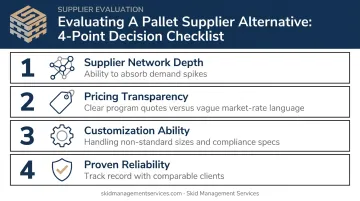
- Supplier network depth: Can this provider absorb a demand spike without leaving you short?
- Pricing transparency: Are you getting a clear program quote, or vague "market rate" language that shifts later?
- Customization ability: Does the provider handle non-standard sizes, load ratings, or compliance specs your operation actually needs?
- Proven reliability: Has this supplier served comparable clients in your industry, at your volume, for a meaningful stretch of time?
Before committing, ask for references or client examples: long-term food and CPG relationships established providers showcase openly. If a provider hesitates to produce them, treat that as a red flag.
Conclusion
There's no single "best" Kamps alternative. The right fit depends on aligning network reach, pricing model, and reliability with your operation's actual goals, not just brand recognition. A global CPG brand managing multi-partner exchanges has different needs than a mid-size food manufacturer needing custom food-grade pallets on a tight regional lane.
Whatever direction you lean, pilot the new supplier on a portion of your volume first. Track cost-effectiveness and scalability over a full quarter or two before fully transitioning. Overnight, all-at-once switches are what cause supply chain disruptions in the first place.
If competitive pricing and uninterrupted nationwide supply are priorities for your 2026 planning, contact Skid Management Services to talk through your pallet procurement needs.
Frequently Asked Questions
Is it illegal to have CHEP pallets?
CHEP pallets remain CHEP's property and are meant only for use within its pooling system. Keeping or reselling them without authorization violates the rental agreement, a contractual matter rather than a criminal one in most jurisdictions.
Does Costco only accept CHEP pallets?
Costco has historically accepted both CHEP and PECO pooled block pallets for North American deliveries, with requirements varying by distribution center. Suppliers should confirm current pallet specifications directly with their Costco vendor contact before shipping.
What is the biggest competitor to Kamps Pallets?
PalletOne, UFP Industries, and CHEP are the most frequently named competitors, though the right fit depends on your needs. Pooling programs suit CHEP or PECO, high-volume manufacturing favors PalletOne or UFP, and network flexibility favors a distributor like SMS.
How do I switch pallet suppliers without disrupting my supply chain?
Use a phased pilot approach: test a new supplier on a portion of your volume while validating quality, pricing, and delivery reliability. Expand the relationship only after confirming performance over a full quarter or more.
What's the difference between buying pallets and using a pooling service?
Buying gives you full ownership and control over storage, repair, and reuse decisions. Pooling shifts those costs into recurring rental fees and hands repair and logistics responsibility to the pooling provider.
What should I look for in a national pallet supplier?
Prioritize network breadth, consistent and transparent pricing, a proven client base in your industry, and demonstrated reliability during demand spikes. These factors matter far more than a low per-unit price alone.