
The 3-stringer design is the workhorse of American shipping. Stringer pallets make up 76% of the US pallet market, and the 48x40 GMA size alone accounts for roughly 35% of new pallet production. Grocery, food manufacturing, and distribution centers run on this design daily.
This guide breaks down what actually determines a 3-stringer pallet's weight capacity, shares standard capacity benchmarks by size, and walks through how to calculate the right pallet for your load.
Key Takeaways
- Static, dynamic, and racking capacities are three different numbers — don't confuse them
- Standard 48x40 GMA 3-stringer pallets typically handle around 4,600 lbs static and 2,500 lbs dynamic
- Wood species, board thickness, moisture content, and pallet condition all change rated capacity
- Overloading causes structural failure. Calculate load per pallet and inspect before every use.
What Is a 3-Stringer Pallet?
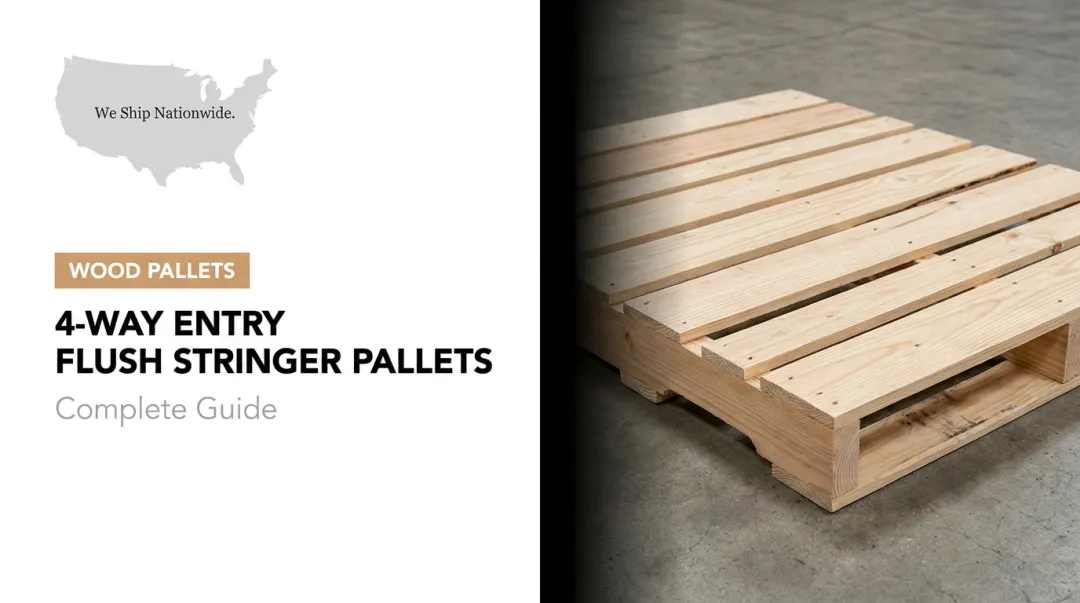
A 3-stringer pallet uses three parallel wood beams (stringers) running the length of the pallet, with deck boards fastened on top and typically on the bottom too. It's the classic North American pallet design.
This differs from other common configurations:
- Block pallets use blocks instead of solid stringers, allowing true four-way forklift entry
- Skids have no bottom deck at all, just a top surface on runners
Two-Way vs. Partial Four-Way Entry
Notched stringers create pockets that let a forklift enter from the sides as well as the ends, which is partial four-way entry. Unnotched stringers only permit entry from the two open ends.
Skid Management Services supplies both notched and unnotched configurations, including double-wing stringer builds for heavier applications.

Factors That Determine 3-Stringer Pallet Weight Capacity
No single number defines a 3-stringer pallet's capacity. Six variables set the real rating.
Construction choices come first:
- Wood species — A USDA Forest Service study found mixed hardwood pallet parts averaged 41% stronger and 40% stiffer than mixed softwood. Oak and hickory stringers outperform pine and spruce under the same load.
- Stringer thickness and spacing — Thicker stringers set closer together reduce deck-board sag and spread weight along the pallet's length.
- Deck board count and placement — More top and bottom boards share load across the stringers instead of loading a few contact points.
Those design choices set the ceiling. Condition, moisture, and fasteners decide how much of that rating you actually get in service.
Condition, Moisture, and Fasteners
Pallet condition affects the rating directly:
- New pallets offer the most consistent, dimension-controlled performance
- Grade A recycled pallets are near-equivalent to new for most applications
- Grade B pallets have minor repairs but retain full structural integrity
- Utility/Grade C pallets lose significant strength; one USDA summary found Grade C kept roughly half the racking strength of new stock
Moisture content changes strength too. Wood below 25-30% moisture (the fiber-saturation point) gets progressively stronger and stiffer as it dries. Green or wet lumber underperforms kiln-dried stock in the same stringer size.
Fasteners matter as well. Ring-shank nails resist withdrawal better in softwoods; helically threaded nails handle bending stress better in dense hardwoods. Weak nails usually fail by head pull-through or shank withdrawal, the two most common joint failures.

3-Stringer Pallet Weight Capacity by Size and Type
Here's a benchmark comparison based on manufacturer specification data. Note: these are safe maximum load figures, not certified static/dynamic/racking test results — actual condition, grade, and moisture will shift real-world numbers.
| Size | Safe Max Load | Empty Weight (avg) |
|---|---|---|
| 48x40 | ~4,592 lb | ~37 lb |
| 42x42 | ~4,445 lb | ~36 lb |
| 48x48 | ~4,673 lb | ~37 lb |
| 40x48 | ~3,696 lb | ~42 lb |
| 36x36 | ~3,544 lb | ~32 lb |
Racking capacity is always lower than static. When a pallet sits on rack beams instead of a solid floor, its middle section has nothing underneath it. That unsupported span means the pallet must hold its shape with far less load before it starts to sag or crack.
Capacity also depends on grade and construction:
- New hardwood stringer pallets generally offer the highest capacity across static, dynamic, and racking loads
- Grade A recycled pallets come close for most warehouse applications
- Grade B and utility-grade units fit lighter, internal-flow loads only
For loads beyond standard GMA ratings, use custom heavy-duty builds. Skid Management Services supplies custom 3-stringer and reinforced stringer pallets for heavy machinery, chemical drums, and industrial applications rated from 4,000 lbs up to over 10,000 lbs dynamic, sourced from its own inventory and an expansive national supplier network.

How to Calculate Load Capacity for a 3-Stringer Pallet
Basic check: Total product weight ÷ number of pallets = load per pallet. Compare that figure to the pallet's rated static, dynamic, or racking capacity, whichever matches your handling method.
To size a single SKU on one pallet, flip the math: rated capacity ÷ unit weight = maximum units per pallet.
Worked Example: 50 lb Bags on a 40x48 Pallet
A 40x48 pallet carries a safe maximum load of roughly 3,696 lbs.
- Divide capacity by bag weight: 3,696 ÷ 50 = 73.9
- Round down for a safety margin: ~65-70 bags is a realistic safe target
- Confirm the bags stack within the pallet footprint without overhang
That safety margin isn't optional. Rated capacities assume even distribution, and real-world stacking rarely hits that ideal.

Build these factors into every calculation:
- Uneven weight distribution concentrates stress on individual stringers
- Overhang past the pallet edge removes structural support entirely
- Stacked or racked loads need the lower racking rating, not the static figure
Businesses shipping heavy machinery, drums, or irregular loads shouldn't rely on generic charts alone. Skid Management Services can help spec a load-rated pallet for those cases — call 717-202-0304 or email Info@SkidManagementServices.com.
Tips for Maximizing Safe Load Capacity
A few habits prevent most pallet failures:
- Center heavy items over the stringers, not between them, since the stringers carry the structural load.
- Never overhang pallet edges: overhang removes support and creates forklift hazards during transport.
- Inspect before every load cycle: check for cracked stringers, split deck boards, and missing or protruding fasteners.
- Match pallet grade to load weight: save Grade A and new pallets for your heaviest, highest-value shipments.
Frequently Asked Questions
What is the maximum weight capacity of a 3-stringer pallet?
Standard 48x40 3-stringer pallets typically hold 2,500-4,600 lbs, depending on whether you're measuring static, dynamic, or racking capacity. Custom heavy-duty versions can exceed 10,000 lbs.
How do you calculate the load capacity for a 3-stringer pallet?
Divide total product weight by the number of pallets used, then compare that figure against the pallet's rated static, dynamic, or racking capacity. Always build in a safety margin for uneven distribution.
How much weight can a wood 3-stringer pallet handle?
Wood species, grade, and condition drive the range. New hardwood 48x40 units typically land in the 2,500–4,600 lbs band; recycled or softwood pallets often handle 20–40% less.
How heavy is a 3-stringer pallet?
A standard 48x40 pallet weighs roughly 35-59 lbs empty, depending on wood species and moisture content. That's separate from its load capacity, which is measured in thousands of pounds.
How many 50 lb bags can fit on a 40x48 pallet?
Based on a ~3,696 lb safe maximum load, that's roughly 73 bags at full capacity. Most operations target 65-70 bags to maintain a safety margin.