Here's the quick answer: a standard 48"x40" wood pallet typically weighs between 30 and 70 lbs empty, depending on wood species, construction style, and moisture content. That's a wide range, and the details matter.
This guide breaks down average weights by pallet type and size, the factors that push those numbers up or down, how pallet weight interacts with load capacity, and why getting this number right protects both your budget and your warehouse crew.
Key Takeaways
- A standard 48x40 GMA pallet weighs 30-48 lbs empty; heavy-duty block pallets can top 70 lbs
- Wood species, board thickness, construction style, and moisture content drive most weight variation
- Pallet tare weight directly affects freight billing, forklift safety, and racking limits
- Static, dynamic, and racking load capacities are separate numbers from the pallet's own weight
- A consistent, quality-controlled supplier cuts down on unexpected weight and load surprises
How Much Does a Standard Wood Pallet Weigh?
The 48"x40" GMA pallet is the workhorse of North American shipping, fitting standard truck trailers, rack systems, and forklift equipment almost everywhere.
Its empty weight generally falls between 30 and 48 lbs, according to PalletOne's manufacturer specifications, with some manufacturers citing an average closer to 37 lbs for a basic build.
That said, "standard" doesn't mean identical. Weight shifts based on what the pallet is built for:
- Lightweight/one-way pallets (~25-34 lbs): Built for single-trip export shipments, using thinner boards and less material
- Standard GMA pallets (~30-48 lbs): The general-purpose choice for warehouse and retail distribution
- Heavy-duty block pallets (~50-75+ lbs): Reinforced for repeated industrial use and heavier loads
New pallets also weigh differently than seasoned or recycled ones. Freshly milled lumber holds more moisture, so a brand-new pallet can weigh noticeably more than the same design after it's dried out in a warehouse for a few months.
That moisture loss alone can shift tare weight by several pounds, a factor we'll dig into more below.
Wood Pallet Weight by Common Dimensions
Not every shipment fits a 48x40 footprint. Here's how average empty weight tends to scale across other common sizes:
| Pallet Size | Approximate Weight |
|---|---|
| 36x36 | ~32 lbs |
| 42x42 | ~36 lbs |
| 44x44 | ~38.5 lbs |
| 48x48 | ~37 lbs |
| 40x48 | ~42 lbs |
| Euro (1200x800mm) | ~55 lbs |
These figures are general industry averages, not universal specs, so always verify with your actual supplier's build sheet. Custom sizes scale weight up or down based on total board footage, meaning a larger footprint with the same board thickness will simply weigh more.
What Factors Affect Wood Pallet Weight?
Pallet weight isn't random. Six variables account for nearly all the difference between a 30 lb pallet and a 70 lb one.
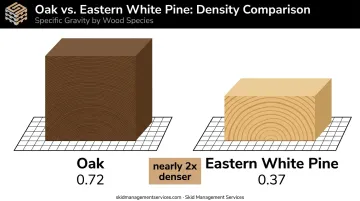
Wood species is often the biggest driver. Hardwoods like oak and maple are denser than softwoods like pine or spruce. According to USDA Forest Products Laboratory data, white oak has a specific gravity of 0.72 at 12% moisture content, while eastern white pine sits at just 0.37. That's nearly double the density, meaning an oak pallet of identical dimensions can weigh nearly twice as much as a pine one.
Construction style matters just as much: block pallets use more timber and fasteners to allow four-way forklift entry, adding weight, while stringer pallets rely on parallel support boards and generally use less material, keeping them lighter.
Moisture content is the hidden variable most buyers overlook. Wood is hygroscopic, meaning it absorbs and releases water based on humidity. A pallet stored in a damp warehouse or exposed to rain can pick up measurable pounds compared to a kiln-dried equivalent. This is exactly why cold-storage and frozen-food operations often specify kiln-dried stock: it resists the weight gain and warping that comes from freeze-thaw moisture cycles.
A few smaller factors round things out:
- Deck design: solid deck pallets (continuous top surface) weigh more than open, slatted stringer designs
- Add-ons: heat treatment stamps, metal reinforcement plates, or board repairs add incremental weight
- Age and wear: splintering and board loss gradually reduce a pallet's weight over its service life
Wood Pallet Weight by Type, Size & Load Capacity
Different pallet categories carry distinct average weights. Here's a quick comparison across the types you'll encounter most often:
- GMA/standard stringer: ~30-48 lbs, the most common buy-pallet configuration
- Heavy-duty block: 50-75+ lbs, built for repeated industrial cycling
- Euro pallet (EPAL): ~55 lbs, standardized for European logistics networks
- Presswood/molded pallets: 34-41 lbs depending on duty rating, often used for one-way export
Pooled rental pallets from programs like CHEP or PECO tend to run heavier than standard buy pallets. PECO's reusable 48x40 block design, for example, weighs 65-68 lbs, reflecting its reinforced construction for multiple reuse cycles. If you're comparing pooled versus owned pallets, verify current weight specs directly with the pool provider since figures vary by program.
One clarification that trips people up constantly: pallet weight (tare weight) is not load capacity. Tare weight is what the empty pallet weighs. Load capacity is how much product it can safely carry. These are two completely separate numbers, and confusing them is where freight and safety mistakes happen.
Static, Dynamic & Racking Load Capacity Explained
Three load ratings matter for any wood pallet:
- Static load capacity: the weight limit when the pallet is stationary and stacked (highest rating, since there's no movement stress)
- Dynamic load capacity: the weight limit while being moved by forklift or pallet jack
- Racking load capacity: the weight limit when the pallet spans open beam racking with no floor support underneath
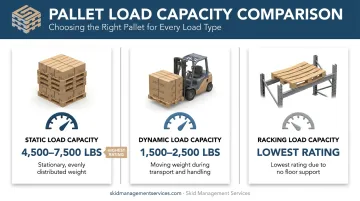
Standard 48x40 wood pallets commonly range from 1,500-2,500 lbs dynamic and 4,500-7,500 lbs static, though these numbers are product-specific and should always be verified against the manufacturer's spec sheet before use.
Worked example: Say you're loading 50 lb bags of product on a pallet rated for 2,000 lbs dynamic capacity. That works out to roughly 40 bags per pallet before hitting the dynamic limit, though in practice, stacking height and pallet footprint often limit you before weight does. Always check both numbers together, not just one.
Why Pallet Weight Matters for Shipping and Storage
Pallet weight isn't just a technical detail. It shows up directly on your invoices and your safety audits.
Freight billing is the most immediate impact. Carriers bill LTL and FTL freight based on total shipment weight, including the pallet's tare weight. Get that estimate wrong, and you're looking at reweigh fees.
Under Old Dominion Freight Line's published tariff, a carrier can charge a $25 fee when scaled weight comes in 20 lbs or more above what's declared on the bill of lading. Multiply that across dozens of monthly shipments and it adds up.
Safety compliance is the second piece, since accurate pallet weight data supports:
- Correct stacking height calculations to prevent tip-over
- Racking limit compliance so beams aren't overloaded
- Forklift capacity checks so operators aren't exceeding rated loads
Cost control ties it together: choosing the right pallet weight class for the job (lightweight for one-way export, heavy-duty for repeat industrial cycling) directly controls your long-term shipping and replacement costs. Overspec a pallet you're only using once, and you're paying for weight and durability you don't need.
Choosing a Reliable Wood Pallet Supplier for Consistent Weight and Quality
Here's a problem that doesn't show up until it's already cost you money: inconsistent pallet weight and quality between batches. One shipment ships clean, the next triggers a reweigh fee because the supplier swapped lumber species without telling you. Multiply that across a national account with pallets flowing through several facilities, and small inconsistencies become a real line-item cost.
Skid Management Services treats this as a supply architecture challenge that starts before the first order ships. The company combines its own held inventory with an expansive network of pallet and packaging manufacturing partners, giving national accounts consistent specifications and uninterrupted supply even when a single mill hits a production snag.
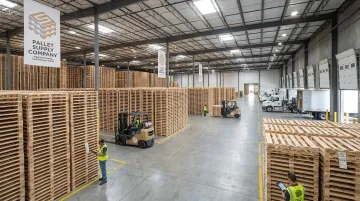
Own inventory locks in the dimension-controlled baseline. The supplier network adds the volume depth to fill national orders without substituting off-spec material.
This model already supports demanding food and CPG supply chains, where sanitation standards and dimensional consistency aren't optional. Client programs include:
- Campbell Snacks
- Knouse Foods
- Stauffer's
- Nissin Foods
- Hain Celestial Group
- Plainville Farms
That kind of scale-tested reliability is exactly what protects your freight calculations and your racking safety, batch after batch.
Frequently Asked Questions
How much does an empty wooden pallet weigh?
A standard 48x40 wood pallet typically weighs 30-48 lbs empty. The exact figure depends on wood species, board thickness, and how much moisture the wood is holding at the time.
How many 50 lb bags can fit on a pallet?
Based on a typical 2,000 lb dynamic load rating, you could fit roughly 40 bags by weight alone. In practice, stacking height and pallet footprint often limit the count before weight capacity does.
What is the difference in weight between a stringer and a block pallet?
Block pallets generally weigh more because they use more timber and fasteners for four-way forklift entry. Stringer pallets are lighter and remain the more common choice for general-purpose shipping.
Does moisture really change how much a wood pallet weighs?
Yes. Wood absorbs water in humid or damp storage conditions, adding measurable pounds compared to a kiln-dried equivalent. This is why moisture-controlled lumber matters for cold storage and export applications.
Are plastic pallets lighter than wood pallets?
Some plastic pallets, like a 40x48 model weighing around 30 lbs, land at the low end of the standard wood GMA (Grocery Manufacturers Association) weight range. Weight alone rarely decides the choice, since wood pallets remain the lower-cost, easier-to-repair option for most shipping programs.
How much does a fully loaded wood pallet weigh?
Total weight equals the pallet's own tare weight plus the product load on top of it. Carriers use this combined figure, not just the pallet weight alone, when calculating freight charges.