Many HVAC manufacturers struggle with a familiar cycle: units arrive damaged, pallets don't match the load, and receiving delays push installation schedules back by days. A 2019 survey of 259 material handling professionals found that missing top deckboards contributed to unit-load instability for 51% of respondents — a warning sign for anyone shipping top-heavy equipment on generic pallets.
This guide breaks down why palletizing matters for HVAC equipment, which pallet types actually work, the handling challenges you'll run into, and how to pick a supply partner that won't leave you scrambling.
Key Takeaways
- Pallet footprint and entry type directly impact HVAC damage rates and dock speed
- ISPM-15 heat-treated pallets are mandatory for international and cross-border HVAC shipments
- Generic pallets force forklift operators into risky workarounds that slow throughput
- A nationwide supplier prevents stockouts and price spikes that stall HVAC production
Why Proper Palletizing Matters for HVAC Equipment
HVAC units don't behave like boxed goods. A condenser or compressor has an irregular footprint, a high center of gravity, and exposed coils or refrigerant lines that dent or crimp under pressure. Put that load on a generic, undersized pallet and you're asking for trouble.
Undersized or flexible pallet bases are a common culprit. When the deck flexes under a load that overhangs the edges, the unit shifts during multi-stop LTL or TL routes. Small movements at the origin dock become full tips by the time the trailer reaches its third or fourth stop.
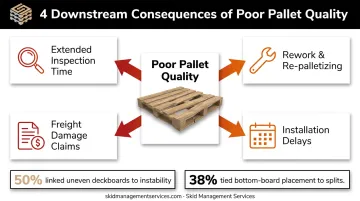
The Downstream Cost of Poor Palletizing
Damage doesn't just cost you a replacement unit. It triggers:
- Extended inspection time at receiving as dock staff check for hidden coil or cabinet damage
- Rework and re-palletizing before the unit can even move to installation
- Freight damage claims, which rarely cover the full cost of schedule disruption
- Installation delays that ripple through contractor schedules and customer commitments
A Modern Materials Handling (MMH) survey found that 50% of respondents linked uneven deckboards to stacking instability, and 38% tied incorrect bottom-board placement to split or damaged pallets. Poor board quality caused daily or weekly jams for over half the sample.
None of this is HVAC-specific data, but the mechanism transfers directly: a pallet built without attention to deck condition and load geometry becomes a liability the moment it hits a dock plate or a pothole.
Forklift Safety Is Part of the Equation
OSHA's rule on powered industrial trucks is blunt: only stable or safely arranged loads shall be handled, and operators must exercise extra caution with loads that can't be centered. A tall, off-center HVAC unit on a mismatched pallet forces the operator to compensate — slower travel, awkward tilting, more exposure to tip-over risk. Consistent, well-matched palletizing protects more than the equipment. Every lift becomes a workplace safety issue when the load isn't centered correctly.
Types of Pallets and Packaging Solutions for HVAC Equipment
Pallet selection should start with the unit's weight, footprint, and handling path, not a "standard" size grabbed off the shelf. A 400-pound ductless mini-split and a 2,000-pound packaged rooftop unit have almost nothing in common structurally, and neither should share a pallet spec by default.
Heat-Treated Pallets for HVAC Shipments
Any HVAC equipment crossing an international border typically needs ISPM-15 heat-treated wood packaging. The standard requires raw wood to be debarked and treated, with conventional heat treatment reaching 56°C throughout the wood profile, including the core, for 30 continuous minutes, per the IPPC ISPM-15 standard.
The finished pallet must carry a stamp with four elements:
- IPPC two-leaf logo
- ISO country code
- Treatment provider ID
- Treatment code
Skid Management Services sources heat-treated pallets through USDA APHIS-recognized treatment providers. This matters because a stamp applied by an unauthorized party is grounds for rejection at the destination port, even if the wood was treated correctly.
That nationwide supplier network also means HVAC manufacturers aren't stuck waiting on a single mill's kiln schedule when export volume spikes.
Block vs. Stringer Pallets for Heavy HVAC Units
Block pallets generally hold up better under top-heavy, high-center-of-gravity loads like condensers and compressors, since the block support structure resists flex better than a standard three-stringer design. Stringer pallets can still handle heavy loads, but they typically need a reinforced 4-stringer configuration to match block-pallet rigidity.
| Construction | Best suited for |
|---|---|
| 3-stringer standard | Lighter, lower-profile HVAC components |
| 4-stringer reinforced | Compressors, packaged units up to 4,000+ lb |
| Block | Top-heavy condensers, rack storage, automated handling |
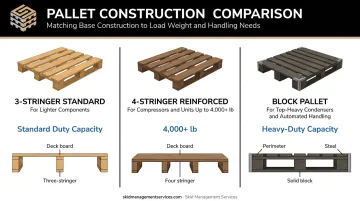
For a deeper technical comparison, see Skid Management Services' stringer vs. block pallet breakdown.
2-Way vs. 4-Way Entry Pallets
Two-way entry pallets only accept a forklift from the ends. That's fine on a straight production line, but it turns into a bottleneck the moment a dock worker needs to reposition a unit in a tight aisle.
Four-way entry, whether through true block construction or a notched stringer design, lets forklifts and pallet jacks approach from any side. This cuts down on the awkward turns that slow warehouse throughput.
Custom Skids and Crating for Oversized or Sensitive Components
Standard pallets don't always cut it. Ductwork, motors, and coil assemblies with unusual dimensions or fragile surfaces often need a custom skid or crate. Skid Management Services builds these to spec across softwood, hardwood, mixed, and A-grade premium lumber, with kiln-dried heat-treated options for export or cleanroom-adjacent applications.
Common Challenges in Handling Palletized HVAC Equipment
Even with a decent pallet, HVAC handling has built-in friction points.
- Inconsistent footprints on one "standard" pallet. A 48x40 pallet under three different HVAC SKUs means three different overhang patterns, three different tip risks.
- Limited blocking and bracing. Without defined anchor points, units shift or lean, especially on multi-stop or rehandled freight where the load gets jostled repeatedly.
- Improvised fixes. Dock and warehouse staff reach for scrap wood or extra stretch wrap to stabilize a wobbly load, adding labor hours and producing inconsistent quality from shipment to shipment.
That last point is easy to overlook because it doesn't show up on a damage report. It shows up in labor costs and in the occasional shipment that still arrives damaged despite the extra wrap.
Best Practices for Efficient Palletized HVAC Handling
Small specification changes produce outsized results here.
- Match pallet footprint to the unit's base dimensions. Overhang wastes trailer space and creates a rocking point during transit.
- Size deck thickness and stringer/block spacing to actual load weight, not a generic capacity assumption, and confirm it matches your forklift or clamp-truck access requirements.
- Add locator blocks or defined fork-entry points. This standardizes placement instead of relying on whichever way the operator happens to set the unit down.
- Pair the wood pallet base with dunnage built around the unit's actual contact points, using corrugate or foam to absorb shock and vibration during transit.
- Set up a closed-loop pallet supply arrangement so packaging shortages, whether closed-loop or just-in-time, never become a line-stoppage issue.
- Start with one high-volume, damage-prone SKU — outdoor condensers are a common starting point — before rolling changes out across the rest of your product line.
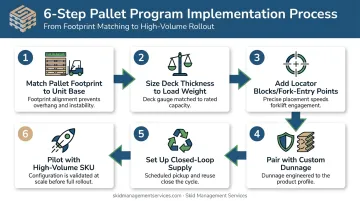
Skid Management Services' closed-loop program handles new pallet delivery, used pallet pickup, and trade-in credit on a single scheduled cadence, eliminating the guesswork behind setting up that kind of arrangement.
Choosing the Right Pallet Supplier for HVAC Equipment
Pallet design only gets you so far. Supply consistency across plants and shipping lanes matters just as much for reducing variability in damage rates and handling time.
HVAC manufacturers should be looking for:
- Stable pricing that doesn't spike every time lumber costs move
- Uninterrupted supply, even during regional shortages
- A single-vendor relationship across multiple plants and shipping lanes, rather than juggling different suppliers with different specs
That last point isn't hypothetical. A 2021 survey of 176 pallet users found that 47% reported reduced availability of used wood pallets, up from 27% the year before — and 33% said pallets had gotten more expensive. Single-source vendors feel that kind of squeeze immediately. A supplier drawing from a broader network absorbs it instead.
Skid Management Services combines its own inventory with an expansive network of pallet and packaging suppliers. This gives HVAC manufacturers access to standard, heat-treated, and custom pallets without the stockouts that come from relying on one mill or region.
Need a JIT-cadence program for a production line or a one-time custom build for an oversized rooftop unit? That kind of coverage should be in place before a shortage hits, not after.
Ready to lock in a reliable pallet supply for your HVAC line? Contact Skid Management Services at 717-202-0304 or Info@SkidManagementServices.com for a quote.
Frequently Asked Questions
What are the three types of HVAC?
Split systems, packaged systems, and ductless mini-splits. Split systems ship as separate indoor/outdoor components, packaged units combine everything in one cabinet, and ductless systems pair smaller units, so each configuration needs a different pallet footprint and handling approach.
What is a heat-treated pallet?
A heat-treated pallet has completed an approved ISPM-15 heat schedule, reaching at least 56°C throughout the wood for 30 continuous minutes, and carries a valid stamp with an "HT" code. Untreated pallets lack both the process and the mark, so most destination countries will reject them for international shipment.
Why do HVAC units get damaged during shipping even when palletized?
Generic pallets often don't match the unit's weight, footprint, or center of gravity. That mismatch lets the load shift or rock during transit, even though it's technically "palletized."
How much weight can a pallet hold for HVAC equipment like condensers or compressors?
Capacity depends entirely on construction: a reinforced 4-stringer or block pallet can be rated for 4,000 lb or more, while a standard 3-stringer build handles far less. Heavier units need a custom-rated pallet, not a generic capacity assumption.
How do I choose between standard and custom pallets for HVAC equipment?
Standard pallets work fine for lighter, uniform components like small ductless units. Oversized, heavy, or irregularly shaped equipment (think packaged rooftop units or large coil assemblies) usually needs a custom skid or crate.
How can I avoid pallet supply shortages for my HVAC production line?
Partner with a supplier that has a broad network and consistent inventory, such as Skid Management Services, rather than relying on a single source. A closed-loop or JIT arrangement adds another layer of protection against line stoppages.